The Texas real estate market is a vibrant and dynamic landscape, often making headlines for its remarkable growth and investment potential. Yet, beneath the surface of soaring home values lies a complex narrative of affordability challenges that impact a significant portion of its population. This week, we dive deep into the latest real estate news, exploring where Texas, and specifically Dallas, stands in terms of home value appreciation, its position on national affordability rankings, and the crucial question of how many Texans can truly afford the median home price in their communities.
Texas Leads the Nation in Home Value Appreciation: A Closer Look at Dallas and Other Booming Cities
Texas has firmly established itself as a national leader in residential real estate growth. A recent in-depth analysis by Forbes highlighted that an impressive five of the top 25 cities nationwide, where home values continue their upward trajectory, are proudly located in the Lone Star State. This remarkable performance underscores Texas’s magnetic appeal for both homeowners and investors alike, driven by robust economic growth, a thriving job market, and a steady influx of new residents.
Among the standout cities experiencing significant year-over-year increases in home values are Midland, Beaumont, Odessa, Irving, and Dallas. These urban centers have all witnessed appreciation rates exceeding 11 percent, signaling a powerful and sustained demand within their respective markets. Midland led the charge with an astonishing 17.2 percent increase, securing the No. 2 spot on the national list. This surge in Midland’s market is largely attributable to its pivotal role in the oil and gas industry, which, when strong, fuels a ripple effect across its local economy and housing sector.
Beaumont followed with a strong 11.9 percent appreciation, ranking No. 9 nationally. Its strategic location as a port city and its industrial base contribute significantly to its economic stability and housing demand. Odessa, another city deeply intertwined with the energy sector, secured the No. 12 position with an 11.6 percent increase, mirroring Midland’s resource-driven growth.
Closer to the bustling Dallas-Fort Worth metroplex, Irving showed an equally impressive 11.6 percent appreciation, placing it 13th. Irving’s growth is indicative of the broader DFW area’s robust expansion, attracting major corporations and offering diverse employment opportunities. Dallas itself, a cornerstone of the Texas economy and culture, came in 14th with a solid 11.4 percent increase in home values. This consistent growth in Dallas reflects its status as a major economic hub, offering a vibrant urban lifestyle, diverse industries, and a highly competitive job market.
The Forbes report insightfully noted, “Texas property taxes might be on the higher side, but with tons of cities to choose from and plentiful supply without oversaturation makes homes in Texas both affordable and a good investment.” This statement encapsulates the unique appeal of the Texas market: despite relatively higher property taxes compared to some other states, the sheer volume of options, coupled with a healthy supply of housing in many areas, contributes to a balanced market that remains attractive to buyers and investors seeking long-term value. The underlying strength of the Texas economy, characterized by diversified industries and a pro-business environment, further solidifies the state’s reputation as a prime location for real estate investment.
To compile this comprehensive analysis, Forbes meticulously examined the year-over-year change in median home values across the 300 largest cities in the United States, leveraging extensive data provided by Zillow, a leading authority in real estate analytics. This rigorous methodology ensures that the findings accurately reflect the most current and significant trends in the nation’s housing markets, offering valuable insights for potential buyers, sellers, and real estate professionals navigating these dynamic conditions.
Source: Forbes
Understanding Affordability: Texas Ranks 20th Nationally According to the National Low-Income Housing Coalition
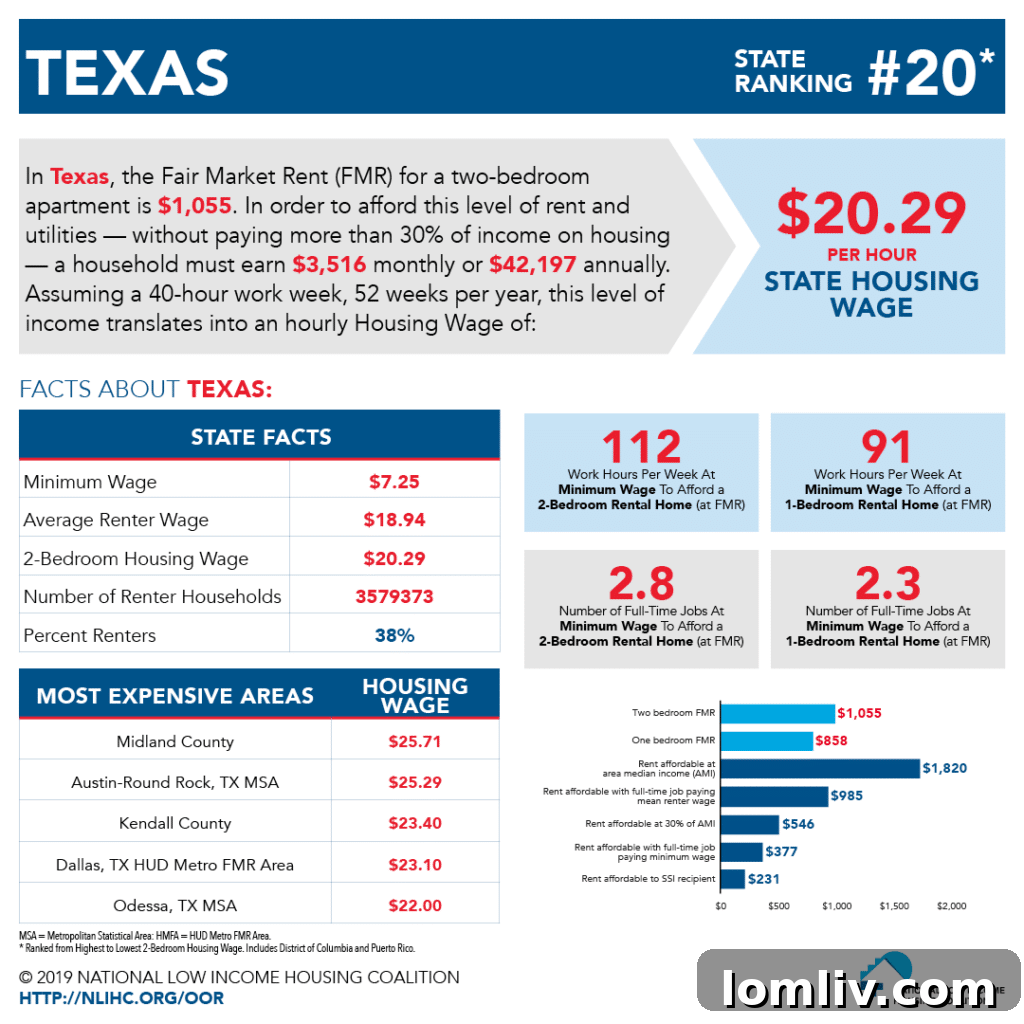
While Texas shines brightly in home value appreciation, the discussion around housing affordability presents a more nuanced picture. The National Low-Income Housing Coalition (NLIHC), a prominent organization dedicated to ensuring that the lowest-income people have affordable and decent homes, recently ranked Texas 20th in the nation for affordability. This ranking is a critical indicator, suggesting that while the state offers opportunities, it also faces significant challenges in providing accessible housing for all its residents, particularly those with average or lower incomes.
The NLIHC’s reports often highlight the stark contrast between the wages earned by many working individuals and the cost of housing, whether for rent or homeownership. A ranking of 20th out of 50 states means that Texas is roughly in the middle, indicating that a substantial portion of its workforce struggles to find housing that is considered affordable by generally accepted standards (typically, spending no more than 30% of income on housing costs). This challenge is often exacerbated by rapid home value appreciation, as seen in the previous section. When home prices and rents rise quickly, wages often fail to keep pace, creating a widening gap that makes it increasingly difficult for average wage earners to secure stable and affordable housing.
For many Texans, the dream of homeownership, or even the ability to rent a decent apartment, remains out of reach due to these economic disparities. This situation impacts various demographics, from service workers and educators to entry-level professionals, all of whom contribute significantly to the state’s economy but may find themselves priced out of desirable neighborhoods or even entire communities. The NLIHC’s analysis typically considers factors like the prevailing minimum wage, the average hourly wage required to afford a modest two-bedroom rental unit, and the overall housing market conditions, providing a comprehensive view of the affordability crisis.
Addressing these affordability concerns is crucial for the long-term health and equity of the Texas economy and society. It involves a multi-faceted approach, including discussions around living wages, affordable housing initiatives, zoning reforms to encourage diverse housing types, and strategic urban planning to manage growth sustainably. Understanding Texas’s position in national affordability rankings is essential for policymakers, community leaders, and residents to collaboratively work towards solutions that ensure housing remains accessible for everyone who calls the Lone Star State home.
The Affordability Gap: Majority of Texans Face Challenges Affording the Median Home Price
Delving deeper into the issue of affordability, a comprehensive report by ATTOM Data Solutions for the second quarter of 2019 revealed a stark reality: the majority of Texans find themselves unable to afford the median home price within their respective counties. This finding casts a critical light on the state’s booming housing market, illustrating that while property values may be appreciating rapidly, this growth does not universally translate into accessible homeownership for the average resident.
According to the ATTOM Data Solution’s 2019 U.S. Home Affordability Report, a significant 74 percent of average wage earners in Texas cannot afford the median home price. This statistic underscores a profound affordability gap, where the income levels of a large segment of the workforce are simply insufficient to comfortably meet the financial demands of purchasing a home. This challenge is particularly acute in rapidly developing urban and suburban areas, where demand drives prices upward at a pace that far outstrips wage growth for many professions.
The report provided interesting contrasts within the state’s major metropolitan areas. Dallas County emerged as one of 288 counties nationally where wage growth outpaced home price growth. This positive trend in Dallas County suggests that, for some residents, rising incomes are providing a better footing to enter the housing market, potentially due to the concentration of high-paying jobs and robust economic diversification within the county. However, this is not a universal experience across Texas.
Conversely, Tarrant County, which neighbors Dallas and is home to Fort Worth, was identified as one of 40 percent of Texas counties where home price appreciation significantly outpaced wage growth. This disparity indicates that residents in Tarrant County may face increasingly difficult hurdles to homeownership, as their incomes struggle to keep up with the accelerating cost of housing. Such trends can lead to increased housing insecurity, longer commutes as people seek more affordable options further from employment centers, and a strain on household budgets.
ATTOM’s methodology for determining affordability is robust and widely respected in the real estate industry. Their report assessed the amount of income required to make a monthly mortgage payment on a median-priced home, factoring in standard lending assumptions. These assumptions included a three percent down payment – a common benchmark for various loan programs, including FHA loans, which are popular among first-time homebuyers – and a 28 percent maximum debt-to-income (DTI) ratio. The 28 percent DTI ratio is a critical lending guideline, indicating that a household’s monthly housing expenses should ideally not exceed 28 percent of their gross monthly income to be considered financially healthy and capable of managing mortgage payments. By applying these parameters, the report provides a realistic snapshot of the financial feasibility of homeownership for the average wage earner in Texas.
The findings from ATTOM Data Solutions reiterate the complex and often paradoxical nature of the Texas real estate market. While the state offers substantial opportunities for investment and growth, it simultaneously grapples with significant challenges in ensuring that its economic prosperity translates into accessible and affordable housing for the majority of its residents. Addressing this affordability gap will require concerted efforts from all stakeholders to foster sustainable growth that benefits the entire community, not just those at the upper end of the economic spectrum.
Source: ATTOM Data Solutions