Maximizing Urban Value: A Deep Dive into Productive Land Use and Property Tax in Dallas
Welcome to the Productive Land Use Series, an in-depth exploration into one of the most critical aspects of urban sustainability: how a city utilizes its land. This series meticulously examines annual property tax revenue at the neighborhood level, treating land as the city’s foremost resource. By analyzing current land-use patterns, we aim to uncover opportunities for greater efficiency and enhanced financial contribution to municipal operations. For those who missed our initial discussion on residential land use, you can click here to catch up on Part 1.
Our previous installment established a foundational understanding of property tax contributions from various housing types across Dallas. We introduced a benchmark for evaluating land use efficiency: a well-maintained, single-family neighborhood generating an annual property tax revenue of $30,000 per acre. This figure serves as our baseline, a crucial standard against which we assess the financial performance and overall productivity of our urban land.
As we continue to dissect the productivity of Dallas’s neighborhoods, a clear pattern emerges: the desirability of a specific area directly correlates with higher property tax returns for the city. This attractiveness is often intrinsically linked to the presence of diverse commercial amenities situated conveniently within residents’ vicinities. These vibrant spaces, frequently referred to as “third places”—environments where people gather for work, leisure, and social interaction—do more than just define a community’s unique character. They are economic powerhouses, contributing substantially to the city’s financial health through both property and sales taxes, thereby funding essential municipal services and fostering local economies.
The Essential Role of Commercial Spaces in Urban Economies
It is only natural to anticipate significantly higher revenue generation from commercial properties compared to residential ones, primarily due to their intense activity levels. Commercial zones act as vital hubs, drawing people together for a multitude of purposes, from entertainment and dining to employment and essential services. They are the engines of local economies, facilitating commerce and fostering community engagement. Consequently, these crucial cogs in our urban machinery must shoulder a proportionate share of the financial burden for the extensive municipal services they require, including infrastructure, public safety, and sanitation.
To understand the nuances of commercial land use, let’s begin by examining one of the most ubiquitous commercial forms found throughout our city’s landscape.
The Evolution and Challenges of Suburban Strip Malls
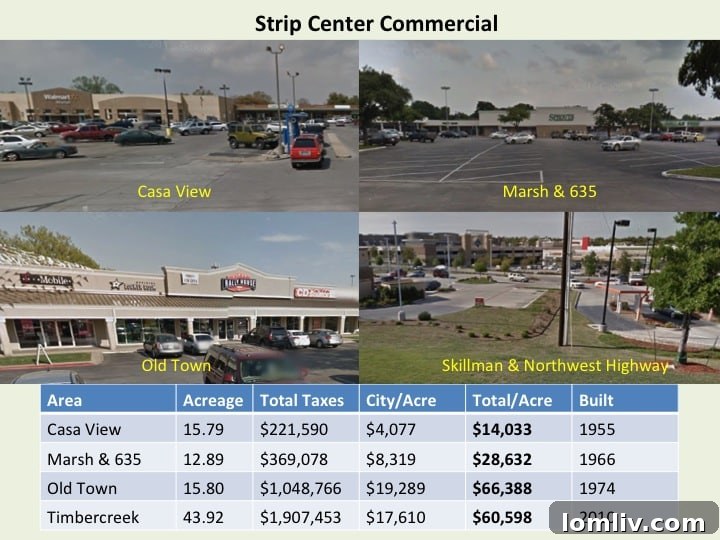
These expansive commercial centers, characterized by their linear arrangement of stores and vast parking lots, were once at the very heart of the suburban movement that swept across the United States during the latter half of the 20th century. They epitomized convenience in an increasingly car-dependent society, offering a one-stop destination for shopping and services. However, the prevailing trend indicates a concerning decline in their productivity as these strip malls age. The primary culprit? Excessive parking spaces. While essential for automobile access, acres of parked cars do not actively foster economic activity, nor do they directly contribute to property tax revenue. This over-allocation of land for parking drastically limits the potential for diverse uses, thereby prohibiting more productive land utilization. Locations like Old Town at Lovers and Greenville, while attempting to offer a slightly higher density of commercial spaces relative to their parking footprint, still largely adhere to the fundamental strip mall model. Similarly, Timbercreek Crossing represents another variation, presenting a concentration of big-box stores separated by what can only be described as seas of asphalt, further emphasizing the car-centric design.
Infrastructure Demands and Access Limitations
Beyond the internal inefficiencies of these developments, it’s crucial to consider the infrastructure required to support them. Accessing these strip centers almost invariably necessitates massive six-lane arterial roads, often complete with elevated medians. These sprawling arteries represent significant financial investments, not only in their initial construction but also in their ongoing maintenance, consuming substantial portions of municipal budgets. Moreover, these environments are inherently hostile to alternative modes of transportation. The presence of six lanes of high-speed traffic creates an intimidating barrier for pedestrians and cyclists, making visits by any means other than driving a rare occurrence. This car-dependency is often enshrined in law or investor requirements, mandating that strip centers provide enough parking at all times to accommodate peak shopping seasons, further exacerbating the issue of wasted space.
Despite these criticisms, it’s undeniable that neighborhoods require essential amenities such as grocery stores, banks, restaurants, and various other services to function. In many of our suburban areas, the current urban planning forces residents to drive considerable distances to reach these commercial centers for their daily chores. However, when evaluating the significant services and infrastructure these sprawling commercial properties demand, the city often receives a less than favorable financial return. This is particularly true when considering the immense amount of land these developments occupy, the declining value of the structures as they age, and the perpetually high cost of maintaining the extensive infrastructure required for vehicular access. This model poses a long-term financial burden on the city and its taxpayers.
In stark contrast to the challenges posed by conventional strip mall developments, let’s now explore examples of land use that demonstrate significantly greater efficiency and yield:
Embracing Efficiency: The Enduring Value of Traditional Urban Development
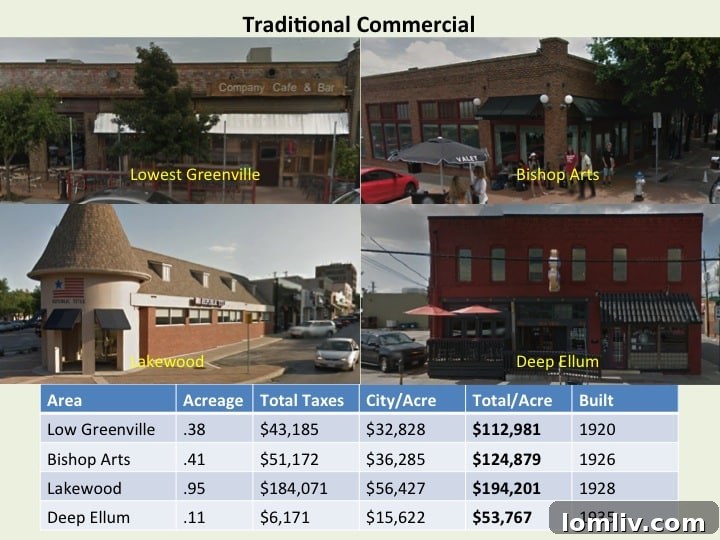
The four buildings depicted above stand as prime examples of Dallas’s most attractive and high-performing real estate. They consistently draw customers, appeal to savvy business owners, and entice investors, collectively creating vibrant economic hubs. Crucially, these smaller, more integrated developments deliver exceptional returns as investments for the city. While strip centers might marginally outperform our baseline of mature single-family homes, the pre-World War II form of development showcased here can astonishingly quadruple the property tax yield of their modern, car-centric counterparts. Despite potentially incurring higher maintenance costs over time due to their age and intricate construction, strategic investment in these properties and the surrounding neighborhoods consistently yields a remarkably favorable return on investment for the city. These are often older developments, originally built along former streetcar lines, embodying a pattern of development that is not only in high demand but, regrettably, in woefully short supply across many modern urban landscapes.
Designing for People: Accessibility and Community
Consider the stark difference in accessibility and community integration these traditional urban forms offer. Because they were constructed during the streetcar era, their scale and design are inherently suited to the pedestrian experience, fostering walkability and serving as natural social centers for their surrounding communities. The two- and four-lane roads that serve these areas are designed to safely accommodate multiple modes of transportation, seamlessly integrating cars, pedestrians, and cyclists. A significant advantage of these smaller road networks is their considerably lower maintenance costs compared to the sprawling, six-lane arterials prevalent in more suburban environments, freeing up municipal funds for other essential services.
Nonetheless, even these highly desirable traditional commercial centers grapple with their own set of challenges, particularly concerning parking issues. This dilemma arises because many were originally constructed in an era predating the automobile’s dominance as the primary mode of transportation. What were once local, neighborhood destinations, like Lowest Greenville Avenue and the Bishop Arts District, now attract visitors from an entire region. This regional draw, while economically beneficial, inevitably introduces a demand for more car access and parking. The critical question then becomes: at what point does the provision of necessary parking begin to adversely affect the very property tax yield and vibrant urban fabric that makes these areas so successful?
A Tale of Two Urbanisms: Modern Suburban vs. Traditional Urban
Our final analysis in this post directly compares these two distinct forms of urban development: the traditional, dense urban pattern versus the modern, sprawling suburban model.
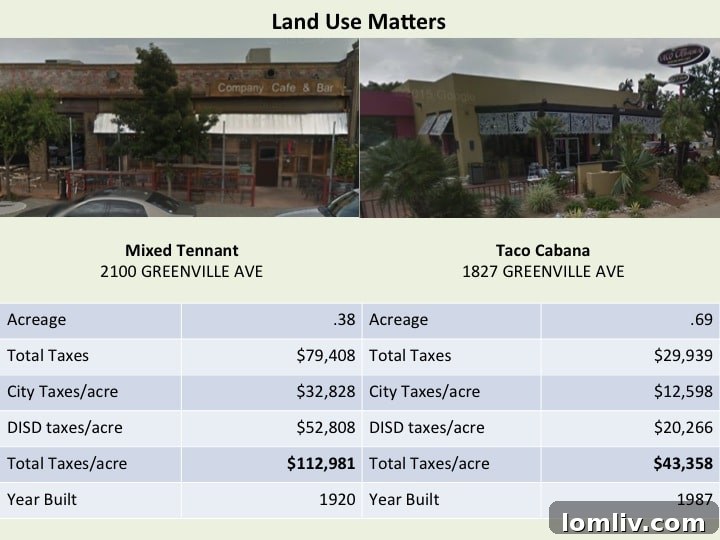
Consider the visual juxtaposition of the mixed-tenant building and the nearby Taco Cabana, situated mere blocks from each other. Despite their proximity, their development styles, the variety of uses they support, and their financial productivity diverge entirely. The Taco Cabana dedicates a disproportionately large amount of land to the automobile, featuring an expansive parking lot and a drive-thru. While convenient for quick service, this design fundamentally limits the potential uses of the surrounding area and, consequently, devalues the land itself. Over its 95-year existence, the mixed-tenant building has likely housed countless different businesses and served a multitude of community needs, demonstrating remarkable adaptability and resilience. In stark contrast, one must ponder: how many other uses, beyond fast food, can the Taco Cabana building realistically serve in the long term without significant and costly modifications?
Charting a New Path: Balancing Development for a Productive Future
Like many American cities that experienced rapid outward sprawl during the latter half of the 20th century, Dallas has historically prioritized automobile dependency, often at the expense of efficient and productive land use. As we look towards the future, our growing suburban cities face a critical imperative: establishing a healthier balance between car-centric development and the more traditional, human-scaled patterns of urbanism. This pivotal shift requires thoughtful consideration and innovative solutions.
The pressing questions before us are profound: How can we strategically redevelop our existing structures and infrastructure to better reflect the multi-faceted utility and superior property tax yield of traditional commercial centers? What are the inherent barriers, both regulatory and economic, that currently prevent us from constructing these proven, traditional developments that demonstrably enhance urban vibrancy and financial sustainability? Addressing these questions will be key to unlocking Dallas’s full potential for productive, resilient, and community-focused growth.