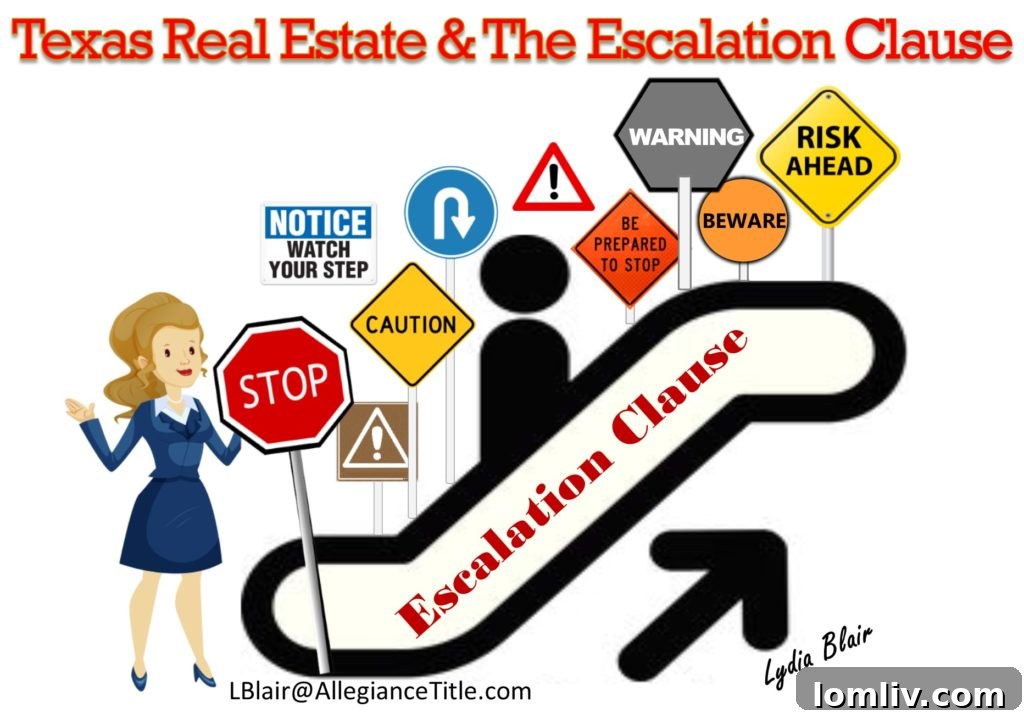
Navigating the Bidding War: Why Escalation Clauses May Not Be Your Best Strategy
In today’s competitive real estate market, especially in sought-after areas, buyers often find themselves embroiled in intense bidding wars. Amidst the flurry of multiple offers, various tactics emerge as buyers strive to make their proposal stand out. One such strategy that frequently surfaces is the “escalation clause.” While it might seem like a clever way to secure a property without overpaying significantly, a deeper look reveals inherent complexities and potential pitfalls that make it less desirable for most residential contracts.
For both buyers dreaming of their perfect home and sellers aiming for the highest possible sale price, the concept of an escalation clause might initially sound appealing. However, as we peel back the layers, it becomes clear why many seasoned real estate professionals, including leading associations like the Texas Association of Realtors, strongly advise against their use. This article will delve into what an escalation clause entails, why it’s often problematic, and what alternative strategies might serve you better in a competitive market.
What Exactly is an Escalation Clause in Real Estate?
An escalation clause is a specific provision written into a buyer’s offer that states their willingness to increase their bid under certain conditions. Typically, it commits the buyer to pay a predetermined amount above the next highest legitimate offer the seller receives, up to a specified maximum price. For example, a buyer might offer $500,000 for a home but include an escalation clause agreeing to pay $2,000 more than any higher competing offer, not to exceed a cap of $525,000.
The primary aim of an escalation clause is to strengthen a buyer’s offer in a multiple-offer scenario, theoretically giving them an edge without blindly bidding the highest possible amount from the start. It’s designed to ensure that their offer remains competitive, or even becomes the winning bid, by automatically adjusting upwards against rivals, but only to a predefined limit. On the surface, it seems like a win-win: the buyer pays just enough to beat the competition, and the seller potentially gets a higher price. But, as we will explore, the practical application is far more complicated than the theory suggests.
Why Are Escalation Clauses Frowned Upon by Real Estate Experts?
Despite their apparent strategic advantage, escalation clauses are met with skepticism and often outright discouragement by many in the real estate industry. Their rejection isn’t born from a desire to complicate transactions, but rather from years of experience revealing the myriad of issues and ethical dilemmas they can create. The Texas Association of Realtors, for instance, has long maintained a strong stance against their inclusion in standard contracts due to the potential for disputes, lack of clarity, and overall detrimental impact on the negotiation process.
Industry leaders caution against their use because they introduce ambiguity into what should be a straightforward contractual agreement. Real estate transactions require clarity, certainty, and mutual understanding of terms. Escalation clauses, by their very nature, introduce variables that can destabilize these foundational principles. They can lead to confusion, distrust, and even legal challenges, ultimately hindering a smooth closing process. Understanding these underlying concerns is crucial for any buyer or seller considering this strategy.
The Pitfalls and Problems of Escalation Clauses for Buyers and Sellers
The theoretical benefits of escalation clauses often crumble under the weight of real-world application. Here are some of the most common and significant problems that arise:
1. Revealing Your Maximum Willingness to Pay: The Open Wallet Scenario
One of the most significant drawbacks for a buyer is that an escalation clause essentially lays bare their maximum budget. By stating, “I will pay X dollars more than the next highest offer, up to a cap of Y dollars,” the buyer immediately tells the seller their absolute top price. This is akin to opening your wallet and inviting the seller to help themselves. In a traditional negotiation, a buyer aims to keep their maximum budget confidential to maintain leverage. With an escalation clause, that leverage is completely surrendered.
Why would a seller bother countering with a slightly lower price when they know precisely how much you are willing to pay? In most cases, once a seller sees that maximum cap, their expectations are reset, and they will likely counter at or very close to that highest disclosed figure. This effectively removes the “escalation” aspect and turns your offer into a firm bid at your absolute maximum, often leading to buyers paying more than they might have in a more conventional negotiation scenario.
2. Confidentiality Conundrums and Ethical Concerns
Real estate contracts are confidential documents between the parties involved. Realtors are permitted to disclose that multiple offers exist, but they are generally not allowed to reveal the specific terms or amounts of other offers without the express written consent of the buyers and sellers involved in those offers. An escalation clause fundamentally requires the disclosure of another offer’s terms (specifically its price) to trigger its mechanism.
This creates an ethical tightrope walk for agents and sellers. To activate an escalation clause, the seller or their agent would typically need to provide proof of a higher offer to the buyer with the escalation clause. This act of revealing details of a competing, confidential offer without the consent of the originating party can be an ethical breach and, in some jurisdictions, even a legal one. It puts all parties in a precarious position and can undermine trust in the transaction process.
3. The Verification Predicament: Are Competing Offers Legitimate?
For a buyer utilizing an escalation clause, verifying the legitimacy of a competing offer becomes a critical, yet often impossible, task. How does the buyer truly know if the “next highest offer” is a bona fide, sincere proposal from another interested party, and not simply a fabricated or solicited offer designed solely to drive up the price? There is a real risk that a seller, or even an unscrupulous agent, could present a fictitious offer from a friend, relative, or even an empty shell corporation to trigger the escalation clause and push the price higher.
Buyers are left with little to no assurance that they are competing against genuine offers. They are essentially forced to outbid something they cannot independently verify as authentic. This lack of transparency fosters distrust and can lead to significant buyer’s remorse, particularly if they suspect they were manipulated into paying more than fair market value.
4. Ambiguity in Finalizing the Sales Price and Contract Terms
A core principle of contract law is the need for clear, definite terms, especially regarding price. An escalation clause introduces an element of uncertainty into the final sales price until triggered and proven. When a buyer and seller “accept” a contract with an escalation clause, the actual sales price is still undetermined. It could be $1,000 more, $10,000 more, or even $100,000 more than the initial base offer, depending on the competing bids.
This ambiguity can cause problems with appraisals, financing, and the overall enforceability of the contract. Lenders require a definitive sales price to process loan applications. Appraisers need a clear contract price to justify their valuation. Until the final price is definitively established, agreed upon, and clearly reflected in the executed contract, both buyer and seller are operating with an inherent level of uncertainty, making it challenging to rely on the agreement’s terms.
5. The Seller’s Agent’s Fiduciary Duty and “Highest and Best” Requests
A seller’s agent has a fiduciary duty to act in the best interest of their client, which includes securing the highest possible price and most favorable terms. When multiple offers are received, the common strategy is to ask all interested buyers to submit their “highest and best” offer by a specific deadline. This approach ensures all buyers have an equal opportunity to present their strongest bid, and it clarifies the competitive landscape.
An escalation clause complicates this. If some offers contain escalation clauses and others are firm, fixed-price offers, how does the agent fairly compare them? At what point is a specific dollar amount identified as the absolute highest price that could be obtained? The presence of escalation clauses can muddy the waters, making it difficult for the seller’s agent to effectively fulfill their duty and definitively determine the strongest offer among a complex mix of escalating and fixed bids. This can lead to delays and potential dissatisfaction from all parties.
6. The Risk of Buyer’s Remorse and Contract Termination for Sellers
From a seller’s perspective, accepting an offer with an escalation clause might initially seem like a guaranteed way to maximize the sale price. However, until the contract is fully executed with a definitive price and all contingencies are cleared, an offer with an escalation clause functions somewhat like a “free right-of-first refusal.” The buyer is effectively saying, “I’ll buy it if no one offers more than X, or if someone offers more, I’ll pay Y, but I need to see what others are offering first.”
This can lead to significant buyer’s remorse once the final, escalated price is determined. If a buyer feels they were pushed into paying significantly more than their initial comfort level, they may use their option period (if one exists) or other contingencies to terminate the contract. This puts the seller back to square one, having lost valuable marketing time and potentially missing out on other strong, firm offers that were presented. Savvy home sellers often prioritize clean, unambiguous offers with a definitive dollar amount, as these represent a lower risk of fallout and a more predictable path to closing.
Considering Alternatives to Escalation Clauses
Given the significant drawbacks, both buyers and sellers should consider alternative strategies in a competitive market. Buyers might instead submit their strongest possible initial offer based on their maximum comfort level and market research, perhaps including an appraisal gap coverage if financially feasible, and limiting contingencies. Sellers, on the other hand, benefit from clear, firm offers that minimize uncertainty and reduce the likelihood of contract complications or terminations. A clean, strong offer, even if not the absolute highest dollar amount, often represents the “best” offer when all factors are considered.
In conclusion, while the allure of an escalation clause is understandable in a heated market, its practical implementation often creates more problems than it solves. It undermines negotiation, introduces ethical dilemmas, fuels distrust, and injects uncertainty into a process that demands clarity. Both buyers and sellers are generally better served by straightforward, transparent, and firm offers that pave the way for a smooth and confident real estate transaction.
The opinions expressed are of the individual author for informational purposes only and not for the purpose of providing legal advice. Contact an attorney for any particular issue.
Lydia Blair (formerly Lydia Player) was a successful Realtor for 10 years before jumping to the title side of the business in 2015. Prior to selling real estate, she bought, remodeled and sold homes (before house flipping was an expression). She’s been through the real estate closing process countless times as either a buyer, a seller, a Realtor, and an Escrow Officer. As an Escrow Officer for Allegiance Title at Preston Center, she likes solving problems and cutting through red tape. The most fun part of her job is handing people keys or a check.