

As the Texas economy continues its robust expansion and employment figures steadily climb, the performance of the new home market in North Texas becomes a critical indicator of regional health. This week, we delve into the latest real estate news and economic reports to provide a comprehensive overview of how new home sales are faring amidst the state’s remarkable growth. Understanding these trends is crucial for prospective homebuyers, investors, and anyone interested in the dynamic landscape of the Texas real estate market.
Texas Economy Maintains Rapid Growth Pace Outpacing the Nation
The Texas economy continues to exhibit extraordinary strength, demonstrating a growth trajectory that consistently surpasses national averages. According to the Texas Real Estate Center’s Monthly Review of the Texas Economy, the state saw an impressive addition of 271,000 non-agricultural jobs year-over-year in March. This substantial increase translates into an annual growth rate of 2.2 percent, a notable achievement when compared to the national rate of 1.7 percent. This sustained outperformance underscores Texas’s economic resilience and its appeal as a hub for business and talent.
The private sector has been a significant driver of this expansion, contributing 262,300 new positions at a robust growth rate of 2.5 percent, further widening the gap against the nation’s private sector growth rate of 1.9 percent. This indicates a thriving business environment and strong entrepreneurial spirit across the Lone Star State. Moreover, Texas’s seasonally adjusted unemployment rate stood at 3.8 percent, matching the national average and representing a 0.2 percentage point decrease from the previous March. The state’s actual unemployment rate was even lower, at 3.5 percent, highlighting a remarkably tight labor market.
Job creation was widespread across Texas, with nearly all metropolitan areas reporting increases in employment. Midland led the charge in job growth, followed closely by Odessa, Dallas-Plano-Irving, Sherman-Denison, and College Station-Bryan, which rounded out the top five. This broad-based growth across diverse regional economies, from energy hubs to major metropolitan centers and university towns, showcases the diversified nature of Texas’s economic engine. The consistent influx of businesses and individuals seeking opportunities continues to fuel this impressive expansion, setting a strong foundation for future prosperity.
Source: Texas A&M Real Estate Center
Dallas Fed Forecasts Continued Texas Employment Expansion
Looking ahead, the Federal Reserve Bank of Dallas projects continued positive momentum for the state’s job market. In its Texas Employment Forecast, the Dallas Fed predicts that Texas employment will grow by 1.8 percent over 2019. This forecast is based on a comprehensive analysis, incorporating factors such as the 2.2 percent year-over-year employment growth observed in March 2019. The Fed anticipates that the state will add approximately 226,700 jobs this year, pushing total employment close to an impressive 13 million individuals by the end of the year. This continued growth trajectory reinforces Texas’s reputation as an economic powerhouse.
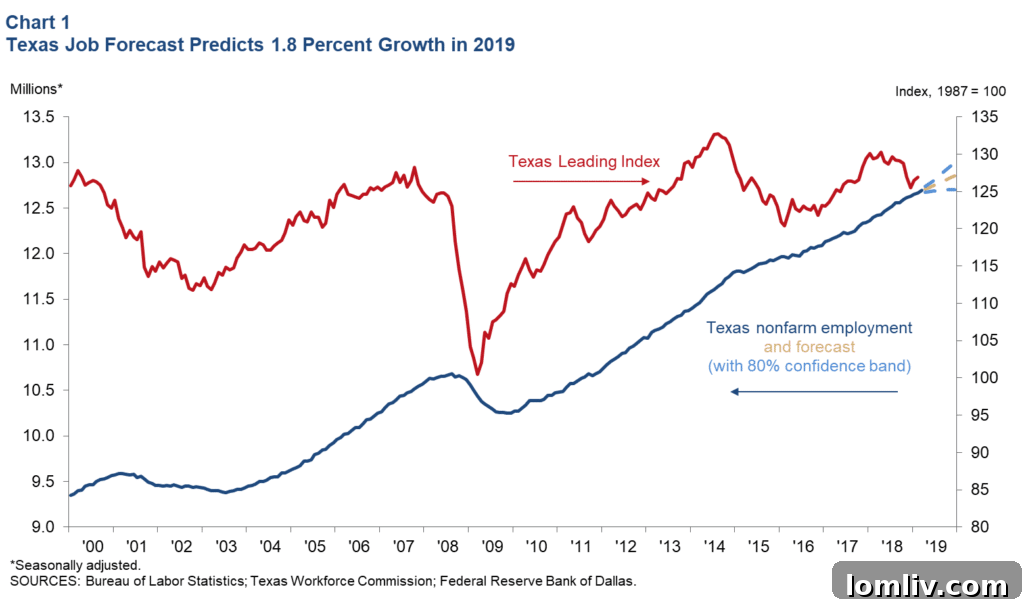
Keith R. Phillips, Dallas Fed assistant vice president and senior economist, noted the improving economic indicators. “After a sharp weakening at the end of 2018, leading indicators of the Texas economy continue to improve, reflecting improved outlooks for the national and global economies and higher oil prices,” Phillips stated. He added that “Job growth in the first three months of the year generally was steady at a pace near 2.0 percent—slower than the 2.3 percent growth in 2018.” This nuanced perspective acknowledges a slight moderation from the previous year’s blistering pace but still points to healthy and sustainable growth.
While the overall forecast remains optimistic, Phillips also highlighted key challenges that could influence the state’s economic performance throughout the year. “While the forecast has improved since January, it still suggests weaker job growth this year than in 2018,” he explained. “The three primary factors facing the Texas economy in 2019 remain historically tight labor markets, moderately lower oil prices, and continued uncertainty about trade restrictions.” These factors—including potential wage pressures from limited talent pools, the impact of fluctuating energy markets on the crucial oil and gas sector, and the broader implications of global trade policies on Texas’s diverse industries—will require careful monitoring as the year progresses. Despite these headwinds, the underlying strength and diversification of the Texas economy are expected to ensure continued employment expansion.
Source: Federal Reserve Bank of Dallas
Dallas-Fort Worth New Home Market Experiences Flat Performance in March
Despite the booming state economy and robust job growth forecasts, the new home market in Dallas-Fort Worth demonstrated a more subdued performance in March. According to the latest report from HomesUSA.com, compiled from comprehensive MLS data, new home sales, prices, and the overall sales pace remained largely flat across the Dallas-Fort Worth metroplex. This suggests a period of stabilization, or perhaps even a slight pause, in what has historically been one of the nation’s most dynamic housing markets.
A more concerning trend revealed in the report was the continued decline in local pending sales. Pending new home sales saw a dip across all four of Texas’s largest new home markets: Dallas-Fort Worth, Houston, Austin, and San Antonio. This statewide pattern indicates a broader shift in buyer behavior or market conditions. Pending sales are a forward-looking indicator, representing homes under contract but not yet closed. A consistent decline can signal a future slowdown in closed sales, making this a critical metric for market watchers.
Ben Caballero, the Addison-based owner of HomesUSA.com and a prominent figure in the new home sales industry, offered his perspective on the DFW market. “Despite the fact that the Dallas-Ft. Worth new home market was flat in March, we are still seeing a strong overall volume of new home sales here,” Caballero commented, indicating that while the pace might have softened, the sheer number of transactions remains robust. However, he expressed concern about the pending sales figures: “Pending home sales are the one troubling number, as there has been a steady decline since September. We will just have to wait and see the long-term impact of lower pending sales.” This sentiment underscores the uncertainty surrounding future market trajectories given the recent trends in buyer commitments.
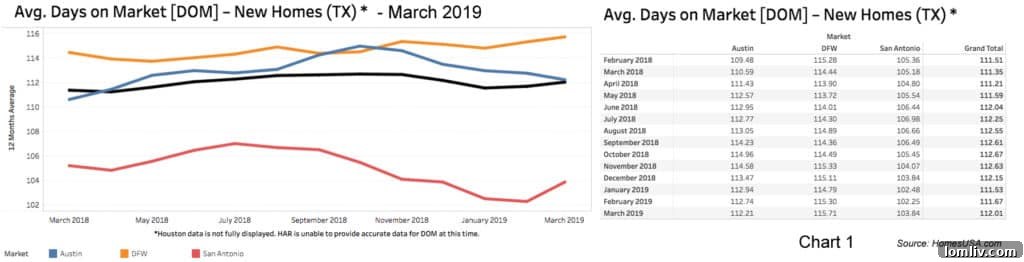
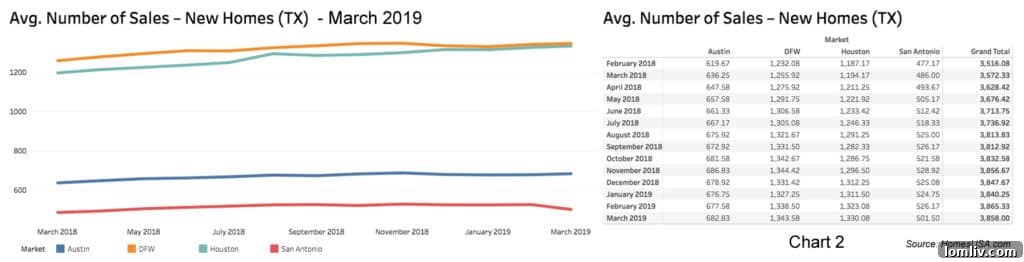
Further analysis from HomesUSA.com’s New Home Sales Index revealed that the average days on market (DOM) for new homes in DFW remained remarkably stable, moving only slightly from 115.30 days in February to 115.71 days in March. This consistent DOM suggests that homes are neither flying off the market at an accelerated pace nor languishing for extended periods, pointing to a balanced but not frenzied environment. New home sales, measured by a 12-month rolling average, showed a modest increase, rising from 1,339 sales in February to 1,344 in March. This marginal uptick in sales volume, even amidst other flat metrics, indicates underlying demand.
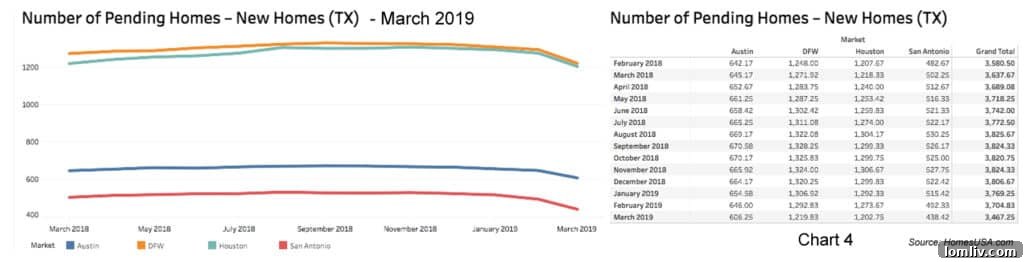
Despite the stable days on market and a slight increase in sales volume, prices remained largely flat. The average new home price in DFW experienced a slight dip in March, recorded at $373,252, compared to $374,233 the previous month. This minor fluctuation suggests that while demand is present, it might not be strong enough to drive significant price appreciation in the current climate. The decline in pending new home sales was more pronounced. In DFW, the 12-month rolling average for pending sales dropped from 1,293 in February to 1,220 in March. Statewide, this trend was mirrored, with pending sales falling from 3,705 in February to 3,467 in March. This consistent downturn in pending sales across major metropolitan areas bears watching, as it could signal a shift in buyer sentiment, increased caution due to interest rates, or challenges with housing affordability and inventory. The sustained decline may eventually impact future closed sales, potentially leading to a more competitive environment for sellers or a leveling off of market values.
Source: HomesUSA.com
Navigating the Nuances: A Balanced Outlook for North Texas Real Estate
In conclusion, the economic landscape of Texas remains exceptionally robust, characterized by impressive job growth and a forecast for continued expansion that outpaces the national average. This strong underlying economy provides a solid foundation for all sectors, including real estate. However, the North Texas new home market presents a more nuanced picture. While overall sales volume remains significant and days on market are stable, the flattening of prices and, more critically, the consistent decline in pending new home sales across major Texas metros, including DFW, suggest a period of adjustment.
These indicators highlight the complex interplay of economic strength, buyer sentiment, affordability challenges, and inventory levels. For prospective homebuyers, this environment could present opportunities as the market cools slightly from its previous high-growth pace. For sellers and builders, it may necessitate a more strategic approach to pricing and marketing. The insights from the Texas Real Estate Center, the Dallas Fed, and HomesUSA.com collectively paint a picture of a dynamic region that, while facing some headwinds in its housing sector, is powered by an undeniable economic vitality. Monitoring these trends closely will be essential for making informed decisions in the evolving North Texas real estate market.