Preston Center’s Future: A Critical Look at Urban Planning and Community Engagement
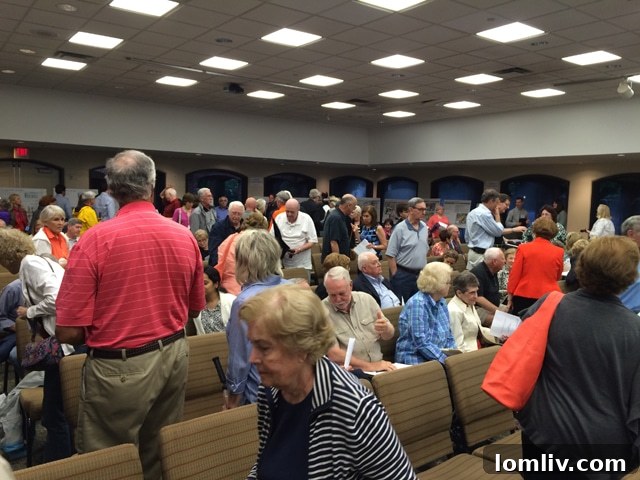
The latest public presentation from the Preston Center Task Force offered some notable improvements over previous proposals, yet it still fell short of delivering a fully comprehensive and actionable plan. My immediate impression was that while progress had been made, the vision remained somewhat unrefined. As anticipated, the “Pink Wall Negative Nancys” were out in full force towards the end of the session, expressing their concerns. However, as I conveyed to Dallas City Council member Jennifer Gates, I didn’t feel the immediate need for a stiff drink afterward—and that, I believe, signifies a step forward.
Despite these minor improvements, this plan is far from a document I would proudly present to the Plan Commission and City Council. The audience echoed this sentiment, with many urging Council Member Gates to hold another public meeting to unveil the definitive final proposal before it advances to official review. She seemed receptive to this suggestion, and we can only cross our fingers that another opportunity for public discourse will be granted.
The Flawed Methodology: Beyond “Can Be Done” to “Should Be Done”
I find the methodology employed by Kimley-Horn to be fundamentally flawed, as its output appears to prioritize what can be done over what should be done for Preston Center’s long-term sustainability and vibrancy. There’s a significant disconnect in how specific development impacts on underlying infrastructure—such as roads, parking, and utility systems—are identified and subsequently integrated into a cohesive strategy. The absence of crucial baseline research, which would demonstrate how optimized infrastructure directly influences various development scenarios, is a glaring omission.
The current results often give the impression of development proposals being shoehorned into a defined area with minimal application of intelligence or common sense regarding how the urban fabric would truly function. The focus remains on promoting “could” rather than delving into the critical “should.” For a study that aims to provide meaningful recommendations for urban development, the emphasis should unequivocally be on what is optimal, sensible, and beneficial for the community.
Building a Data-Driven Framework for Sustainable Development
To truly develop a robust and effective plan for Preston Center, several key components are essential:
- Detailed Infrastructure Impact Data: Comprehensive data tables are needed to quantify the specific infrastructure impacts of every incremental increase in residential units, office square footage, or retail space on critical elements like traffic patterns, utility load, and public services. This data would provide a clear, evidence-based understanding of development consequences.
- Dynamic Development Capacity “Buckets”: Armed with precise infrastructure impact information, a system of “buckets” could be established. These buckets would represent the suggested maximum capacity for increased residential, office, and retail development. As new projects are considered and approved, their impacts would be subtracted from these buckets. When a bucket runs dry, it signifies that a particular type of development has reached its sustainable capacity in that area.
- Infrastructure Improvement Triggers: A clear system of triggers should be implemented where a defined amount or type of development automatically necessitates corresponding infrastructure improvements from the city. Given the substantial increase to the tax base that accompanies new development, this represents a vital quid pro quo: the city invests in infrastructure to support the growth that, in turn, boosts its revenues.
- Intelligent and Realistic Placement: Overlaying all these data-driven mechanisms must be an intelligent approach to placing realistic development in realistic locations. This ensures that proposals align with existing neighborhood characteristics, environmental considerations, and community needs, preventing incongruous or unsustainable projects.
Despite outlining these critical needs a year ago, I have yet to see their implementation or even their foundational research integrated into the current proposals.
Community Insight: Advocating for Concrete Triggers
On a more positive note, one perceptive audience member specifically emphasized the crucial need to incorporate defined infrastructure and development triggers directly into the plan. Following the meeting, during a brief conversation with Council Member Gates, I reiterated this vital point, and she appeared genuinely receptive to the idea. After all, any significant city investment in infrastructure, while initially costly, would inevitably be offset by the substantial increases in revenue generated from property and potentially sales taxes as new developments come to fruition.
Debunking “Pink Wall” Development Myths: Realism vs. Projection
Another audience member, Jack Welch (not affiliated with GE fame), skillfully dissected the “Pink Wall” development scenarios, bringing a much-needed dose of sanity to some of their more speculative suppositions. His astute observations rightly earned him my personal “Smartest Guy in the Room” prize. When one examines the proposed plans for areas east of Edgemere, for instance, they reveal “development opportunities” on buildings that are barely a decade old. The probability of these relatively new structures being demolished for only a minor increase in density is infinitesimal, yet they are inexplicably factored into the plan’s projected housing increases. This clearly highlights a concerning lack of common sense and practical economic understanding within the presented strategies.
Welch also pointed out that while the proposed density increases might sound substantial in raw numbers, they are, in fact, quite modest when translated into units per acre. If one subtracts the eastern portion of the zone and applies the density formula specifically to the area west of Edgemere, the maximum increase he calculated was approximately 600 units. Critically, 80 of these units are already accounted for within the existing PD-15 strip, stretching from Preston Tower to the Athena. While an additional 600 units is not negligible, it pales in comparison to the “1,800-unit bedlam” that the plan often implies. Furthermore, it’s essential to remember that this maximum figure assumes every single Pink Wall complex would be bulldozed and rebuilt at its absolute highest possible density—a scenario that is simply not realistic in practice.
Deed Restrictions: A Double-Edged Sword for Development
Many “Pink Wallers” perceive their deed restrictions as an impregnable shield against developers, but is this truly the case? If we assume the majority of residents oppose any form of redevelopment, this opposition compels developers to acquire a controlling 51 percent of the complexes within a given sub-tract. Such a requirement all but guarantees that 51 percent or more of these complexes would be immediately redeveloped upon acquisition. However, if deed restrictions were voluntarily lifted, a developer would then only need to acquire complexes on a case-by-case basis. This alternative approach could potentially lead to a more fragmented, patchwork development outcome with overall lower density. This isn’t to say one strategy is inherently right or wrong, but it underscores the critical importance of understanding the strategic implications of these restrictions.
Unsurprisingly, the meeting room was filled with “don’t touch a hair on our chinny-chin-chins” Pink Wall residents, firmly entrenched in their desire for the status quo. However, another resident made a compelling plea, urging them to consider how thoughtful development could significantly increase resale values within the area. What he perhaps overlooked is that in this particular demographic, a substantial portion of real estate holdings only change hands after probate. I was personally told of one resident who softened her stance upon realizing that any significant new development was likely to occur well beyond her lifetime. This speaks to a broader issue: while preserving charm is important, mental stagnation in urban planning can prevent a community from adapting and thriving for future generations.
Addressing Preston Center’s Parking Paradox: More, Not Less
One of the most baffling suggestions I encountered was the idea of relaxing parking requirements as a catalyst to kick-start residential development in Preston Center. My firm belief is that parking, much like electric outlets, is a resource for which you invariably need more than you initially anticipate. While there’s ongoing discussion about shifting attitudes towards car ownership among Millennials and the rise of ride-sharing services like Uber, we simply don’t possess sufficient long-term data to definitively ascertain whether this perceived decline in the “automobile love affair” is a temporary trend or a permanent societal shift. Therefore, to prematurely reduce residential parking requirements based on such assumptions would be profoundly short-sighted and potentially detrimental to the area’s future functionality.
Even if the trend of car ownership were to permanently cool, it’s highly improbable that parking spaces would go to waste. One only needs to observe the booming self-storage unit industry—essentially glorified garages for storing possessions—to understand the enduring human need for space. Unused parking areas could easily be adapted for other purposes, demonstrating that over-provision is less risky than under-provision when it comes to essential infrastructure like parking in a city like Dallas.
Beyond the Bubble: The Critical Role of External Expertise and Data
Receiving public input after many months spent within the confines of the task force “bubble” served as a crucial reminder of this entire exercise’s original intent: effectively managing traffic and parking challenges within Preston Center. The persistent problem, however, is that Kimley-Horn does not appear to specialize as traffic engineers, and neither the City of Dallas nor TXDoT have been integral participants in this planning process. While representatives from these entities may have attended meetings, nothing the task force has accomplished thus far seems directly related to, or in response to, any actionable input or inaction from these critical infrastructure authorities. Indeed, TXDoT’s recent re-engineering of Northwest Highway, while beneficial, felt like a fortunate accident rather than a direct response to the task force’s recommendations.
I spoke with a city planner and specifically asked if the roadways within Preston Center had ever been thoroughly analyzed and optimized for traffic flow. His answer was a definitive “no.” I impressed upon him that it is long past time for city officials to actively engage in this critical assessment, which would significantly enhance the accuracy and viability of any development study. Furthermore, this isn’t necessarily a major budget item. Optimizing traffic flow primarily involves running sophisticated software simulations and then, in many cases, simply re-striping existing roadways to improve efficiency. At the public meeting, attendees with pressing traffic and parking questions were regrettably directed to a table at the back of the room, where they could review placards, speak to someone (who was notably not from TXDoT nor the city), and scrawl their suggestions on a flip chart. It created an unfortunate impression akin to a waiter promising to “be right back” only to never reappear—a clear sign of dismissive handling.
The Art of Visualization: Ensuring Realistic Depictions
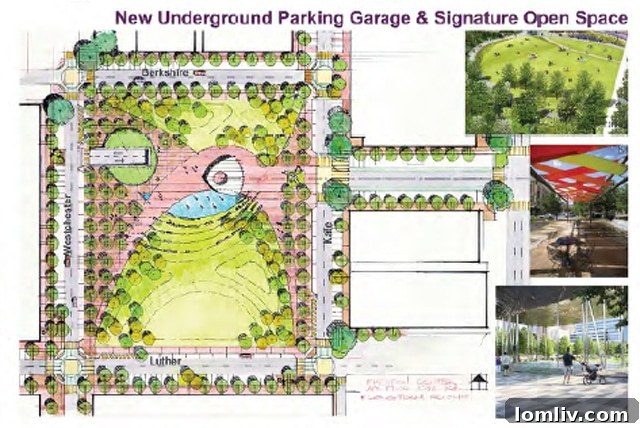
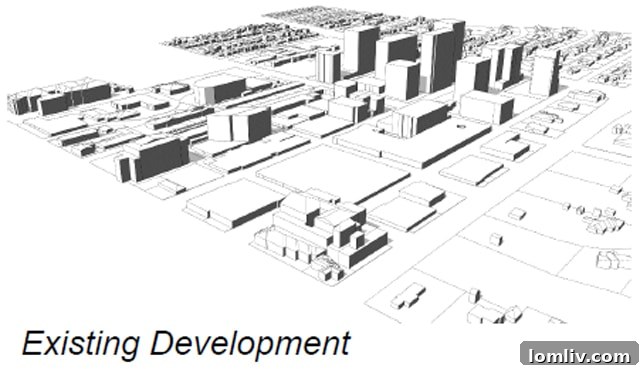
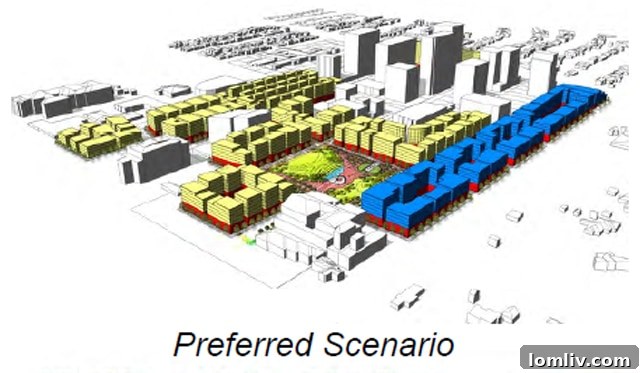
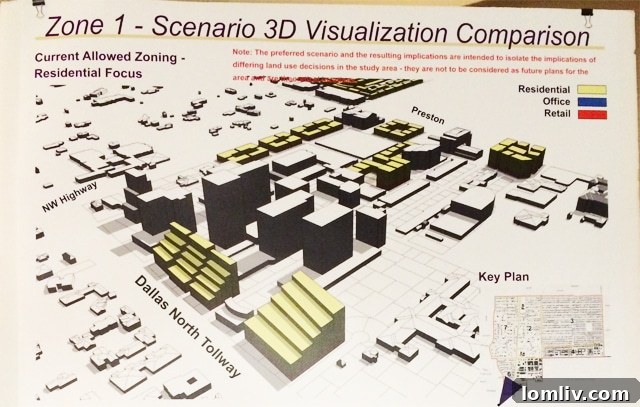
The walls of the meeting venue were adorned with various 3-D images for attendees to inspect. I suspect that much of this visual content was produced within the two weeks following the postponement of the original meeting. While not the physical model that Laura Miller and I had previously suggested, these visualizations were undeniably an improvement over earlier, less detailed iterations. However, it would have been significantly more helpful had these visuals accurately placed proposed retail, residential, and office developments in their most plausible and functional locations. Instead, much like the “Pink Wall” diagrams depicting unlikely development sites, the Preston Center plans showcased new residential towers fronting directly onto the tollway. One might sarcastically suggest they be dubbed the “My Way” towers, prompting residents to answer the age-old question: “My Way or the highway?”
It is, however, reassuring to see that St. Michael’s previously proposed high-rise development is not included in the current recommendations. The lower stepped building visible in the image is 8100 Lomo Alto, which is owned by the church. The bare parcel of land to its right is the site where the controversial “cat’s out of the bag” high-rise project is being actively pursued.
Tunnel Vision: Prioritizing Practicality Over Novelty
Another recent addition to the proposed plans has been the concept of a tunnel bike and walkway beneath Northwest Highway. One suggested location was alongside Douglas, despite the presence of an existing traffic signal there. With a touch of bemusement, I quipped that such a tunnel would likely see more use from sedan chairs and rickshaws transporting the area’s affluent older residents than from actual bike or foot traffic. In reality, there is no truly optimal or practical place for such a tunnel.
Given the higher density situated east of Preston, accessing a tunnel west of Preston would necessitate crossing Preston Road itself. If one must already cross Preston, why not simply cross Northwest Highway at the same intersection, utilizing existing infrastructure? While the “Pink Wall” area isn’t currently teeming with avid cyclists or pedestrians, increased density will undoubtedly attract a more car-less demographic. However, if we are to discuss tunnels, a far more pressing and practical need would be to construct one beneath Northwest Highway to effectively manage stormwater runoff during heavy rains. That, to me, represents a tunnel that truly serves the community’s essential infrastructure needs.
Engage with Us: Share Your Preston Center Story!
Remember: We believe in the power of community voices. Do you have a compelling HOA story to tell, perhaps a unique high-rise history from your neighborhood? Realtors, would you like to feature a listing that’s ripe for renovation or one that has been completed with flying colors, showcasing its transformation? How about hosting a Candy’s Dirt Staff Meeting right in your community? We’re open to all your ideas and insights! Even marriage proposals are accepted (they’re legal, after all)! Don’t hesitate to shoot Jon an email at [email protected]. Your perspective helps shape the ongoing conversation about Preston Center’s evolution.