

The Far-Reaching Impact of Government Shutdowns on Texas: A Detailed Analysis
When the U.S. federal government grinds to a halt due to a budget impasse, the repercussions ripple across the nation, affecting everything from national parks to federal services. While some states might appear relatively insulated, no region is truly immune to the financial and social tremors of a government shutdown. Texas, a state known for its robust economy and diverse industries, finds itself in a particularly nuanced position during such events. According to a comprehensive report analyzing the states most and least affected by a federal shutdown, Texas generally navigates these turbulent waters better than some, yet its most vulnerable citizens invariably bear the brunt of the disruption.
Understanding the WalletHub Report: A Nationwide Perspective
The insightful report, meticulously compiled by analysts at WalletHub, offers a critical lens through which to examine the localized impacts of a federal shutdown. This in-depth analysis didn’t just scratch the surface; it meticulously compared all 50 states plus the District of Columbia across several vital economic and social metrics. Key indicators included each state’s share of federal jobs, a direct measure of federal employment reliance, and the proportion of families receiving food stamps, indicative of socioeconomic vulnerability. By assessing these and other relevant factors, WalletHub provided a granular view of how different states cope when federal operations are curtailed.
A government shutdown triggers a cascade of detrimental effects that touch millions of lives directly and indirectly. As the report elaborates, “When the government shuts down, certain federal employees work without pay or receive a furlough.” This isn’t merely an administrative detail; it represents significant financial hardship for thousands of dedicated public servants. The scope of this impact is vast, encompassing a wide array of critical personnel: over 41,000 law enforcement officers, including those safeguarding our borders and communities; 52,000 IRS workers, crucial for tax processing and revenue collection; and a staggering 96 percent of NASA employees, whose work drives scientific discovery and technological innovation. Beyond individual employees, “Non-essential” government services also remain inactive, leading to delays in permits, licenses, and vital research, while certain federal benefits, a lifeline for many, are liable to run out of funding if the shutdown persists for an extended period. The uncertainty and financial strain placed on these individuals and the broader public services highlight the severe consequences of federal paralysis.
Nuances in Impact: Red States vs. Blue States
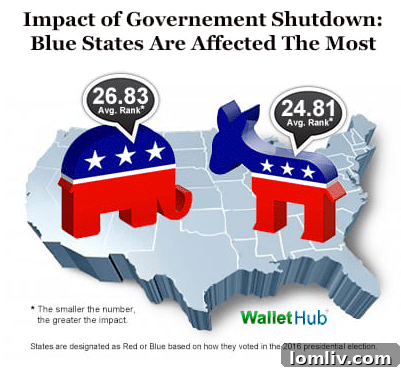
One of the more intriguing revelations from the WalletHub report was the observation regarding the political leanings of states and their susceptibility to shutdown impacts. The analysis indicated that states typically considered “red states” (those predominantly voting Republican) were, on average, less affected by the shutdown than their “blue state” counterparts (those predominantly voting Democratic). Red states ranked 26.83 on average, compared to 24.81 for blue states, with a lower rank signifying a greater impact. This finding could be attributed to various factors, including differences in economic structure, reliance on specific federal programs, the concentration of federal employees, or the proportion of defense industries within a state. Understanding these underlying differences is crucial for policymakers seeking to mitigate the widespread economic fallout of future shutdowns.
State-Specific Vulnerabilities: SNAP and Federal Employment
The report also highlighted stark contrasts in state-level vulnerabilities. Washington D.C., as the nation’s capital and a hub for federal operations, predictably exhibited the highest share of families relying on Supplemental Nutrition Assistance (SNAP), commonly known as food stamps, at 20.95 percent. This figure underscores the high concentration of both low-income residents and federal employees in the District whose livelihoods are directly tied to government functioning. Conversely, Wyoming, with its sparse population and different economic drivers, registered the fewest SNAP recipients at just 6 percent, illustrating a lower dependency on this particular federal assistance program.
In terms of federal employment, Wisconsin emerged with the lowest share of federal jobs, accounting for just over 1 percent of its workforce. This suggests Wisconsin’s economy is relatively less intertwined with direct federal employment compared to the national average of 2.61 percent. States with a larger percentage of federal jobs, such as Maryland or Virginia, which border D.C., typically face more immediate and widespread economic disruption during a shutdown due to furloughs and unpaid work affecting a larger segment of their population. These disparities underscore the diverse economic landscapes across the U.S. and how they dictate the localized severity of federal financial disruptions.
Texas’s Position in the Shutdown Landscape
Texas, a colossal state both geographically and economically, occupied a middle-ground position in WalletHub’s shutdown impact report, ranking 28th among all states. This “middle of the pack” status suggests that while Texas is certainly not immune to the financial and social repercussions of a federal government shutdown, it also isn’t among the hardest-hit states. However, a deeper dive into the specific metrics reveals areas of significant concern and potential vulnerability for the Lone Star State.
Federal Jobs and Contracts in Texas
Texas accounted for 1.66 percent of federal jobs, placing it at 32nd out of 51 entities analyzed. This relatively lower share of direct federal employment contributes to its middling overall ranking. However, when it comes to federal contract dollars per capita, Texas’s ranking shifts significantly. The state was at just shy of $1,707 per capita, which propelled it to a respectable 16th position nationwide. This higher ranking in federal contract dollars highlights a crucial aspect of the Texas economy: its substantial reliance on government contracts for industries ranging from defense and aerospace to energy and infrastructure. A prolonged shutdown can severely impact these sectors, stalling projects, delaying payments to contractors, and creating uncertainty for thousands of businesses and their employees across the state. The financial slowdown in these high-value contracts has a ripple effect, potentially reducing investment and job creation.
SNAP Benefits and Real Estate: Critical Texas Indicators
Texas’s role in supporting its most vulnerable citizens is also evident in its SNAP statistics. The state ranked 17th in the country for the percentage of residents receiving SNAP benefits, with 14.46 percent of its population relying on this crucial food assistance program. This significant proportion underscores the potential for widespread hardship if SNAP funding were to be jeopardized by a lengthy shutdown. Ensuring the continuity of such benefits is paramount for maintaining food security for hundreds of thousands of Texans.
Furthermore, the report highlighted the importance of real estate to the Texas economy. Approximately 15.20 percent of the state’s Gross State Product (GSP) is derived from real estate, positioning Texas at 34th in this metric. This substantial contribution means that any disruption to the real estate market, such as those caused by federal government inefficiencies during a shutdown, could have a considerable impact on the state’s overall economic health.
A Historical Perspective and Expert Insights
Government shutdowns are not a new phenomenon in U.S. political history. The shutdown analyzed in the WalletHub report marked the 21st such occurrence since 1976. As the previous shutdown stretched well into its 19th day, many observers drew parallels to and wondered if it would surpass the previous record of 21 days set during the Clinton administration. Each prolonged shutdown erodes public trust, causes economic instability, and creates significant human cost.
To gain a deeper understanding of the specific challenges Texas faces, we turned to Jill Gonzalez, a prominent analyst at WalletHub, for her expert perspective on how the state’s residents continue to fare amidst federal paralysis.
The Ripple Effect on Texas Investments and Infrastructure
When asked about the ongoing impact on Texas residents, Gonzalez emphasized the state’s substantial engagement with federal contracts. “Texas has the 16th highest amount of federal contract dollars per capita,” she noted. “This means that the longer the shutdown continues, the longer investments in things like infrastructure and real estate will be slowed, which would negatively affect the state’s residents.” This slowdown isn’t merely an inconvenience; it can mean delayed construction projects, stalled technological advancements, and a dampened business environment, all of which contribute to a less vibrant economy and fewer opportunities for Texans. Infrastructure projects, from road repairs to energy grid upgrades, rely heavily on consistent funding and federal oversight, making them particularly vulnerable to shutdown-induced delays.
The Critical Status of Federal Assistance and SNAP Funding
Considering Texas’s 17th-place ranking in the number of residents on federal assistance, the stability of programs like SNAP is a pressing concern. Gonzalez clarified the immediate situation but also highlighted the inherent risk: “SNAP funding will continue during the partial shutdown. However, it is in danger of eventually running out, depending on how long the shutdown lasts, and that will affect the families currently receiving food stamps.” This precarious situation underscores the critical need for swift resolution, as the cessation of SNAP benefits would plunge many Texas families into severe food insecurity, creating a humanitarian crisis and placing immense pressure on local food banks and social services.
The Shutdown’s Grip on the Texas Real Estate Market
Given that 15.2% of Texas’s Gross State Product stems from real estate, the shutdown’s effect on this sector is particularly scrutinized. Gonzalez detailed the direct mechanisms of impact: “The shutdown is causing staffing shortages within the IRS, FHA, and VA, which in turn affects mortgage processing. This will have a direct impact on Texas’ real estate market, as fewer transactions will occur.” The inability to process tax transcripts quickly, approve government-backed FHA and VA loans efficiently, or conduct necessary property assessments creates significant bottlenecks. This directly impacts homebuyers and sellers, potentially freezing transactions, delaying closings, and reducing market activity. For a state with a dynamic and growing real estate market like Texas, such disruptions can lead to significant economic losses and dampen investor confidence.
Conclusion: Navigating Uncertainty in the Lone Star State
While Texas holds a comparatively stable position during U.S. government shutdowns, its relative resilience does not translate to immunity. The WalletHub report and expert analysis reveal a nuanced landscape where federal contract dependencies, a significant population relying on federal assistance, and a robust yet vulnerable real estate market all contribute to the state’s exposure. The lingering uncertainty and the tangible slowdowns in investment and critical services underscore a profound truth: even a partial government shutdown casts a long shadow, disproportionately affecting the most vulnerable and incrementally eroding the economic foundations of states like Texas. As federal budget battles continue to loom, understanding these localized impacts becomes paramount for safeguarding both the state’s economy and the well-being of its diverse population. The experience of Texas serves as a potent reminder that stability in governance is a prerequisite for prosperity across the nation.