

The dynamic real estate landscape in Fort Worth is currently undergoing a significant rebalancing, a transformation most clearly signaled not just by an increase in housing inventory or longer days on market, but by an undeniable surge in direct marketing from new home builders. As an active participant in this market, the weekly influx of nearly 50 emails from new home construction companies provides a compelling barometer of the evolving conditions.
Any seasoned real estate agent in the Fort Worth area can attest to the dramatic uptick in email, text, and physical marketing collateral received from new home builders over the past few months. This aggressive outreach stands in stark contrast to the preceding two years, a period characterized by an exceptionally hot market where builders often scaled back their marketing efforts, sometimes adopting an almost aloof posture towards both real estate professionals and prospective buyers.
During the intense seller’s market, marked by unprecedented demand and rapidly appreciating home values, many builders felt empowered to prioritize their profit margins. While certainly not representative of every construction company, a noticeable trend emerged where builder incentives for buyers were rare, Realtor commissions were often reduced, and communication with all parties could be less than ideal. Some even went as far as to invite buyers to cancel their contracts, confident they could quickly remarket the property at an even higher price, a clear reflection of the immense market power they wielded at the time.
However, the tables have now turned. As the Fort Worth real estate market cools and the pool of eligible homebuyers tightens due to factors like rising interest rates and economic uncertainty, new home builders are strategically rolling out the red carpet. They are actively courting prospective buyers and real estate agents with enticing incentives, enhanced communication, and a renewed emphasis on customer service, all in a concerted effort to meet their projected sales targets and ensure the satisfaction of their shareholders and financial partners.
Fort Worth’s Expanding Housing Inventory
A recent deep dive into the Multiple Listing Service (MLS) data for the City of Fort Worth reveals a substantial increase in available housing. There are currently approximately 3,800 homes listed for sale, a figure that provides a clearer picture of the market’s shift towards greater supply. Significantly, over 700 of these listings represent new homes, either recently completed or still under construction in 2022. This means that new construction now accounts for nearly 20 percent of the total residential inventory available in Fort Worth.

The robust contribution of new homes to the overall inventory helps explain why the “months of supply” metric for the Fort Worth market has recently climbed to nearly two months. In the red-hot market of previous years, new home companies often bypassed the MLS and direct Realtor engagement, as homes frequently sold through pre-sales, waiting lists, or internal sales teams before they even reached completion. Their renewed reliance on the MLS underscores a clear strategic pivot: broadening their reach to a wider audience of real estate professionals and potential buyers in a more competitive environment.
The health and stability of the United States economy are intricately tied to the vitality of its new home construction sector. Far more than just building houses, this industry acts as a powerful economic engine, stimulating growth across a vast array of related sectors. It drives demand for building materials, creates countless jobs in construction, manufacturing, and logistics, fuels the mortgage and real estate industries, and boosts local retail and service economies as new homeowners furnish and customize their properties. While it’s certainly positive to observe new construction comprising 20 percent of listed homes, the pivotal question for the Fort Worth market is whether this influx of new supply truly aligns with the prevailing demand and affordability needs to sustain a genuinely balanced and healthy market cycle.
An increased supply is generally seen as a positive development for buyers, offering more choices and potentially easing price pressures. However, the true impact hinges on the characteristics of this inventory. If the new homes hitting the market are predominantly in price brackets beyond the reach of the majority of prospective buyers, then an increase in sheer numbers alone will not resolve the underlying challenges of affordability and market accessibility. The qualitative aspect of this inventory—specifically its price point—is paramount for achieving genuine market equilibrium.
Defining and Addressing Affordable Housing in Fort Worth
The concept of “affordable housing” is often subject to varied interpretations, depending largely on individual financial circumstances and local economic realities. Globally, a commonly accepted benchmark, often cited by organizations like Google, defines affordable housing as residential costs that do not exceed 30 percent of a household’s total monthly income. Under this broad principle, affordability becomes relative; a high-priced home could still be considered affordable for an individual or family with a sufficiently high income.
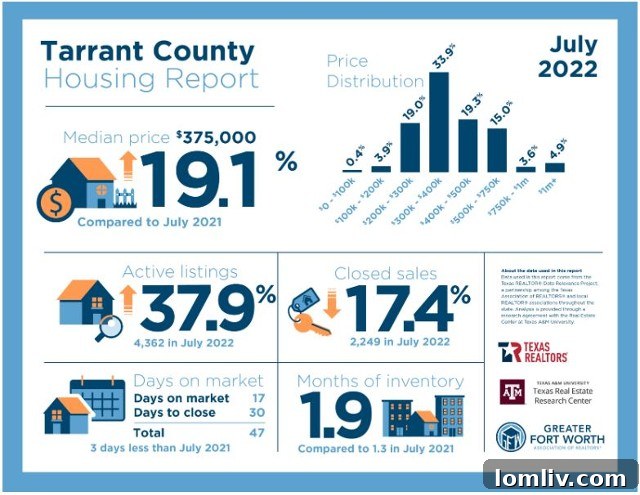
However, for a more precise and localized understanding within the Fort Worth market, insights from the Greater Fort Worth Realtor Association’s most recent housing inventory report are invaluable. This report highlighted that more than 50 percent of homes sold in July 2022 were priced at or under $400,000. Therefore, for the purposes of this analysis, we will adopt this data-backed figure as our practical definition of “affordable housing” in the Fort Worth area. While individual budgets and preferences will always vary, this benchmark effectively captures the accessible price point for a significant majority of the local homebuyer demographic.
This established affordability benchmark brings us to a critical examination of the current new home inventory. Returning to the more than 700 new homes available on the MLS, a stark discrepancy becomes evident: less than 30 percent of these newly constructed properties are priced at or below the $400,000 threshold. This translates to an alarming statistic where over 70 percent of new homes entering the Fort Worth market are priced beyond the budget constraints of the majority of prospective buyers. This significant misalignment between available supply and buyer affordability creates a substantial challenge for the market.
The problem is clear: while a healthy pool of buyers exists, and the total housing inventory is growing, the pricing of a vast majority of new homes simply does not align with the financial capabilities and demands of these buyers. This fundamental disconnect creates a bottleneck, hindering the natural flow of the market and making it difficult for many to achieve homeownership. The implications for builders are profound. They can certainly continue to build at current paces, but if these new homes consistently outprice the primary demographic of buyers, a sustainable market becomes elusive.
During the recent low-inventory, high-demand period—which spanned over 20 months—builders could confidently set prices and expect quick sales with minimal hesitation. In stark contrast, the current environment sees buyers exercising greater prudence, meticulously evaluating their budgets, and facing limitations on their purchasing power due to higher interest rates. In this new reality, homes, especially those in higher price brackets, are simply not selling with the same rapid momentum; they are no longer “flying off the shelf” as they once did.
The Evolving Landscape: Challenges and Future Outlook for Fort Worth New Home Builders
The discernible shift in market dynamics is already having a tangible impact on new home builders throughout Fort Worth. Many are now actively deploying strategies that would have been inconceivable just a year or two ago, including substantial price reductions, offering generous buyer incentives, and even bonuses for real estate agents. It’s increasingly common to observe reductions of tens of thousands of dollars from the initial asking prices of completed or near-completion inventory homes. These proactive measures are a clear indicator that builders are “feeling the squeeze,” compelled to make their properties more attractive to a shrinking, yet more discerning, pool of qualified buyers.
However, the effectiveness and sustainability of these aggressive adjustments remain a critical question for the industry. For the past several years, builders consistently escalated their prices, a trend driven by a combination of surging market demand and escalating costs for land, labor, and building materials. While these cost pressures were legitimate, the ability to effortlessly pass them onto eager buyers ensured robust profit margins. If the primary strategy for moving inventory now relies solely on slashing prices—thereby eroding profit margins—many smaller, less financially robust builders will inevitably face severe financial strain. The harsh reality is that without healthy profitability, a significant number of new home construction companies could ultimately find themselves unable to sustain operations and forced out of business.
An ideal scenario for fostering a truly balanced and affordable housing market would involve a synchronized reduction in key input costs: lower demands from landowners for raw land, more competitive pricing from contractors for labor, and a significant decrease in the cost of building materials. Such a confluence of factors would empower builders to construct high-quality homes priced under $400,000 while still maintaining a sustainable profit margin. Yet, these conditions, which perhaps characterized earlier market cycles, seem increasingly remote in today’s complex economic environment. Land values remain elevated, skilled labor continues to command premium rates, and global supply chain disruptions persist, contributing to sustained inflationary pressures on materials.
Given these entrenched challenges, a probable future trajectory for Fort Worth’s new construction sector involves a period of stagnant sales. As new homes linger on the market for extended periods, the carrying costs for builders—including interest on construction loans, property taxes, and maintenance—will continue to accumulate, further intensifying financial pressures. This could precipitate a wave of consolidation or even insolvencies among construction companies unable to adapt to the diminished demand and shrinking margins. Such an outcome draws unsettling parallels to certain aspects of the 2008 housing crisis, where an oversupply of homes coincided with a dramatic contraction in buyer demand and access to credit.
While a complete replication of the 2008 meltdown is likely averted due to stricter lending standards and improved financial regulations currently in place, the similarities in builder vulnerability and market oversupply are undeniably concerning. In such a downturn, larger, more financially resilient “big box” builders would likely seize opportunities to acquire distressed properties and potentially absorb smaller, struggling construction firms, leading to further industry consolidation. The pace of new land development would inevitably slow dramatically, and the overall volume of new construction would decline sharply. However, real estate markets are inherently cyclical. Eventually, perhaps within one to three years, broader economic conditions will likely shift again: interest rates could be lowered to stimulate growth, pent-up demand will undoubtedly resurface, and the market will likely return to a familiar complaint about an insufficient supply of quality, affordable housing. This enduring, cyclical nature of the real estate market, where periods of excess supply give way to scarcity, and then back again, powerfully reinforces the age-old adage: the more things change, the more they ultimately stay the same.