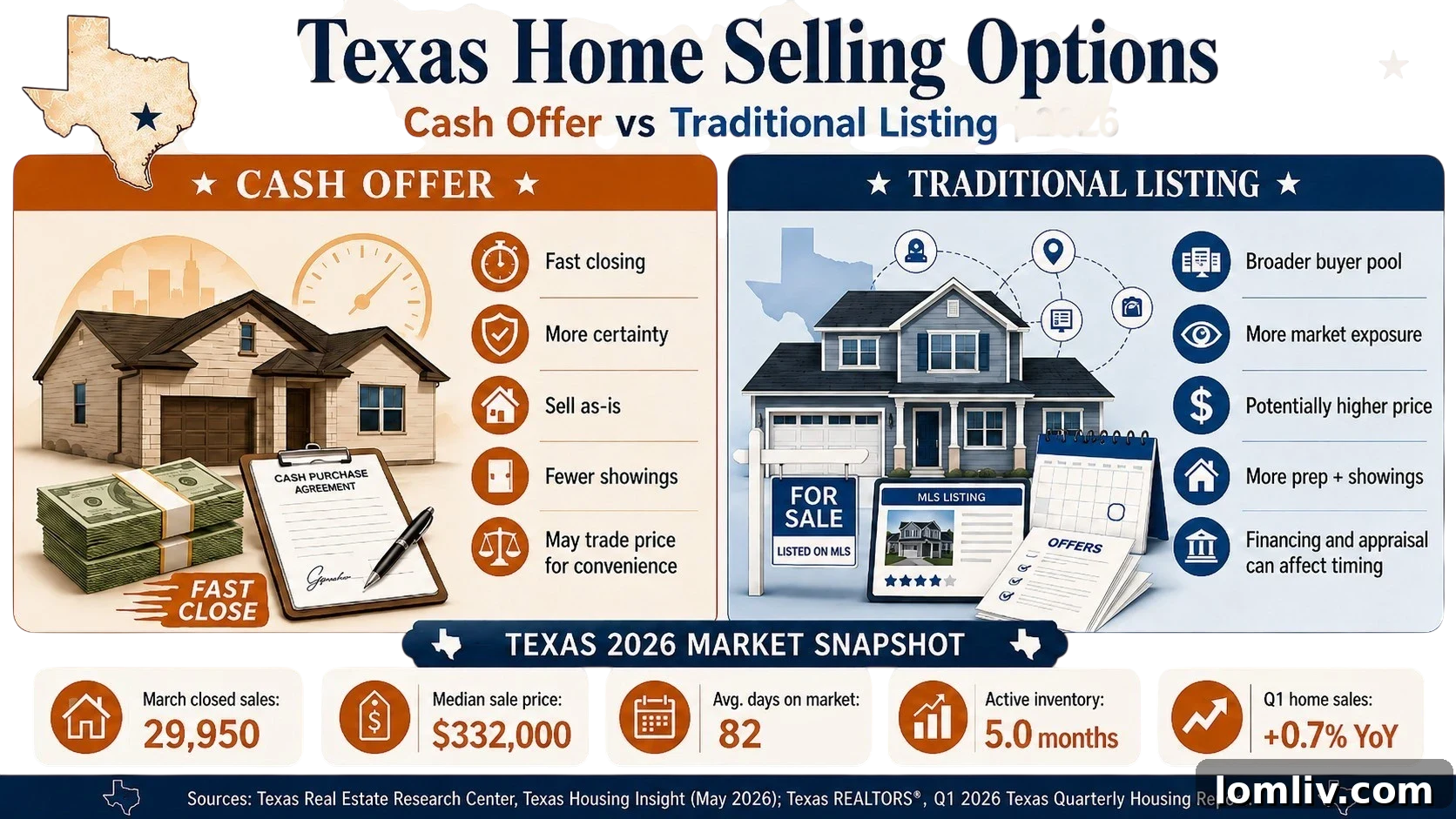
Selling a home in Texas once felt straightforward: list the property, wait a few weeks, review offers, and move toward closing.
Today’s market often feels different.
Homes still sell, but the process now requires more strategy than during the recent hot market. Buyers have more options, pricing errors are easier to spot, timelines are longer, and many homeowners face a key question: how should they sell?
Should you pursue a fast cash or guaranteed-offer sale, or list traditionally and aim for the highest possible price?
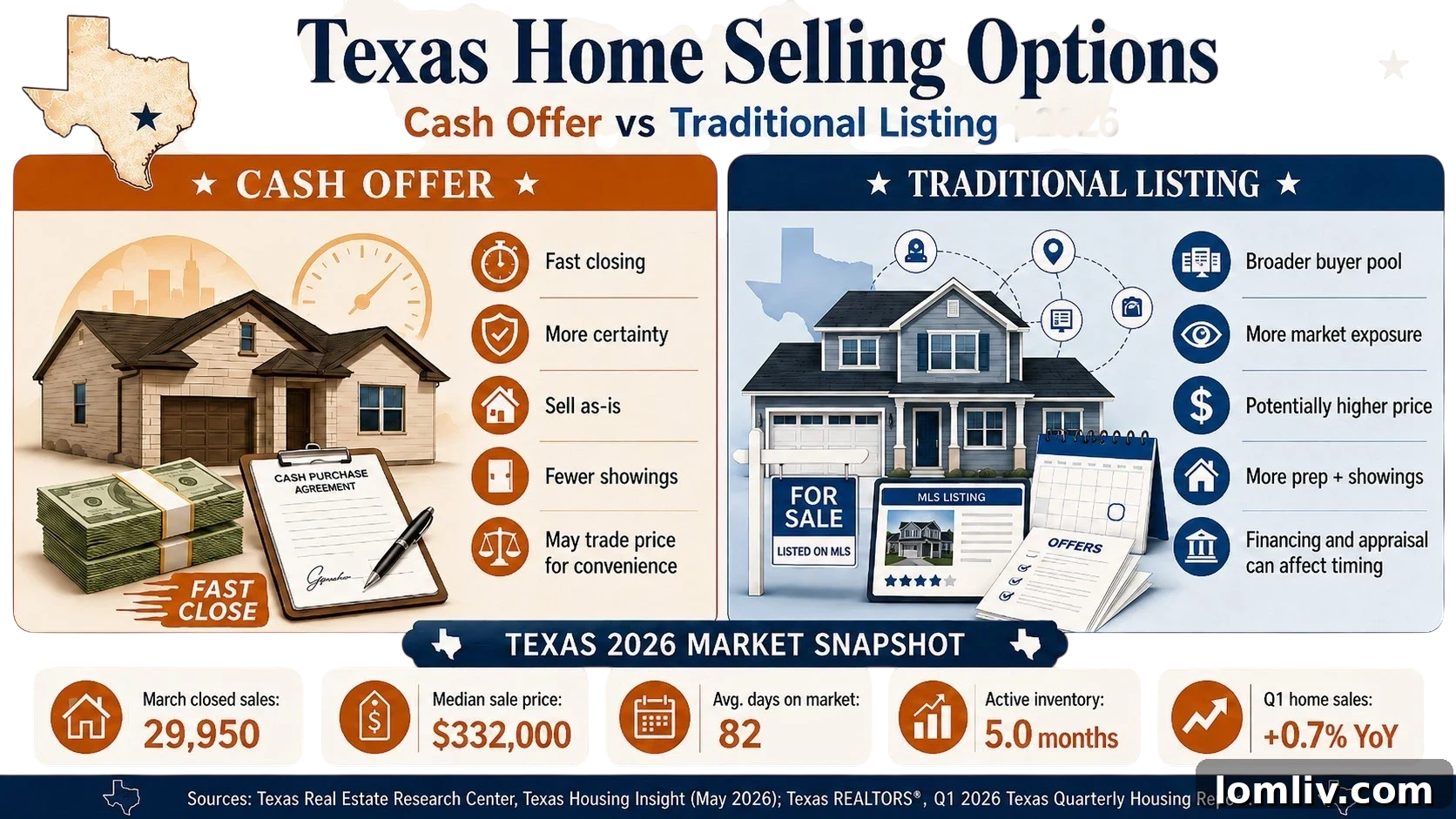
Here’s a clear comparison of both approaches to help you decide.
Texas Housing Market
Understanding current market conditions in Texas helps you choose the right selling strategy.
The market has cooled from the frenetic pace of the pandemic years. Demand remains, but buyers are pickier, inventory has risen, and sellers have less leeway to overprice.
Recent data show homes in Texas are spending more time on the market and sellers are making price reductions more often to complete sales. Turnover has declined, meaning properties generally sit longer before changing hands.
Median and average timelines vary by region, but many sellers can expect a multi-week to multi-month process from listing to closing. Likewise, statewide price growth has slowed and performance differs across cities and neighborhoods.
What This Means for Sellers
In today’s Texas market:
- Homes are still selling, but not as quickly as before.
- Buyers have more choices and are more selective.
- Accurate pricing from day one is essential.
- Seller concessions and price reductions are more common.
- The right selling strategy depends on timeline, property condition, and financial goals.
The fastest option and the highest-price option often differ, so weigh your priorities before deciding.
Option 1: Sell Fast With a Cash or Guaranteed Offer
If speed and certainty are your top priorities, a cash buyer or a guaranteed-offer program can be attractive.
These buyers or companies typically assess your home, estimate value based on local conditions and property condition, and present an offer. If you accept, the sale can close much faster than a traditional listing.
Many sellers in these programs skip repairs, showings, open houses, and prolonged negotiations.
Pros of a Fast Cash Sale
A cash or guaranteed-offer sale is a good fit for sellers who want simplicity and speed.
- Speed: Closings can occur far quicker than with traditional listings.
- Convenience: Staging, open houses, and repeated showings are often unnecessary.
- Certainty: Cash buyers reduce the risk tied to mortgage approvals.
- Flexibility: Some buyers allow you to pick a convenient closing date.
- Less prep: Many buyers purchase homes as-is, minimizing repair or upgrade requirements.
This option is especially useful for sellers facing relocation, financial pressure, inherited property, major repairs, divorce, or other situations where time is limited.
Cons of a Fast Cash Sale
The main trade-off is price.
Cash buyers typically factor repair costs, risk, holding costs, and profit into their offers, which can result in a lower sale price than a full-market listing might achieve.
- Lower offers: You may not receive the highest possible price.
- Less exposure: Your home isn’t shown to the entire buyer pool.
- Limited negotiation: Some offers are near take-it-or-leave-it.
- Program variation: Terms differ between companies, so details matter.
In short: you often trade some upside for speed, convenience, and predictability.
Option 2: List Traditionally With a Real Estate Agent
The traditional route—working with a real estate agent—remains the most common method for selling a home.
An agent helps prepare, price, market, show, negotiate, and close the sale with the goal of exposing your home to as many qualified buyers as possible to generate competitive offers.
Most sellers still follow this path because broader exposure increases the chances of receiving strong offers, especially when buyers have multiple homes to choose from.
Pros of a Traditional Listing
A traditional listing is often the best route for sellers focused on maximizing price.
- Higher price potential: Greater exposure can attract more buyer interest and multiple offers.
- Professional guidance: An experienced agent helps set the right price and avoid costly mistakes.
- Marketing reach: Listings appear on MLS and major platforms, plus agent networks and digital campaigns.
- Negotiation support: Agents manage offers, inspections, appraisals, and closing details.
- Structured process: Transactions follow standard steps—inspections, appraisals, financing timelines, and paperwork.
Data commonly show a price gap favoring agent-assisted sales over for-sale-by-owner transactions, highlighting the value of professional representation for many sellers.
Cons of a Traditional Listing
Traditional listings can deliver higher returns but require more time and effort.
- Longer timeline: From listing to closing can take months.
- Uncertainty: Financing, inspections, or appraisal issues can delay or derail deals.
- Preparation: Repairs, cleaning, landscaping, photography, and staging may be necessary.
- Showings: Keeping the home show-ready for an extended period is often required.
- Costs: Brokerage fees, closing costs, repairs, and concessions reduce net proceeds.
Traditional listings can work very well, but they demand patience and ongoing effort.
Cash Offer vs. Traditional Listing: The Real Trade-Off
The choice usually comes down to three factors: certainty, convenience, and net proceeds.
Certainty
Cash sales typically offer more certainty because they reduce financing risk. Traditional listings can succeed too, but carry more potential complications from financing, inspections, and appraisals.
Convenience
Cash sales are generally easier—fewer repairs, fewer showings, and less day-to-day involvement. Traditional listings require preparing the home, accommodating buyers, and staying flexible throughout the process.
Net Proceeds
Cash offers are often lower initially. Traditional listings may achieve higher sale prices, but final proceeds depend on price reductions, repair costs, concessions, closing fees, and how long the property sits on the market.
If a home requires price cuts or repairs and carries ongoing holding costs, the difference between a quick cash offer and the traditional route can narrow. That’s why comparing real numbers before deciding is important.
Which Selling Option Fits Your Situation?
There’s no universal answer. The best path depends on your timeline, property condition, and personal priorities.
If You Need to Sell Quickly
A cash or guaranteed-offer sale may suit you if you’re facing:
- Job relocation
- Divorce
- Financial pressure
- An inherited home
- A vacant property
- A home needing major repairs
- A tight moving deadline
In these cases, speed and certainty often outweigh pursuing every possible dollar.
If You Want the Highest Possible Price
Choose a traditional listing if:
- You have time to wait.
- Your home is in good condition.
- You’re willing to prepare the property for showings.
- You want full market exposure.
- You’re comfortable with negotiations and the selling process.
This path offers the best chance to attract multiple buyers and test the open market.
If You Are Buying Another Home
Move-up sellers often face timing challenges. Some choose cash offers for certainty, while others list traditionally and coordinate contingencies, leasebacks, or flexible closing dates with an agent. Your tolerance for timing risk will determine the best approach.
If You Inherited a Property
Inherited homes can involve repairs, multiple heirs, or out-of-state owners. A cash sale can simplify the process by minimizing repairs, cleanouts, showings, and lengthy coordination.
A Simple Decision Framework
Ask yourself four questions before choosing how to sell your Texas home.
1. How fast do I need to sell?
If you must sell in days or weeks, a cash offer warrants consideration. If you have months, a traditional listing may offer more opportunity to maximize price.
2. What condition is my home in?
If major repairs are needed, cash buyers can be appealing. If the home is updated and move-in ready, listing traditionally may attract stronger offers.
3. How much uncertainty can I handle?
If you prefer predictability, a cash sale likely fits better. If you accept inspections, appraisals, and potential delays, a traditional listing may be appropriate.
4. What matters more: time or money?
Most sellers want both, but there’s usually a trade-off. The fastest option isn’t always the most profitable, and the highest-price option isn’t always the easiest. Be honest about what matters most for your situation.
Final Thoughts
Selling a Texas home today requires a thoughtful strategy. The market has shifted: homes take longer to sell, buyers have more choices, inventory is higher, and accurate pricing matters more than ever.
- If you want speed, simplicity, and predictability, a cash or guaranteed-offer sale can be the right move.
- If your priority is the highest possible price and you’re willing to wait, prepare, and negotiate, listing with an agent remains a strong option.
Neither path is universally correct. Evaluate your timeline, your property’s condition, and your financial goals. Compare offers, run the numbers, ask questions, and choose the approach that best balances speed, certainty, and value for your situation.