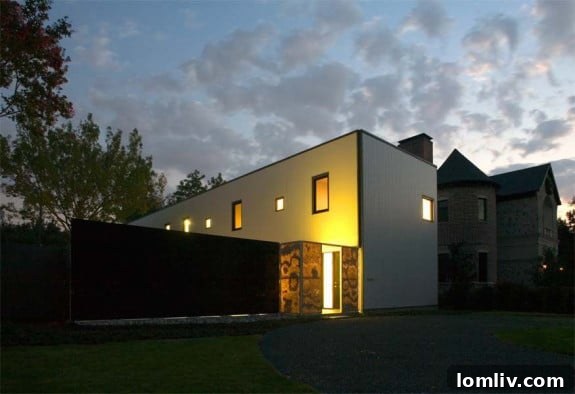
The Iconic Mockingbird House: A Masterpiece of Modern Architecture in Highland Park
Nestled amidst the traditional grandeur of Highland Park, Dallas, stands a structure that boldly defies conventional residential aesthetics: the Mockingbird House. Designed by the visionary architect Russell Buchanan, this “box-like residence” has garnered significant attention, not only for its avant-garde design and innovative material use but also for the lively discussions it sparked among neighbors.
From its striking exterior, which evokes the robust simplicity often associated with industrial warehouses, to its sophisticated interior adorned with an array of natural stones, the Mockingbird House is a testament to Buchanan’s forward-thinking approach. Its distinctive appearance quickly caught the discerning eye of AIA Dallas, earning the home a prestigious Honor Award. This recognition solidifies its place as a pivotal example of modern Dallas architecture and a benchmark for contemporary design.
A Vision of Modernity: Russell Buchanan’s Architectural Philosophy
Russell Buchanan is renowned for his minimalist yet profound architectural statements, and the Mockingbird House on Mockingbird Lane is arguably one of his most celebrated projects. His design philosophy for this particular residence was rooted in efficiency, thoughtful material selection, and a desire to challenge prevailing notions of what a home should look like in an affluent, traditionally styled neighborhood like Highland Park. The “box-like” form, far from being a simplistic choice, is a deliberate embrace of modernism, emphasizing clean lines, functional space, and a deliberate absence of superfluous ornamentation. This architectural decision creates a striking contrast with its surroundings, forcing a reconsideration of aesthetic norms.
The “Box” Unveiled: Design and Dimensions
The Mockingbird House is a commanding two-story residence spanning 4,140 square feet. Its fundamental structure is an elegant rectangular box, meticulously designed to maximize both form and function. This seemingly simple geometric shape belies a complex interplay of internal volumes and external expressions. Central to its design is a dramatic vestibule, which serves as a luminous beacon. When night falls, this entrance is bathed in a warm, amber glow, a captivating effect achieved through its unique construction: a series of translucent onyx slabs. This feature alone speaks volumes about the home’s commitment to both beauty and innovative material application, transforming a functional entry point into an artistic installation.
A Symphony of Stone: Interior Grandeur and Craftsmanship
The interior of the Mockingbird House is where its true material luxury unfolds, a direct reflection of the owners’ expertise in the wholesale stone trade. This partnership between architect and client allowed for an unparalleled exploration of natural materials, resulting in a home that is both visually stunning and structurally rich. Every surface tells a story of geological beauty and meticulous craftsmanship.
- Onyx Vestibule: The aforementioned vestibule is a tour de force. Composed of carefully selected onyx slabs, its translucency allows light to filter through, creating a soft, inviting radiance. This feature is not just an entry point; it’s a sensory experience, setting the tone for the entire residence. The intricate veining and varying hues of the onyx provide a natural artwork that shifts with the changing light.
- Granite, Quartz, and Marble: Beyond the captivating onyx, the owners incorporated several distinct types of granite, quartz, and marble throughout the home. These luxurious stones are skillfully utilized in diverse applications, from polished countertops in the gourmet kitchen to expansive flooring that flows seamlessly between living spaces, and accent walls that introduce texture and depth. Each selection contributes to the home’s sophisticated palette, offering both durability and an undeniable touch of elegance. The deliberate choice and placement of these materials highlight their natural beauty, transforming functional elements into sculptural components.
- Beyond Aesthetics: The extensive use of stone is not merely decorative. It contributes significantly to the home’s thermal mass, aiding in temperature regulation and offering an inherent sense of permanence and solidity. This deep integration of material science with aesthetic intent is a hallmark of the Mockingbird House.
Industrial Elegance Meets Residential Comfort: The Insulated Panel System
Buchanan often likened the Mockingbird House to a “giant refrigerator box,” an analogy that perfectly captures its commitment to superior insulation and efficiency. The exterior’s “building envelope,” while industrial in appearance, is actually composed of advanced insulated panels. These panels are typically found covering warehouses due to their exceptional performance, but Buchanan ingeniously repurposed them for a residential setting, demonstrating their versatility and myriad benefits:
- Unmatched Construction Efficiency: The use of prefabricated insulated panels significantly streamlines the construction process. This modular approach allows for faster assembly, reducing both labor costs and overall project timelines. This efficiency was a key factor in the home being completed in a remarkably short period, approximately one year.
- Superior Thermal Performance: These panels offer extraordinary insulation properties, far surpassing those of traditional construction methods. This translates directly into enhanced energy efficiency, keeping the home cool during Dallas’s hot summers and warm in its milder winters, thereby reducing utility costs and the home’s environmental footprint.
- Exceptional Sound-Dampening: One of the most critical benefits for a home situated on a busy thoroughfare like Mockingbird Lane is its ability to mitigate external noise. The dense, multi-layered composition of the insulated panels provides significant sound-dampening properties. This creates a remarkably quiet and serene interior environment, offering a tranquil sanctuary despite the constant hum of city life just outside its walls.
- Durability and Low Maintenance: The materials chosen for the exterior envelope are inherently durable and require minimal maintenance, ensuring the home retains its striking appearance and structural integrity for decades to come.
The Friction and the Forum: A House That Ignited Debate
The Mockingbird House, with its bold, unyielding design, was bound to generate discussion. Its stark, minimalist aesthetic, characterized by an industrial facade and lack of traditional adornments, stood in stark contrast to the more conventional, often revivalist architectural styles prevalent in Highland Park. This divergence sparked “friction with neighbors,” who may have found its modern expression jarring or out of place within the established visual lexicon of the community.
However, this very controversy underscored the house’s significance. It became a focal point for debates about architectural freedom, contextual design, and the evolving definition of luxury and beauty in residential spaces. Far from being a drawback, this discourse amplified the home’s presence, making it a landmark in Dallas’s architectural narrative.
The home’s innovative spirit was celebrated and thoroughly explored during a Dallas Architecture Forum event, where the building was opened for tours. Visitors, including this observer, were profoundly impressed by the versatility and intelligent application of this type of construction. Stepping inside, the exterior’s industrial austerity gave way to an inviting, luminous interior, where the quality of materials and the mastery of light and space were immediately apparent. It was during this tour that the true genius of Buchanan’s design, and the immense value of the insulated panel system in creating such a serene and well-controlled environment, became undeniably clear.
A Testament to Forward-Thinking Design and Sustainable Practice
The completion of such a complex, well-insulated, and meticulously crafted home in approximately one year is a remarkable feat. This rapid turnaround is a direct testament to the efficiency of the chosen construction methods, particularly the prefabricated insulated panels, and the seamless collaboration between the architect, builders, and the stone-expert owners. It highlights how modern techniques can not only deliver aesthetic excellence but also significantly reduce construction timelines without compromising quality or performance.
The Mockingbird House stands as a powerful statement on several fronts:
- It champions the integration of commercial/industrial materials into sophisticated residential design.
- It exemplifies how architectural innovation can address practical concerns such as energy efficiency and noise pollution.
- It proves that contemporary design can coexist, even if controversially, within traditional urban fabrics.
- It showcases the profound impact of thoughtful material selection, especially when informed by expert knowledge, as seen with the owners’ deep understanding of stone.
Congratulations are undoubtedly due to Russell Buchanan for his truly forward-thinking design. The Mockingbird House is more than just a home; it is a monument to ingenuity, a beacon of modernism in Highland Park, and a compelling case study in the power of architecture to provoke, inspire, and endure. Its legacy will continue to influence and shape discussions around contemporary living and design for years to come.