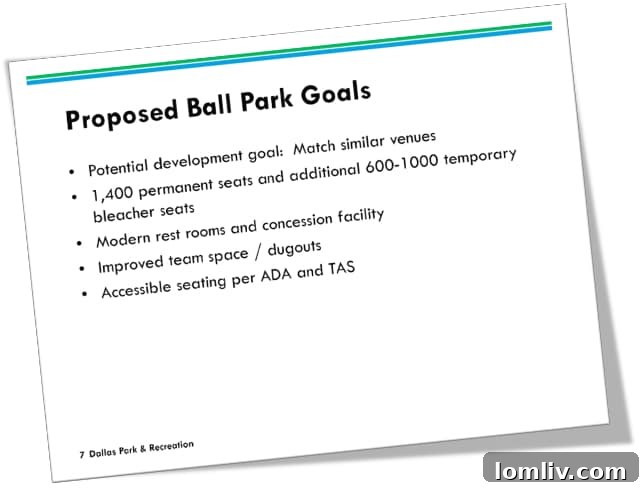
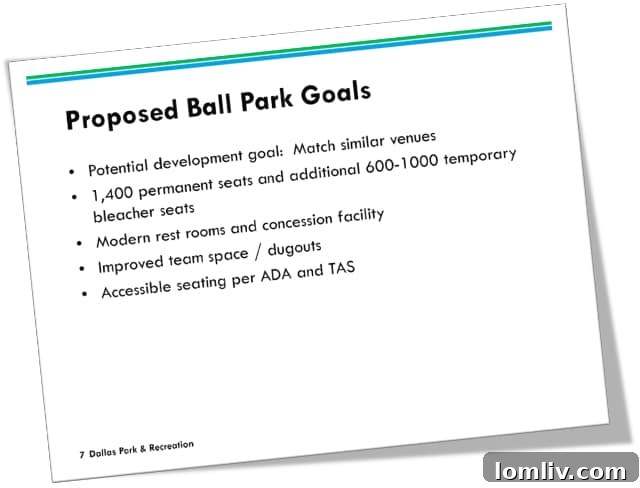
Reverchon Park, a cherished green space in Dallas, found itself at the center of a significant redevelopment proposal in December 2016. During a pivotal briefing to the Dallas Parks Department, the organization known as Friends of Reverchon Park outlined their vision: a comprehensive overhaul of the existing baseball field. Their ambitious plan hinged on a long-term agreement with a self-funded private entity, signalling a shift towards a public-private partnership model for one of the city’s valuable recreational assets. This initial proposal set the stage for a series of events that would raise questions about transparency, fairness, and the future direction of urban park development.
As illustrated by the presentation slide from that December 2016 meeting, the Friends of Reverchon group presented remarkably specific parameters for the reimagined Reverchon Ball Field. A key point of their proposal was a dramatic increase in seating capacity, expanding from the existing 700 seats to an ambitious 2,400. This substantial leap begs a fundamental question: how was this particular number determined? Without a dedicated expert in ballpark design or operations seemingly on staff, the sudden emergence of this specific seating target in 2016, coupled with the intent to completely reshape the ballfield and lease it out, suggests a very particular pre-existing vision. Such precise figures often point to prior consultations or specific interests rather than an organic, community-led brainstorming process. The journey from a 700-seat community field to a 2,400-seat facility marks a significant conceptual leap, transforming the park’s potential role within the Dallas landscape.
Ballpark Development: A Case of Deja Vu and Strategic Timing
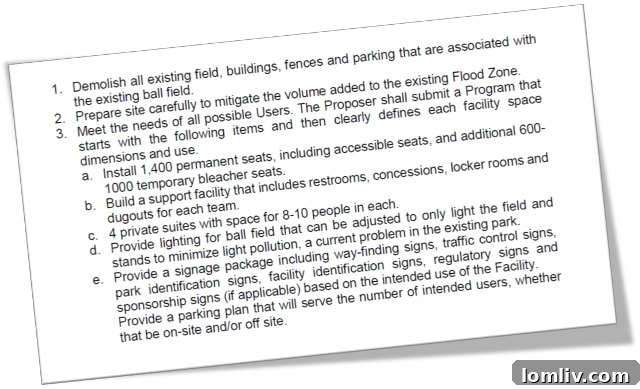
The highly specific vision articulated in 2016 for the Reverchon Ball Field quickly found its way into official municipal processes, resurfacing in the initial Request for Proposal (RFP) issued by the city in 2018. This RFP, dated January 17, 2018, allotted a mere 30-day response window for potential developers. This tight timeframe, for a project of such significant scale and complexity, immediately raised eyebrows among observers. Unsurprisingly, this constrained window garnered only a single submission: from Mark Schuster’s Reverchon Sports and Entertainment LLC. (It’s important to distinguish this entity from Donnie Nelson’s similarly named Reverchon Park Sports and Entertainment LLC, highlighting a potential for confusion even in the naming conventions.)
While former Park Board president Calvert Collins-Bratton asserted that “a response time of 30 days is normal for City projects,” this argument struggles to hold weight when applied to multi-million-dollar, non-commodity ventures. For routine purchases like office supplies, a 30-day window is perfectly adequate. However, for a complex public-private partnership involving significant capital investment, detailed architectural plans, operational strategies, and financial projections, assembling a competitive and comprehensive proposal within such a short period is an extraordinary challenge. This brief window inherently favors entities that are already well-prepared, suggesting a level of pre-existing knowledge or engagement that might disadvantage other potential bidders and limit genuine competition.
A more plausible scenario suggests that the Friends of Reverchon Park may have been in communication with Schuster’s group — which, coincidentally, was established in 2016 — even before presenting their December 2016 proposal to the city. This would explain how the parameters outlined by the Friends group so precisely aligned with Schuster’s apparent needs. Mark Schuster, then president of the Southwest League, was simultaneously attempting to launch the league’s inaugural season with six new franchises, one of which was slated for Reverchon Park. This alignment in timelines and interests creates a compelling narrative of a pre-coordinated effort rather than a serendipitous coincidence. Unfortunately, Schuster’s Southwest League faced a series of financial hurdles and appears to have ceased operations in 2019, long before most of its initial teams ever got off the ground, causing the first RFP to fail.
Any lingering doubts about Schuster’s broader ambitions for Reverchon Park, beyond merely hosting baseball, were dispelled after his group was awarded the RFP. He was quoted in Ballpark Digest expressing profound appreciation: “I applaud the Dallas Parks Department and Dallas City Council for having the vision to transform Reverchon Park into an entertainment destination.” The emphasis on “entertainment destination” is critical here, indicating a vision far beyond a simple baseball field and hinting at a much more commercialized use of public parkland. This aspiration for a broader entertainment hub, rather than solely a sports venue, aligns with the subsequent expansions in the project’s scope, leading to a persistent pattern of specific project tailoring.
The sequence of events – from a specific proposal to a tailored RFP, a tight bidding window, and a single, pre-aligned bidder – prompts a crucial question: is this merely a series of convenient coincidences, or does it hint at a more intricate, pre-arranged development strategy for a public park?
Unpacking the 2019 RFP: Escalation, Specificity, and Unanswered Questions
The story of Reverchon Park’s redevelopment took another intriguing turn with the release of the 2019 RFP, which emerged after Mark Schuster’s financing for the 2018 project collapsed. This failure was primarily financial, not due to the scale or specific features of the proposed facility, such as its real grass field. Yet, the subsequent 2019 RFP presented significantly expanded and altered parameters, sparking renewed scrutiny and raising further questions about the city’s procurement practices.
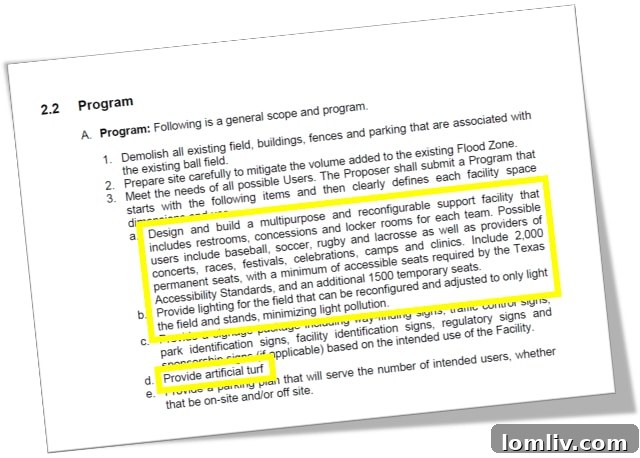
The revised RFP proposed an astonishing increase in seating capacity to 3,500 – a 46% jump from the 2,400 seats in the previous proposal, and a staggering fivefold increase from the original 700 seats. Beyond seating, the 2019 RFP introduced the requirement for artificial turf, reconfigurable lighting, and explicitly stated the field should be a “multipurpose and reconfigurable support facility.” This transformation from a traditional baseball field to a versatile, entertainment-ready venue suggests a very deliberate shift in vision. How did the city conclude that these specific enhancements were the only way to attract another lone bidder within yet another expedited 30-day response window? The consistency of the short bidding period and the expectation of minimal competition in these multi-million-dollar projects remains a significant area of concern, undermining the principles of fair and open public procurement.
Former Park Board president Collins-Bratton’s assertion that “There was no substantial change between the first and second RFPs” is difficult to reconcile with the facts. A 46 percent increase in scale, the fundamental shift from natural grass to artificial turf, and the explicit redefinition of the facility as “multipurpose” are anything but inconsequential. These are profound modifications that carry significant implications for the park’s environmental impact, operational costs, community access, and overall character. Artificial turf, for instance, often raises concerns about heat island effects, stormwater runoff, and potential health impacts, contrasting sharply with the benefits of natural green space in an urban environment. Such changes warrant extensive public discussion and a robust justification, neither of which appeared to be thoroughly provided.
To many, these modifications appear not only consequential but strikingly specific. They almost seem tailored to fit the precise specifications and business model of a particular type of respondent – one already accustomed to large-scale sports and entertainment operations. Such specificity in an RFP can inadvertently or intentionally limit the field of potential bidders, giving an unfair advantage to an entity with prior knowledge or influence over the RFP’s drafting. This tailoring would also provide a logical explanation for how an entity could realistically develop a profitable $10-15 million development deal and prepare a comprehensive proposal in fewer than 30 days. While one instance of such a pattern might be dismissed as a coincidence, its repetition across two successive RFPs strongly suggests a more deliberate, less transparent process at play.
Transparency, Accountability, and Unanswered Questions
Seeking clarity on these concerning patterns, I reached out to key figures involved: Park Board president Calvert Collins-Bratton and Lori Ashmore Peters, president of the Friends of Reverchon Park, with a set of specific questions. As of press time, the Friends of Reverchon Park had not provided a response, highlighting a troubling lack of public engagement from a group purporting to represent park interests. However, a weekend exchange with Collins-Bratton offered some insights, though ultimately left many core questions unresolved.
My initial inquiry focused on the earliest stages of the proposal: “Did the briefing notes (from the December 1, 2016 briefing) reflect that Friends of Reverchon Park was already in discussions with Mark Schuster’s group before the December meeting? It seems curious that the parameters suggested in December and that wound up in the 2018 RFP were what Schuster’s group needed.” Collins-Bratton’s response distanced herself from the initial briefing: “I did not join the Park Board until October 2017, so I was not in the first briefing related to a potential RFP in December 2016. I do remember when Mark Schuster presented to the Park Board in June 2018 for the briefing and vote, there were several representatives from Friends of Reverchon Park in the gallery, and one who spoke in favor of the deal. Like I said, I had very little knowledge of that RFP; you might reach out to Jesse Moreno since it’s his district and he’s been on the Board since 2015.” While her lack of direct involvement in 2016 is understandable, the observation of Friends of Reverchon’s clear support for Schuster in 2018 reinforces the perception of a strong, possibly pre-existing, alignment of interests. The suggestion to contact Jesse Moreno, while reasonable, shifts the accountability without providing immediate answers about the historical context.
My next question addressed the significant scope creep: “Who suggested and what was the reasoning for the increases in scope in the 2019 RFP? The lack of those changes don’t seem to have been a contributing factor in the first RFP winner’s overall business failure.” Collins-Bratton reiterated her limited knowledge: “Similarly, I had no knowledge of any change in scope to the second RFP. I remember disappointment that Schuster’s group couldn’t raise the money (which we questioned him about extensively during the June 2018 briefing and vote), so it was my understanding that Park staff reissued the RFP based on hearing of other potential interest in reviving the idea.” This response, again, highlights a potential gap in institutional memory or oversight, as significant changes to a public project’s scope should ideally be thoroughly documented and justified to the public and the Park Board itself. The notion of staff reissuing an RFP based on “other potential interest” without clear, public deliberation about the *changed* specifications remains a critical area of ambiguity, suggesting decisions made behind the scenes.
In a final exchange, I expressed my fundamental skepticism about the rapid proposal development: “I just can’t see someone waking up one morning, checking the city’s RFPs and thinking, ‘Gee, I’ll build a ballfield’ and get everything together in a month.” Collins-Bratton offered a professional counterpoint: “I understand your questioning, but both of these proposers are in the ballpark/minor league sports operation business around the country. So, they are more accustomed to municipal processes and deadlines than just anyone who would haphazardly want to build a new ballpark.” While it’s true that experienced developers are familiar with municipal procedures, this argument doesn’t fully address the core concern: how did these specific entities become aware of these very specific, rapidly released RFPs in the first place, and were they privy to the evolving requirements before public dissemination?
The crucial, lingering question, though unasked in that specific exchange, remains central to the controversy:
Unasked: But how did they know about the RFP in the first place? I can’t imagine either of these groups scouring the city’s RFPs to see if there’s something they’re interested in, especially not with the precise, tailored specifications that eventually emerged.
Ultimately, these inquiries lead to fundamental questions about the stewardship of public assets and the integrity of municipal processes. How and when did these private groups first gain knowledge of the city’s intent to redevelop Reverchon Park, particularly with such tailored specifications? Did they actively influence the creation or shaping of the RFPs, ensuring the terms favored their unique proposals? And, if so, is this method of public-private partnership procurement truly serving the best interests of the Dallas community and its residents, or does it risk compromising fairness and public trust? Ensuring transparency and robust competition in all phases of public projects is paramount to maintaining public confidence and achieving optimal outcomes for the city and its cherished green spaces.