Navigating the Dynamic Texas Housing Market: Demand, Affordability, and Growth Challenges
The Texas housing market, a perennial national leader, continues to present a fascinating paradox of robust demand coexisting with persistent challenges. Despite a slight dip in housing sales, the underlying demand across the Lone Star State remains undeniably strong. This dynamic landscape, highlighted by the Texas A&M Real Estate Center’s insightful reports, reveals that while the market’s pulse is vigorous, significant headwinds, particularly concerning housing affordability in major metropolitan areas like Dallas, are far from resolved. Understanding these intricate forces is crucial for anyone looking to buy, sell, or invest in Texas real estate, as they collectively shape the future trajectory of one of the nation’s most watched markets.
Resilient Demand Meets Shifting Sales Patterns in Texas
The recent June Housing Insight report from the Texas A&M Real Estate Center indicated a 3.2 percent decline in housing sales. However, this modest figure doesn’t tell the whole story of a market under immense pressure. Texas’s enduring appeal, fueled by a booming job market, continuous population growth, and a business-friendly environment that attracts corporations and individuals alike, ensures that the appetite for housing remains insatiable. This sustained demand keeps upward pressure on housing supply, which in turn significantly influences prices and overall affordability across the state. The slight softening observed in sales can be attributed to various factors, including adjustments to rising interest rates, inflationary pressures, and a natural market correction after several years of unprecedented appreciation. Despite these factors, the fundamental desire for homeownership in Texas remains a powerful driver.
Further underscoring the market’s underlying strength and future potential, the Texas Residential Construction Cycle (Coincident) Index soared to its highest level since 2008. This impressive surge is primarily a direct reflection of significant growth in construction employment and increasingly competitive wages within the sector. The index, serving as a vital barometer for current construction activity, signals an active and expanding building environment. Developers and builders are striving to meet the state’s continuously expanding housing needs. This robust construction activity is a clear testament to the ongoing investment in infrastructure and housing development, which are absolutely crucial for supporting Texas’s remarkable demographic and economic expansion. It reflects a strategic response to the long-term housing deficit that has characterized the market.
The Supply-Side Puzzle: Inventory, Construction, and Permits in Major Metros
One of the most critical factors influencing the stability and accessibility of the Texas housing market is the delicate balance between supply and demand. Persistent housing shortages have undeniably spurred an uptick in supply-side activity across key regions. This is particularly evident in the dynamic Dallas-Fort Worth metropolitan area, which saw a 3.3 percent increase in the inventory of vacant developed lots. This growth in available land parcels suggests that developers are actively preparing for future construction, signaling strong optimism in the long-term growth prospects of the region and a commitment to address the housing crunch.
However, a contrasting trend emerged in the second quarter, where single-family housing construction experienced a modest 1.8 percent dip. This subtle decline could be attributed to several compounding factors, including escalating material costs, persistent labor shortages plaguing the construction industry, and even temporary permitting delays or evolving regulatory hurdles. These elements can collectively impede the pace of new home builds, creating bottlenecks in the supply chain. Despite this slight retraction, Texas proudly maintains its dominant position in the national housing market, accounting for an impressive 16 percent of the total national permits issued. This leadership role highlights the state’s pivotal contribution to the nation’s overall housing supply. Within Texas, the Dallas-Fort Worth region continues to be a powerhouse, securing a strong second place in permit activity with 3,295 permits, closely trailing the bustling Houston market. This consistent volume of permits indicates a continuous and substantial pipeline of new homes designed to alleviate some of the existing inventory pressures and meet the demands of a growing population.
Months of Inventory: A Market in Significant Imbalance
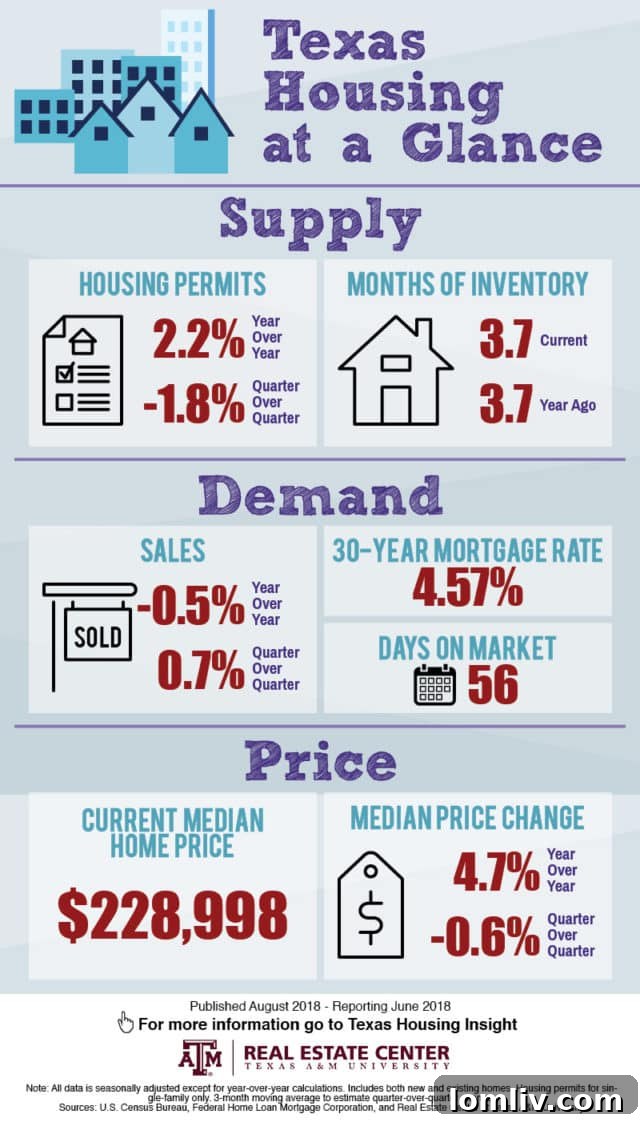
A healthy, balanced housing market is generally characterized by approximately six months of inventory, representing a sufficient supply to meet buyer demand without undue pressure on prices. However, Texas’s months of inventory currently stand at a significantly lower 3.7 months. This considerable gap underscores a market profoundly skewed towards sellers, where the demand for available homes far outstrips the existing supply. A persistently low inventory level typically leads to a cascade of market behaviors, including quicker sales cycles, intense competitive bidding wars among prospective buyers, and relentless upward pressure on home prices. These dynamics contribute directly to the ongoing affordability challenges faced by many Texans, making entry into the homeownership market increasingly difficult. Until the inventory levels begin to approach the six-month benchmark, the Texas housing market will likely remain highly competitive for prospective buyers, maintaining its “seller’s market” designation.
Deep Dive into Sales Trends and Key Market Dynamics
The overall 3.2 percent decline in Texas housing sales during June was largely concentrated in the market segment for homes priced below $300,000. This softening in sales at the lower price points is a direct and concerning indicator of the mounting affordability crisis, particularly for first-time homebuyers and those with more constrained budgets. When entry-level homes become scarce, or are consistently priced out of reach for a significant portion of the population, it creates a detrimental ripple effect throughout the entire housing ladder, impacting not only new buyers but also existing homeowners looking to move up or downsize.
The report explicitly stated, “This same price cohort hindered the markets in Austin, Dallas, and Fort Worth, where housing affordability declined substantially over the past year.” Delving deeper into the first six months of 2018, total housing sales saw notable drops across these key metropolitan areas: Austin experienced a substantial 9.2 percent decrease, Dallas a 5.7 percent decline, and Fort Worth a 4.1 percent reduction. It’s crucial to note that the majority of this decline in North Texas was observed specifically within the resale market. This trend suggests that existing homeowners might be hesitant to list their properties, perhaps due to enjoying favorable mortgage rates on their current homes, or more commonly, the significant difficulty of finding an equally affordable and suitable replacement property in the current tight market. This ‘lock-in’ effect further constrains supply.
New Construction vs. Resale Market: A Notable Divergence
In a positive and somewhat counter-intuitive trend that highlights market segmentation, new-home sales in the Dallas-Fort Worth area actually saw a robust 7.3 percent increase in the second quarter. This notable divergence between declining resale activity and rising new-home sales highlights a critical market shift. Builders are actively responding to robust demand, often by targeting specific price points or amenity packages that might not be readily available in the existing home inventory. However, the price point for many newly constructed homes can still contribute significantly to the overall affordability challenge if they are predominantly built in higher price brackets, catering to a more affluent segment of the market.
Another key metric indicating a rapidly moving and competitive market is Days on Market (DOM). Homes in Dallas spent an average of fewer than 42 days on the market, while Fort Worth properties moved even faster, averaging just 38 days. Statewide, homes priced between $200,000 and $300,000, which are increasingly difficult to find due to market dynamics, still averaged a relatively swift 50 days on market. These consistently short DOM figures powerfully underscore the competitive nature of the Texas housing market, where well-priced homes often receive multiple offers shortly after listing, further pressuring prospective buyers to act quickly and decisively in order to secure a property.
Texas Housing Prices: A Detailed Look at Median Values and Per-Square-Foot Costs
The statewide median home price in Texas saw a dip to a six-month low, falling just below $229,000. While this figure might, at first glance, appear to be a sign of a cooling market, it’s absolutely essential to analyze it in conjunction with other critical pricing metrics to gain a complete understanding. Interestingly, the median price per square foot (PPSF) continued its relentless upward trajectory, marking its 13th consecutive month of growth to reach a record high of $115.53. This fascinating juxtaposition suggests a nuanced market dynamic: while the overall median price might be influenced by a shift in the sales mix (for example, fewer larger, higher-end homes selling, or a greater proportion of smaller homes selling), the underlying value of real estate on a per-square-foot basis is still undeniably appreciating. This could indicate that smaller, more efficiently designed homes are becoming more prevalent and sought after, or simply that the fundamental demand for living space remains strong, even as overall average transaction values fluctuate due to shifts in the types of properties being purchased.
Focusing specifically on the Dallas market, the median price and price per square foot appeared to flatten, settling at $281,348 and $131.45 respectively. This flattening trend could indicate a period of market stabilization after years of intense, rapid growth, or it could potentially be a precursor to a more significant market correction, depending on future economic indicators and supply responses. For potential buyers and sellers in Dallas, understanding these nuanced price movements is incredibly vital for making informed and strategic decisions in what remains a highly dynamic and responsive market. This period of stabilization might offer a brief respite for buyers or a moment for sellers to reassess their strategies.
The Growing Affordability Crisis Across Texas Metros: A Deeper Dive
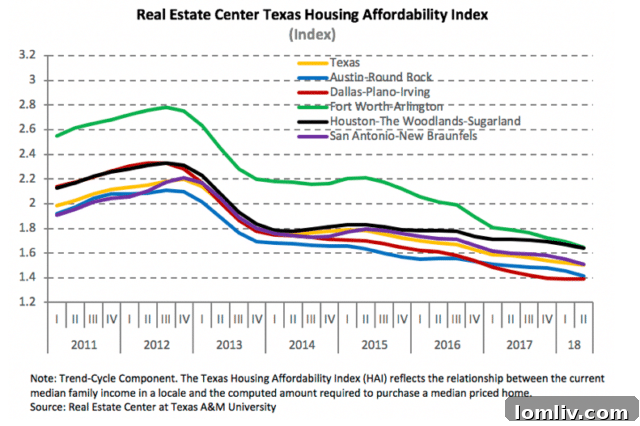
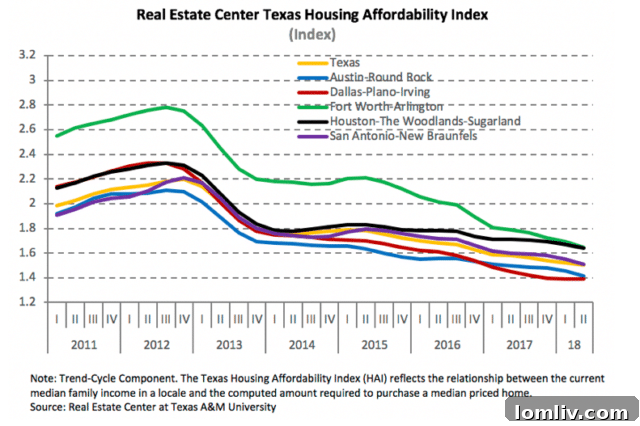
The Texas Housing Affordability Index serves as a critical barometer for how accessible homeownership truly is for the average Texan family. In the second quarter, this index notably fell below 1.50. In practical terms, this alarming drop signifies that a typical Texas family, earning the state’s median income, could no longer comfortably afford a home priced 50 percent above the median sale price. This declining affordability is a major red flag, indicating that a significant and growing portion of the population is being priced out of homeownership, leading to increased rental demand and potential long-term social and economic stratification within communities. The dream of owning a home is becoming increasingly distant for many working families.
The challenges are particularly acute and deeply felt in the major metropolitan areas, which are often the engines of the state’s economic growth. Dallas recorded the lowest affordability index among the major metros at a concerning 1.39, closely followed by Austin at 1.40. These stark figures powerfully underscore the severe financial pressure on homebuyers in these high-demand urban centers, where robust job growth and persistently limited housing supply create an incredibly competitive and financially daunting environment. Fort Worth experienced the largest decline in affordability, mirroring Houston at an index of 1.63, indicating a rapid and significant erosion of purchasing power in these rapidly expanding cities. Even San Antonio, often historically considered a more affordable alternative to its larger counterparts, saw its affordability index sink six points to 1.50 in the second quarter, signifying a widespread and escalating trend across the state’s urban hubs. This broad decline highlights that the affordability crisis is not isolated but rather a systemic issue impacting diverse markets.
Future Outlook and Strategic Considerations for the Texas Housing Market
The Texas housing market, while showing signs of slight moderation in sales volumes, continues to operate under the significant and enduring influence of robust underlying demand and a persistently constrained supply. The state’s economic vitality, fueled by continuous corporate relocations, substantial job creation, and a favorable business climate, ensures a steady influx of new residents, all of whom require housing solutions. This demographic pressure will likely keep demand strong for the foreseeable future, despite any short-term fluctuations in sales volume or economic headwinds. Texas’s growth trajectory remains a powerful force in its real estate narrative.
Addressing the persistent affordability crisis in key metropolitan areas like Dallas and Austin will undoubtedly require multi-faceted and innovative solutions. These could include significantly increasing the pace of new construction across all price points, exploring more innovative housing solutions such as denser developments and diverse housing types, and potentially implementing proactive policies that support affordable housing initiatives and diverse housing options. The ongoing rise in the price per square foot, even as overall median prices show slight dips, indicates that the underlying intrinsic value of real estate is still appreciating, suggesting a healthy long-term outlook for property values, albeit with accessibility challenges for many lower and middle-income families.
For prospective buyers in Texas, careful financial planning, a thorough understanding of local market nuances, and potentially a willingness to explore different communities are more crucial than ever. For sellers, the current environment, characterized by low inventory and high demand, continues to be favorable, often leading to quick sales, though they must also strategically navigate the challenge of finding their next suitable home in a competitive market. Investors will find abundant opportunities in both new development projects and the robust rental market, given the strong and sustained demand for housing across all segments of the population.
Ultimately, the Texas housing market remains a dynamic, complex, and incredibly resilient ecosystem. Its remarkable strength, primarily driven by a robust economy, continuous population growth, and a generally pro-business environment, is undeniable. However, the critical and escalating issue of affordability will continue to shape its trajectory, demanding strategic planning, innovative solutions, and proactive measures from policymakers, developers, and residents alike to ensure sustainable growth, equitable access, and long-term prosperity for all Texans.