The dynamic Dallas-Fort Worth (DFW) metropolitan area continues to be a magnet for residents and businesses alike, driving a robust and ever-evolving rental market. Amidst this bustling landscape, one city consistently stands out for its premium rental prices: Grapevine, Texas. Renowned for its unique blend of attractions, strategic location, and vibrant community, Grapevine has earned the distinction of hosting the most expensive one-bedroom apartments in the DFW metro, as highlighted by recent analyses. This trend underscores the desirability of Grapevine, yet also presents a critical consideration for those navigating the competitive North Texas housing market.
Grapevine’s allure is multifaceted. Its crown jewel is the expansive Grapevine Lake, offering residents and visitors alike a plethora of recreational activities, from boating and fishing to scenic trails. The city also boasts a meticulously preserved historic downtown, brimming with charming shops, gourmet restaurants, and cultural venues that evoke a sense of timeless appeal. Furthermore, Grapevine’s unparalleled geographical advantage, nestled directly adjacent to the Dallas/Fort Worth International Airport (DFW) and encompassed by the Texas 114/121 freeway corridor, places it squarely between the economic powerhouses of Dallas and Fort Worth. This strategic positioning not only ensures convenient access to major employment hubs but also enhances its appeal as a residential haven. The proximity to Las Colinas, an industrious master-planned community known for its corporate campuses and upscale amenities, further solidifies Grapevine’s status as a prime location. Real estate developers and apartment communities frequently leverage these undeniable advantages in their marketing strategies to attract prospective renters, highlighting the exceptional lifestyle and connectivity Grapevine offers.
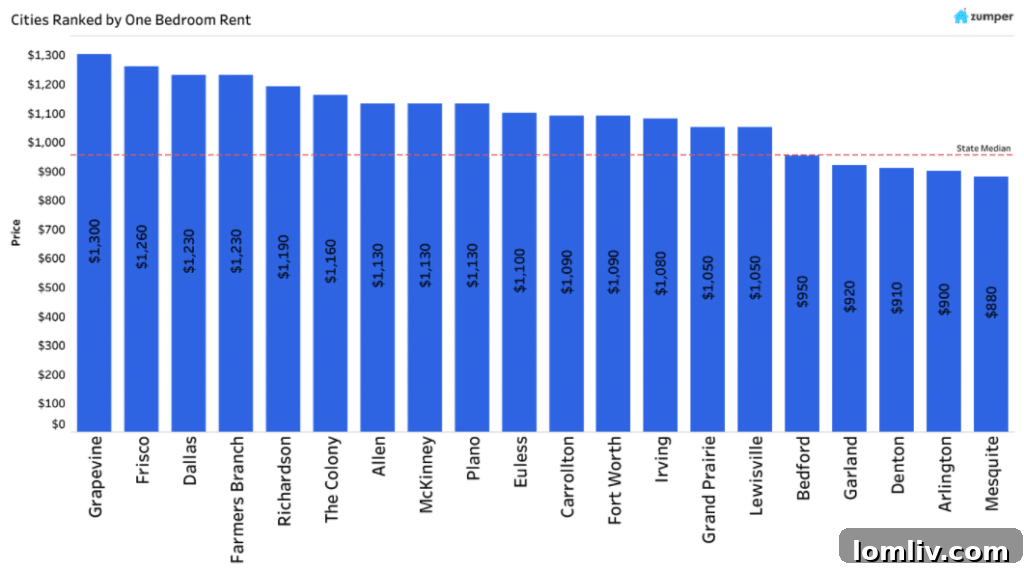
However, for renters drawn to these premium amenities and unparalleled convenience, the cost of living reflects this desirability. The Zumper Dallas Metro Area Report, a comprehensive analysis covering 20 key cities within the DFW region, unequivocally states that Grapevine commanded the highest median rent for a one-bedroom apartment in August, reaching $1,300 per month. This figure positions Grapevine at the pinnacle of the local rental market, signaling a premium for its unique blend of suburban charm and metropolitan access.
Following closely behind Grapevine in the rankings was Frisco, a rapidly expanding northern suburb celebrated for its excellent schools, sports facilities, and master-planned communities. Despite its high ranking, Frisco experienced a slight dip in its one-bedroom median rent, falling by 2.3 percent to $1,260 per month. This marginal decrease could reflect a dynamic market adjustment or an increase in available inventory, though it retains its status as one of DFW’s pricier locales. Meanwhile, Mesquite, a more established community situated to the east of Dallas, offered the most affordable one-bedroom apartments among the surveyed cities, with a median rent of $880. Dallas, the region’s central urban hub, and Farmers Branch, a centrally located suburb, were tied for third place with a median one-bedroom rent of $1,230. These figures provide a crucial benchmark for renters, especially when contrasted with broader market trends. In August, the statewide median rent for a one-bedroom apartment in Texas stood at $954, significantly lower than the DFW top-tier cities, underscoring the higher cost of living in the metroplex’s most sought-after areas. Nationally, the median one-bedroom rent was $1,233, indicating that DFW’s leading cities like Grapevine and Frisco often surpass even the national average, reflecting their strong local economies and high demand.
To further contextualize the DFW rental market, it’s insightful to compare it with major coastal metropolitan areas. For instance, securing a one-bedroom apartment in San Francisco would set a renter back an astonishing $3,040, while New York City demanded $2,700. These figures dramatically eclipse even the highest rents in DFW, highlighting the vastly different economic and housing dynamics at play. However, what is particularly noteworthy about these coastal giants is that their August rents represented the lowest price points since Zumper began systematically tracking median rental prices in 2014. San Francisco, for example, experienced a significant 14.1 percent year-over-year plunge in rental costs, while New York saw a 10.9 percent decrease from the previous year. This downward trend in historically expensive markets stands in stark contrast to the relative stability and often upward trajectory observed in many DFW communities, suggesting a shift in urban living preferences and economic migration patterns, potentially fueled by changing work environments and a desire for more affordable, spacious living options.
The Zumper Dallas Metro Area Report’s methodology is crucial for understanding the reliability of its findings. The report meticulously analyzes active apartment listings that became available on the market during August. These listings are then aggregated by individual cities to accurately calculate median asking rents. This rigorous approach provides a snapshot of actual market conditions, offering valuable insights for both prospective renters and real estate investors looking to understand the fluid DFW rental landscape.
Beyond the top-tier pricing, other DFW suburbs showed significant movement in their rental markets. McKinney, an increasingly popular city in Collin County known for its historic downtown and strong economic growth, registered the fastest-growing rental increases. Its median rent surged by 8.7 percent since the previous year, indicative of its burgeoning popularity and rising demand. This growth reflects McKinney’s expanding job market and an influx of new residents attracted to its quality of life and community amenities.
The “Mid-Cities” area, comprising a cluster of suburbs strategically located between Dallas and Fort Worth, also experienced notable rent increases. Bedford and Euless, two prominent cities within this region, saw significant jumps. Bedford’s rent climbed by an impressive 8 percent year-over-year, while Euless recorded a 5.8 percent increase, which included a 4.8 percent month-over-month surge. These increases underscore the growing attractiveness of the Mid-Cities, offering residents a convenient commute to both major urban centers and a more suburban lifestyle. Bedford notably led the way for two-bedroom rental increases, reaching $1,260, representing a substantial 12.5 percent jump from the previous year. This rapid appreciation in Bedford suggests a strong demand for larger units in a family-friendly and well-connected location.
The two-bedroom apartment market presented a slightly different hierarchy for rental costs. Frisco, despite its slight dip in one-bedroom rates, still held the title for the most expensive two-bedroom rents at $1,730. However, this figure also reflected a 2.8 percent decrease year-over-year, indicating potential market adjustments even in its premium segment. Mesquite once again offered the most budget-friendly option for two-bedroom apartments, with a median rent of $1,120, showing a 4.3 percent decrease from a year ago. Grapevine’s two-bedroom rent ranked second highest at $1,690, tying with Dallas. This consistent high ranking for Grapevine across both one-bedroom and two-bedroom categories further solidifies its position as a high-demand, high-cost rental market within the DFW metroplex.
Beyond Rent Price: Exploring Apartment Size and “Elbow Room” in DFW
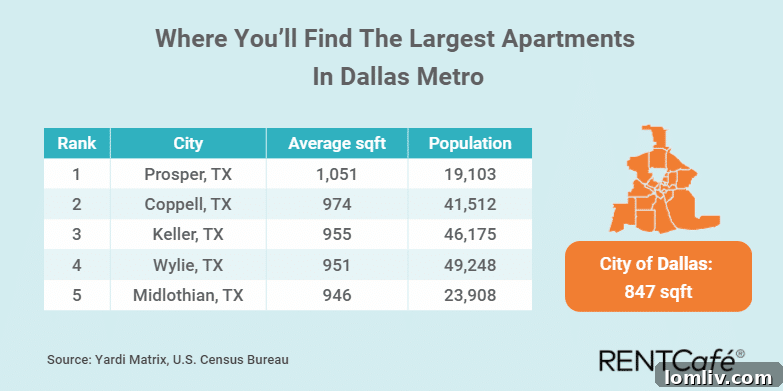
While Grapevine may command the highest rents, the question of value often extends beyond mere price to encompass the living experience itself. For many renters, “elbow room” or the sheer square footage of an apartment is a critical factor in their housing decisions. In the sprawling Dallas-Fort Worth region, not all apartments are created equal when it comes to space. According to a compelling study conducted by RENTCafé, which analyzed apartment sizes across various DFW cities, the honor for the most spacious apartments goes to Prosper.
Prosper, a burgeoning town situated north of Frisco and McKinney, is where renters can find the most generous living spaces, with apartments averaging an impressive 1,051 square feet. This figure stands in stark contrast to the average apartment size in Dallas, the region’s largest city, where units typically offer around 847 square feet. The difference of over 200 square feet can significantly impact a renter’s quality of life, offering more space for home offices, entertainment, or simply greater comfort. This trend in Prosper is often attributed to its newer developments and master-planned communities, which tend to prioritize larger floor plans to cater to families and those seeking a more expansive suburban living experience.
The RENTCafé study’s methodology is specifically designed to provide a focused and relevant analysis, exclusively basing its findings on apartment data related to buildings containing 50 or more units. This ensures that the data reflects trends in larger, professionally managed apartment communities, which represent a significant portion of the rental market. Sanziana Bona, a researcher at RENTCafé, sheds light on the underlying reasons for these size disparities. “Large apartments are typically found in high-rated, newer buildings, often referred to as ‘Class A’ in the industry,” Bona explains. Class A properties are characterized by their prime locations, high-quality construction, extensive amenities, and professional management. “In contrast,” she adds, “suburbs with smaller apartments mostly feature ‘Class B’ or lower-rated buildings,” which may be older, have fewer amenities, or be located in less desirable areas. This distinction is crucial for renters understanding the trade-offs between space, price, and building quality.
Bona also highlights a significant industry trend: “There has been a consistent trend to build top-rated properties with larger units which started in the early 2000s and peaked in 2019.” This trend indicates a developer response to a market demand for more spacious, higher-end rental options, particularly in rapidly growing areas like Prosper. For renters prioritizing space, these newer developments offer a compelling option, even if it means moving slightly further out from the traditional urban core. The availability of larger apartments in cities like Prosper caters to a demographic seeking suburban comfort without sacrificing the conveniences of modern amenities, offering a valuable alternative to the denser, often smaller units found in core cities.
DFW’s Rental Market: Construction Boom and Migration Patterns
The vitality of the Dallas-Fort Worth rental market isn’t just reflected in prices and sizes, but also in its robust construction pipeline and fascinating migration patterns. These elements paint a holistic picture of a region experiencing significant growth and continuous evolution.
- Unprecedented Apartment Construction in DFW: The Dallas-Fort Worth area has solidified its position as a national leader in apartment development. According to comprehensive data compiled by Yardi Matrix, DFW was forecasted to complete an impressive 19,318 new apartment units by the end of 2020. This monumental figure not only makes DFW the top market in the nation for new construction but also marks its third consecutive year leading all metropolitan areas for annual apartment construction. This sustained growth in new inventory is a testament to the region’s strong economic fundamentals, consistent job creation, and burgeoning population. The influx of new residents necessitates a continuous supply of housing, and developers have responded vigorously. For comparison, the New York metro area, typically a powerhouse in real estate, was expected to see 15,952 new apartments in 2020, placing it second. The sheer volume of DFW’s construction underscores Texas’s overall economic dynamism, with other major Texas cities also making significant contributions: Houston ranked third nationally with 10,404 new units, and Austin secured the fifth spot with 9,342. This widespread construction across Texas indicates a statewide trend of robust growth and urban expansion, offering diverse housing options for a growing population. For renters, this constant influx of new units can potentially alleviate some market pressures, providing more choices and potentially moderating rent increases in certain segments, even amidst high demand.
- Dynamic Renter Migration Patterns in Dallas: Understanding who is moving to and from the Dallas area provides crucial insights into its economic health and lifestyle appeal. ApartmentList.com’s third-quarter Renter Migration Report, which analyzed search data from April 1 to August 11, revealed fascinating trends. The data indicated that a significant portion of prospective renters looking to relocate to Dallas originated from within Texas. Houston led the pack, with 9 percent of searches for Dallas apartments coming from the Bayou City. San Antonio followed at 5.2 percent, and Austin contributed 4.3 percent. This intra-state migration highlights Dallas’s strong appeal within Texas, drawing residents from other major metros, likely due to job opportunities, a diverse economy, and a robust cultural scene. On the other hand, the report also tracked where current Dallas area residents were looking to move. Austin emerged as the top destination for those wanting to move out of Dallas, accounting for 10.8 percent of outbound searches. Houston was second at 7.5 percent, and Los Angeles, California, surprisingly came in third at 5.1 percent. The strong pull of Austin, known for its tech industry and vibrant culture, suggests a desire for different lifestyles or specific career opportunities among some Dallas residents. The appeal of Houston could be related to its energy sector and potentially more affordable housing options, while Los Angeles represents a more significant cross-country move, possibly driven by unique job markets or lifestyle preferences. These migration trends underscore the DFW area’s role as both a destination for growth and a significant hub within a broader national and regional relocation network.