In today’s fast-paced digital landscape, social media stands as an indispensable tool for businesses aiming to connect with their audience. For the real estate industry, this truth is amplified. Whether you’re an independent agent, part of a local team, or affiliated with an international brokerage, effectively marketing yourself and your listings online is paramount. Among the myriad platforms, Facebook remains a cornerstone for real estate professionals. An astounding 90 percent of real estate agents leverage Facebook for their marketing efforts, underscoring its critical role in reaching potential clients and building a robust professional brand.
However, navigating Facebook’s ever-evolving algorithms and policy changes can be challenging. Many real estate agents, rightfully experts in property transactions, often find themselves less adept at the nuances of social media management. This disconnect frequently leads to common pitfalls, particularly concerning Facebook Business Pages. This article aims to shed light on some prevalent issues and offer actionable advice, empowering realtors to optimize their Facebook presence without the constant oversight of a dedicated social media manager.
Beware of Phishing: Fake Pages Mimicking Facebook Error Messages
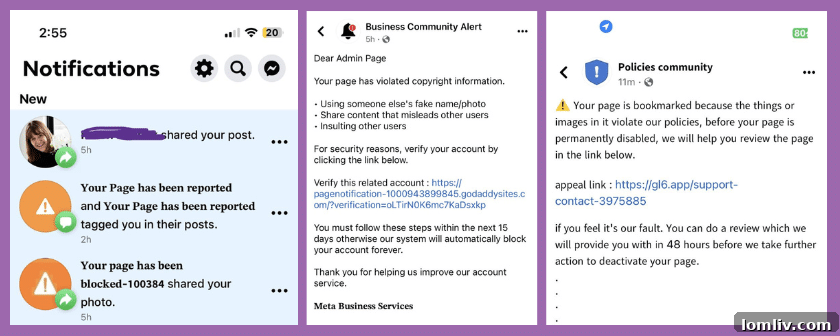
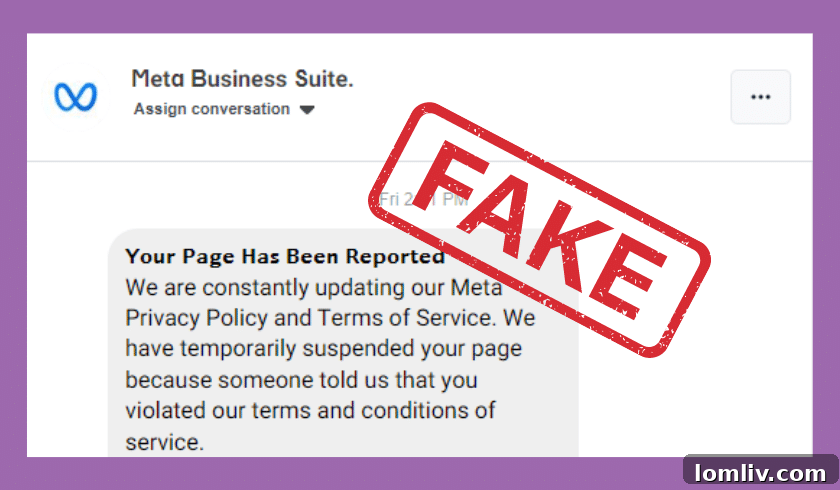
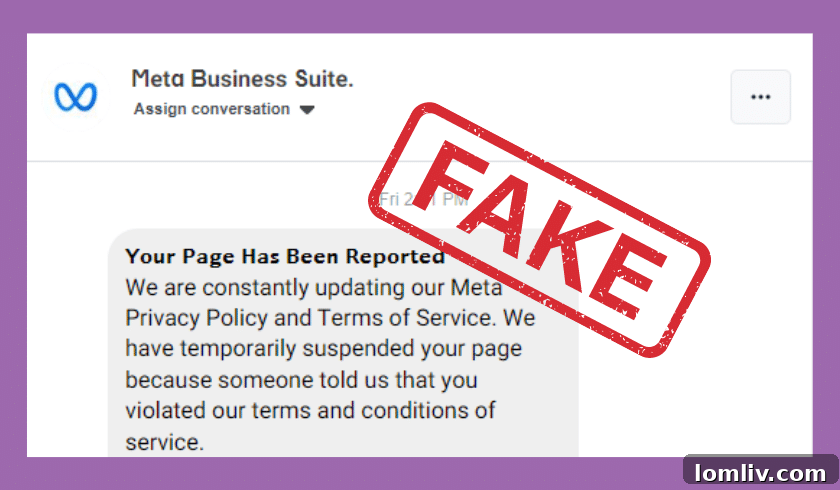
This particular scam has become distressingly common and persistently annoying for anyone managing a Facebook Business Page, especially in the real estate sector. The modus operandi involves malicious actors creating fraudulent Facebook pages with profile pictures that artfully mimic official Facebook warning symbols or Meta Business Suite icons. These pages often adopt alarmist names such as “Your Page has been reported,” “Business Community Alert,” or even “Meta Business Support” to lend an air of authenticity.
The scam unfolds when these fake pages tag your business page in a post containing a dire warning. The message typically states that your page has committed a severe violation, is at risk of deletion, or requires immediate action to prevent penalties. Crucially, it instructs you to “click on this link” to rectify the supposed error.
Let us be unequivocally clear: Do not click on that link.
The cleverness of this scam lies in its ability to generate a legitimate-looking Facebook notification featuring the alarming symbol and message. When you click on this notification, you are subtly redirected to a regular post from the scammer’s page, which is meticulously designed to mimic Facebook’s official interface and language. The provided images illustrate how convincingly these fake posts attempt to replicate Facebook’s design. If you were to scroll down on such a post, you would often find that the scammers have tagged hundreds of other business pages, demonstrating the widespread nature of their attack.
The ultimate goal behind this sophisticated phishing attempt is to trick you into clicking their fraudulent link. This link will lead you to a convincing but fake page designed to “confirm your account.” Here, you will be prompted to enter your Facebook login credentials—your username and password. Submitting this information grants the scammers immediate access to your account, potentially compromising all your private data, business assets, and even spreading malware to your network. For real estate professionals, this could mean losing control of your business page, exposing client information, and damaging your professional reputation.
What you should do: If you encounter such a notification or post, do not click the deceptive link. Instead, click directly on the fraudulent page’s name or profile picture, navigate to the page itself, and then use Facebook’s reporting tools to block the page and report it as a scam. This action helps protect not only your account but also other real estate agents who might fall victim.
Debunking “Facebook is Selling Your Contact Info”: The Copy-Paste Post Hoax
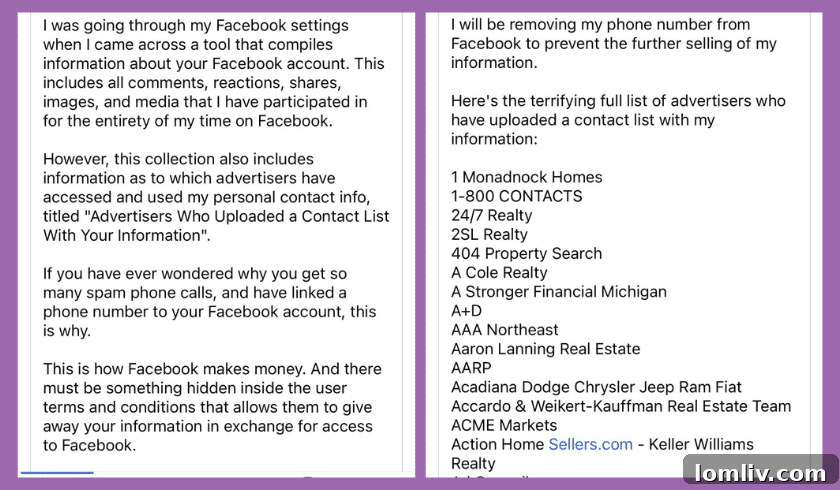
You’ve likely seen posts circulating on Facebook claiming, “Facebook is selling your contact info to advertisers: Copy and Paste This Post to Stop Them.” The truth is, no, they’re not, or at least not in the way these posts suggest. If you follow the instructions outlined in these viral messages to find evidence of your data being sold, what you will actually discover is a list of advertisers that Facebook has recently displayed to you—based on your activity and interests—not a list of companies to whom Facebook has sold your personal contact details. This highlights a fundamental principle: always read and understand what you’re interacting with online. As a general rule of thumb, be highly skeptical of any post that instructs you to “Copy and paste this post and then share it.”
Why should you avoid such posts? The individuals or groups who originate these copy-paste messages often have specific motives. Sometimes, these are benign, like attempting to track engagement for marketing purposes. Other times, the reasons are far more nefarious, including building lists of active users for future scams, spreading misinformation, or even identifying individuals prone to sharing unverified content. The instruction to “copy and paste” rather than simply “share” the original post is a key indicator of their intent.
As explained by cybersecurity experts, individual privacy settings on Facebook can impede the ability to trace the full chain of shares when a post is simply re-shared. However, when you copy and paste the text into a new post, the original poster can often track its dissemination by embedding subtle, unique elements. These could be an intentionally misspelled word, awkward spacing, unusual grammar, or even invisible characters within the text. By searching for these specific textual patterns, the originators can effectively map out who has copied and reposted their content, circumventing standard privacy controls and building a database of engaged users.
What you should do: Exercise extreme caution. Do not copy/paste such posts. Avoid typing responses like “Amen,” “Done,” or similar affirmations on these obviously reposted messages, regardless of the emotional appeal—whether it’s about a heartwarming cause, an alarming health issue, or something designed to outrage you. If you see a friend sharing such content, consider gently informing them about the risks and advising them to avoid such practices in the future. Protecting your professional image and the integrity of your Facebook presence is crucial for a real estate agent.
Personal Profiles Versus Professional Business Pages for Realtors
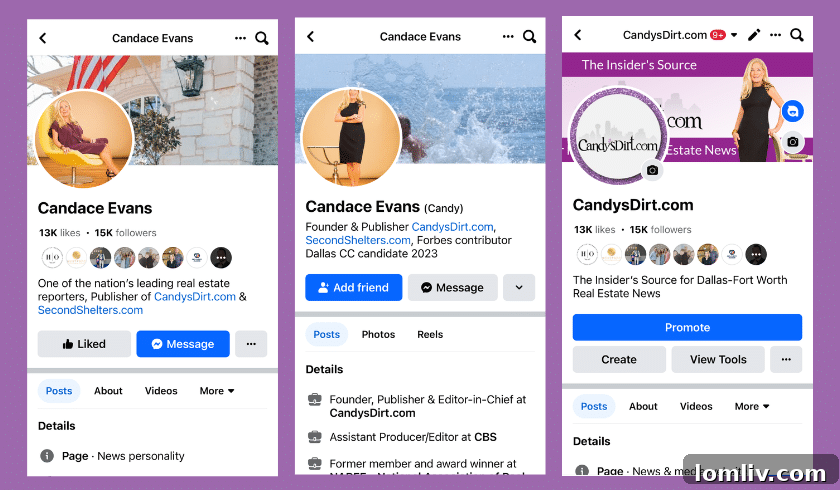
For many real estate professionals, the choice between using a personal Facebook profile, a dedicated business page, or maintaining both simultaneously, is a significant decision. While largely a matter of personal preference, each approach comes with its own set of distinct advantages and disadvantages that warrant careful consideration for your real estate brand.
- Personal Profile for Business: If your personal Facebook profile is primarily used for sharing private photos, strong opinions, or sensitive information that you would not want to disclose to clients, colleagues, or the general public, then it is strongly advisable to keep your personal and professional lives separate. Using such a profile for business could blur boundaries and potentially damage your professional image.
- Leveraging an Established Personal Network: Conversely, if you enjoy sharing a more personal aspect of yourself with clients, believe in prospecting among your existing Facebook friends, and find that your personal profile already boasts a substantial following, then it might seem beneficial to use it for business. Many agents discover their personal profiles have a larger, more engaged audience than a nascent business page, and they opt to cultivate that existing network. If this is your strategy, ensure your content is meticulously crafted to maintain professionalism while showcasing your personality.
- Growth Limitations of Personal Profiles: A critical limitation of personal profiles for business growth is the “friend” cap. Once you reach 5,000 friends, Facebook prevents you from sending any more friend requests. While people can continue to “follow” you beyond this limit, you lose the ability to actively expand your network through direct connections. If you find yourself approaching or hitting this 5,000-friend threshold, it is highly recommended that you migrate your professional presence to either a Facebook Business Page or a Public Figure Page. These page types offer unlimited followers and allow you to actively invite people to connect with your professional entity, providing far greater scalability for your real estate business.
- Meta Business Suite Advantages: One of the most compelling reasons to utilize a Facebook Business Page is access to the comprehensive Meta Business Suite. A personal profile offers none of these robust tools. With a Business Page, you can strategically schedule posts in advance, gain invaluable insights through detailed analytics on audience engagement and post performance, run highly targeted advertising campaigns to reach specific demographics, and access numerous other features designed to enhance your digital marketing efforts. These functionalities are essential for any serious real estate agent looking to maximize their reach and efficiency on Facebook.
Essential Tips for Optimizing Your Realtor Facebook Business Page
Optimizing your Facebook Business Page is crucial for visibility and professionalism in the competitive real estate market. Here are some indispensable tips:
- Create a Custom Facebook URL for Easy Discoverability: One of the simplest yet most overlooked steps is to create a custom, memorable Facebook URL. This makes it significantly easier for potential clients to find you. Ideally, your URL should reflect your name, your team’s name, or your brokerage. For example, if your name is Brenda Masse and your team is Xtra Real Estate Group, but the group isn’t widely known yet, consider a URL like
facebook.com/BrendaMasseRealtor. Consistency is key; if your page name is “Brenda Masse, Realtor at Xtra Real Estate Group,” ensure your URL aligns closely for brand recognition. - Avoid Overly Generic Keywords in URLs: While incorporating keywords like “dallasrealtor” or “dfwrealtor” in your URL might seem appealing for SEO, be aware that thousands of other agents have likely done the same. This can make your page difficult to distinguish and find in a crowded search. If a client specifically searches for “Brenda Masse Realtor,” and your URL is
facebook.com/DallasRealtor4U, they might struggle to locate your page on the first attempt. Prioritize uniqueness and brand identity over generic keyword stuffing for your URL. - Absolutely DO Create a Facebook URL: It’s astonishing how many agents neglect this step during page creation, leaving their page with a convoluted, random URL like
facebook.com/mkdsangivnrfiaondisjkdalhfjglfdjajdavnj. Such URLs are impossible to remember, share, or market. A custom URL not only makes you easy to find but also provides you with a professional, succinct handle (e.g.,@BrendaMasseRealtor) to share in all your marketing materials, significantly enhancing your online presence.
As someone who frequently finds and tags Realtor pages, I can attest to the frustration of trying to locate pages without a custom, easily identifiable URL. Make it simple for clients and colleagues to connect with your real estate business on Facebook.
General Facebook Etiquette and TREC Compliance Rules for Realtors
Beyond simply having a Facebook presence, maintaining proper etiquette and adhering to regulatory compliance, such as those set by TREC (Texas Real Estate Commission), is vital for real estate agents. These practices not only enhance your professional reputation but also protect you from potential liabilities.
- Strategic Tagging for Enhanced Reach and Professionalism: When showcasing a listing or any project, always remember to tag all significant contributors. This includes the photographer who captured stunning visuals, the stager who prepared the property, the interior designer, and the builder. This practice is more than just good professional etiquette; it significantly boosts your post’s visibility by extending its reach to the audiences of those you’ve tagged. It fosters goodwill, strengthens professional relationships, and can lead to valuable cross-promotion opportunities within the real estate ecosystem.
- “Sold” Posts: Celebrating Success and Expanding Your Network: When celebrating a successful “sold” transaction, make it a point to tag the other agent involved, particularly if the transaction was amicable. Craft a congratulatory message such as, “Congrats to all, it was a pleasure working with you!” This simple gesture not only acknowledges a successful collaboration but also puts your accomplishment in front of their audience, potentially increasing your visibility and network reach within the professional community.
- Embrace Video Content for Unmatched Engagement: The power of video in social media marketing cannot be overstated. Statistics show that video content garners an astonishing 1,200 percent more likes and shares than combined text and image content. This is not a typo; the engagement rate is truly transformative. For real estate listings, video tours, neighborhood spotlights, agent introductions, and client testimonials can bring properties to life and forge deeper connections with potential buyers. When you send us your fabulous listing information at daltxrealestate.com, remember to send us some video content too! We would be delighted to feature your awesome video content, amplifying your reach even further.
PRO TIP: Feeling daunted by video creation? User-friendly tools like Veed offer intuitive interfaces and powerful features, including an AI text-to-video function that can effortlessly transform your property descriptions into engaging, shareable video content. Additionally, explore CapCut alternatives for even more advanced customization and editing options to ensure your real estate listings truly shine. - TREC Compliance: Mandatory Consumer Notices: The Texas Real Estate Commission (TREC) has rigorously enforced the rule regarding the posting of specific consumer notices on all social media accounts and websites. As of September 2018, every real estate professional must prominently display the TREC Consumer Protection Notice and the Information About Brokerage Services forms if they are advertising their services or listings. Neglecting this crucial requirement can lead to significant fines and even prohibition from advertising. If you’re using a personal profile for business, it becomes challenging to ensure consistent compliance. The simplest and most effective way to meet this requirement on Facebook is to upload these forms to your Business Page and then “pin” the posts to the top of your feed, ensuring they are always visible and easily accessible.
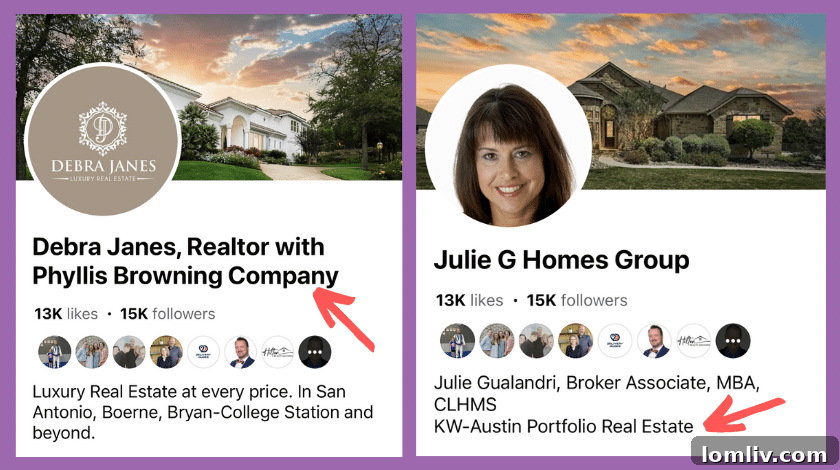
- TREC Compliance: Broker Name Disclosure: Another critical TREC regulation requires Realtors to clearly list their broker’s name on their Business Page. Continuing with our example, if Brenda Masse, a Realtor with Xtra Real Estate Group, is brokered by Super Luxe Homes, she must explicitly indicate “Super Luxe Homes” either within the name of her Facebook Business Page or prominently in the “About” section. Furthermore, a direct link to the broker’s website or official Facebook page must be provided. (Refer to the examples of compliant pages shown above for illustration.) For instance, her page name could be “Brenda Masse, Xtra Real Estate Group at Super Luxe Homes,” or she could simply name it “Brenda Masse, Xtra Real Estate Group” and place the Super Luxe Homes information and link in the About section. Many pages are currently non-compliant on this point, risking penalties. This requirement extends to all your social media accounts and your professional website, ensuring transparency and accountability in all your online marketing efforts.
To encapsulate these critical points for effective and compliant Facebook marketing for Realtors:
First and foremost, understand that Facebook will never issue threats to take down your page via a notification that requires you to click on an external link in a post. Official communications regarding content violations or account issues will always come directly through official Meta Business notifications within the platform itself, or via email from official Facebook channels. Often, in cases of reported content, Facebook simply deletes the problematic content without requiring user action through a suspicious link.
Secondly, cultivate a healthy skepticism. If something looks like a scam, it most probably is. A quick verification step involves copying a few distinct words or phrases from the suspicious post and performing a search on Google or another search engine. This often reveals discussions about the scam, warnings from cybersecurity experts, or official statements debunking the misinformation.
Thirdly, continuous education is paramount. Make it a priority to take the social media courses offered by your local Realtor Association. These courses are specifically designed to keep real estate professionals updated on the latest platform rules, best practices, and crucial regulatory compliance, such as current TREC rules. Staying informed is your best defense against scams and your strongest asset for effective and ethical online marketing.