Preston Hollow’s Pivotal Night: City Council Forum Addresses Key Urban Development Challenges
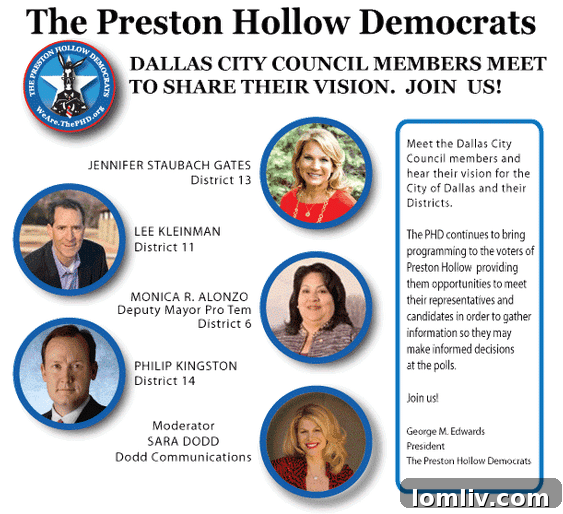
The vibrant community of Preston Hollow is set to host a crucial gathering tonight, bringing together residents and their elected representatives for a robust discussion on pressing local issues. The Preston Hollow Democrats are organizing this insightful forum at the welcoming Northaven United Methodist Church, offering a unique opportunity for direct engagement with several influential Dallas City Council members. Scheduled from 7 to 8:45 p.m., the event promises an evening of dialogue, moderated by the esteemed Sarah Dodd, ensuring a structured and comprehensive exploration of the topics at hand.
This highly anticipated forum will feature a distinguished panel of city leaders, including Jennifer Staubach Gates, Philip Kingston, Lee Kleinman, and Monica Alonzo. Their presence underscores the significance of Preston Hollow within the broader Dallas urban landscape and the importance of fostering open communication between constituents and those who shape the city’s future. Residents eager to understand the dynamics of local governance and the decisions impacting their daily lives will find this forum indispensable. It’s an essential platform for civic engagement, where concerns can be voiced, questions answered, and community priorities highlighted, particularly in an area grappling with intense urban development pressures.
Navigating Urban Growth: The Heart of the Discussion in Preston Hollow
While the forum’s agenda is broad, encompassing various facets of city life, one area is expected to dominate the conversation: the recent and significant developments—or rather, non-developments—within the Preston Hollow area. The community has recently witnessed the cancellation of two major projects, both of which had garnered considerable attention and, in some cases, significant debate. These include the proposed Highland House development and Transwestern’s luxury apartment complex, both strategically planned for sites near the bustling intersection of Preston Road and Northwest Highway. These cancellations are not merely isolated incidents but reflect a deeper narrative about community priorities, zoning regulations, and the delicate balance between urban growth and neighborhood preservation in a rapidly evolving metropolitan area like Dallas.
The intersection of Preston Road and Northwest Highway serves as a critical artery within Dallas, known for its mix of high-end retail, affluent residential areas, and significant traffic flow. Any substantial development in this vicinity inevitably sparks discussions about infrastructure capacity, neighborhood character, and potential impacts on local schools and services. The decisions surrounding projects in such key locations resonate far beyond property lines, influencing the quality of life for thousands of residents in Preston Hollow and beyond. Therefore, the recent “axe” wielded against these two high-profile ventures provides a compelling backdrop for tonight’s discussions, offering a tangible example of community influence and the complexities of urban planning in a growing city.
Highland House: A Closer Look at Community Resistance and Development Challenges
The Highland House project, envisioned as a premium residential development, aimed to introduce a new layer of luxury living to Preston Hollow. While specific details of its design and scale varied throughout its planning stages, it consistently represented a significant investment in the area’s real estate market. Proponents often highlighted the potential for increased property values, additional tax revenue for the city, and modern housing options for a growing populace seeking upscale amenities. Developers typically argued that such projects contribute to the economic vitality of a district, attracting new residents and businesses, and enhancing the overall urban fabric of Dallas.
However, the vision for Highland House met with substantial resistance from a considerable segment of the Preston Hollow community. Residents expressed myriad concerns, ranging from anticipated increases in traffic congestion on already strained thoroughfares like Preston Road and Northwest Highway, to worries about the aesthetic impact on the established neighborhood character. The sheer scale and density of the proposed development often raised questions about its compatibility with existing single-family homes and the potential strain on local infrastructure, including water, sewer, and emergency services. Public hearings and community meetings became battlegrounds for these differing viewpoints, showcasing the power of organized neighborhood groups and individual citizens passionate about preserving their locale’s unique identity.
Ultimately, the collective voice of the community, coupled with diligent advocacy by local council members responsive to their constituents, proved instrumental in the project’s eventual termination. This outcome serves as a powerful testament to the democratic process at a local level, demonstrating that well-organized and articulate public opposition can indeed influence major development decisions. It also underscores the evolving expectations of urban residents who seek not just growth, but thoughtful, sustainable development that respects the unique identity and resources of their neighborhoods, ensuring that progress aligns with community values rather than overriding them.
Transwestern’s Luxury Apartment Development: A Parallel Narrative of Community Advocacy
In a strikingly similar trajectory, Transwestern’s proposed luxury apartment development faced comparable obstacles and ultimately shared the same fate as Highland House. Positioned in close proximity to the first project, this development also aimed to capitalize on the desirability of the Preston Hollow location. Luxury apartment complexes, by their nature, often target a specific demographic, promising high-end amenities, modern designs, and convenient access to urban conveniences. For developers like Transwestern, such projects represent significant commercial opportunities in a thriving city like Dallas, which continues to attract new residents and businesses.
Yet, the concerns raised by the community against Transwestern’s proposal mirrored those directed at Highland House. Residents voiced anxieties over increased population density, which could potentially overwhelm local public schools, impact open spaces, and contribute to an already challenging parking situation in a predominantly suburban-feel neighborhood. The concept of “luxury” often brings with it expectations of exclusivity and higher prices, but for existing residents, it often translated into fears of gentrification, altered community dynamics, and a departure from the cherished suburban feel that many Preston Hollow residents value. The cumulative effect of multiple large-scale projects proposed for the same corridor amplified these anxieties, leading to a coordinated and persistent pushback from neighborhood associations and individual homeowners determined to protect their community.
The cancellation of Transwestern’s project, therefore, reinforces the narrative established by the Highland House outcome. It suggests a strong, consistent sentiment among Preston Hollow residents regarding the appropriate pace and type of development for their community. These decisions send a clear message to developers: while Dallas is open for business and growth, community input, thoughtful planning, and respect for established neighborhood character are paramount. The city’s growth must be managed in a way that enhances, rather than detracts from, the quality of life for its long-term residents. This dual cancellation illustrates a significant victory for community-led advocacy in local urban planning, setting a precedent for future development proposals.
The Broader Implications for Dallas Urban Planning and Community Engagement
The recent decisions regarding Highland House and Transwestern’s development are not isolated incidents but rather significant indicators of the ongoing tensions and debates within Dallas’s broader urban planning landscape. The rapid growth of the city, coupled with increasing demand for diverse housing options, often puts pressure on existing neighborhoods. This creates a delicate balance for city planners and council members who must weigh economic development against community preservation, infrastructure capacity, and resident satisfaction in high-demand areas like Preston Hollow.
These cancellations highlight several critical themes in contemporary urban development. Firstly, they underscore the rising power of grassroots community activism. In an age of digital communication and heightened civic awareness, residents are more empowered than ever to organize, articulate their concerns, and directly influence policy outcomes. Neighborhood associations, once primarily social organizations, have evolved into potent advocacy groups, capable of mobilizing significant opposition to projects perceived as detrimental to their quality of life. This shift demands greater transparency and earlier engagement from developers and city planners alike.
Secondly, the cases emphasize the complexities of zoning and land-use regulations. Zoning laws, designed to guide urban development and separate incompatible land uses, become focal points of contention. Developers often seek variances or rezonings to accommodate their projects, leading to intense scrutiny and debate over whether proposed changes align with the long-term vision for a neighborhood. These incidents serve as a powerful reminder that zoning is not merely a technical exercise but a reflection of community values and aspirations, requiring careful consideration of its social and environmental impacts.
Finally, these events will likely shape future development proposals in similar established neighborhoods across Dallas. Developers will need to engage earlier and more comprehensively with communities, incorporating feedback and addressing concerns proactively rather than reactively. The expectation for thoughtful, context-sensitive design, and a clear demonstration of community benefit will undoubtedly increase. This shift could lead to more collaborative planning processes, fostering developments that are better integrated into existing urban fabrics and more widely accepted by local residents, promoting sustainable and harmonious urban growth.
Anticipating a Lively Discussion: The Potential Presence of Laura Miller
The stage is set for an interesting and perhaps spirited discussion tonight, and the potential presence of Laura Miller adds another layer of intrigue to the forum. As a former Mayor of Dallas, Laura Miller is a recognizable and influential figure in local politics, known for her sharp intellect and deep understanding of city affairs. Her attendance, though speculative, would signal the high-profile nature of the issues at hand, particularly the implications of development decisions for the future of Dallas neighborhoods like Preston Hollow. Her involvement would elevate the conversation, drawing attention to the broader policy implications.
If she were to attend, Miller’s perspective could provide valuable historical context to the ongoing debates about development, environmental concerns, and the balance of power between developers and residents. Her experience navigating similar challenges during her tenure as mayor would undoubtedly enrich the discussion, offering insights into the broader political and economic forces at play in shaping urban landscapes. Her presence would also underscore the enduring relevance of community forums as vital spaces for civic discourse, attracting not only residents but also prominent figures invested in the city’s well-being and long-term vision.
Conclusion: Empowering Preston Hollow’s Future Through Dialogue and Action
Tonight’s Preston Hollow Democrats forum at Northaven United Methodist Church is far more than just a local political gathering; it is a critical moment for community empowerment and democratic participation. With the recent cancellations of the Highland House and Transwestern luxury apartment projects still fresh in public memory, the opportunity for residents to engage directly with Council Members Jennifer Staubach Gates, Philip Kingston, Lee Kleinman, and Monica Alonzo, expertly moderated by Sarah Dodd, is invaluable. This assembly serves as a testament to the power of organized community voice in shaping the future of a beloved neighborhood.
This forum represents a vital link between the aspirations of Preston Hollow residents and the policy decisions made at Dallas City Hall. It’s a chance to explore how community voices can effectively shape urban development, ensuring that growth is managed thoughtfully and sustainably, preserving the unique character and quality of life that defines this esteemed neighborhood. The discussions surrounding these cancelled projects serve as a powerful reminder that local politics directly impacts everyday lives, and active participation is key to fostering a city that truly reflects the needs and desires of its diverse communities. Residents are strongly encouraged to attend, listen, and contribute to this important conversation, reinforcing the democratic spirit that underpins Dallas’s progress and ensures its neighborhoods thrive.