Unpacking the Rhetoric: Fact vs. Fiction in Preston Hollow’s District 13 Development Debate
A recent email, widely circulated among Preston Hollow residents, landed in my inbox with all the subtlety of a foghorn. Its bold, uppercase declarations – “CHANGE IS COMING to District 13!!! (and I don’t mean Staubach’s supersized version)” – followed by urgent calls to action, petitions, and public meetings, left me momentarily speechless. The email, riddled with grammatical errors and employing a bombastic tone, felt less like a genuine call for civic engagement and more like the frantic squawking of gulls over a discarded meal, a familiar cacophony in the digital age. It immediately brought to mind the contentious atmosphere of online forums and politically charged social media feeds.
CHANGE IS COMING to District 13!!! (and I don’t mean Staubach’s supersized version) Click the links below – AND: SIGN the change.org petition – AND: GO PARTICIPATE IN DEMOCRACY FEBRUARY 19th at 6:30pm at Hyer Elementary!!!!!!!!! SPREAD THE WORD NOW!!!!!
(three pro-Laura Miller links)
SORRY JEN: LONG LIVE DEMOCRACY!
The poor grammar, hyperbolic language, and accompanying misleading images in this message are reminiscent of the unfiltered, often chaotic nature of the internet itself. One can only wonder if the same fervent cries of “LONG LIVE DEMOCRACY” will resonate with these residents if Laura Miller’s bid for the council seat against incumbent Jennifer Gates proves unsuccessful.
The orchestrators behind this campaign appear to be the very same individuals who fueled the fire at the recent towers meeting. Their modus operandi seems to involve painting Council Member Jennifer Gates as the mastermind behind every perceived threat, attributing all development concerns to a politically motivated agenda. This narrative, devoid of nuance, reduces complex urban planning discussions to a simplistic good-versus-evil struggle, an approach that typically serves to obscure facts rather than illuminate them.
Deconstructing the Development Proposals: Separating Reality from Exaggeration
Let’s delve into the specific development “versions” that have been weaponized in this campaign, examining them against the backdrop of actual zoning realities and city recommendations. The discussions around PD-15, particularly concerning parcels along Northwest Highway, highlight a significant disconnect between what is being feared and what is genuinely proposed or even feasible. Understanding these nuances is crucial for any resident truly invested in the future of Preston Hollow.
Version 1: Understanding Actual Height and Density Limitations
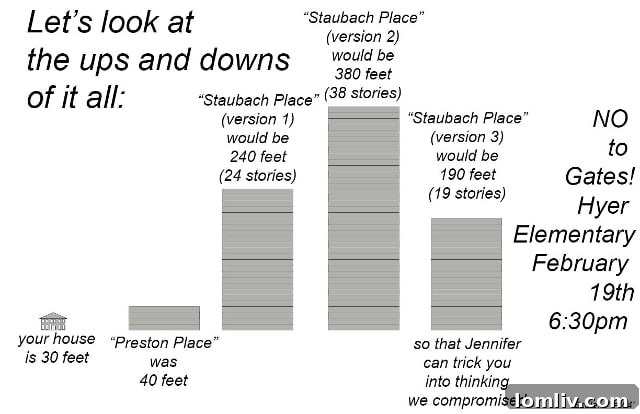
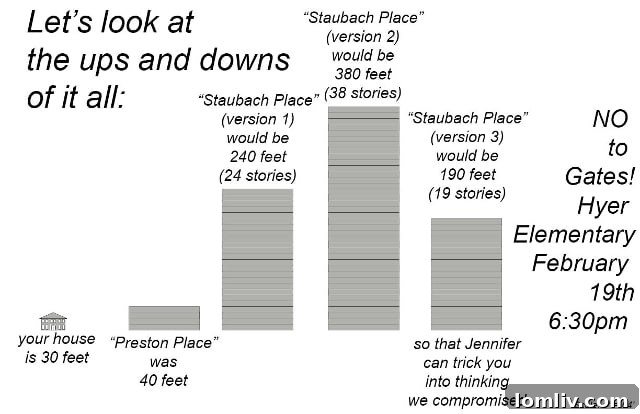
Consider a hypothetical scenario where you reside in a three-story, 30-foot-tall home – a rarity for most. The current zoned height limitation in this area, under old PD-15 rules, is, astonishingly, effectively infinite. This means that without specific restrictions, developers technically could propose structures of any height. However, the city is actively recommending new residential proximity slope guidelines. Under these proposed guidelines, even if we imagine a towering 240-foot structure, depicted as “Version 1,” it would actually represent a substantial reduction from the current “infinity” zoning. Such a building would be comparable to heights allowed along Northwest Highway if it strictly adhered to the city’s draft proximity slope, which is designed to protect adjacent lower-density properties.
More importantly, the city is also proposing a density limit of 90 units per acre. This specific density would likely yield units starting somewhere around 1,500 square feet – a size and configuration not currently being built by any major developer in Dallas due to contemporary market demands and construction economics. Contrast this with A.G. Spanos’s actual proposal, which calls for approximately 115 units per acre distributed across seven stories, a plan far more aligned with current development trends and market realities. This isn’t abstract theory; it’s basic mathematics applied to urban development that balances density with livability.
Furthermore, it’s crucial to differentiate between parcels. The northern parcels, for instance, are proposed to have a height cap of 96 feet. Again, this is a dramatic reduction from the existing unlimited height zoning and significantly less than the 85 feet being proposed by A.G. Spanos for the Diplomat lot. This demonstrates a commitment to more moderate scaling in specific areas. Paradoxically, on these northern parcels, the proximity slope guidelines could technically allow for even taller structures, up to around 120 feet, yet the current discussions often overlook these nuanced distinctions in favor of sensationalized maximums.
Version 2: The Myth of Provident Realty’s “Proposal”
“Version 2” surfaced during last week’s Preston Hollow East Neighborhood Association meeting, presented as a potential Provident Realty development. However, my investigations reveal a critical flaw in its premise: the city, Council Member Gates, and Plan Commissioner Margot Murphy had never seen this proposal. I personally confirmed this with all parties involved, a basic due diligence step seemingly bypassed by the email’s author. Provident Realty has a reputation for presenting outlandish, oversized renderings primarily to gauge public and regulatory tolerance, not as serious, actionable plans. The stark reality is, “Version 2” will never be built. It serves merely as a scare tactic, a phantom threat designed to inflame public opinion without any basis in actual development planning or feasibility.
Version 3: A Fabricated “Compromise”
Equally baseless is “Version 3,” which depicts a 19-story building presented as a “compromise.” No developer has ever brought forth such a plan. This “compromise” is entirely manufactured, existing only within the realm of speculative fear-mongering. The creation of non-existent proposals as a means to rally opposition undermines genuine civic discourse and misdirects public attention from legitimate planning considerations and the real challenges of development in Dallas.
The Art of Scaremongering: Distorted Visuals and Misleading Narratives
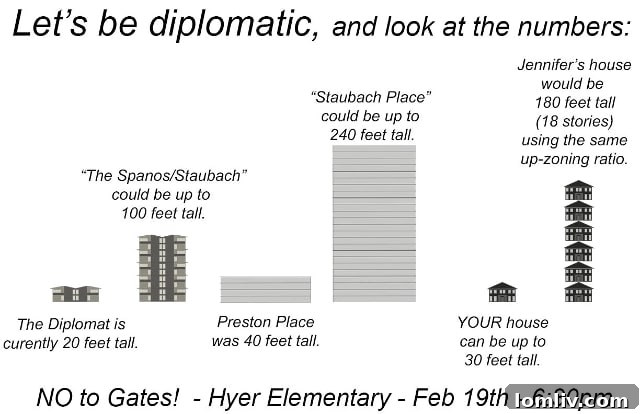
The visual content accompanying these messages is often just as misleading as the text. Take, for instance, the graphic playfully labeled “diplomatic” – presumably a nod to the Diplomat building. While clever, its underlying purpose is insidious. It juxtaposes the actual “Spanos/Staubach” proposal, which has consistently been 85 feet tall, with wildly exaggerated “could be” heights. This tactic is pure scaremongering. It preys on residents’ anxieties by presenting worst-case, often impossible, scenarios as imminent threats, ignoring the concrete plans that are actually on the table and have gone through rigorous review processes.
The discussion around a hypothetical 240-foot “Staubach Place” is another prime example of this distortion. The irony is palpable: this structure would sit between the already existing 21-story Athena and 29-story Preston Tower, towers of comparable, if not greater, height. This reality seems to be conveniently overlooked by those raising alarms, who selectively highlight new developments while ignoring existing precedents. Furthermore, drawing parallels to Council Member Gates’ home, situated in a single-family neighborhood, is a false equivalency. The historical context of the “Pink Wall” area, originally zoned commercial and later as MF-3 with unlimited height when PD-15 was established in the 1960s, is fundamentally different. This isn’t a comparison of apples and oranges; it’s a comparison of apples and elephants, entirely different categories of land use and zoning history. The question remains: with the proposed density limits, will something truly 240 feet tall be built? It’s highly speculative, as no credible proposal of that magnitude has been presented or approved, making such fears largely unfounded.
Addressing “California Developers” and Regional Prejudices
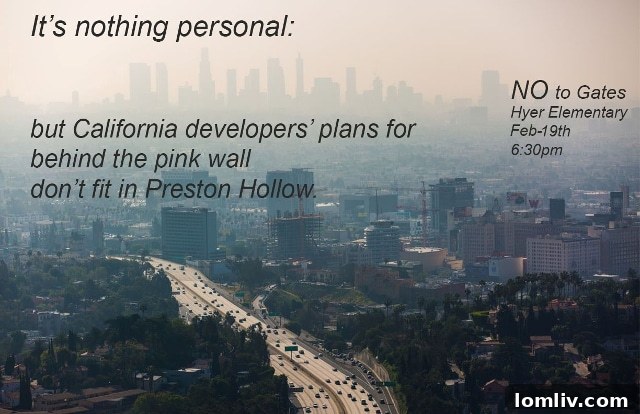
The phrase “California developers” often surfaces as a pejorative, designed to tap into a misplaced sense of “Texas exceptionalism.” While A.G. Spanos is indeed based in California, their local executive is a resident of Preston Hollow, deeply integrated into the community. This detail alone dismantles the “outsider” narrative often propagated to fuel local resentment, reminding us that development is rarely a simple “us vs. them” issue. More significantly, the focus on Spanos’s known 85-foot proposal for the Diplomat site, while a legitimate point of discussion, often distracts from a far more critical issue: the uncertainty surrounding other, undeveloped lots within PD-15. The potential for various proposals, or even the lack thereof, on these less defined parcels represents a greater unknown for the community. Whether one supports Spanos’s plan or not, a known quantity, even if contentious, is inherently less destabilizing than the ambiguity of what could emerge on other sites. Uncertainty, in urban planning, is almost always more challenging to navigate than a clear, albeit debated, proposal, as it leaves communities vulnerable to unexpected changes.
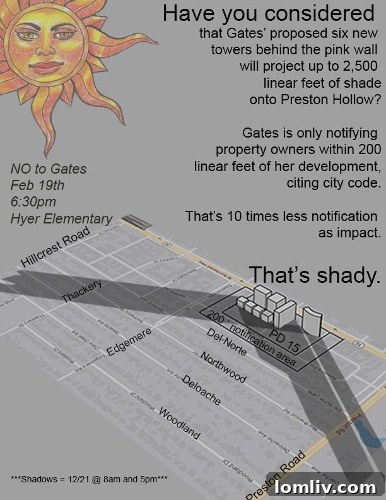
Exposing Misleading Visuals: The Shadow Projection Deception
One of the most insidious forms of misinformation comes in the guise of scientific-looking projections, such as the shadow analysis provided. While appearing factual, such images are profoundly misleading. It’s difficult, if not impossible, for an untrained eye to discern which shadows originate from existing buildings and which are fabricated projections. The graphic incorrectly depicts Preston Place and Royal Orleans as high-rise structures extending from front to back, a configuration not recommended by the city and nearly impossible to build on Royal Orleans’ compact lot. This misrepresentation distorts the true scale and potential impact of new development, exaggerating its effects for dramatic impact.
Furthermore, the choice of projection date is deliberately manipulative. This particular shadow study is based on December 21st, the shortest day of the year. On this date, the sun is at its lowest angle, casting the longest and most dramatic shadows. This effectively presents a worst-case scenario that is not representative of year-round conditions. If the projection were based on June 21st, the summer solstice and the longest day of the year, the sun’s higher trajectory would result in shadows that largely fall within University Park, minimizing their perceived impact on Preston Hollow. This selective presentation of data is a classic propaganda technique, designed to maximize alarm rather than provide an accurate, balanced assessment of environmental impact.
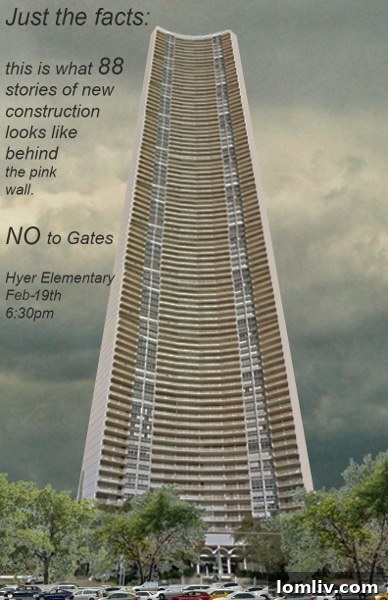
The Absurdity of the 88-Story Building: A Masterclass in Exaggeration
Saving perhaps the most egregious example for last, the depiction of an 88-story building is nothing short of propaganda. Beyond the aesthetic judgment that such a massive structure shouldn’t resemble a “dump,” its existence as a serious proposal is pure fantasy. Preston Tower, for context, achieves its density of 85 units per acre by spreading across four acres. To then illustrate an 88-story version of Preston Tower on a fraction of that land, suggesting it as a realistic outcome for a single lot, is an exercise in absurdity. It’s akin to piling an entire city block’s worth of single-family homes onto a single residential plot and then lamenting its height. While such a visualization is indeed “tall,” it completely disregards the principles of density, land use, and urban design that govern actual development. The rest of the block, by this logic, would be an empty pasture. This tactic stretches a concept to its illogical extreme, leveraging the term “absurdity” – a potent word in political campaigns – to incite fear and outrage rather than fostering informed debate about sustainable growth.
The True Stakes: Informed Engagement vs. Political Pawns
The current fervor, fueled by sensationalized emails and misleading graphics, underscores a critical failure: the neighborhood’s lack of engagement throughout the two-year planning process for PD-15, which began in earnest after the tragic Preston Place fire. Had residents actively participated and informed themselves during this crucial period, much of the current misinformation could have been pre-empted. Now, as concrete plans and proposals take shape, the propagandists have emerged in full force, exploiting the vacuum of knowledge. Their objective is disturbingly straightforward: to incite an uninformed and angry mob, transforming residents into mere political pawns in a larger game that, ironically, has very little to do with their actual, long-term interests in community development.
True democracy and effective urban planning depend on an informed citizenry capable of discerning fact from fiction. It requires engaging with complex issues, understanding zoning laws, and critically evaluating proposals rather than succumbing to fear-based rhetoric. The future of Preston Hollow, and indeed District 13, hinges not on hyperbolic campaigns, but on thoughtful, evidence-based participation from its residents, ensuring that decisions reflect community needs rather than political machinations.

About the Author: Jon Anderson
Jon Anderson is a distinguished voice in real estate and urban development, known for his insightful contributions to Daltxrealestate.com. His expertise covers a broad spectrum, from the intricacies of high-rises and Homeowners Associations (HOAs) to the nuances of renovation projects. He holds a deep appreciation for the delicate balance between modern and historical architecture, often viewed through the lens of the evolving YIMBY (Yes In My Backyard) movement.
His insightful contributions have not gone unnoticed; the National Association of Real Estate Editors has honored his writing with multiple awards, including three Bronze accolades in 2016, 2017, and 2018, alongside two Silver awards in 2016 and 2017.
Jon is always eager to connect with readers. If you have a compelling story to share, a perspective to discuss, or even a whimsical marriage proposal to make, feel free to reach out via email at [email protected]. While you’re welcome to search for him on Facebook and Twitter, Jon playfully warns that you might not find him, adding a touch of his characteristic humor to his online presence.