Shaping the Future of Preston Center: Insights from Resident Engagement and Urban Planning Challenges
The future of Preston Center, a vital commercial and residential hub in Dallas, is a topic of significant interest for its residents and the broader community. Recently, consultants from Kimley-Horn and Associates, working with the Preston Center Task Force, conducted a series of meetings to gather crucial input from local residents. These sessions are fundamental to developing a comprehensive plan for the area’s evolution, addressing everything from infrastructure to community amenities. However, the initial engagement process, particularly for residents of Zone 4 (often referred to as the “Pink Wall” area), presented several challenges that underscored the complexities inherent in large-scale urban planning initiatives.
During a recent evening meeting, the Zone 4 group, significantly larger than others, faced considerable time constraints. What was meant to be an open dialogue turned into a rushed information-gathering exercise, with attendees only able to jot down their thoughts on flip charts in response to eight open-ended questions. This limitation, exacerbated by an untimely focus on the contentious “Transwestern” issue, meant genuine discussion was sidelined. Such an outcome is regrettable, as meaningful resident engagement requires ample time for thoughtful exchange and nuanced perspectives, particularly when discussing the long-term future of Preston Center and its surrounding neighborhoods.
Addressing Obstacles to Effective Resident Engagement in Preston Center Planning
The author expresses a strong hope that the consultants will prioritize scheduling another, more comprehensive meeting with Zone 4. This follow-up session should foster an environment conducive to substantive dialogue, free from the distractions that marred the initial gathering. A key impediment noted was the disproportionate amount of time spent rehashing the “Transwestern” topic, a divisive issue that, while locally significant, overshadowed broader discussions about the entire Preston Center area’s development. This highlights a common pitfall in public forums: when specific, highly charged issues consume the agenda, the opportunity to address overarching community-wide concerns and long-term urban renewal strategies can be lost.
A Critical Note on Focus: Regardless of individual stances on the Transwestern matter, its dominance in the discussion proved counterproductive. Precious time dedicated to shaping the collective future of Preston Center was squandered. Effective community planning demands a forward-looking perspective, prioritizing the “diamonds” of comprehensive development over isolated “pennies” of singular controversies. There is indeed a time and a place for specific project discussions, but a holistic visioning session for the entire area demands a wider lens.
Beyond the “Transwestern rat hole,” another recurring theme that perplexed the author was the emphasis some residents placed on the area’s history and their personal longevity within it. While historical context can be valuable, the suggestion that opinions from long-term residents should inherently carry more weight than those of newer residents is problematic for truly inclusive neighborhood development. Intelligence, wisdom, or foresight in urban planning are not acquired simply by duration of residency. The objective should always be to involve all current residents in making the most informed decisions for the future, leveraging diverse perspectives rather than privileging tenure. This collaborative approach ensures that the resulting plan reflects the varied needs and aspirations of the entire community, fostering equitable and sustainable growth.
Some participants also veered into anecdotal storytelling, reminiscing about past property owners or specific buildings that have since been redeveloped. While these stories may hold personal significance, they often fail to contribute constructively to a rational discussion about Preston Center’s evolution. If the aim is to learn from past mistakes in development, it is more effective to articulate the perceived errors clearly and concisely, rather than getting lost in nostalgic narratives. Such digressions can obscure the core issues and impede progress toward actionable solutions for Dallas urban planning challenges.
The author genuinely questions the relevance of these personal, historical anecdotes to the critical task of planning for the area’s future. The implicit suggestion that “nothing should change simply because ‘I’ like it this way and ‘I’ve’ been in the area a long time” oversimplifies complex urban renewal decisions. Preston Center’s buildings, many of which are several decades old, are not sacrosanct historical landmarks. They represent opportunities for thoughtful redevelopment that can enhance the community’s vibrancy and functionality. Understanding this distinction is crucial for moving beyond emotional attachment to a more analytical and future-oriented approach to development.
Key Questions and Resident Insights for Preston Center’s Future Vision
Despite the challenges, the meeting did capture valuable initial feedback through eight key questions posed by the consultants. While the author’s own detailed thoughts on Preston Center’s future have been previously submitted, the consolidated resident responses offer a fascinating glimpse into community priorities. Efforts have been made to clarify spellings and abbreviations in the following summary:
Note: It was evident that some participants found it difficult to move past the Transwestern discussion even when addressing these broader questions.
1. Problems / Concerns / Issues that must be addressed for Preston Center:
- Increased traffic and problematic cut-through traffic in residential neighborhoods.
- Protecting the distinct character and interests of existing stakeholder neighborhoods.
- Significant spillover parking on side streets, largely attributed to inadequate parking facilities (with specific concerns raised about Edgemere assisted living).
- Crime management and public safety within the area.
- Insufficient and unsafe walking and biking areas, impacting pedestrian and cyclist mobility.
- Aging condominiums and older owners’ reluctance or inability to reinvest in their properties, leading to potential blight.
- General resistance to essential change and modernization within the community.
- Concerns about where displaced residents might relocate if redevelopment occurs.
- Long-term demographic shifts: uncertainties about the number of homeowners still residing in the area in 20-30 years.
The predominance of traffic concerns underscores their critical importance in residents’ minds. Interestingly, objective traffic data often reveals that overall traffic has, counter-intuitively, decreased in many areas over the past decade, with peak congestion points remaining stable. Educating residents with actual city traffic planning data could help dispel misperceptions and focus discussions on targeted solutions. The Edgemere parking issue, while localized, serves as a crucial learning point for future developments: ensuring adequate, integrated parking is paramount. Concerns about resistance to change, aging properties, and demographic shifts are natural evolutionary processes in any urban environment. The real challenge arises when demands for maintaining the status quo for some begin to dictate the possibilities for all, potentially stifling necessary urban renewal and hindering progress in Dallas neighborhood development. Positively, the perceived lack of walkability and bike infrastructure is widely recognized as an area for improvement, aligning with modern urban planning principles.
2. What preliminary ideas / solutions do you have related to future vision for Preston Center?
- Propose specific zoning for the Pink Wall area; suggesting that if MF-1R zoning isn’t relaxed to allow for increased height and density, high-quality development projects will be unfeasible.
- Some believed zoning could be altered by individual HOAs to meet specific requirements (a misunderstanding, as city council approval is required).
- Desire for a consistent aesthetic and architectural look across all newly developed areas.
- Radical infrastructure proposals, such as tunneling Northwest Highway from Edgemere to Douglas, or even further from North Park to the Tollway or Midway.
- Recognition that increased walkable density can paradoxically help solve traffic issues by reducing reliance on personal vehicles.
- Anticipation that Pink Wall condos will become functionally obsolete by 2030, necessitating redevelopment.
- Advocacy for diverse mixed-use land development strategies.
- Development of dedicated, affordable Senior Citizen Community Areas and meeting places.
- Implementation of no-turn hours for cross-through traffic at key intersections (e.g., no right turns during morning and evening rush hours).
- Consideration of building a crossover bridge to alleviate east-west and north-south traffic conflicts.
While balancing increased zoning with quality development is a valid goal, the notion that an HOA can unilaterally change zoning without City Council approval reflects a fundamental misunderstanding of regulatory processes. The suggestion of submerging Northwest Highway, a staggering engineering feat with immense costs, exemplifies a “wacky idea.” Building new road capacity often encourages more driving, leading to induced demand that can worsen, rather than solve, traffic problems in the long run. More effective traffic solutions for Preston Center would focus on demand management, enhanced public transit, and creating a more walkable environment. The desire for increased density and mixed-use development, combined with the need for senior community areas and improved walkability, points towards a more integrated and people-centric future vision for Preston Center, aligning with contemporary urban planning trends.
3. How would you define a successful plan for the Preston Center area?
- Maintaining a mixed economic level for the area, avoiding extreme exclusivity similar to Highland Park Village.
- Creating a walkable “community” seamlessly connecting Preston Center with the Pink Wall, emphasizing the preservation of all existing trees and greenspace.
- Emulating successful models like Legacy and the Tollroad area, known for their greenspace, water features, hidden garages, and bike-friendly infrastructure.
- A future where residents can easily walk to most services and shopping, and ideally to a DART (Dallas Area Rapid Transit) station.
- Implementation of a bold and effective traffic plan, coupled with significant public transit improvements.
- Ensuring walkability throughout the entire neighborhood, not just in isolated pockets.
- A robust plan that accounts for future expansion and growth.
- Commitment to responsible development practices that benefit the community.
It’s notable that while traffic and parking were identified as paramount problems, they were not explicitly cited as defining characteristics of a successful plan. This might suggest a focus on outcomes (walkability, greenspace) over the immediate challenges, or perhaps an assumption that successful resolution of these problems is inherent in the broader vision. The emphasis on socio-economic diversity, walkability, greenspace, and robust public transit highlights a desire for a balanced, vibrant, and accessible Preston Center that caters to a wide range of residents.
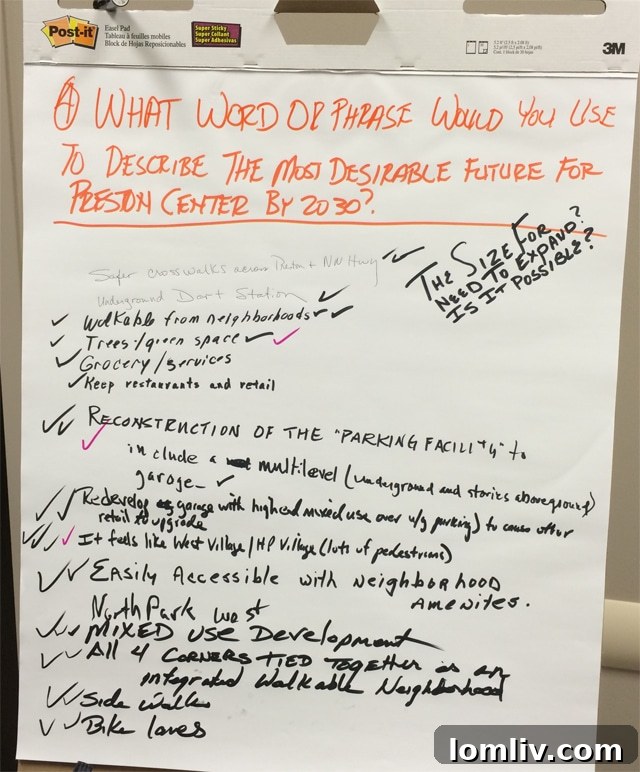
4. What word or phrase would you use to describe the most desirable future for Preston Center by 2030?
- Safer crosswalks, particularly across Preston Center and Northwest Highway.
- An underground DART station for enhanced regional connectivity.
- Walkability from surrounding neighborhoods to the core center.
- Abundance of trees and green space to enhance aesthetics and quality of life.
- Availability of grocery stores and essential services within walking distance.
- Retention and enhancement of existing restaurants and retail businesses.
- Reconstruction of the primary parking facility to include a multi-level garage (underground preferred, with commercial/retail above ground).
- Redevelopment of the existing garage into a mixed-use structure over underground parking, encouraging surrounding retail to upgrade.
- An atmosphere akin to West Village or Highland Park Village, characterized by high pedestrian activity.
- Easy accessibility complemented by comprehensive neighborhood amenities.
- A vision for “North Park west,” suggesting a similar vibrant retail and community environment.
- Embracing mixed-use development principles.
- Integration of all four corners of Preston Center into a cohesive, interconnected neighborhood.
- Expanded and improved sidewalks.
- Dedicated bike lanes.
A crucial point regarding the Preston Center west parking garage is its convoluted ownership structure, which currently restricts the city from developing retail or commercial spaces on the property. This structural barrier hinders integrated mixed-use development. A viable alternative would be for the city to construct a new garage (preferably underground) and transform the surface level into a vibrant town square or greenspace. This approach could significantly enhance public amenities and pedestrian experience without engaging in complex skirmishes with current commercial stakeholders, paving the way for a more integrated and attractive Preston Center.
5. What are the biggest barriers that might prevent the community from reaching that future?
- Lack of vibrant and effective public transit with direct connections to major interest and commerce centers.
- Existing major intersections are impossible to navigate, leading to significant diversions through residential neighborhoods.
- A prevailing thought process that views congestion as an inherent “evil,” rather than a symptom of underlying issues.
- The structure of Dallas’s single-member council districts, which can lead to localized thinking rather than a holistic vision for the city.
- Overwhelming traffic and the sheer number of property owners, complicating consensus.
- Fractured ownership of key properties, particularly in Preston Center west.
- Resistance to change, despite the inevitability of change.
- A perceived lack of creative thinking in problem-solving.
- General fear of change among residents.
- Excessive traffic and an aging resident population that may not actively participate in planning processes.
- The ongoing need for mixed-use development, which faces various hurdles.
- A belief that the City is not listening to community stakeholders, prioritizing tax dollars over managed planning and zoning.
Many of these comments, particularly those concerning fractured ownership, traffic woes, and challenging intersections, seem to be directed primarily at the specific conditions of Preston Center west. This area’s unique challenges often overshadow the broader discussion about the entire district’s potential for cohesive urban planning and redevelopment. Addressing these specific barriers effectively will be key to unlocking the full potential of Preston Center’s future.
6. What assets does Preston Center have now that are “Hidden Treasures” – things that people and businesses outside the area are unaware of or don’t fully appreciate?
- Its exceptional geographical location, strategically positioned near Northwest Highway, the Tollway, and Central Expressway.
- One of the highest concentrations of dental practices in the entire North Texas area.
- A diverse and vibrant culinary scene, including popular spots like Flying Fish and numerous other restaurants.
- The potential for a highly walkable neighborhood with access to retail, offering a unique, almost “European” feel.
- An abundance of quality eating establishments.
- The inherent potential for developing a truly walkable and pedestrian-friendly environment.
The comparison to a “European feel” for a walkable neighborhood, particularly in the context of Preston Center west, might be an optimistic projection rather than a current reality. However, the recognition of its strategic location, diverse business community, and underlying potential for enhanced walkability are indeed valuable assets for future Preston Center development.
7. If you could invest in just one or two capital investments in the next few years, which ones would provide the greatest catalytic benefit for the area?
- More efficient traffic flow and better-landscaped roads and rights-of-way.
- Significant improvements in public transit infrastructure and services.
- Demolishing the existing parking garage and replacing it with green space, water features, pedestrian-friendly activities, and public gathering areas.
- This would necessitate an underground garage solution.
- A dedicated DART station to improve regional connectivity.
- Development of neighborhood-style retail north of Northwest Highway, featuring smaller shops and professional services.
- Construction of a new, centrally located parking facility in Preston Center, with the city leasing it to developers.
- Comprehensive upgrades to sidewalks, the addition of bike lanes, and the expansion of green space.
8. In your view, what two or three features differentiate the Preston Center area from other nearby centers today?
- Its distinctive and often fragmented ownership structure.
- The inherent potential for seamless access from surrounding neighborhoods via walking and biking.
- Its character as a “hodgepodge” of different developments and styles.
- A rather blunt assessment: “Belongs in Akron” (suggesting it’s outdated or out of place).
- A very diverse array of restaurants, retail establishments, and dental and medical offices.
- The presence of many independent, one-person, one-shop ownerships, contributing to a unique local character.
- A feeling of being a “little town” – except during rush hour.
- Significant untapped potential for development and improvement.
- Its existing mixed-use character.
- The notorious lack of a cohesive plan and a dangerous, outdated parking lot.
- Often described as “dirty” and “outdated.”
Once again, much of the criticism regarding lack of plan, outdated facilities, and dangerous parking seems primarily directed at Preston Center west. The diversity of businesses and the potential for neighborhood integration, however, are consistently identified as unique strengths.
A notable concern raised by the author regarding the consultant’s methodology was the query about where residents perceived traffic to be a problem. For a significant investment of $350,000, one would expect the consultants to rely on empirical data and professional traffic pattern analysis rather than anecdotal resident observations. While resident input is invaluable for identifying issues, it should complement, not replace, data-driven assessments. In urban planning, correlation does not equate to causality, and solutions must be grounded in accurate, objective information.
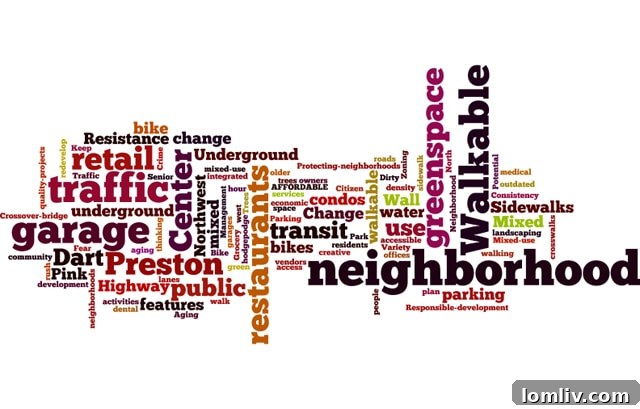
Preston Center Questionnaire Summary: Key Themes and Future Directions
The collective responses from the residents, particularly from the Zone 4 “Pink Wall” area, provided a surprisingly progressive vision for Preston Center’s future. For an area sometimes stereotyped by its established demographic, many suggestions exhibited a forward-thinking “youthful bent.”
In summary, a clear consensus emerged around the desire for enhanced walkability and bike-ability, emphasizing safe and seamless connectivity to the core of Preston Center. The integration of more trees and green spaces was also highly desired, reflecting a broader movement toward sustainable and aesthetically pleasing urban environments. Public transit improvements are seen as critical, not only for facilitating commutes for workers but also for enabling residents to access other parts of Dallas. While some residents expressed hope that improved public transit would significantly reduce traffic, the author notes that this outcome might be overly optimistic in a car-centric city, though it will certainly contribute to easing congestion.
A near-universal sentiment expressed was dissatisfaction with the current Preston Center west parking garage. This sentiment extends to the fragmented ownership of the retail shops in that section, which is widely perceived as hindering the area’s visual appeal and coherence compared to more integrated developments like Preston Center east and Highland Park Village. Addressing these issues through coordinated urban renewal and strategic redevelopment will be crucial for creating a more cohesive and attractive environment.
Another prominent theme that emerged, particularly from the Pink Wall area, was a strong desire for the area to maintain its financial diversity. Given that the Pink Wall is primarily a middle-class community, residents expressed concerns about being priced out by new developments—a sentiment that the author strongly understands and supports. The importance of socio-economic diversity in neighborhood development is emphasized as it enriches the community and offers invaluable, often subconscious, “teaching moments” through varied interactions and perspectives.
While a few “loo-loos” (unrealistic ideas) were floated, such as submerging Northwest Highway or the imminent arrival of a DART subway station directly in Preston Center, these were surprisingly few. The overall tenor of suggestions points to a community that, when given the chance, can articulate a sensible and progressive vision for its future. The author reiterates the necessity of another, more in-depth meeting for Zone 4 to properly flesh out these ideas and ensure their voices are fully heard and considered in the final Preston Center Task Force recommendations.
Toward Better Quality Input for Preston Center Planning
Drawing on professional experience in questionnaire design and focus group moderation, the author underscores the importance of obtaining knowledgeable and unbiased input from participants. This process is akin to jury selection, where informed perspectives lead to superior outcomes. For future Preston Center planning, any resident wishing to contribute their opinion should ideally commit to understanding factual information and listening to diverse viewpoints before articulating their own. Implementing such a framework would significantly enhance the quality of feedback, leading to more robust and helpful results.
This approach would also be highly effective in filtering out “echo-chamber” residents—individuals resistant to considering perspectives or data that challenge their preconceived notions. The future of the Preston Center area is too significant an issue to be swayed by uninformed or entrenched opinions. It demands a proper allocation of time and resources to ensure that well-informed viewpoints are thoroughly heard, debated, and integrated into the decision-making process for effective Dallas urban planning.
Is the Preston Center Study a Waste of Time and Money?
The author adopts a stance of “hopeful pessimism” regarding the ultimate impact of the Preston Center Task Force study. While hopeful that the considerable effort invested by numerous individuals will yield positive outcomes, there’s also a realistic apprehension about the kind of plan the City Council might ultimately approve. Greater optimism would be justified if the City Council had initiated the study by declaring a specific budget allocated for the area, inviting recommendations on its most effective utilization. Such a commitment would signal a tangible intent to implement changes, rather than merely study them.
As it stands, the study’s report is slated for delivery to the Task Force in approximately a year, followed by their deliberation before presentation to the City Council. This extended timeline, coupled with the inevitable political maneuvering, suggests a protracted path to implementation. The author conservatively estimates that any concrete decisions and resulting plans won’t materialize until late 2017 at the earliest, with the first ground breaking not expected until 2018. This protracted process underscores the challenges inherent in municipal urban planning and the often-slow pace of progress in large-scale neighborhood development initiatives.