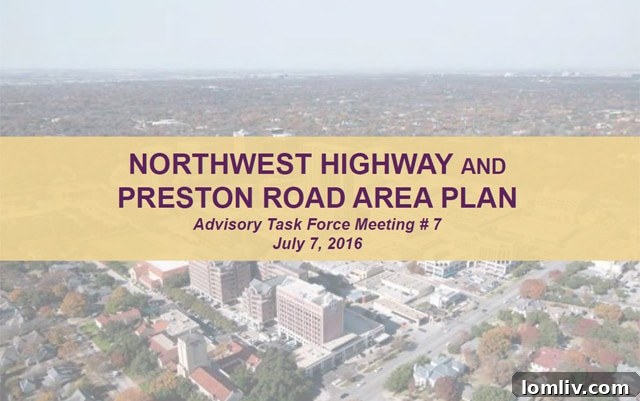
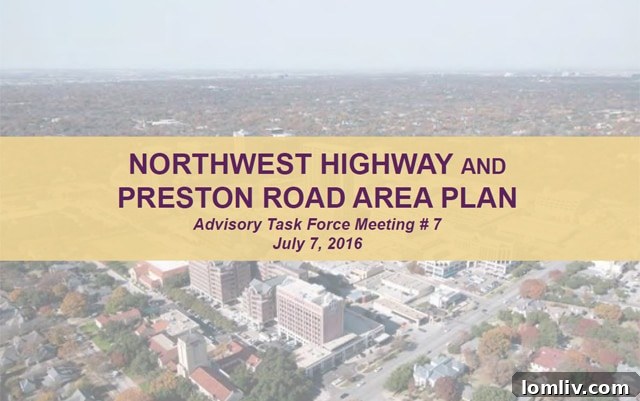
Preston Center Development: A $350,000 Investment Yielding Zero Progress
“Train Wreck.” “Waste of Time.” “Squandered Money.” “Are you eff-ing kidding me?”
These were the furious thoughts echoing through my mind during the most recent Preston Center Task Force meeting. After sixteen arduous months and a staggering $350,000 investment, it’s profoundly disheartening to admit that we find ourselves precisely where we began. In fact, one could argue we’ve regressed. Despite a glimmer of hope following the previous gathering, any perceived progress has evaporated, leaving us squarely back at Square One. Even the concept of an underground parking lot topped with a vibrant park, which had emerged as a central pillar of potential progress, was an idea actively discussed and considered over a year ago. The sheer lack of forward momentum is not just frustrating; it’s a glaring indictment of the process.
Consultants Kimley-Horn, tasked with guiding this extensive project, have, for their part, tabulated some traffic data and cobbled together various developmental scenarios. These scenarios were presented to the task force and the broader public, often eliciting more skepticism than enthusiasm. Just last week, they unveiled a 150-page report, purportedly detailing their “findings” to task force members. However, “findings” feels like an overly generous term for what many perceive as an overwhelming volume of data and theoretical scenarios that ultimately fail to reach any concrete conclusions or actionable recommendations. Compounding the issue, the report was criticized for not adequately incorporating the personal recommendations and insights of the task force members themselves – individuals who, understandably, feel that 16 months of dedicated effort should not culminate in an empty-handed departure.
Personal Agendas Eclipse Expert Recommendations
The true turning point, or perhaps derailment, came when these critical task force recommendations were privately forged, notably in the absence of Councilwoman Jennifer Gates. This pivotal moment effectively nullified a year’s worth of collective effort, allowing individual agendas to be masqueraded as official policy and forward strategy. It was a stark demonstration of how deeply entrenched personal interests can undermine a public planning initiative.
Councilwoman Gates then, arguably, sealed the fate of this controversial report by declaring she would only champion recommendations that garnered the unanimous support of the task force members. Her statement, in essence, amounted to, “Write your own ticket, and I’ll present it.” This declaration effectively relegated the $350,000 investment in Kimley-Horn’s extensive (though ultimately ignored) work to mere footnotes. The substantial financial outlay became a legitimizing cover for a process driven by pre-existing biases rather than objective analysis.
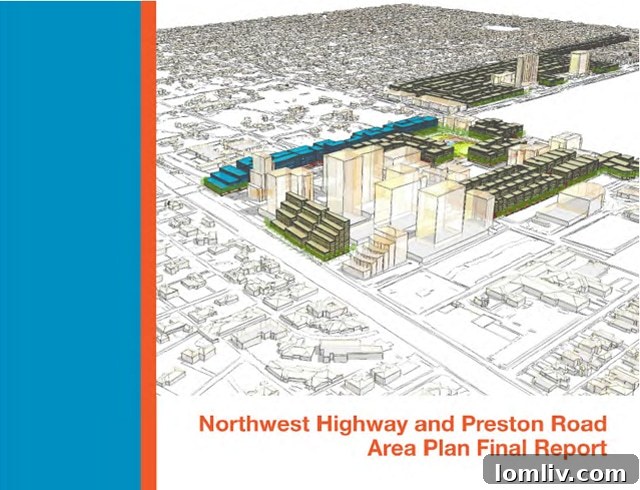
Unpacking the Core Issues Hindering Preston Center’s Progress
Let’s delve deeper into the specific points of contention and dysfunction that have plagued the Preston Center Task Force’s journey:
-
Resistance to Structured Development Ratios and the Persistent Parking Myth
Representatives of Preston Center’s business owners, notably supported by what appears to be a de facto leadership under Laura Miller, have consistently expressed a desire to avoid any restrictive numbers or ratios regarding the mix of residential, office, and retail development. Their core argument is that “the market sorts itself out.” However, if the current chaotic state and traffic woes of Preston Center are indeed the result of unfettered free market dynamics, then their proposed plan essentially advocates for more of the same, offering little hope for meaningful improvement. The question remains: without strategic guidance, how can a truly vibrant and functional urban core emerge?
While I acknowledge a sliver of truth in the assertion that certain development proposals by Kimley-Horn might be unrealistic in their suggested location and form, it is crucial to recognize that predefined ratios for retail, residential, and office spaces are indispensable. Without these parameters, or at the very least strong incentives, genuine change is unlikely. Perhaps not rigid, exact percentages, but a clear articulation that “the residential target, for example, should fall between X and X percent,” is fundamental for guided and sustainable growth. This provides a framework for developers while still allowing for market responsiveness.
Furthermore, a persistent and, frankly, unsubstantiated narrative continues to be pushed: that parking at Preston Center remains a significant, debilitating issue. This claim has been debunked repeatedly. Extensive studies and observations have consistently shown that, outside of the peak weekday lunch rush, there is no shortage of available parking in the central garage. This perpetuation of a known falsehood, particularly in what happens to be an election year, strongly suggests a deliberate strategy of repeating a lie until it gains perceived legitimacy, serving specific political or commercial agendas rather than actual community needs.
Speaking of the parking facility, the dilapidated, “rotting concrete corpse” of the central garage remains a prominent, unresolved problem. One Preston Center representative even claimed that even with immediate access to funds to double its size, rebuild it underground, and create a park on top, securing unanimous agreement from neighboring businesses would be an insurmountable hurdle. Yet, paradoxically, these same entities seem agreeable to spending an estimated $8 million just to add a third level to the existing structure. Coupled with a reported $10 million offer from a neighboring billionaire (presumably with various conditions attached), this brings the total to nearly half of the estimated $40 million needed for a more comprehensive overhaul. It makes one wonder if a more collaborative approach, perhaps involving figures like Mark Cuban (who has been at odds with some stakeholders), could unlock additional funding if not for prevailing hostilities. Crucially, like so many aspects of this protracted project, the $40 million figure is merely a speculative guess. After 16 months of deliberation and significant expenditure, no one has apparently bothered to obtain an actual, verifiable quote for the proposed works. This fundamental lack of due diligence at such a late stage is astonishing.
-
The “Pink Wall” Conundrum: Stifled Redevelopment and Misrepresented Community Views
Steve Dawson, representing the “Pink Wall” community, has consistently taken a firm stance against any development that might potentially compete with his business interests located behind the wall. This protective posture directly impacts several decrepit complexes in the area that are in dire need of repair and whose only economically viable long-term option is demolition and redevelopment. However, under the current zoning regulations, redevelopment is not financially feasible, effectively trapping these properties in a perpetual state of decay. The proposed “solution”? To impair the land value further until rebuilding the exact same, antiquated structures becomes viable? This is an unrealistic and unsustainable approach, ensuring these complexes remain effectively trapped in their current, deteriorating condition.
Dawson has gone to great lengths to cite precise numbers of “Pink Wallers” who returned surveys, emphasizing how many align with his anti-development viewpoint. What often goes unchallenged, however, is the critically important context: those returned surveys represented less than eight percent of the total residents. Furthermore, the “no development” voters likely constituted a meager six percent of all Pink Wall property owners. To put this into perspective, the author notes, “I’ve had more people at a dinner party.” This anecdote effectively underscores the unrepresentative nature of the data being presented as a consensus.
Contrast this with a broader, more robust survey conducted by the City last November concerning the Laurel apartments on Northwest Highway and Preston. That survey saw 165 returns out of 242 sent, with an overwhelming 96 percent in favor of development, and only seven dissenting voices. This clear, compelling data, however, seemingly fell victim to “collective amnesia” because it did not conform to the preferred anti-development narrative.
The task force’s ultimate recommendation for the Pink Wall area? Zero redevelopment beyond what existing zoning and deed restrictions currently permit. This approach, as the author aptly describes it, amounts to “handcuffs” – severely limiting any potential for revitalization and growth in a critical part of Preston Center.
-
Traffic and Infrastructure: A Staggering Lack of Research and Concrete Planning
Perhaps one of the most alarming revelations is that neither TXDoT nor the City of Dallas has conducted even a single iota of meaningful research over the past 16 months on how to effectively improve traffic flow and parking within Preston Center and its surrounding intersections. This inertia is particularly frustrating when the author had already taken the initiative, a year prior, to outline a viable plan. The absence of official, data-driven solutions highlights a profound systemic failure.
Consider, for example, the proposed Texas U-turn at the intersection of the Tollway and Northwest Highway. TXDoT frankly has no clue if this U-turn can even be physically constructed on the south side of the intersection. They possess no data on how many vehicles exiting Preston Center office buildings would actually be siphoned off Northwest Highway during rush hour. Crucially, they have absolutely no idea how those vehicles would even navigate multiple lanes of already gridlocked traffic on Lomo Alto to reach this theoretical Texas U-turn. Yet, despite these fundamental unknowns, it was proposed as part of the plan – a clear instance of superficial, unresearched suggestions being presented as solutions.
Discussions also revolved around vague “development triggers” – the idea that if a developer builds ‘X’, they would then ‘do Y’ to enhance roadways. The use of the term “stuff” here is telling, as there is no clear understanding of how or if these triggers would actually impact traffic. For instance, if the Pink Wall were to add 500 residential units and 60,000-80,000 square feet of retail – a substantial development – the “prize” offered would be merely a new traffic signal at Northwest Highway and Edgemere, alongside some “perimeter sidewalks.” There was no detailed explanation of what this would actually accomplish in terms of traffic reduction, nor any acknowledgment that the “perimeter” includes sections of the Pink Wall that are bound by deed restrictions, further complicating any practical implementation.
The proposed signal at Edgemere would introduce a tenth signal and bottleneck between the Tollway and Central Expressway, exacerbating existing congestion. Furthermore, similar to the signal at Pickwick, it would not extend into University Park. Even if University Park authorities were to permit it (which is doubtful), there’s no opposing street on their side to connect to. Moreover, the signal would operate 24/7, despite being genuinely needed for only a few hours each weekday. This exemplifies a lack of integrated planning and efficiency.
There was ample talk about “low-hanging fruit” – easy, quick wins for traffic improvement – but absolutely no specific details were provided about what this “fruit” actually is, nor what “picking it” would concretely accomplish to reduce traffic congestion. This vagueness further undermines public confidence.
And, inevitably, the perennial problem: there is currently no budget allocated for these proposed traffic improvements. The implicit assumption is, “maybe the developer will pay?” Seriously? These are seasoned professionals, and this is the extent of their strategic planning after 16 months? It is a truly baffling revelation.
Beyond the lack of quotas or ratios, the task force business owners, unsurprisingly, also expressed a desire to avoid any “triggers” attached to development. Their rationale is that a single, ultimately unworkable trigger could gum up the entire development process. The answer to this concern is, in fact, refreshingly simple. Traffic planners must undertake the diligent work of assigning specific, measurable values to each potential traffic reduction or easing option. A development project would then simply need to implement enough of these options to sufficiently offset the increase in traffic its project would generate (e.g., selecting two options from column A and three from column C). Using a “grab-bag” approach, it becomes irrelevant which specific options a developer chooses, as long as their combined value meets the required mitigation target. Once the available “bag” of proven options is exhausted, development would pause until more effective solutions are researched, evaluated, and assigned clear values, recognizing that at some point, the area reaches its development capacity. This practical solution, incidentally, is something the author articulated over a year ago.
-
Mark Cuban: An Unconcerned Player in the Preston Center Saga
Through all the political machinations and planning paralysis, one constant remains: everybody still seems to harbor animosity towards Mark Cuban. What I find particularly ironic, however, is Cuban’s apparent indifference to the task force’s seemingly endless “sewing bee.” He operates with the understanding that whenever he chooses to proceed with development on his Northwest Highway lots, he will do so. In fact, the more developed and, perhaps, congested Preston Center becomes due to these ongoing planning failures, the stronger his case for advocating for zoning changes on his side of the highway becomes. His strategic position is arguably strengthened by the task force’s inability to forge a coherent, forward-looking plan.
Conclusion: Self-Interest Masquerading as Public Service
Based on this fantastical last-minute hijacking of the process, the task force is poised to take Kimley-Horn’s meticulously prepared PowerPoints, rejigger them to their liking, and essentially “write their own ticket.” Kimley-Horn’s consultants will then be tasked with the unenviable job of re-gussying these self-serving recommendations before the public is once again invited to weigh in during another “fandango” in September. The predictable outcome will be a “plan” that 13 task force members can agree upon – a plan primarily designed to further feather their own financial, personal, and political nests. The 16 months of effort and the significant $350,000 wasted on Kimley-Horn’s consultancy ultimately serve only one purpose: to apply a thin “varnish of respectability” over what is, at its core, unvarnished self-interest.
As the saying goes, “My bologna has a first name, it’s F-U-B-A-R…” – a fitting, albeit disheartening, epitaph for the Preston Center Task Force’s journey thus far.
Remember: High-rises, HOAs, and renovation are my primary focus. However, I also deeply appreciate modern and historical architecture, always balancing these aesthetics against the dynamic realities of the YIMBY (Yes In My Backyard) movement. If you’re interested in hosting a Candysdirt.com Staff Meeting event, I’m always eager to connect. My writing was honored in 2016 with both Bronze and Silver awards from the National Association of Real Estate Editors. Do you have a compelling story to tell, a groundbreaking project to share, or perhaps even a marriage proposal to make? Don’t hesitate to shoot me an email at [email protected]. I look forward to hearing from you.