Unlocking Dallas’ Pink Wall: A Deeper Dive into Redevelopment Feasibility and the Flaws of the PRNHAP
The future of Dallas’ cherished “Pink Wall” parcels, nestled within the parameters of the Preston Road and Northwest Highway Area Plan (PRNHAP), has long been a subject of intense debate and speculation. A recent, comprehensive economic analysis, commissioned by A.G. Spanos, sheds crucial light on the financial viability of redeveloping these key sites. Spanos, a firm with a contingent contract to revitalize the Diplomat condos within PD-15, has funded two pivotal studies aimed at understanding the true economic landscape. While Spanos’ motivations are transparently driven by their development interests, the economic data they’ve brought forth stands in stark contrast to the notable absence of financial underpinnings within the city’s own $350,000 PRNHAP study. The fact that the city adopted a plan so devoid of economic foundation remains, for many, a source of profound bewilderment.
Back in October 2017, initial calculations quickly exposed the then 10-month-old PRNHAP as economically untenable. This assessment was further validated in January 2018 when Spanos released its first report, developed by the esteemed architects Looney Ricks Kiss. Both analyses consistently demonstrated that the recommendations outlined in the PRNHAP study’s “Zone 4” were simply not viable for construction. The most recent study delves even deeper, offering more intricate and sobering details specifically for the PD-15 area. Readers can download this detailed report here.
Understanding Economic Viability in Redevelopment
To clarify, when we speak of a project being “not economically viable,” it means that the existing condo units in their current state would fetch a higher market price than the land they occupy if it were to be sold for redevelopment. Under such conditions, current homeowners would essentially incur a financial loss by selling their properties for a new development project. While it’s generally beneficial for land value to represent a fraction of a structure’s worth – as it aids in neighborhood stabilization and helps to curb gentrification – this dynamic creates a significant hurdle for revitalization efforts in the Preston Center area.
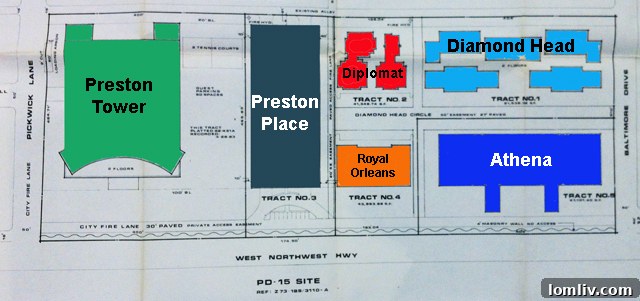
However, true neighborhood revitalization becomes severely impeded when the combined costs of land acquisition and development rights fall below the value of the existing structures. It’s a common misconception that some advocate for the wholesale bulldozing of the Pink Wall to erect cheap apartment complexes. This is not the case. The reality is that many Pink Wall buildings have suffered from years, if not decades, of deferred maintenance due to undercharged HOA dues. A casual observation reveals that the Imperial House is one of the few buildings to have upgraded its original, inefficient windows. This visible issue is often just the tip of the iceberg, concealing deeper plumbing, foundation, and electrical problems that continue to accumulate. Residents from multiple Pink Wall complexes have candidly shared that while these buildings maintain an appealing exterior, they are, unfortunately, “rotting on the inside,” underscoring the pressing need for sustainable redevelopment.
The Authoritative HR&A Economic Feasibility Study
The latest in-depth analysis, an 18-page report, was produced by HR&A, an internationally renowned real estate consulting firm. This is not light reading; it’s a dense, rigorous document designed for serious stakeholders. HR&A’s extensive portfolio ranges from advising on major urban projects like New York’s High Line Park and leading five-year energy efficiency initiatives, to critically analyzing Dallas’ underinvestment in its crucial park system. The report’s author, Joseph Cahoon, brings exceptional qualifications to this study, with vast experience in multi-family residential development and a role as an adjunct professor and Director for the Folsom Institute for Real Estate at SMU’s prestigious Cox School of Business. In short, his expertise is unquestionable.
For those new to the intricacies of real estate finance, the document can be challenging, likely requiring multiple readings (as this author can attest). It contains specialized jargon that demands clarity for full comprehension. Before delving into the study’s findings, let’s define two critical terms:
Residual Land Value: This term refers to the maximum price a developer can afford to pay for land, calculated by working backward from the potential total revenue generated by a completed project (through rent or sales) and subtracting all development costs, including expected profit margins and capitalization rates. It’s the land value from a developer’s perspective, not merely a seller’s asking price.
Capitalization (Cap) Rate: The capitalization rate represents the expected rate of return on a real estate investment property. It is calculated by dividing the property’s net operating income by its current market value. Essentially, it’s the initial yield or profit margin anticipated from a project, taking into account total generated rent minus construction and all short-term and long-term operating costs. A higher cap rate generally indicates a higher potential return but can also signal higher risk.
Armed with these definitions, the HR&A study proceeds to model nine distinct development scenarios, meticulously varying three key parameters: building heights (four, seven, and ten stories) and three average unit sizes. The four-story examples are designed to strictly adhere to the height and underground parking limitations stipulated by the original PRNHAP study. In contrast, the seven- and ten-story scenarios represent significant departures, allowing for taller structures and incorporating completely underground parking solutions. These taller options push beyond the PRNHAP’s restrictive guidelines, acknowledging that the original plan may not align with economic realities.
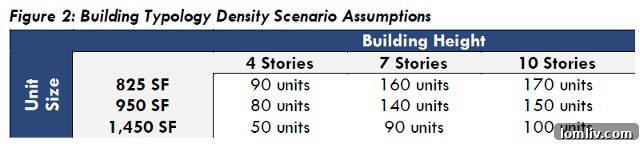
The study also assumes unit counts based on what could reasonably be built on a one-acre parcel, disregarding current PD-15 density limitations but factoring in reasonable setbacks. While these unit counts are illustrative for a single acre, extrapolating them to larger parcels like Preston Place and Diamond Head, or smaller buildable lots such as Royal Orleans, would naturally adjust the total unit numbers. It’s important to note that these adjustments would not be linear, as both larger and smaller lots present unique economies of scale that impact development efficiency and cost per unit.
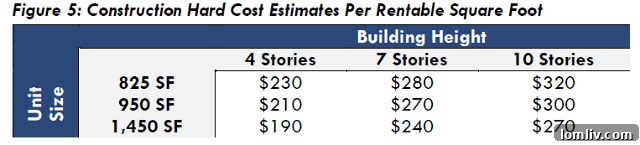
A crucial component of the economic analysis involves estimating construction costs per square foot, which are meticulously broken down by unit counts, unit sizes, and the extent of underground parking. While these construction cost estimates may initially appear high, they comprehensively include the significant expense of fully underground parking structures and account for the tighter constraints of a hypothetical one-acre lot. Smaller lots inherently present less efficient building conditions. For comparison, construction costs for a larger, two-acre site like Preston Place would likely be somewhat lower, assuming all other factors remain constant.
Construction Methodologies and Their Economic Impact
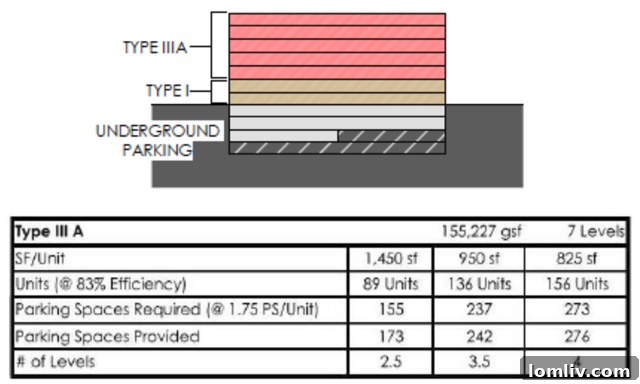
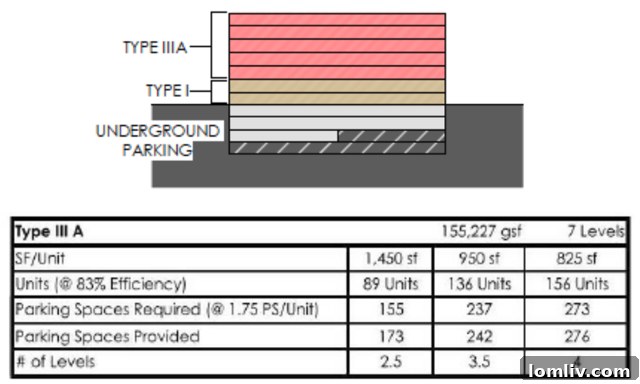
The type of construction methodology employed is a significant factor filtered into these cost analyses. For a four-story building, the construction would typically involve wood “stick” framing above ground, resting upon 1.5 to 2.5 levels of underground concrete parking. The exact number of underground parking levels depends on unit size and count, with fewer, larger units generally requiring less parking. This method is demonstrably the most cost-effective to build among the scenarios, a prime example of which can be observed at The Laurel, located at Northwest Highway and Preston Road.
Moving to a seven-story building introduces hybrid construction techniques. These structures would feature 2.5 to four levels of underground parking, followed by an additional two stories of above-ground apartments constructed with concrete. Above these concrete levels, the bulk of the units—typically five stories—would utilize stick construction. This architectural approach is commonly referred to as a “five over two” building, blending the cost-efficiency of wood framing with the structural integrity of concrete where it matters most.
At the ten-story height, the scenario shifts to a full concrete construction, featuring 2.5 to 4.5 levels of underground parking supporting ten complete stories of concrete apartments. One might logically wonder why the cost differential for an all-concrete, ten-story building isn’t dramatically higher than the jump from four to seven stories, given concrete’s higher expense. The explanation lies in two key points: Firstly, due to lot coverage differences (a ten-story building occupies a smaller footprint), there isn’t a vast difference in the total number of units between the seven- and ten-story models. Effectively, adding just ten units and three stories to the seven-story hybrid model increases overall costs by nearly 15 percent. Secondly, because the increase in unit count is relatively modest, the additional requirement for underground parking is also not substantially higher. Opportunities to increase lot coverage, such as placing a pool on the rooftop, could further impact height and potentially reduce a floor for residential units.
The ten-story example, interestingly, often falls into what can be described as a “no man’s land” in building economics. The incremental gains in efficiency or revenue over a hybrid seven-story structure are frequently insufficient to justify the substantial additional investment required for full concrete construction, unless one plans to build significantly taller structures.
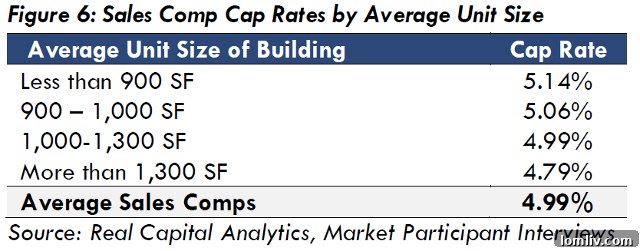
In its assessment of the Dallas real estate market, the HR&A report sets a 5 percent capitalization rate as the average expected return for comparable buildings. To provide context, a relatively risk-free 10-year Treasury note currently offers an interest rate of approximately 2.85 percent. Investing in a real estate project with a cap rate lower than this risk-free rate would make little financial sense given the inherent risks involved in property development. These risks encompass a variety of factors, including fluctuating future property taxes and the ability to command competitive rental rates in a dynamic market.
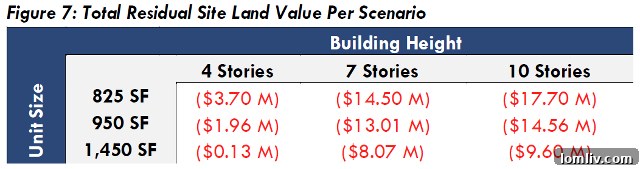
A quick glance at the accompanying table reveals a stark picture: a significant amount of red. This visual cue powerfully underscores the study’s primary conclusion: based on the restrictive guidelines of the PRNHAP study, none of the four-story development scenarios are financially viable or cost-effective to build in the current Dallas market. Alarmingly, the economic picture for even taller buildings, under strict PRNHAP adherence, appears even less promising, consistently yielding negative residual land values.
The report unequivocally concludes that the PRNHAP study, as it stands, is economically unworkable if its stated objective of neighborhood revitalization is to be achieved. Even under the most optimistic projections, it becomes challenging to imagine, for instance, the owners of Preston Place paying a developer $260,000 (for a double lot) just to construct a four-story building featuring average units of 1,450 square feet. Such a proposition is simply not economically rational.
The study clearly articulates that for the financial model to succeed, there must be greater flexibility within the PRNHAP guidelines. Alternatively, market rents would need to surge significantly beyond current expectations, even in a high-end market that is already showing signs of cooling. While influencing market rents is largely beyond local control, construction costs, particularly those related to parking, present a critical lever for adjustment.
The Critical Role of Underground Parking in Development Economics
One of the most significant economic levers in urban development, particularly within dense areas like the Pink Wall, is the preference—and often mandate—for entirely underground parking. The cost differential between constructing parking above ground versus below ground is substantial, typically ranging from a two-to-one to a three-to-one ratio. Were some allowance made for above-ground parking, the economics of taller buildings would notably shift, potentially moving them from unviable to feasible. However, for the four-story scenarios, allowing above-ground parking would necessitate trading valuable residential space for parking, thereby reducing the total unit count and, critically, profitability. This fundamental trade-off means that four-story buildings, regardless of parking modifications, would struggle to ever reach economic viability.
To illustrate this point, consider a mid-sized development example with 80 units of 950 square feet, requiring two full levels of underground parking. If these two parking floors were to be moved above ground, the residential unit count would realistically have to be halved to around 40 units. However, 40 units wouldn’t necessitate two floors of parking; perhaps a single floor of above-ground parking could suffice, supporting three levels of 60 apartments. While such a scenario would save on excavation costs associated with underground parking, it would still incur the substantial concrete costs of an above-ground garage (as cars cannot be parked in a wood-framed structure). The net effect of this reduced unit count would be a significant drop in profitability, ensuring the project remains financially unfeasible and thus unlikely to be built by any rational developer.
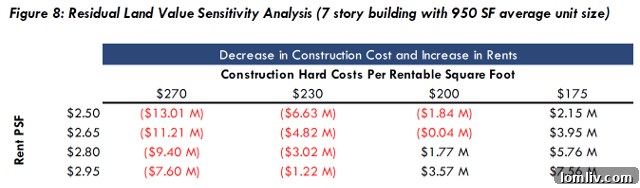
While the initial assessment might suggest that the seven- and ten-story examples appear even more unprofitable, their inherent height and the resulting higher unit counts offer a crucial opportunity. These taller structures possess the potential to strategically incorporate some above-ground parking—cleverly wrapped inside the building envelope to remain invisible from the exterior—which could significantly improve their economic feasibility. The convergence of increased height, which boosts unit density, with a flexible approach to mixed above- and underground parking, creates a pathway towards viability.
Furthermore, the ability to construct a higher-quality building that can command slightly higher rental rates represents a sweet spot where the interests of developers, property sellers, and the broader neighborhood can harmoniously align. This balance is critical, especially in the current economic climate where construction margins are razor-thin. Ongoing trade wars continue to impact raw material pricing, and a persistent shortage of skilled construction workers, exacerbated by federal immigration policies, has driven up labor costs even further than a year ago.
A.G. Spanos’ Vision: A Strategic Alignment with Economic Reality?
Some observers might view this comprehensive research as suspiciously aligning with A.G. Spanos’ interests, especially since their proposed redevelopment for the Diplomat condos is specifically a seven-story building. However, this is not Spanos’ first foray into complex urban development. It is highly probable that the firm conducted its own rigorous financial modeling and due diligence long before committing to the project. Indeed, they spent an entire year on meticulous measurements, drilling core samples, negotiating terms, and crunching numbers before even drafting their contract for the Diplomat. Much like the tale of Goldilocks, Spanos’ internal analysis likely concluded that a four-story structure was too limited in scope and profitability, while a ten-story building offered insufficient upside to justify the added aggravation and cost. Consequently, the seven-story model emerged as “just right”—a sweet spot balancing economic viability with development potential and community integration.
Certainly, there are various metrics and parameters that can be explored and fine-tuned during the PD-15 authorized hearing process to further optimize outcomes for the neighborhood. It is crucial to remember that higher profit margins for developers often translate into a greater capacity to provide community benefits and desirable amenities. Similarly, increased density allows the costs associated with these “givebacks” to be distributed across a larger number of units, making them more achievable. Striking the right balance between these factors is paramount for successful and sustainable urban redevelopment.
Ultimately, this new, detailed report provides committee members, and the broader Dallas community, with an invaluable, data-driven understanding of the complex financial considerations involved in the redevelopment of the Pink Wall parcels. It moves the conversation beyond mere preference and into the realm of economic reality.
Finally, for those who continue to champion the Preston Road and Northwest Highway Area Plan as an immutable guide: where are your supporting numbers? We are fully aware that none of the $350,000 invested in the original PRNHAP study was allocated for economic modeling to substantiate its ambitious desires. The critical question now is: what financial data can be presented today to support its continued adherence?

About the Author: My focus consistently revolves around high-rises, homeowners’ associations (HOAs), and renovation projects. I also deeply appreciate the delicate balance between modern and historical architecture, especially within the context of the YIMBY (Yes In My Backyard) movement. My commitment to insightful real estate journalism has been recognized by the National Association of Real Estate Editors, earning me three Bronze awards in 2016 (for an analysis of housing styles), 2017 (on property taxes), and 2018 (covering a fire at Preston Place), along with two Silver awards in 2016 (for a feature on a Marrakech home) and 2017 (exploring Bermuda second homes). Do you have a compelling story to share, or perhaps an important proposal to discuss? Feel free to reach out via email at [email protected]. You can also look for me on Facebook and Twitter, though finding me might prove to be a charming challenge.