UPDATED February 26, 2020
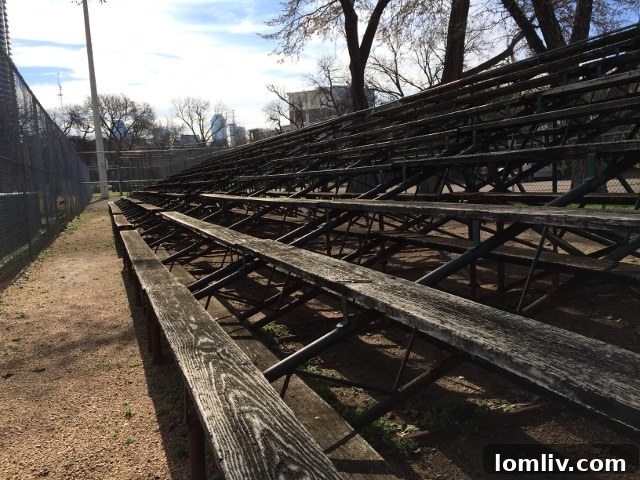
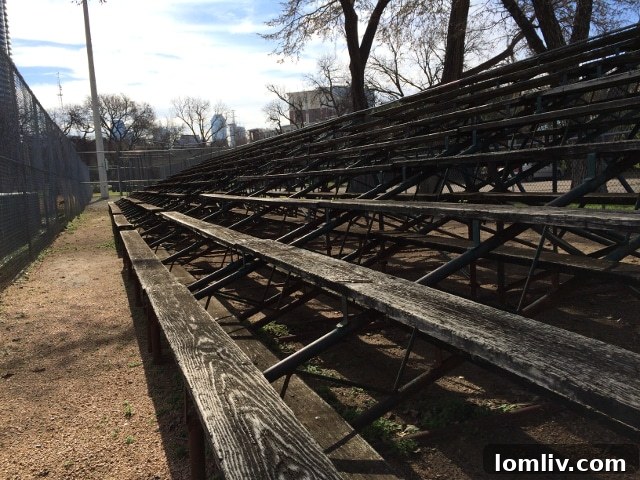
Reverchon Park, a cherished green space in the heart of Dallas, stands at a critical juncture. The city’s proposal to grant a substantial 40-year lease for a significant portion of this public park to Donnie Nelson’s Reverchon Park Sports and Entertainment LLC has ignited considerable public debate and legal challenges. Central to the city’s justification for this long-term privatization is the assertion that the ballpark within Reverchon Park is in a dire state of disrepair, coupled with a claimed lack of municipal funds to undertake the necessary renovations. However, a closer examination of the city’s financial records and past actions reveals a narrative that sharply contradicts these claims, suggesting a more calculated strategy at play.
Before delving into the financial intricacies, it’s crucial to acknowledge the foundational legal argument underpinning the opposition to this lease. The lawsuit filed against the city of Dallas hinges significantly on Chapter 26 of the Texas Parks and Wildlife Code. Specifically, Section 26.001(a) mandates that a city council must definitively determine if “there is no feasible and prudent alternative” to a proposed action that involves the alienation or lease of public parkland. This legal requirement places a considerable burden on the city to prove that handing over a public asset to a for-profit private entity is truly the last resort, rather than a convenient choice. A core component of evaluating a “feasible alternative” – one that preserves the park as public land with an operational baseball field – inherently involves assessing the availability of financial resources to make such an alternative a reality. The city’s repeated claims of financial hardship concerning Reverchon Park, and indeed many other public facilities, appear to be disingenuous, raising serious questions about transparency and accountability in municipal governance.
Unraveling the Financial Fabric: The Case of Unspent Bond Money
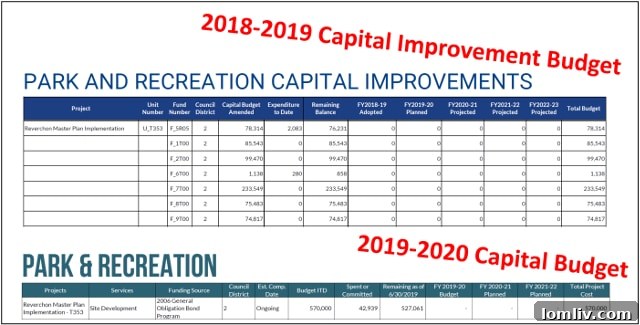
The city’s narrative of poverty, particularly regarding Reverchon Park’s maintenance needs, quickly unravels upon reviewing its own capital improvement budgets. A substantial allocation of funds from the 2006 bond package was earmarked for Reverchon Park, yet a staggering amount of this money remained unspent for well over a decade. As per the 2018-2019 Capital Improvement Budget, Reverchon Park held a balance of $648,314 in bond money, of which a mere $2,363 had been expended. This means that 13 years after its allocation, less than half a percent of the bond money had been put to use for its intended purpose. The situation remained largely unchanged in the subsequent 2019-2020 budget, where the park still retained $527,061, with no commitments for expenditure through at least the 2021-2022 fiscal year. This prolonged inactivity begs the question: why were these critical funds left idle while the park’s condition reportedly deteriorated?
UPDATE: On February 26, 2020, Tim Rogers of D Magazine published a follow-up to this column, citing that only $331,977.91 remained in city coffers from the 2006 bond, a figure he obtained from interim Park Department director John Jenkins. This contrasts sharply with the $527,061 stated in the officially posted 2019-2020 budget. This discrepancy of $195,083.09 raises an even more pressing concern: where did nearly two hundred thousand dollars vanish between the city’s publicly accessible budget documentation and an internal report? This difference not only highlights a lack of clarity in the city’s financial reporting but also fuels public distrust regarding the true state of park funding.
Considering the available funds – whether the initially reported $527,061 or even the lower figure of $331,977.91 – could such amounts have been effectively utilized to address the most urgent needs of the ballpark, such as refurbishing the bleachers, upgrading restrooms, and undertaking other essential repairs to render the field fully functional and safe for public use once again? The answer is a resounding “yes.”
A compelling precedent for the effective use of similar bond funds exists within the Dallas Parks and Recreation Department’s own history. In 2003, an agreement with DISD led to a comprehensive overhaul of Randall Park, near Woodrow Wilson High School. This project successfully delivered new soccer, softball, and baseball fields, a 1,600 square foot concession stand, modern restrooms, and associated parking facilities. Even with additional improvements in 2006, including an irrigation system, sidewalks, and a shade structure, the total expenditure amounted to $1,256,178.11. This demonstrates unequivocally the Park Board’s capacity to manage and spend bond money effectively on significant park infrastructure projects. While more than a decade has passed since then, it is entirely reasonable to conclude that the funds available for Reverchon Park could have been – and still largely can be – sufficient for a substantial baseball field refurbishment. Furthermore, utilizing the 2006 bond monies closer to their original allocation date would have presented an even greater budgetary advantage, allowing for more extensive improvements at a lower cost due to inflation and rising construction expenses.
“Friends” Indeed? The Controversy Surrounding “Friends of Reverchon Park” Funds
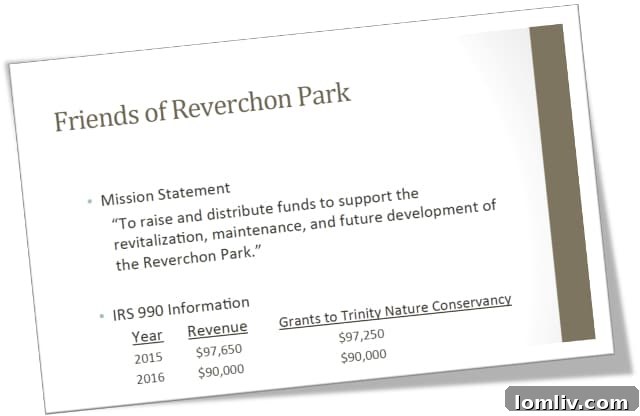
Beyond the unspent bond money, another significant pool of funds that could have benefited Reverchon Park appears to have been diverted. The organization “Friends of Reverchon Park,” presumably established to support the park’s well-being, reportedly transferred $187,250 out of its coffers in 2015 and 2016. According to IRS 990 filings, these substantial monies were redirected to the Trinity Nature Conservancy. A deeper dive into these filings reveals that the Trinity Nature Conservancy’s total 2015 revenues of $97,250 came entirely from Friends of Reverchon, and a significant $90,000 of their $110,000 revenues for 2016 also originated from the same source.
This transfer of funds raises serious ethical and fiduciary questions. According to the advocacy group Defend Reverchon Park, the Trinity Nature Conservancy shares directors and officers with Friends of Reverchon Park, suggesting a concerning degree of interconnectedness between the two entities. If the mission of “Friends of Reverchon Park” is to champion and financially support Reverchon Park, as their name and presumed letterhead imply, then why were nearly $200,000 of funds intended for Reverchon Park channeled elsewhere? This apparent misdirection of donor funds not only deprives Reverchon Park of much-needed resources but also undermines public trust in such “friends” organizations and their stewardship of community assets.
Had these two significant financial resources – the unspent municipal bond money and the diverted “Friends of Reverchon Park” funds – been administered correctly and transparently, Reverchon Park would have commanded a healthy reserve of at least $835,564 as recently as 2018, specifically allocated for the repair and revitalization of its dilapidated ballpark. This cumulative sum represents a considerable budget that could have readily financed the necessary upgrades to restore the park’s condition and ensure its continued public use. The persistent failure to allocate these funds towards their rightful purpose lends credence to the cynical conclusion: why would one renovate a structure destined for demolition or, in this case, for a fundamental transformation under private control?
The Art of Redefinition: From “Renovation” to “Redevelopment”
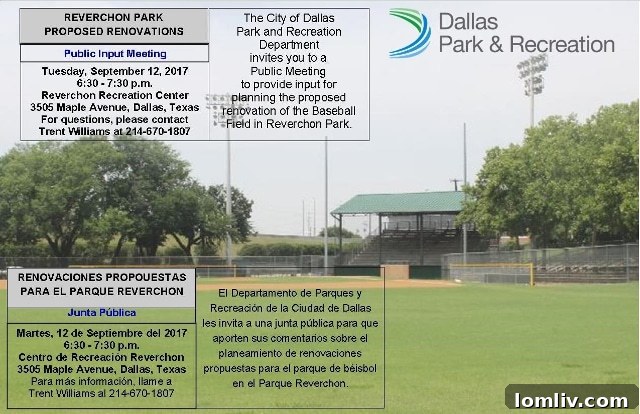
To truly understand how Reverchon Park found itself on the path to potential privatization, one must trace the subtle but significant shifts in language and strategy employed by city officials and interested parties. Public records reveal a series of events, starting with two notably “shady” community meetings organized by the Parks Board in 2017, followed by the issuance of Requests For Proposals (RFPs) in 2018 and 2019. These community gatherings, ostensibly held for public input, were misleadingly titled “Reverchon Park Proposed Renovations.” However, a crucial Park Board briefing document from December 1, 2016, preceding these meetings by several months, carried a different and far more revealing title: “Reverchon Park Ballfield – Proposed Redevelopment.”
This deliberate downgrading from “redevelopment” to the seemingly innocuous “renovations” in public outreach efforts was a strategic move designed to minimize neighborhood concern and potential opposition. “Renovations” implies repairs and improvements within the existing framework, while “redevelopment” signals a fundamental change, often involving demolition, significant construction, and a shift in purpose or character. By softening the language, the city and its partners effectively sidestepped broader public scrutiny over what was, in reality, a plan to fundamentally alter a public park.
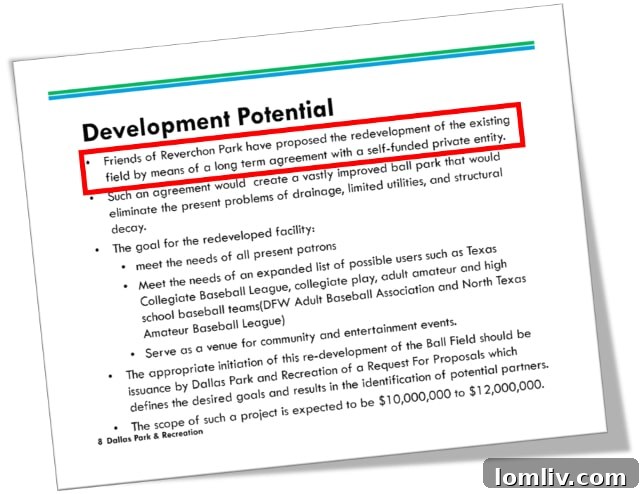
But what was the catalyst for this initial Parks Board briefing that laid the groundwork for “redevelopment” rather than simple maintenance? The briefing document itself provides a stark answer:
“Friends of Reverchon Park have proposed the redevelopment of the existing field by means of a long term agreement with a self-funded private entity.”
“The appropriate initiation of this re-development of the Ball Field should be issuance by Dallas Park and Recreation of a Request For Proposals which defines the desired goals and results in the identification of potential partners.”
This statement unequivocally reveals that the impetus for fundamentally changing Reverchon Park, and specifically for bringing in a private, self-funded entity through a long-term agreement, originated from “Friends of Reverchon Park.” This revelation casts the actions of the “Friends” organization in an even more concerning light, suggesting they were not merely passive benefactors but active proponents of privatizing a public asset, even while diverting funds ostensibly meant for its direct benefit.
The Vision of a Privatized Park: More Seats, Less Green
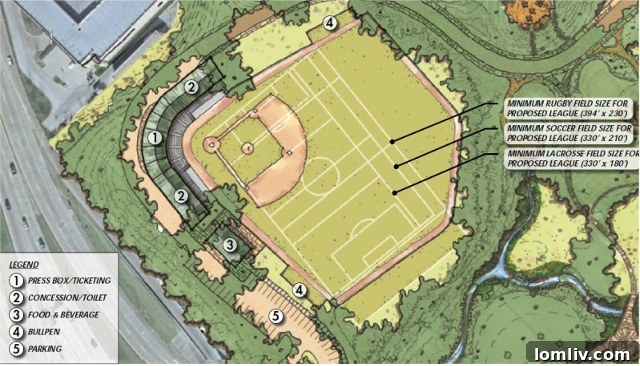
The vision outlined in that initial briefing for a redeveloped ballfield was precise: “1,400 permanent seats and additional 600-1,000 temporary bleacher seats.” This proposal closely mirrored the specifications in the 2018 RFP, which then further expanded to a combined 3,500 seats by 2019, and ultimately appears to have settled on a cleverly crafted total of 5,000 seats. This dramatic escalation in seating capacity is a clear indicator of the shift from a neighborhood park for local sports to a commercial venue catering to larger events.
How does one achieve 5,000 seats in a relatively compact urban park? The strategy involves replacing the natural grass with artificial turf across the entire field. This is presented under the guise of supporting multiple sports like rugby, lacrosse, and soccer, which ostensibly require a more durable playing surface. However, the true motive behind this extensive artificial turf installation is to create a larger, sturdier, and more resilient area capable of accommodating substantial concert and event “lawn” seating. Such a transformation fundamentally alters the character of Reverchon Park, converting a public green space into a hardened, commercialized venue, diminishing its ecological value and traditional role as a natural retreat for the community.
The unfolding saga of Reverchon Park presents a concerning case study in the potential erosion of public assets through administrative maneuvering and opaque financial practices. Those entrusted with the solemn duty to safeguard and maintain Reverchon Park appear to be pursuing a path that aligns more with private commercial interests than with the public good. This compels a reinterpretation of Mark Antony’s famous speech from Shakespeare’s Julius Caesar, “I come to bury Reverchon Park, not to maintain it.” The citizens of Dallas deserve transparency, accountability, and a commitment from their elected officials to truly protect and preserve their invaluable public spaces for generations to come, rather than facilitating their privatization under the guise of necessity.