

The real estate market is a dynamic landscape, constantly evolving with shifts in urban safety, rental trends, and the intricate financial aspects of homeownership. This comprehensive report delves into three pivotal insights shaping the current environment: Plano’s commendable recognition as one of America’s safest cities, the fluctuating yet persistently high national rent prices, and the widespread confusion among Americans regarding the often-misunderstood closing costs of a home purchase. Understanding these factors is crucial for anyone navigating the complex world of real estate, whether as a homeowner, prospective buyer, or renter.
Plano Shines: Recognized as One of America’s Safest Cities
In an era where personal security and community well-being are paramount concerns, achieving a high ranking for safety is an exceptional honor for any municipality. Plano, Texas, has proudly earned the distinction of being named the No. 3 safest city in America, according to WalletHub’s rigorous 2019 report. This prestigious recognition underscores Plano’s commitment to fostering a secure environment for its residents, setting a benchmark for urban safety across the nation.
WalletHub’s comprehensive study, designed to assess where Americans can feel most protected against various forms of danger—both physical and non-physical—evaluated over 180 U.S. cities. The methodology behind this ranking is extensive, comparing cities across an impressive 41 key metrics. These metrics span a broad spectrum, ranging from tangible indicators like assaults per capita to less obvious yet equally critical factors such as the local unemployment rate and the quality of road infrastructure. This holistic approach ensures that the safety ranking reflects not just crime statistics but also the broader conditions that contribute to a city’s overall security and resident peace of mind. As WalletHub spokeswoman Diana Polk highlighted, the diverse dataset provides a nuanced perspective on what truly constitutes a safe urban environment.

Plano’s impressive ranking places it among an elite group of cities dedicated to public safety. According to the report, only Columbia, Maryland, and Yonkers, New York, surpassed Plano in overall safety. Other notable cities that earned a spot on this distinguished list include Gilbert, Arizona; South Burlington, Vermont; Virginia Beach, Virginia; Bismarck, North Dakota; Nashua, New Hampshire; Chandler, Arizona; and Warwick, Rhode Island. This diverse collection of cities, from various regions across the U.S., suggests that effective safety strategies can be implemented successfully in different urban contexts.
The significance of living in a highly-ranked safe city extends beyond mere statistics. For residents, it translates into a higher quality of life, reduced anxiety, and increased opportunities for community engagement and outdoor activities. Families benefit from safe neighborhoods and schools, while businesses are attracted to areas with stable environments and a secure workforce. A strong sense of security also contributes to property value stability and encourages long-term investment in the community. Plano’s achievement is a testament to its effective urban planning, dedicated law enforcement, engaged community programs, and a robust local economy that collectively contribute to its exceptional safety record, making it an exemplary model for cities nationwide.
Source: WalletHub
Navigating the Rental Market: National Data Reveals Shifting Rent Trends
The national rental market remains a significant point of discussion and concern for millions of Americans. As former New York political candidate Jimmy McMillan famously declared in 2005 and 2009, “The rent is too damn high,” a sentiment that continues to resonate with renters across the country. While McMillan’s political party, “The Rent Is Too Damn High,” brought humorous yet poignant attention to the struggles of New York renters, recent data from Zumper underscores that this issue is far from confined to the Big Apple, reflecting broader trends impacting housing affordability nationwide.
The 2019 National Rent Report by Zumper offered a detailed snapshot of the rental landscape, highlighting key trends and regional disparities. The report confirmed that some of the nation’s most expensive rental markets consistently remain at the top. San Francisco, a leading tech hub, held the unenviable position of having the highest median rent for a one-bedroom apartment, commanding an astounding $3,490 per month. Following closely were other major metropolitan areas known for their robust economies and high demand, including New York, Boston, Oakland, San Jose, Los Angeles, Washington, D.C., Seattle, and San Diego. Miami rounded out the top 10, with a median monthly rent of $1,710.
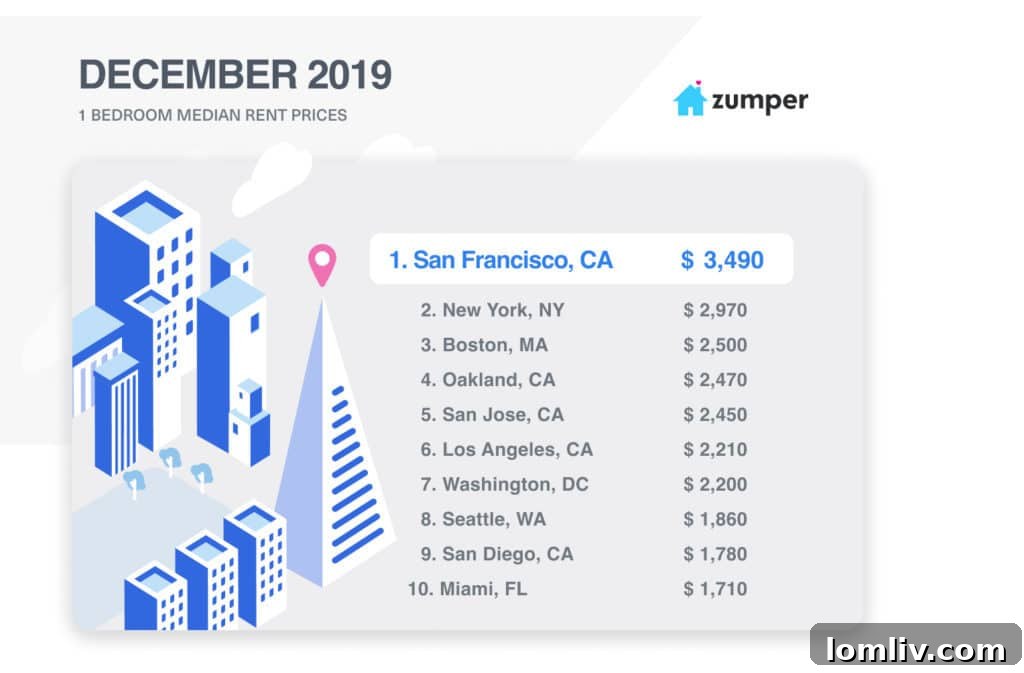
While these cities consistently present high rental costs, the report also observed intriguing short-term fluctuations. During what is typically referred to as the “slow-moving season”—a period often characterized by reduced relocation activity, particularly in cooler months—all of the top 10 cities experienced either flat or downward monthly trends. Washington D.C., for instance, even saw its ranking drop to seventh. This seasonal effect suggests that while overall prices remain high, there can be temporary periods of slight relief or stabilization. Conversely, the national data revealed diverse regional shifts: Minneapolis recorded the largest monthly growth rate, an increase of 5.3 percent, while Virginia Beach experienced the most significant decline, dropping by 5.4 percent. On a broader scale, the national median rent for a one-bedroom apartment saw a slight dip of 0.9 percent to $1,230, and two-bedroom rents fell by 1 percent to $1,465. However, when viewed on a year-to-date basis, the upward trend persists, with one- and two-bedroom rents increasing by 1.8 percent and 1.7 percent, respectively, underscoring the long-term pressure on rental affordability.
The implications of these rental trends are far-reaching. High rents can hinder individuals’ ability to save for a down payment on a home, prolonging their renter status. They also contribute to financial strain for families and low-income earners, potentially leading to difficult choices regarding essential expenses. Factors driving these trends include a persistent housing supply shortage in desirable areas, strong job growth attracting new residents, rising inflation, and interest rate hikes that make homeownership less accessible, pushing more people into the rental market. Understanding these dynamics is crucial for renters seeking affordable housing and policymakers looking to address the ongoing challenge of housing accessibility.
Source: Zumper’s 2019 National Rent Report
Demystifying Homeownership: Understanding the Often-Overlooked Closing Costs
The journey to homeownership is often fraught with excitement and anticipation, but it can also be a source of significant confusion, particularly when it comes to the financial aspects beyond the initial purchase price. Many first-time homebuyers, and even some seasoned ones, often find themselves asking, “You mean I have to pay even more, on top of the $300,000-plus I just dropped for a new home?” This sentiment highlights a critical knowledge gap surrounding closing costs, which can represent a substantial additional expense that buyers might not have fully budgeted for.
Home buying is, by its very nature, a significant financial undertaking. Whether one is eyeing a luxurious multi-million-dollar mansion in a prestigious neighborhood or a more modest two-bedroom home, the sticker price is just the beginning. The real complexity often emerges when buyers encounter the various “hidden” or unexpected costs associated with finalizing the transaction. These additional expenses, collectively known as closing costs, are fees paid at the closing of a real estate transaction. They are incurred by either the buyer or the seller, or both, and can vary significantly based on location, loan type, and the specifics of the sale. Common examples of closing costs include: lender origination fees, which cover the administrative costs of processing the loan; appraisal fees to determine the home’s market value; title insurance to protect against defects in the property’s title; escrow fees for managing the closing process; attorney fees (in states where legal representation is required); property taxes (often prorated); recording fees for legally documenting the sale; and transfer taxes imposed by state or local governments.
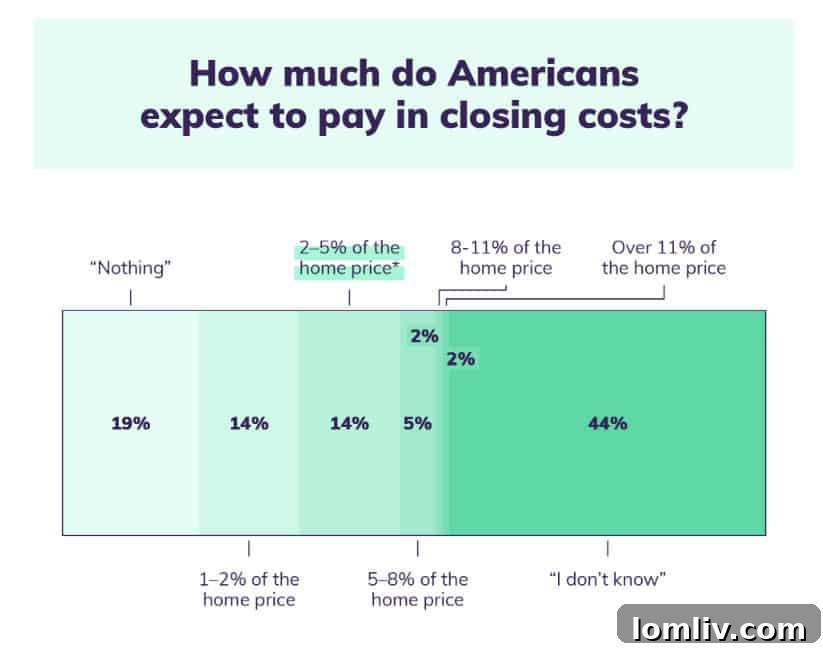
A survey conducted by Esurance, which polled 1,000 Americans to gauge their understanding of closing costs and broader homeownership expenses, revealed a concerning level of confusion and lack of preparedness. Karlie Kramer, a senior content marketing specialist at Esurance, highlighted several key findings:
- Forty-four percent of respondents confessed that they did not know what to expect for closing costs. This statistic underscores a widespread lack of awareness about these crucial expenses, potentially leading to financial surprises at the eleventh hour.
- Alarmingly, one in five individuals surveyed expected to pay absolutely nothing in closing costs. This misconception can create significant budgetary shortfalls and stress for prospective homebuyers who are ill-prepared for these mandatory fees.
- Over half of respondents aged 18 to 34 demonstrated a similar lack of understanding regarding overall homeownership costs. This particular finding is especially critical, as this demographic often represents a large segment of first-time homebuyers who are venturing into real estate with limited prior experience.
The confusion surrounding closing costs can largely be attributed to their complex nature and the varying amounts they can represent, typically ranging from 2% to 5% of the loan amount. For a $300,000 home, this could mean an additional $6,000 to $15,000 in fees. To mitigate this, prospective homebuyers should take proactive steps: diligently question their lenders and real estate agents about all potential fees, carefully review the Loan Estimate provided by their lender (which details all anticipated closing costs), and consider shopping around for certain services, like title insurance, where permitted. Budgeting for these costs from the outset is paramount to ensuring a smooth and financially sound home purchase journey, transforming a potentially stressful experience into an informed and manageable one.
Source: Esurance