
 The dynamic world of real estate and urban living constantly presents new insights, from the practicality of daily commutes to the broader economic indicators influencing property markets, and the ongoing push for diversity within the industry. This week’s real estate roundup brings to light several key developments: Plano and Arlington earning high marks as top cities for drivers, a reported dip in pending home sales during July, and Realogy’s continued leadership in recognizing top LGBT+ real estate agents. These stories collectively paint a picture of varied trends shaping our communities and the housing sector.
Plano and Arlington Shine Among Best Cities for Drivers in WalletHub Study
For residents of North Texas, the latest study by WalletHub offers promising news, identifying several local cities as prime locations for motorists. In a comprehensive analysis of the 100 most populated U.S. cities, Plano proudly secures the 13th spot, making it the highest-ranked city in the Dallas-Fort Worth (DFW) metroplex. Following closely, Arlington distinguishes itself by landing at an impressive 25th place nationally. This recognition highlights the commitment these cities have made to creating favorable driving conditions for their inhabitants.
WalletHub’s methodology for determining the best and worst places to drive considered a wide array of factors crucial to the driving experience. These included not just the immediate costs associated with car ownership and maintenance, but also the quality of traffic and infrastructure, road safety, and accessibility to vehicles and repair services. The study aimed to provide a holistic view of what makes a city truly driver-friendly, moving beyond mere congestion levels to encompass the overall economic and practical aspects of car travel.
Plano’s strong performance at number 13 can be attributed to several factors. Known for its well-planned urban development, Plano often boasts well-maintained road networks, efficient traffic management systems, and a generally lower incidence of traffic-related fatalities compared to other large metropolitan areas. The city’s investment in infrastructure, combined with its suburban design, helps alleviate some of the common frustrations associated with driving in heavily populated regions. Similarly, Arlington’s standing at 25th reflects its efforts in managing urban sprawl and maintaining accessible routes, essential for a city that serves as a major hub for sports and entertainment.
Other DFW cities also made their mark on the list, albeit a bit further down. Dallas, the heart of the metroplex, ranked 29th, followed by Irving at 30th, Fort Worth at 32nd, and Garland at 39th. While these cities face greater challenges in terms of traffic density and larger populations, their inclusion within the top 40 still suggests a commendable level of attention to motorist needs. For the millions of commuters and residents who rely on personal vehicles in North Texas, these rankings provide valuable insights into the quality of their daily driving environments and the broader efficiency of local transportation systems.
Source: WalletHub
Pending Home Sales See a Decline in July, National Association of Realtors Reports
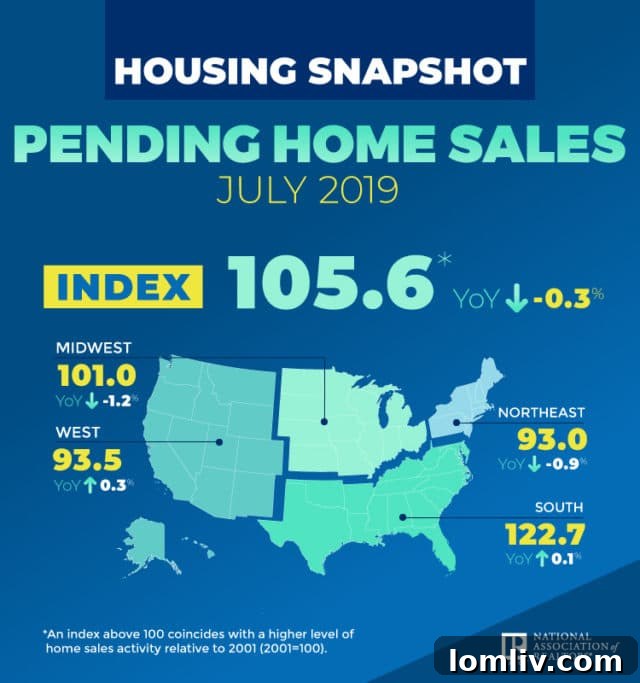 The U.S. housing market experienced a notable shift in July, as pending home sales registered a decline across all four major regions, according to the latest report from the National Association of Realtors® (NAR). This dip followed two consecutive months of gains, suggesting a pause in what had been a period of modest recovery. The Western region, in particular, saw the most significant drop, indicating localized challenges influencing buyer activity.
The Pending Home Sales Index (PHSI), a forward-looking indicator based on contract signings for existing homes, fell by 2.5 percent, moving from 108.3 in June to 105.6 in July. This figure is crucial for understanding the future trajectory of the housing market, as signed contracts typically lead to closed sales within one to two months. On a year-over-year basis, contract signings were down by a marginal 0.3 percent, signaling that despite historically low mortgage rates, the market was struggling to maintain consistent upward momentum.
Lawrence Yun, NAR’s chief economist, offered insights into the underlying causes of this downturn. He noted that even “super-low mortgage rates” have not been sufficient to consistently draw buyers back into the market. This observation points to deeper issues beyond just financing costs. Yun emphasized that “economic uncertainty is no doubt holding back some potential demand,” referring to broader macroeconomic factors that can make consumers hesitant to commit to major investments like home purchases. This uncertainty can stem from various sources, including global trade tensions, fluctuating employment figures, or concerns about future economic growth.
Crucially, Yun also highlighted the persistent challenge of housing supply, stating, “what is desperately needed is more supply of moderately priced homes.” The shortage of affordable inventory continues to be a bottleneck for the housing market, especially for first-time buyers and those with limited budgets. Even with attractive mortgage rates, if there aren’t enough homes available at accessible price points, potential buyers are either priced out or choose to delay their purchases, contributing to slower sales activity.
The regional breakdown of the Pending Home Sales Index reveals varying degrees of impact. In the Midwest, the index dropped by 2.5 percent to 101.0 in July, and was 1.2 percent lower than July 2018. The South also saw a decrease of 2.4 percent, with its index settling at 122.7, though this figure was still 0.1 percent higher than the previous July. The most pronounced decline occurred in the West, where the index fell by 3.4 percent to 93.5 in July. Despite this monthly drop, the Western region’s index was still 0.3 percent higher compared to a year ago, suggesting that while recent momentum may have slowed, the long-term trend still shows some resilience.
The July decline in pending home sales serves as a reminder that the real estate market is influenced by a complex interplay of factors, including interest rates, economic confidence, and crucially, the availability of diverse and affordable housing options. Addressing the supply-side constraints will likely be paramount to fostering sustained growth in the months ahead.
Source: NAR
Realogy Affiliated Agents Dominating the NAGLREP Top LGBT+ Agent List for Second Consecutive Year
Realogy, a global leader in real estate franchising and brokerage services, proudly announced last week that its affiliated agents have once again secured a dominant position on the National Association of Gay and Lesbian Real Estate Professionals (NAGLREP) Top LGBT+ Agent List. This marks the second consecutive year that Realogy-affiliated professionals have led the rankings, underscoring the company’s strong commitment to diversity, inclusion, and the support of its vast network of talented agents.
The NAGLREP Top LGBT+ Agent List is a prestigious recognition that celebrates the highest-producing LGBT+ real estate agents and teams across the United States. It not only highlights individual success but also promotes visibility and excellence within the LGBT+ real estate community. Realogy’s impressive showing reflects the company’s sustained efforts to foster an environment where diverse professionals can thrive and achieve exceptional results.
The statistics from this year’s list are compelling. More than half of the agents recognized were ranked by their outstanding sales volume, while 49 percent of the agents earned their spots based on individual sides. Overall, a remarkable 35 percent of all agents and teams celebrated in the new rankings are proudly affiliated with a Realogy brand. This builds upon Realogy’s already strong performance in last year’s inaugural list, demonstrating consistent leadership and a robust support system for its agents.
Realogy’s diverse portfolio of renowned real estate brands—which includes household names like Coldwell Banker, Better Homes and Gardens Real Estate, Sotheby’s International Realty, Century 21, The Corcoran Group, and Climb Real Estate—played a significant role in this achievement. These brands collectively represented six of the top 10 and an impressive 14 of the top 20 agents ranked by individual volume. Furthermore, they secured six of the top 10 and nine of the top 20 agents ranked by individual sides, showcasing a widespread culture of high performance across the Realogy family.
Breaking down the brand-specific successes, Sotheby’s International Realty distinguished itself by leading all brands in the sheer number of agents ranked by individual sales volume. The luxury real estate giant also boasted five of the top 10 agents ranked by individual volume, reinforcing its position at the pinnacle of high-end real estate. Meanwhile, Coldwell Banker demonstrated its extensive network and agent strength by leading all Realogy company brands with 20 affiliated agents and teams featured in the comprehensive rankings.
John Peyton, President and CEO of Realogy Franchise Group, underscored the company’s dedication to its diverse workforce. “We remain committed to supporting and developing our base of diverse real estate professionals and are elated that they continue to have such a strong showing on NAGLREP’s list of top LGBT+ producers,” Peyton stated. He further emphasized the depth of their partnership and inclusive culture: “Our longstanding, collaborative partnership with NAGLREP and the fact that so many successful LGBT+ agents affiliate with Realogy brands are more proof that the LGBTQ+ community and its allies have a home at Realogy.” This statement reinforces Realogy’s ongoing commitment to fostering an inclusive environment where all agents, regardless of background, can find the resources, support, and community needed to excel in their careers and serve a diverse client base effectively.