In the complex world of urban development and city planning, achieving consensus among various stakeholders is often likened to navigating a minefield. Recent sessions with an Authorized Hearing committee have highlighted this challenge, showcasing a unique dialect forming among its members. When the city facilitator attempts to summarize a previous agreement, phrases like “We agreed on X” are frequently met with immediate dissent: “We didn’t agree on that.” This isn’t merely a semantic squabble; it reflects a deep-seated individualistic approach, where personal non-agreement invalidates any broader group understanding. Such a mindset, where every participant expects 100 percent of their demands to be met, inevitably leads to a stalemate, akin to ancient children unwilling to share their toys. This lack of collective vision and compromise threatens to derail essential progress in urban development, stalling critical decisions that will shape our city’s future.
Strategic Parking Solutions in Urban Development
A significant portion of the recent committee session focused on reviewing responses to homework assignments, with a primary goal of finding common ground on various topics. The discussion on parking requirements quickly emerged as a central, yet ultimately frustrating, point of contention. The inherent challenge lies in asking committee members, who are not certified parking experts, to weigh in on highly technical specifics such as whether the standard should be one space per bedroom, 1.5 spaces per unit, or a full two spaces per residence. These discussions often devolve into mere guesswork, lacking empirical data or expert analysis to guide decisions. Furthermore, an underlying fear permeated the conversation: the concern that developers might overbuild parking facilities, leaving a costly surplus once disruptive technologies like Uber and autonomous vehicles fully transform urban mobility.
However, this apprehension regarding an oversupply of parking in multifamily residential developments is largely misplaced. The reality of urban land use dictates that unused space is a rare commodity. Should a paradigm shift occur, such as a hypothetical “automobile rapture,” parking structures would not simply become derelict. Instead, these versatile spaces could be creatively repurposed: transformed into much-needed storage facilities (a potential disruption to the existing storage industry), converted into valuable amenity spaces for residents, or even adapted into additional living units, especially for above-ground, flat-deck garages. The adaptability of these structures ensures that investment in parking is rarely wasted. Therefore, the greater concern for thoughtful city planners should always be an undersupply of parking, which can create significant ripple effects throughout a neighborhood, rather than a theoretical surplus.
The committee also touched upon the controversial topic of street parking. While a few members expressed a desire to eliminate it entirely, such a move is largely impractical and often undesirable. Most new urban developments will invariably maintain a certain number of external spaces for short-term needs – quick drop-offs, brief visitor parking, or service vehicle access. Requiring every short-term interaction to necessitate entry into a structured garage is inefficient and inconvenient, making a complete eradication of street parking an unrealistic goal in a dynamic urban environment.
Beyond the sheer numbers, there was a general acceptance among most committee members for some form of above-ground parking, provided it could be effectively camouflaged. Solutions like wrapping garages with residential units or implementing attractive screening mechanisms were considered acceptable. A particularly amusing moment arose when one response suggested mandating underground parking for existing structures like Athena and Preston Tower, as if they could simply begin excavating fifty years after their initial construction. This highlights the disconnect between aspirational planning and practical, real-world development constraints.
Residential Proximity Slope (RPS) and Tower Spacing: Safeguarding Neighborhood Character
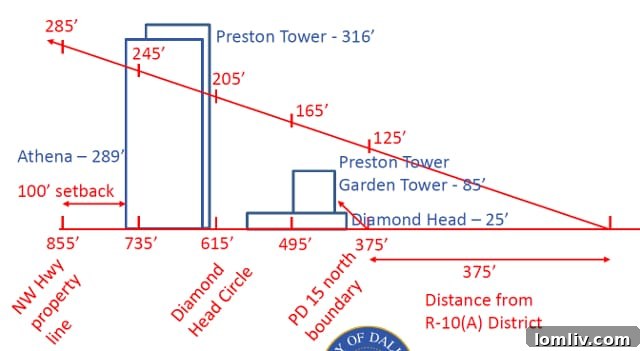
The concept of the Residential Proximity Slope (RPS) re-emerged as a contentious but critical topic. While RPS is not explicitly mandated for PD-15, many stakeholders are keen to understand its potential implications. RPS is an urban planning tool, essentially a hypothetical slope extending from existing single-family neighborhoods towards areas designated for higher allowable building heights. Its primary function is to prevent imposing tall structures from casting shadows or creating an overwhelming presence over lower-rise residential homes by requiring them to step back or reduce in height. This creates a more gradual transition in building scale, similar to the visually appealing stair-step buildings seen at Preston Center along the tollway, which gracefully recede from the adjacent Devonshire neighborhood.
The discussion surrounding RPS proved particularly unsettling for some committee members. The representative for Diamond Head Condos, for instance, vocally opposed being subjected to RPS, arguing that it would unduly restrict their future redevelopment potential, which they envisioned as having “infinite height.” This stance underscores a common tension in urban planning: the balance between maximizing development potential and preserving the existing neighborhood character and residents’ quality of life.
A moment of genuine head-snapping humor, though tinged with irony, occurred when someone suggested that RPS should indeed be applied, even to established structures like Athena and Preston Tower, should they ever undergo voluntary redevelopment or be forced to rebuild after a natural disaster. The immediate, almost panicked, reaction from representatives of these towers was a rapid stammering of “grandfather” – an appeal to their existing, non-conforming status. This revealed a striking double standard: while they were comfortable dictating stringent limitations on others, the mere suggestion of similar restrictions on their own properties sent a jolt through the room. This “not-in-my-backyard-unless-it-benefits-me” mentality is a significant hurdle in achieving equitable and sustainable urban growth.
And frankly, despite the often-negative and self-serving stances taken by these established towers, if I were a representative for the surrounding low-rise properties, I would dedicate myself to ensuring Athena and Preston Tower are indeed tied to the RPS. This isn’t about retribution, but about fairness and ensuring that future development, regardless of its origin, adheres to a consistent set of guidelines designed to protect the broader community’s interests.
Closely related to RPS in its objective of harmonious urban design is Tower Spacing – a critical regulation dictating step-backs and adequate separation when two tall buildings are constructed in close proximity. On this matter, Athena signaled a “yes,” while Diamond Head emphatically said “no.” My perspective firmly aligns with “yes,” and here’s why:
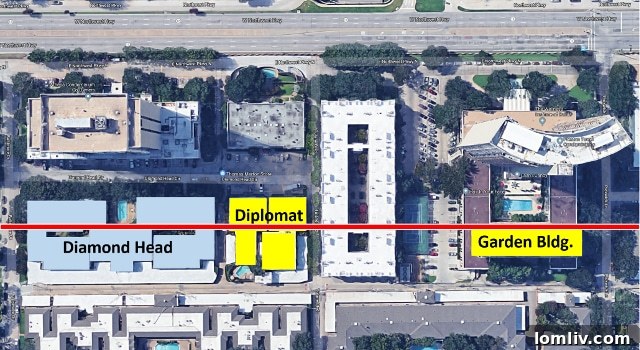
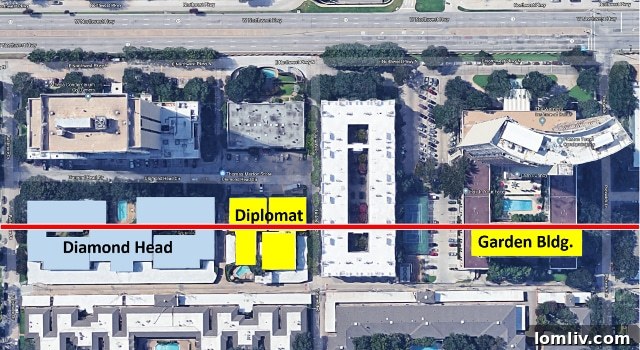
Many proponents of less stringent spacing point to Preston Tower’s garden building, noting its separation from the main tower. However, this comparison overlooks a crucial detail: the garden building is merely two *units* deep. In contrast, Diplomat and Diamond Head comprise two distinct *buildings* deep, with only a slight separation. This structural difference means that the Diplomat and Diamond Head buildings are effectively twice as “thick” as the garden building, and consequently, positioned twice as close to their immediate neighbors. While a somewhat wider separation already exists between Diplomat and Royal Orleans, the proximity between Athena and Diamond Head becomes alarmingly cramped at greater heights. If Diamond Head Condos intends to extend into the residential floor plane of Athena, a significant step-back is not just advisable but essential for light, air, and privacy. It’s highly probable that the complexes bordering Diamond Head’s northern boundary would also advocate for similar step-back requirements.
Furthermore, and perhaps most importantly, the opinions of myself, Athena, or Diamond Head are, in this specific instance, secondary to established regulations. PD-15 documents explicitly state that if a particular parameter is not addressed within its text, it defaults to the provisions outlined in MF-(3) within Chapter 51 of the city code. Critically, Tower Spacing is clearly denoted and regulated within Chapter 51. While the committee might possess the authority to waive certain requirements, unlike RPS which may require specific adoption, tower spacing is already legally binding. City staff initially positioned this as an “option,” but a closer reading of the code reveals it’s a mandatory default. It’s already there, and its enforcement is crucial for maintaining urban design integrity.
On one protectionist point raised by the tower representatives, I did find myself in agreement. Diamond Head lamented having to look out her window directly at the sheer, tall face of Athena. The immediate, and accurate, counter-response was: “you knew what you were buying.” This is a fundamental corollary to moving near an airport and then complaining about the noise. While empathy for residents’ views is important, there are limits to accommodating complaints about pre-existing conditions or foreseeable impacts. I have no sympathy for arguments that disregard due diligence in property acquisition, as it undermines rational planning and fair expectations.
Diamond Head Condos: The Perils of Unrealistic Development Envelopes
This seems an opportune moment to express my frustration with the approach taken by Diamond Head Condos during the recent meeting. I’m not speaking out of turn, as I conveyed these sentiments directly to their representative afterward. Their stated objective for every dimension – height, width, and density – was to achieve the absolute maximum possible. This ambition bordered on excessive greed. The representative later admitted she fully expected the city to reject such an expansive proposal, but their strategy was to secure an enormous “envelope” of development potential, allowing future developers to then “fight it out” with City Hall for a more realistic approval.
My initial point to her was that this unrealistic and excessive demand was counterproductive in a negotiation setting; it was actively scaring other stakeholders and causing them to dig in their heels, making compromise more difficult. My second, and perhaps more critical, point was that pursuing such a vast and ill-defined envelope, then expecting the city to decipher it, misses a fundamental opportunity. The great strength of this often-confusing and frustrating planning process is that it empowers the neighborhood with a significant degree of control *before* projects even reach the Plan Commission and City Council. Why would any community want only two sets of eyes (city staff, and city council) on a development proposal when they could have three, with the third being the highly localized neighborhood that can provide specific, nuanced tweaking? These granular adjustments might seem minor to city planners but could be profoundly important to the immediate residents, ensuring projects are truly integrated and beneficial.
A third, more financially oriented point that occurred to me later, further invalidates this “maximalist” strategy. Even if a virtually unlimited buildable envelope were granted, the city would inevitably scale it back to something realistic when a developer attempts to fill it. Developers don’t base their payments on “maybe”; they pay on “permits.” Therefore, whatever a developer hypothetically agreed to pay (contingent on approval) for a seemingly unlimited envelope would be heavily discounted back to the value of what was actually permitted. This means there’s no real financial advantage in securing a “bazillion dollar” buildable envelope when the city will only ultimately approve a “quarter of a bazillion dollar” project. The final monetary value paid to the landowner remains largely the same, but the entire process is unnecessarily prolonged by the battles fought over an unrealistic envelope. Furthermore, it needlessly frightens the neighborhood, fostering opposition where cooperation is needed. Ultimately, it serves everyone’s best interests to work towards an 80-90 percent “nailed down” envelope upfront, allowing a developer to make only minor, manageable tweaks. This approach streamlines the process, builds trust, and leads to more predictable and successful outcomes for all parties involved in urban development.
The Critical Role of Building Setbacks in Urban Aesthetics and Functionality
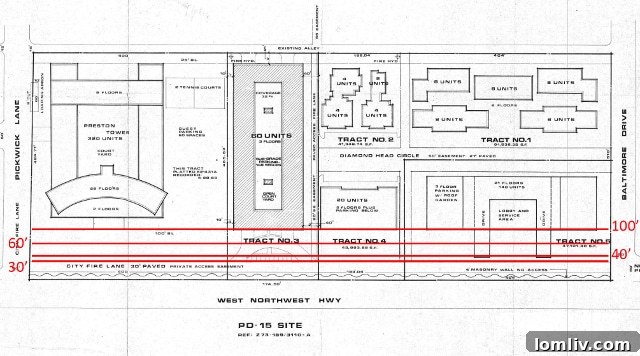
More unintentional comedy unfolded during the discussion on building setbacks. I strongly suspect the homework question concerning this topic was poorly articulated or misunderstood, leading to some perplexing responses. Currently, a significant 100-foot setback exists from Northwest Highway northward, affecting properties such as Preston Tower, Preston Place, Royal Orleans, and Athena. To my knowledge, this setback is explicitly documented within each building’s deed, signifying a long-standing land use agreement. However, the committee was asked to propose what an “appropriate” setback should be, opening the door for creative, if not entirely practical, suggestions.
Before delving into the committee’s specific responses, it’s crucial to visualize the existing physical landscape. The actual “Pink Wall” separating Northwest Highway from the first curb is only about five feet wide. Following this, there’s a parallel parking lane that stretches across most of the area, approximately 10 feet wide. Beyond that lies a generously sized two-lane road. Only after these elements do various land uses begin, eventually leading up to the existing buildings. When all these components are added together, they collectively account for the existing 100-foot setback.
Alarmingly, three committee members expressed comfort with a mere 30-foot setback from the “property line,” which in this context means Northwest Highway itself. Such a drastic reduction would result in new buildings being constructed almost in the middle of the existing frontage road. Even at a slightly more generous 40 feet, a sheer face of a building would rise only a handful of feet north of the roadway. This proposal is deeply problematic on multiple levels.
It demands a serious reconsideration. Not only would such a dramatic reduction in setbacks pull new buildings out of alignment with existing structures, creating a chaotic streetscape, but it would also be aesthetically jarring. We don’t typically place single-family homes directly adjacent to sidewalks in residential areas for good reason; the lack of transition space creates an oppressive and uninviting environment. Applying this principle to multi-story urban developments would result in an ugly and inhospitable urban canyon.
There is, however, one underlying reason why such a drastic change might even be considered: the unique situation of Royal Orleans. While Preston Place, for example, sits on a comfortable two acres, Royal Orleans is situated on a comparatively tiny lot, further constrained by required setbacks on all four sides. If they could significantly build into the 100-foot Northwest Highway setback, it would undoubtedly increase their property’s redevelopment value. But the critical question remains: at what cost to the overall neighborhood aesthetic and functionality? The existing Royal Orleans property already encroaches upon this 100-foot setback with its yard and pool, visibly pinching the frontage road and contributing to an irregular urban fabric.
Royal Orleans’ representative appeared to advocate for a zero setback outside the frontage road. This ambitious proposal would effectively add approximately 65 feet to their buildable lot, dramatically pulling one building significantly out of alignment with its neighbors. Compounding this issue is their desire for the “front” of any new building to face Diamond Head Circle, which would leave the primary frontage road framed by a tall, sheer block jutting out of alignment and directly into the visual plane of passing traffic and adjacent properties.
My unequivocal answer is “No.” I apologize, but such a proposal represents an unacceptable level of aesthetic degradation and functional disruption. I did not design PD-15, and the current owners of Royal Orleans likely did not purchase their property with the explicit expectation of cashing out to a developer based on a radical reinterpretation of zoning. (And if they did, they made a poor investment choice by acquiring the smallest plot in the area with significant constraints.) While it can undoubtedly feel frustrating and unfair when neighboring properties are able to redevelop into more profitable projects, the stark reality is that life, and real estate, are not always fair. While some reasonable accommodations can and should be explored, Royal Orleans’ specific parcel of land simply isn’t worth as much as larger, less constrained plots precisely because there isn’t enough usable land. Furthermore, Royal Orleans has been in ongoing discussions with Preston Place’s buyer, Provident. If Provident successfully connects the two parcels, the entire need for setback relief for Royal Orleans would vanish. The neighborhood certainly has no need for both buildings to be pulled forward, creating a disjointed and visually offensive streetscape. Thoughtful city planning demands adherence to principles that benefit the entire community, not just individual property owners seeking maximal profit.
Streamlining Side and Alley Setbacks for Urban Efficiency
It’s remarkable how much debate can arise from seemingly minor details like alley setbacks. These are currently set at 20 feet, a dimension that typically accommodates the carports lining many urban alleys. For reasons that remained unclear and somewhat baffling, city staff persistently advocated for the inclusion of sidewalks within these alleys. One must question the rationale: are we envisioning leisurely strolls amidst mechanical equipment, noisy HVAC chillers, and malodorous dumpsters, all while gazing poetically at overhead power lines? Alleys traditionally serve as utilitarian service corridors, and introducing pedestrian infrastructure there seems illogical and potentially unsafe, diverting resources from more appropriate pedestrian pathways.
Side lot setbacks exhibit a more varied range, spanning from 10 to 40 feet, often accompanied by a patchwork of inconsistent sidewalks. To gain a practical understanding of effective urban design, I strongly urge all committee members to carpool through vibrant urban districts like Uptown, Oak Lawn, and Knox. Observe the new apartment buildings in these areas and their respective setbacks. Most typically feature setbacks of around 10 feet, complemented by a dedicated sidewalk. This configuration places buildings remarkably close to the street, yet still provides a functional pedestrian zone. To put it in perspective, my sofa measures 10 feet long; as a setback, it’s not particularly impressive in terms of creating expansive open space. However, when considering sidewalk width, a “two-scooter passing width” often proves adequate for urban pedestrian flow, prioritizing functional transit over excessive, unused space.
Balancing Height and Density: A Search for Practical Solutions
The discussion concerning building height continued to elicit a range of impractical and even whimsical responses. For the low-rise properties, suggestions for maximum height varied wildly from a modest 25 feet to an towering 330 feet – a completely unhelpful spectrum given the context. Similarly, density proposals ranged from maintaining existing units per acre to an astonishing 160 units per acre. To contextualize, 160 units per acre represents an increase of 35 units per acre *more* than what A.G. Spanos is currently proposing for a high-density project, which itself is considered substantial. Such a broad and often exaggerated range of responses underscores the committee’s struggle to grapple with realistic development parameters.
For the existing Athena and Preston Tower, proposed heights largely mirrored their current stature, though other replies included calculations based on RPS (ranging from 205-285 feet for the main towers, or 125 feet for the garden building), 250 feet, and 330 feet. Density recommendations for these towers also mirrored the unhelpful spread seen with low-rises, from existing densities up to 160 units per acre. Again, these widely divergent figures offered little actionable guidance for city planners or developers seeking clear parameters for sustainable urban growth.
Compounding the problem was a notable instance where a committee member’s mathematical skills proved to be considerably off the mark. It was posited that constructing $700,000 townhouses would generate comparable profitability for all stakeholders. This assumption is fundamentally flawed. Let’s crunch the numbers: assuming an average townhouse footprint and cramming 15 units onto a single acre (a very dense arrangement for townhouses), the total project value would be approximately $10.5 million. In stark contrast, the proposed Diplomat project by A.G. Spanos, occupying roughly an acre, is estimated to have a completed value in the neighborhood of $50 million. Furthermore, if we consider the rumored $18.5 million price tag for Preston Place’s two acres, a developer like Provident would be left with only $2.5 million for a full build-out after land acquisition – a clearly insufficient amount. This demonstrates that a simple “back-of-the-envelope” comparison often fails to capture the complex economic realities and profitability differentials between low-density and high-density urban development, underscoring the need for expert financial analysis in planning decisions. Indeed, to err is human, but in city planning, such errors can have significant long-term consequences.
Guiding the Process: The Essential Role of City Staff in Facilitating Consensus
In a refreshing turn, the city staff at this particular meeting adopted a more prominent role in offering their opinions and guiding the path forward. While some committee members found this increased assertiveness off-putting, I personally found it immensely encouraging. Without a dedicated individual or team to help steer these complex discussions and actively capture decisions as they are made, this intricate urban planning process would undoubtedly stumble on indefinitely, much like a perpetually running Law & Order franchise. As long as the staff avoids putting words into the committee’s mouths and focuses instead on facilitating, clarifying, and summarizing, I am entirely in favor of this “cat herding” approach. Effective moderation and expert guidance are not just helpful; they are absolutely essential for moving critical urban development discussions from endless debate to actionable outcomes.

Remember: My focus consistently revolves around high-rises, homeowners’ associations (HOAs), and property renovation. However, I also deeply appreciate the delicate balance between modern and historical architecture, especially in the context of the evolving YIMBY (Yes In My Backyard) movement advocating for increased housing density. My writing has garnered significant industry recognition; in 2016, 2017, and 2018, the National Association of Real Estate Editors honored my work with three Bronze awards (2016, 2017, 2018) and two Silver awards (2016, 2017). If you have a story to share, a perspective on urban development, or even an unconventional marriage proposal, please don’t hesitate to reach out via email at [email protected]. You’re also welcome to search for me on Facebook and Twitter; you won’t find me there, but the effort is appreciated.