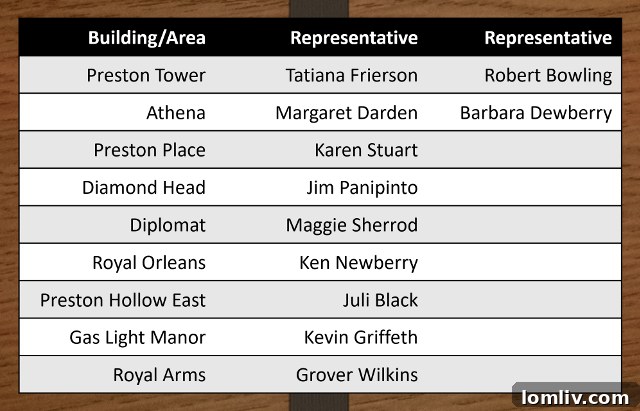
PD-15 Zoning Update: Committee Formed, Critical Decisions Ahead for Dallas’s Preston Hollow
In a significant development for the future of Preston Hollow’s PD-15 zoning district, the highly anticipated Authorized Hearing Committee has been finalized, albeit with a slight change in representation. Following the initial announcement, Preston Tower representative Mary Schulte has stepped down, with Robert Bowling now joining the committee in her place. This adjustment underscores the dynamic nature of community engagement in such crucial planning processes and ensures all voices are represented as effectively as possible.
The formation of this committee marks a pivotal moment, and considerable credit is due to Council Member Jennifer Gates. Her commitment to ensuring the committee comprises individuals genuinely interested in collaborative problem-solving, rather than those intent on obstructing the proceedings, is commendable. This strategic selection aims to foster productive discussions and constructive outcomes for all stakeholders involved in the complex PD-15 redevelopment. The community eagerly anticipates how this diverse group will navigate the intricate landscape of urban planning and neighborhood preservation.
The committee’s composition has been meticulously structured to reflect the unique demographics and land distribution within PD-15. Recognizing that the area encompasses both prominent high-rise towers and several low-rise residential buildings, each occupying roughly six acres, the committee includes two representatives from the high-rises and four representatives from the low-rise communities. This balanced representation ensures that neither side can unilaterally outvote the other, necessitating a spirit of genuine collaboration and compromise from the outset. This deliberate structure sets the stage for negotiations that prioritize collective benefit over individual interests, fostering a truly cooperative environment for urban planning.
Adding another layer of intrigue to the committee’s dynamics are the three “wild card” members. These representatives hail from the Preston Hollow East Homeowners Association and two adjacent buildings, bringing external perspectives to the table. Their independent viewpoints are expected to introduce fresh considerations and potentially bridge divides between the established factions. How these crucial “wild card” members will evaluate various development plans and options remains a key unknown. Their initial sentiments and priorities will likely emerge during the committee’s inaugural meetings, where the collective pulse of the group will undoubtedly be established, setting the tone for future discussions and decisions.
Navigating Dallas City Planning and Zoning: Unveiling the Process
In parallel with the committee’s formation, Dallas city staff has been diligent in providing transparent resources to help the public understand the authorized hearing process. Essential documents, including a comprehensive flowchart detailing each step, have been made available on the Dallas City Hall website (accessible here). This proactive approach aims to demystify what can often be an opaque process, offering clarity to residents and stakeholders alike. It’s crucial to understand that while the flowchart outlines sequential steps, the numbering does not imply a rigid timeline, as the duration of each phase can vary based on complexity and community input.
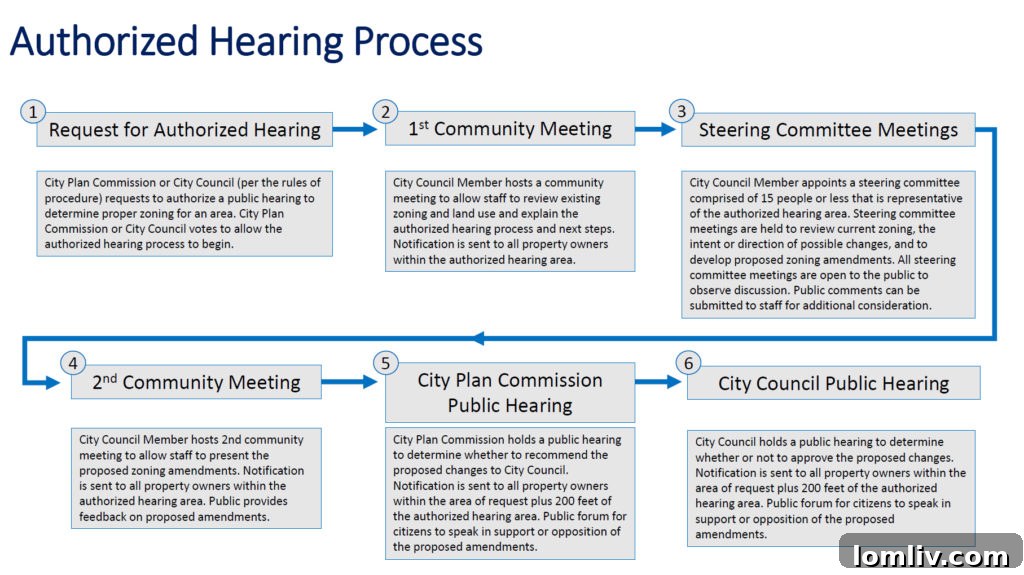
This recently released flowchart serves as an invaluable “cheat sheet” for anyone seeking to grasp the intricacies of the authorized hearing process. It meticulously outlines the progression of steps the committee will undertake, from initial deliberations to final recommendations. By detailing what each phase entails, the document empowers citizens to follow along with greater understanding and to identify key points for potential public input. To ensure widespread accessibility, residents are encouraged to download their personal copy, making it convenient to reference during community meetings or personal review.
A Minor Zoning Bombshell: Unpacking Height Restrictions in PD-15
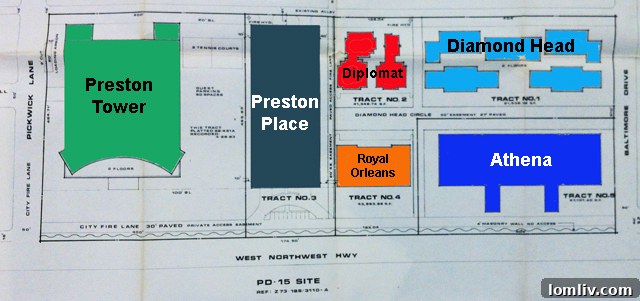
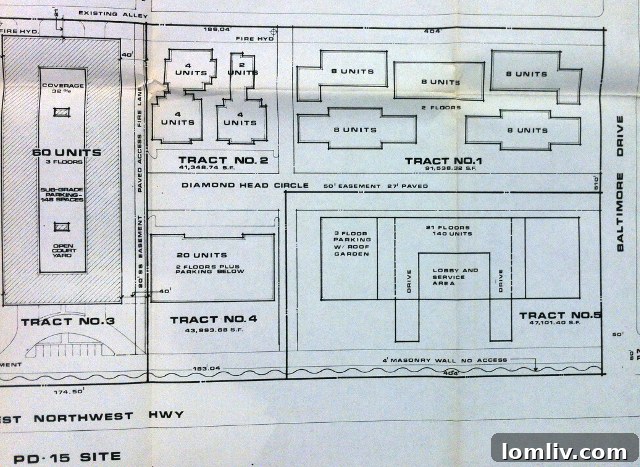
The image above offers a close-up perspective of the current PD-15 development plan, a document whose interpretations continue to evolve. Historically, understanding of PD-15 zoning limitations suggested that new buildings could only replace existing dwelling units on a one-to-one basis, unless developers secured unanimous permission to utilize a pool of approximately 60 surplus units or a comprehensive update to PD-15 was enacted. This understanding primarily focused on density, governed by the dwelling units per acre cap, guiding how much could be built on any given tract.
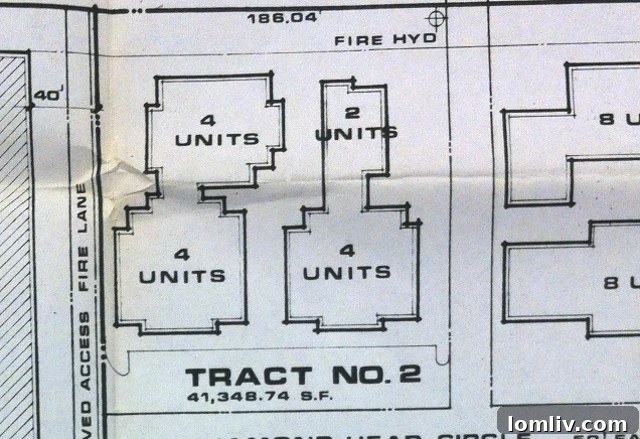
However, city staff have recently introduced a nuanced interpretation through their updated FAQ document, revealing what can be termed a “minor zoning bombshell.” This new clarification asserts that building height is also implicitly capped across much of PD-15, as the existing development plan explicitly lists the heights of most buildings. For instance, Preston Place is noted as three stories, while both Royal Orleans and Diamond Head Condos are listed as two stories. The significant exception is the Diplomat, situated on Tract 3, which has no specified height listed in the development plan. City staff now interpret this omission to mean that only the Diplomat possesses the inherent flexibility to exceed its current two-story construction, a detail that was not widely understood previously.
While this revelation might initially sound impactful, it’s considered a “minor bombshell” because its immediate practical implications are somewhat limited. Even with the theoretical ability to build higher, the Diplomat is still fundamentally constrained by the overall dwelling unit cap for the PD-15 district and the strict floor-area-ratio (FAR) of 4:1. This means that while vertical expansion is technically possible, the total buildable area and number of residences remain firmly regulated, preventing unrestrained high-rise development. Nevertheless, this new interpretation highlights the subtle complexities embedded within long-standing zoning documents and could still influence development proposals for that specific tract.
Empowering Your Voice: Navigating the Approval Process and Protecting Property Rights
Regardless of the recommendations put forth by the Authorized Hearing Committee, which conducts its proceedings open to the public, any proposed changes must still undergo the rigorous, multi-stage typical zoning process. This critical phase involves broad community notification: property owners situated within 200 feet of PD-15 will be formally informed of the proposed modifications. They will receive an official form, providing them with the opportunity to formally “support” or “oppose” the changes by mailing their response back to the city. This mechanism is vital for ensuring democratic participation in land use decisions.
The weight of community opposition in this process is substantial. Should more than 20 percent of notified property owners express opposition, any subsequent action by the Dallas City Council to approve the proposed changes would require a formidable super-majority vote. Specifically, 75 percent of council members—equivalent to 12 “yes” votes—would be needed to move forward. This incredibly high bar serves as a robust safeguard for existing communities, making it exceptionally challenging to push through changes that lack significant public consensus. It underscores the power of organized community voice in shaping local development.
For residents of the “Pink Wall” communities, and especially those within PD-15, a critical internal matter demands urgent attention: the language within their Homeowners Association (HOA) documents. It is absolutely imperative that HOAs review and, if necessary, amend their governing documents to explicitly enable individual unit owners to cast their own votes on such zoning matters. Without this provision, the power to decide on behalf of all residents typically rests solely with the HOA board. This undemocratic structure means that a small group could make decisions impacting the property values and future of an entire community, potentially without even consulting their owners. An attorney could draft the appropriate enabling language in a relatively short timeframe, ensuring every homeowner has a direct say in their future. If an HOA board resists implementing this change, it could be a telling sign that their own decision has already been made, potentially putting individual homeowners in a precarious position regarding their property rights and community future.
High Stakes: The “Doom and Gloom” Scenario vs. A “Ray of Light” for PD-15
The “Doom and Gloom” Scenario: Consequences of Failure
The stakes for the PD-15 Authorized Hearing Committee are incredibly high. Should the committee’s proposal ultimately fail to gain approval, the current zoning and development plans for the area would remain entirely unchanged. This outcome triggers a cascade of severe economic consequences, particularly for the four low-rise complexes within PD-15. Without an updated plan, these communities would be forced to find an internal accommodation to divide the approximately 60 surplus dwelling units, a process fraught with financial peril.
To illustrate the gravity of this situation, consider Preston Place. Their current rumored offer of $18 million is predicated on the ability to develop 220 new units. If the committee’s proposal collapses and they are limited to only 80 units (their existing 60 units plus their land-based allotment of the surplus), the value of their land would plummet to an estimated $6.5 million. This drastic reduction would translate into a catastrophic drop in individual home values, from roughly $300,000 per unit to a mere $109,000. Similarly, the Diplomat’s one-acre parcel, which A.G. Spanos reportedly intended to develop with 120 units, would see its value diminish by an astounding 80 percent if restricted to an allotment of only 25 units (its existing 15 units plus a 10-unit share of the surplus).
Such a severe devaluation would send negative ripple effects across not only PD-15 but also the broader “Pink Wall” community. The prospect of impaired land values would effectively deter reputable developers from investing in the area to construct desirable, million-dollar townhomes or upscale developments. The cautionary tale of the failed Park Hollow development serves as a stark reminder that developers are unlikely to repeat past mistakes by investing in projects with untenable economic models. The economic viability of the entire district hinges on a successful resolution.
Beyond the immediate financial impact, the quality of any resulting projects under the “as-is” scenario would inevitably be compromised, failing to enhance the value of existing complexes. Developers, facing constrained budgets and limited returns, would have little incentive to contribute to neighborhood enhancements, green spaces, or improved infrastructure—critical components for a vibrant community. The minimal construction that might occur would largely go unnoticed by city planners, failing to attract the necessary attention or resources to address existing community problems. While a “doom and gloom” scenario might result in less density, the overall cost—in terms of lost property value, diminished community amenities, stagnant development, and a declining quality of life—would be profoundly detrimental to the long-term health and desirability of the area.
A “Ray of Light”: The Path to a Brighter Future
Fortunately, this bleak “doomsday” scenario is far from inevitable. There is a significant “ray of light” emanating from the current timing and structure of the PD-15 committee process. What makes this moment particularly optimistic is the strong incentive for developers to present their most compelling, well-defined, and community-sensitive plans to the committee. Developers are well aware that this process is unlikely to be reopened anytime soon once completed. Therefore, it profoundly behooves them to bring their “A+” game now, presenting proposals that are not only economically viable but also genuinely beneficial to the community and align with the committee’s vision for specific approvals. Any developer who waits or proposes subpar plans risks being stuck with whatever the committee ultimately decides, which might not be favorable for future, more ambitious projects.
As an observer deeply invested in the thoughtful development of our communities, I eagerly anticipate the proposals that will emerge from this process. My hope is to see innovative solutions that address the area’s challenges, coupled with a genuine commitment of resources and investment from both developers and the city. These contributions could lead to significant neighborhood enhancements, improved infrastructure, and a sustainable future for PD-15. While I am prepared to oppose any plan that falls short of these ideals, I am equally enthusiastic about the prospect of truly outstanding proposals that could profoundly benefit the Preston Hollow community. If they are truly great, wouldn’t that be a remarkable outcome for everyone involved?
A final note to all developers involved: This is your opportunity to demonstrate vision, innovation, and community commitment. Bring your “A+” game – the future of PD-15 depends on it.

Remember: My focus remains on high-rises, HOAs, and renovation trends, alongside a keen interest in balancing modern and historical architecture with the progressive YIMBY (Yes In My Backyard) movement. My commitment to insightful real estate commentary has been recognized by the National Association of Real Estate Editors, earning two Bronze (2016, 2017) and two Silver (2016, 2017) awards in 2016 and 2017. Should you have a story to share, an interesting development to discuss, or even an unconventional marriage proposal, please don’t hesitate to reach out via email at [email protected]. While I encourage you to look for me on Facebook and Twitter, you’ll find I maintain a discreet online presence—but feel free to search!