

The Great Relocation: How Remote Work Reshaped High-Earners’ Mobility and the Housing Market
The global pandemic, an unprecedented disruptor, ushered in a transformative era for the professional landscape. For millions of fortunate individuals, particularly those with roles adaptable to virtual environments, the conventional office setting gave way to the flexibility of remote work. Beyond the immediate practicalities—like endless Zoom calls, impromptu kitchen-table workstations, and a welcome reprieve from daily commutes—this new dynamic revealed a profound opportunity: the freedom to relocate.
This newfound flexibility has not merely been a convenience; it has actively encouraged a significant number of professionals to reconsider their living arrangements. Data from a comprehensive study by ApartmentList.com highlights a unique surge in mobility over the past year, predominantly driven by high-earners whose professions transitioned smoothly to a remote-friendly model.
An Unprecedented Surge in Relocation Activity
“We find that COVID-19 and the widespread expansion of remote work have incentivized 16 percent of American workers to move during the past 12 months,” stated Igor Popov, Chief Economist at ApartmentList.com. He further elaborated on the significance of this trend: “This marks the first instance that the national mover rate has increased in over a decade. Perhaps less surprisingly, affluent remote workers demonstrated the most substantial jump in mobility this year, actively leveraging their work-from-home status to explore the country for their ideal living situations.”
What constituted an “ideal living arrangement” for these highly mobile professionals? The study suggests a clear preference for greater physical space and a considerably lower cost of living—a combination often elusive in traditional urban economic hubs. This shift signifies more than just a change of address; it represents a strategic pursuit of an enhanced quality of life, balancing professional demands with personal aspirations in ways previously unimaginable.
Redefining Historical Mobility Trends
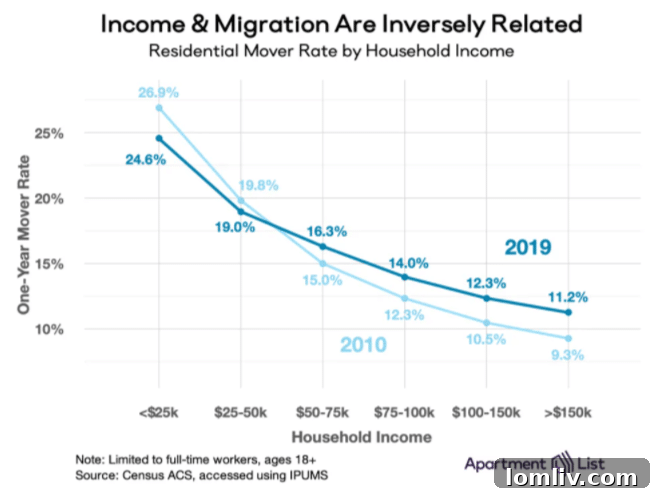
To fully grasp the magnitude of this shift, it’s crucial to examine the historical context. In 2019, the residential mover rate—representing the proportion of Americans who relocate annually—stood at 14 percent, a figure that had been in a steady decline for decades. The year 2020, however, witnessed a remarkable reversal, with the rate climbing above 16 percent. This significant increase was largely attributable to high-income, remote workers earning over $150,000 annually, who suddenly found themselves empowered to seek out new places to reside. This demographic, historically the least likely to move over the preceding decade, became an unexpected catalyst for national migration.
Historically, high-earners have exhibited the lowest propensity to move, often constrained by job markets concentrated in specific, expensive urban centers. Yet, in this unprecedented year, they spearheaded a staggering 39 percent increase in residential migration. Among those at the upper echelets of the income spectrum, remote workers were more than twice as likely to relocate compared to their counterparts who were still required to report to a physical job site. This stark contrast underscores the profound impact of remote work policies on individual mobility and lifestyle choices, fundamentally altering long-held residential patterns.
Remote Work as a Pivotal Negotiation Point
The implications of this shift extend far beyond housing choices; remote work is rapidly solidifying its position as a critical point of negotiation in the contemporary job market. A compelling survey conducted by Owl Labs revealed that 23 percent of respondents expressed willingness to accept a 10 percent pay cut in exchange for the flexibility of working from home. This represents a substantial increase from 2019, when only 15 percent of respondents indicated such a preference. This growing willingness to trade salary for flexibility signals a powerful shift in employee priorities, placing work-life balance and autonomy at a premium. For a deeper dive into these findings, access the comprehensive Owl Labs’ State of Remote Work/Pandemic Edition report here.
While remote work was undeniably gaining traction before the onset of COVID-19, the pandemic acted as an unparalleled accelerant, catapulting the trend into mainstream adoption. The report emphasizes that this acceleration is not merely a temporary adjustment but a fundamental reorientation of labor dynamics. As Rob Warnock, Senior Research Associate at ApartmentList.com, notes, “Our latest research clearly indicates that even after the pandemic recedes, the economy will sustain significantly more remote job opportunities than ever before. This newfound and deeply valued flexibility is the driving force behind people’s renewed willingness to move and redefine their lives.”
The Economic Ripple Effect: Impact on Housing Markets and Beyond
This surge in mobility, particularly among high-income earners, has created significant economic ripple effects, most notably in the housing market. The “burst of moving activity” has already triggered “wild swings in the cost of housing across the country.” Previously affordable secondary cities and suburban areas, suddenly seen as desirable destinations for remote workers seeking more space and lower costs, have experienced unprecedented demand and rapidly escalating property values. Conversely, some of the nation’s most expensive urban centers, which once served as magnets for high-paying jobs, have seen shifts in demand, potentially leading to a rebalancing of rental and ownership markets.
The long-term consequences of this phenomenon are profound. If high-paying jobs are no longer exclusively concentrated in a handful of major metropolitan areas, there is a significant potential for a more equitable redistribution of wealth across the nation. This could revitalize local economies in smaller towns and cities, stimulate new business development, and lead to increased investment in local infrastructure and services. However, it also presents challenges, such as managing rapid population growth, ensuring adequate housing supply, and addressing potential strains on existing community resources in newly popular destinations.
Societal and Regional Transformations: A Glimpse into the Future
Beyond economic shifts, the Great Relocation promises broader societal and regional transformations. The demographic makeup of many communities could change, fostering new cultural dynamics and diverse populations. Schools might experience enrollment fluctuations, public services would need to adapt to evolving demands, and local businesses would either thrive or struggle depending on their ability to cater to new resident profiles.
This enduring trend of remote work enabling geographic flexibility is likely to shape urban planning, transportation infrastructure, and even environmental policies for decades to come. As individuals gain more agency over where they live, cities and towns will increasingly compete not just for businesses, but for residents – offering unique blends of lifestyle, amenities, and community character. This competition could spur innovation in urban development and lead to more diverse and resilient regional economies.
Looking Ahead: The Enduring Legacy of Remote Mobility
In conclusion, the shift initiated by the pandemic and amplified by remote work is far from temporary; it is poised to become a lasting feature of our economic and social landscape. The report’s final observations underscore this permanence: “This year’s burst of moving activity has already created wild swings in the cost of housing across the country. Additional moves have the potential to further redistribute wealth if high-paying jobs are no longer concentrated in the nation’s largest, most expensive cities.”
The implications are clear: the era of mandatory co-location for high-skilled, high-paying jobs is steadily receding. Employers are learning that talent can be found and effectively managed anywhere, and employees are seizing the opportunity to align their professional lives with their personal aspirations for space, community, and affordability. This ongoing recalibration of where and how we work will undoubtedly continue to reshape our cities, our economies, and the very fabric of American life, fostering a more distributed and diversified future.