

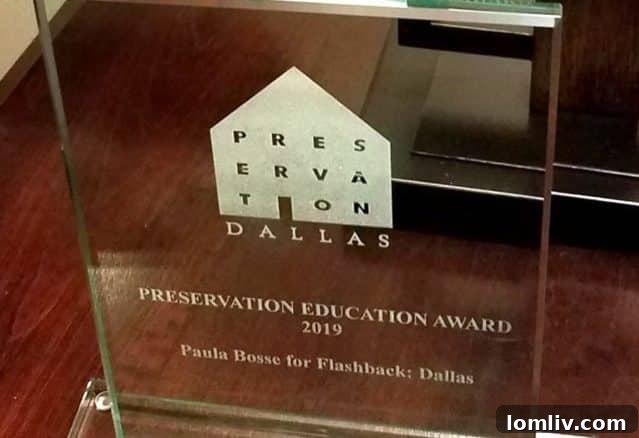
Flashback: Dallas and Paula Bosse Honored with Preservation Education Award for Inspiring Historical Engagement
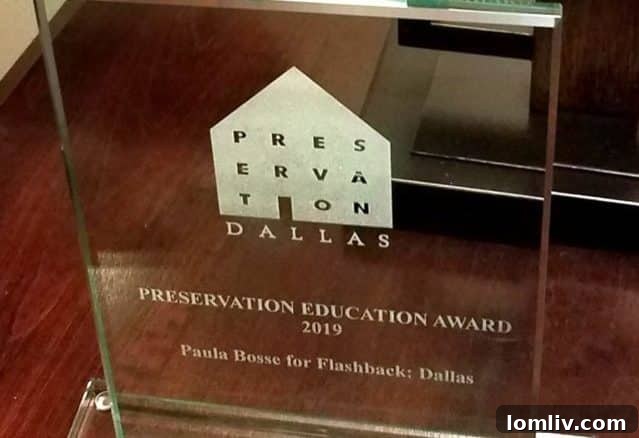
In an era where the past can often feel distant and disconnected from our rapidly evolving urban landscapes, the dedicated work of individuals like Paula Bosse stands as a crucial bridge to our shared heritage. Through her widely cherished social media presence and blog, Flashback: Dallas, Bosse has cultivated a vibrant digital space dedicated to illuminating the rich tapestry of the city’s past. Her exceptional efforts in fostering historical awareness and engaging the wider community were deservedly recognized with the 2019 Preservation Education Award, an esteemed honor presented by Preservation Dallas at its 20th Annual Preservation Achievement Awards.
This significant accolade underscores the profound and far-reaching impact Bosse has had on the local historical landscape. As a lifelong Dallas resident deeply immersed in the city’s narratives and a passionate “history junkie,” Bosse possesses an unparalleled fervor for unearthing and sharing forgotten stories. In 2014, she launched Flashback: Dallas, an innovative platform that brilliantly carved out a unique niche for disseminating local history. Her captivating narratives have not only heightened awareness of the region’s heritage but also inspired a deeper, more personal appreciation for Dallas’s enduring legacy, ensuring that its past remains a dynamic and cherished aspect of its present.
Flashback: Dallas – A Digital Beacon for Local History
What began as a personal quest to explore Dallas’s hidden histories has organically grown into a significant digital archive and a bustling community hub for history enthusiasts. Reflecting on the remarkable reach of her platform, Bosse shared, “Last time I checked the numbers, I had over 10,000 followers across various social media platforms and had surpassed 1 million page views of the blog.” While she humbly added that these figures “might not be earthshaking numbers in terms of internet-reach,” she expressed genuine amazement at the overwhelming response. “It’s pretty amazing to me. Who would have thought that many people would be interested in what is, let’s face it, a fairly esoteric topic?”
Bosse’s modest characterization of her work as “esoteric” playfully downplays the broad appeal and deep resonance her content consistently achieves. Far from being a niche interest, Flashback: Dallas acts as a vital conduit, connecting countless Dallasites to their collective past. Her success stems precisely from her ability to transcend the often academic or dry presentation of historical facts, instead transforming them into an accessible, engaging, and thoroughly enjoyable experience for a vast and diverse audience. This is where her masterful “presentation” truly shines, proving that compelling storytelling is paramount in both education and the broader mission of historical preservation.
Paula Bosse’s Unique Approach: Making History Informative and Entertaining
At the core of Flashback: Dallas’s widespread popularity lies Paula Bosse’s distinctive voice and methodological brilliance. Despite her unwavering commitment to meticulous research and well-cited factual accuracy, her writings are anything but academic or detached. Bosse masterfully employs a conversational writing style that warmly invites readers into the narrative, creating a sense of shared discovery as they explore historical gems alongside her. Her innate storytelling talent breathes vibrant life into old photographs, forgotten advertisements, and dusty archival documents, transforming mere facts into compelling tales of a bygone Dallas era.
Adding another layer of undeniable charm, Bosse frequently infuses her articles with a quirky, relatable humor that both disarms and delights her audience. This unique blend of deeply informative content and genuinely entertaining delivery has endowed her with the rare ability to make history not only educational but genuinely captivating for a broad readership spanning all ages and backgrounds. Whether she is meticulously exploring the architectural nuances of a historic building, recounting the intriguing anecdotes of a prominent Dallas figure, or revisiting a long-lost community event, Bosse ensures that every piece is an immersive journey, not merely a didactic lesson.
A Comprehensive Chronicle: The Expansive Scope of Flashback: Dallas
In the five years leading up to her well-deserved award, Paula Bosse had already curated an impressive and substantial body of work, publishing approximately 1,000 online articles. This prolific output is a testament to her tireless dedication and the expansive breadth of her historical interests. Her investigations cover an incredibly wide array of topics, painting Dallas history with a truly broad and inclusive brush. From the grand, iconic buildings that have defined the city’s skyline to the charming, often overlooked residential houses that have shaped its diverse neighborhoods, Bosse leaves no historical stone unturned in her quest for discovery.
She delves deep into the rise and fall of pivotal businesses that fueled Dallas’s growth, meticulously chronicling the entrepreneurial spirit and economic shifts that characterized different eras. Significant historical events, whether celebratory civic milestones or challenging periods of urban transformation, are revisited with fresh perspectives, offering invaluable context and deeper understanding. Beyond structures and occasions, Bosse also highlights the remarkable people — from civic leaders and innovative pioneers to everyday citizens — who contributed profoundly to the city’s unique identity. Her compelling exploration of distinct Dallas neighborhoods allows readers to trace the intricate evolution of their own communities, understanding how these areas transformed and thrived over many decades.
“Really, if it’s somehow related to Dallas and it happened before the 1970s, it’s something I might write about,” Bosse states, clarifying her seemingly “arbitrary” cut-off time period. This temporal boundary is, in fact, a carefully considered and strategically insightful choice. By focusing on pre-1970s Dallas, Bosse meticulously captures a crucial and formative period of the city’s development—from its nascent stages through its post-World War II boom and transformative mid-century years—before the widespread urban renewal projects of later decades began to significantly reshape its physical and cultural landscape. This focused approach provides invaluable insight into the foundational elements of modern Dallas, diligently preserving memories and narratives that might otherwise have faded into obscurity.