Uptown Dallas Development: Navigating Noise Concerns at the Marriott Fairmount Project
Uptown Dallas stands as a vibrant testament to modern urban living, a dynamic district where luxury residences, upscale dining, and thriving businesses coexist. As one of the city’s most desirable neighborhoods, Uptown continually attracts new development, enhancing its skyline and amenities. However, this rapid growth, particularly the proliferation of luxury hotels and entertainment venues, often brings to the forefront complex challenges – chief among them being the delicate balance between urban vibrancy and residential quality of life. The recent discussions surrounding the new Uptown Marriott on Fairmount Street offer a compelling case study into these intricate dynamics, highlighting how seemingly minor planning variances can unveil broader community concerns, especially regarding noise pollution from amenity spaces.
The project, spearheaded by Alamo Manhattan and situated directly behind the renowned Nick & Sam’s restaurant, is poised to become a significant addition to the Uptown landscape. Yet, its journey through the local planning committees has illuminated a crucial dialogue between developers, future hotel operators, and the established residential community. This article delves into the specifics of these discussions, the implications of hotel design on urban acoustics, and the collaborative solutions sought to ensure harmonious coexistence in one of Dallas’s most densely populated and cherished districts.
The Oak Lawn Committee: A Crucial Forum for Community Voice
The Oak Lawn Committee (OLC) serves as an indispensable civic body, acting as a vital conduit for community input on local development projects. Its meetings are often where the nuances of urban planning are debated, and resident concerns are brought directly to developers and city officials. What initially appeared on the agenda for a recent OLC meeting as a routine discussion concerning a minor variance for a pair of awnings at the Uptown Marriott project quickly evolved into a much more significant conversation. While the pre-awning project had received initial support in December 2016, the request for an 11-inch awning variance became a surprising gateway, an “open mic night,” for residents to articulate deep-seated anxieties about the hotel’s future operations.
This pivot from a mundane architectural detail to a substantive community dialogue underscores the OLC’s critical role. It’s a forum where seemingly small requests can unearth substantial issues, allowing residents to vocalize how new developments might impact their daily lives and the overall character of their neighborhood. For the Uptown Marriott, this meant addressing concerns that extended far beyond the visible structure to the audible experiences it might generate.
The Rise of Hotel Day Parties: Vegas Glamour Meets Dallas Urban Living
The past few years have witnessed a notable cultural shift in urban leisure, particularly the “migration” of the hotel day party trend, a phenomenon once synonymous with the glitz of Las Vegas, to major metropolitan areas like Dallas. For a modest entry fee, these poolside events offer vibrant atmospheres where guests can enjoy thumping beats from outdoor nightclubs, often accompanied by sophisticated poolside amenities. This trend, highlighted by articles such as D Magazine’s coverage, presents a compelling revenue stream for hotels and an attractive leisure option for city dwellers.
However, unlike Las Vegas, where many resorts are strategically located within dedicated entertainment districts, Dallas hotels frequently find themselves embedded within more densely residential areas. This geographical distinction creates inherent friction. Previous experiences, such as the widely discussed “Splash parties” at the Stoneleigh Hotel, served as a stark lesson for Uptown residents. Having endured weekly raucous parties with amplified music literally echoing through their windows, residents of the Stoneleigh Residences and other nearby properties became acutely sensitive to the potential for similar noise disturbances from new hotel developments. This collective memory fueled their proactive engagement with Alamo Manhattan, seeking assurances that the Marriott would not replicate these disruptive scenarios.
Architectural Acoustics: The Marriott’s Design and Sound Propagation
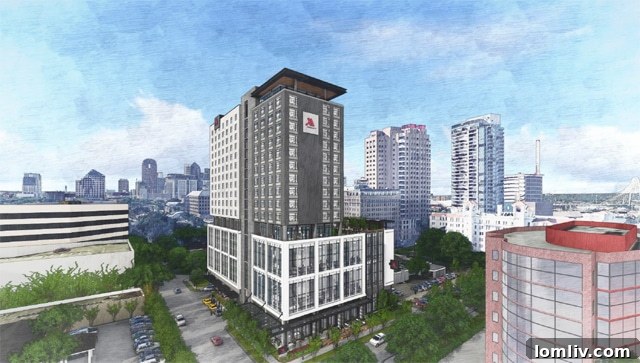
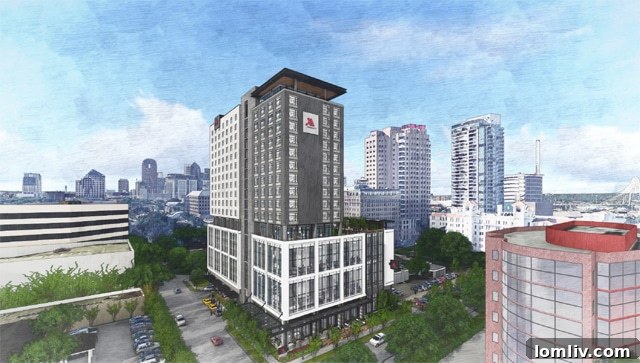
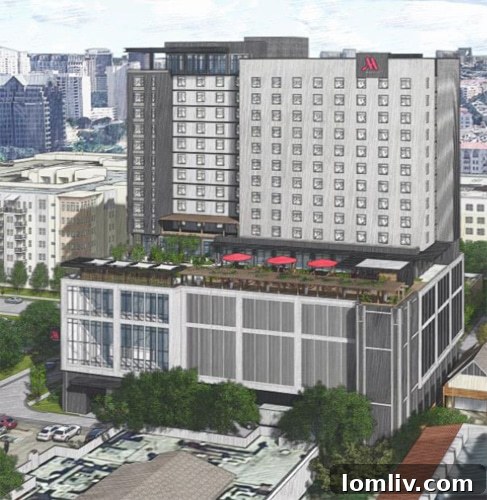
A critical aspect of the OLC discussions centered on the Uptown Marriott’s architectural design and its potential impact on local acoustics. As depicted in the hotel’s renderings, the structure presents a unique challenge for sound mitigation. The pool deck, strategically located on the fifth floor, is not merely an open-air amenity space; it is flanked by a rising tower behind it. This design inadvertently transforms the hotel’s facade into a giant sound reflector, pushing amplified noise predominantly westward, directly towards a significant concentration of residential properties.
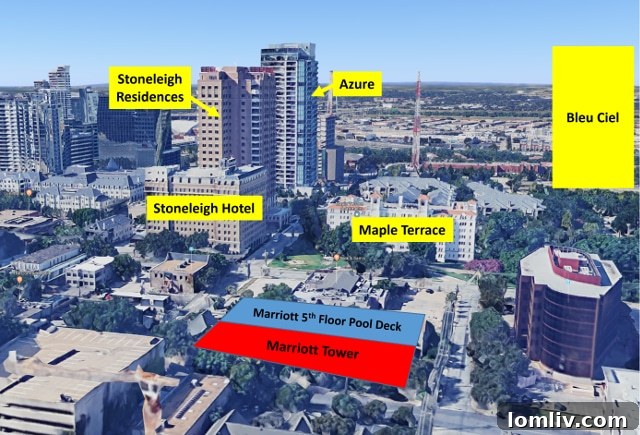
Understanding urban sound dynamics is crucial here. Sound waves, particularly those from amplified music, do not simply dissipate into the open air. In an environment dense with high-rise buildings, sound can travel and bounce in complex, often unpredictable ways. Buildings act as barriers and reflectors, creating “urban canyons” that can channel and amplify noise. For residents in properties like Maple Terrace, a poolside event with amplified music could be deafening, even with windows closed. Furthermore, luxury high-rises such as Bleu Ciel and Azure, while physically further away, could still experience significant noise, making their outdoor patios unusable and potentially audible indoors, severely impacting residents’ ability to enjoy their homes.
Wade Johns from Alamo Manhattan argued that the Stoneleigh Hotel effectively blocked noise from their property. However, this assertion fails to fully account for the architectural context. The Stoneleigh Residences, for example, are considerably taller than the Stoneleigh Hotel. The Marriott’s fifth-floor pool deck elevates the noise source, providing a more direct and unobstructed path for sound waves to reach a majority of the Stoneleigh Residences, negating any perceived ground-level sound barriers.
Alamo Manhattan’s Perspective vs. Resident Quality of Life
During the OLC meeting, Johns repeatedly emphasized that residents living in an urban environment should expect a certain degree of disruption. To some extent, this sentiment holds true; density naturally leads to higher ambient noise from everyday urban sounds, such as traffic, construction, and pedestrian activity. However, there is a critical distinction between the unavoidable hum of city life and excessive, preventable noise pollution. Living in a dense, walkable area of Uptown Dallas is not an open invitation for unchecked noise. Such an argument, suggesting residents simply “deal with it,” quickly loses credibility when applied to scenarios like someone operating a jackhammer every weekend from noon onwards. Johns’ comment was perceived more as a brush-off than a constructive argument, failing to acknowledge the legitimate concerns of long-term residents.
In any community, regardless of its urban density, a fundamental expectation of neighborly respect dictates that one’s activities should not unduly infringe upon the peace and quiet of others. Neighbors, ideally, should be like “wallpaper” – seen and appreciated, but not overtly heard. Johns also stated that Marriott, as a global hospitality brand, would not agree to limitations that restrict their ability to operate the hotel effectively. While a complete ban on amplified music is likely too rigid and impractical, preventing hotels from hosting even low-volume mood music or elegant string quartets would be an extreme measure. The core of the residential buildings’ request, therefore, is not a complete cessation of all sound, but a reasonable limitation or ban on specific types of activities (e.g., loud DJ sets, large-scale parties) or the enforcement of precise decibel level limits, especially during certain hours.
Seeking Solutions: Towards Balanced Noise Mitigation Strategies
The conversation at the OLC meeting, after initial friction, constructively shifted towards exploring practical methods for mitigating potential noise issues. Discussions revolved around implementing architectural solutions for sound deadening, similar to the agreements reached during the planning phase for the as-yet-unstarted Dream Hotel project. This indicates a precedent for developers and communities to collaborate on innovative acoustical strategies. Alamo Manhattan, to their credit, seemed open to continuing discussions with residents on how to effectively work together, while naturally keeping their options open for future event hosting, including the possibility of hosting lively pool parties.
For any subsequent meetings or collaborative planning sessions between the developers and the resident groups, a crucial recommendation emerges: ensure a qualified sound engineer is present. Masking, modulating, and containing sound, especially in complex urban environments with reflective surfaces, is far from simple. Sound behaves in incredibly nuanced ways, making expert acoustical analysis indispensable. A sound engineer can provide objective data, propose effective design modifications (such as sound barriers, strategic speaker placement, or specialized materials), and help define realistic and enforceable decibel limits and operational guidelines. Such expert involvement is key to moving beyond generalized arguments to implement tangible solutions that protect residential quality of life while allowing the Marriott to operate successfully within the vibrant Uptown community. Clear, agreed-upon parameters, monitored and enforced, will be essential for building trust and fostering long-term harmony.
The Future of Uptown Dallas Development: A Call for Thoughtful Planning
The discussions surrounding the Uptown Marriott project on Fairmount Street serve as a vital reminder of the ongoing evolution of Dallas’s urban core. Uptown represents a dynamic blend of progress and preservation, where the excitement of new development must be meticulously balanced with the established character and comfort of its residents. The challenges of noise pollution are not unique to this project but are emblematic of the broader complexities inherent in fostering sustainable urban growth in desirable, dense neighborhoods. The ability of developers, community committees like the OLC, and residents to engage in proactive, informed dialogue is paramount.
Ultimately, the goal is to create developments that not only contribute economically and aesthetically to the cityscape but also integrate seamlessly into the existing social fabric, enhancing the quality of life for everyone. This requires thoughtful planning, innovative design, and a commitment to collaborative problem-solving, ensuring that Dallas continues to thrive as a city that cherishes both progress and community well-being.
The Unexpected Nature of Community Meetings
The journey of the Uptown Marriott project through the Oak Lawn Committee demonstrates how community meetings, often perceived as routine, can take unexpected turns. What began as a banal conversation about minor awning variances quickly spiraled into a crucial discourse about urban noise, residential rights, and the future of development in Uptown Dallas. Much like opening a Christmas present, when you attend an OLC meeting, you’re never entirely sure what significant discussions or community-shaping decisions might emerge from the box.

Remember: High-rises, HOAs, and renovation projects are my primary focus. However, I also have a deep appreciation for the delicate balance between modern and historical architecture, especially in the context of the YIMBY movement. My writing has been recognized by the National Association of Real Estate Editors, earning three Bronze awards in 2016, 2017, and 2018, along with two Silver awards in 2016 and 2017. Do you have a story to share, a perspective to offer, or even a marriage proposal to make? Feel free to reach out via email at [email protected]. You can also look for me on Facebook and Twitter, though finding me might prove to be a delightful challenge.