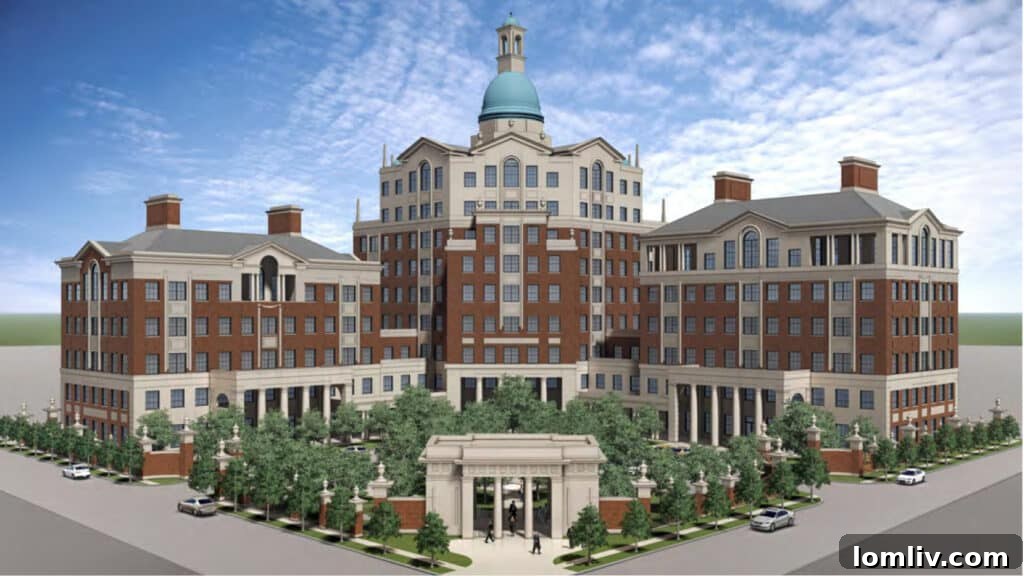
The story of Old Parkland is one of remarkable transformation and strategic vision. For many years, the sprawling lands at the intersection of Maple and Oak Lawn Avenues lay dormant, a silent testament to a bygone era. It wasn’t until 2009 that Crow Holdings embarked on an ambitious journey to breathe new life into the historic hospital campus, meticulously restoring it into what is now recognized as a significant landmark in Dallas’s vibrant urban landscape.
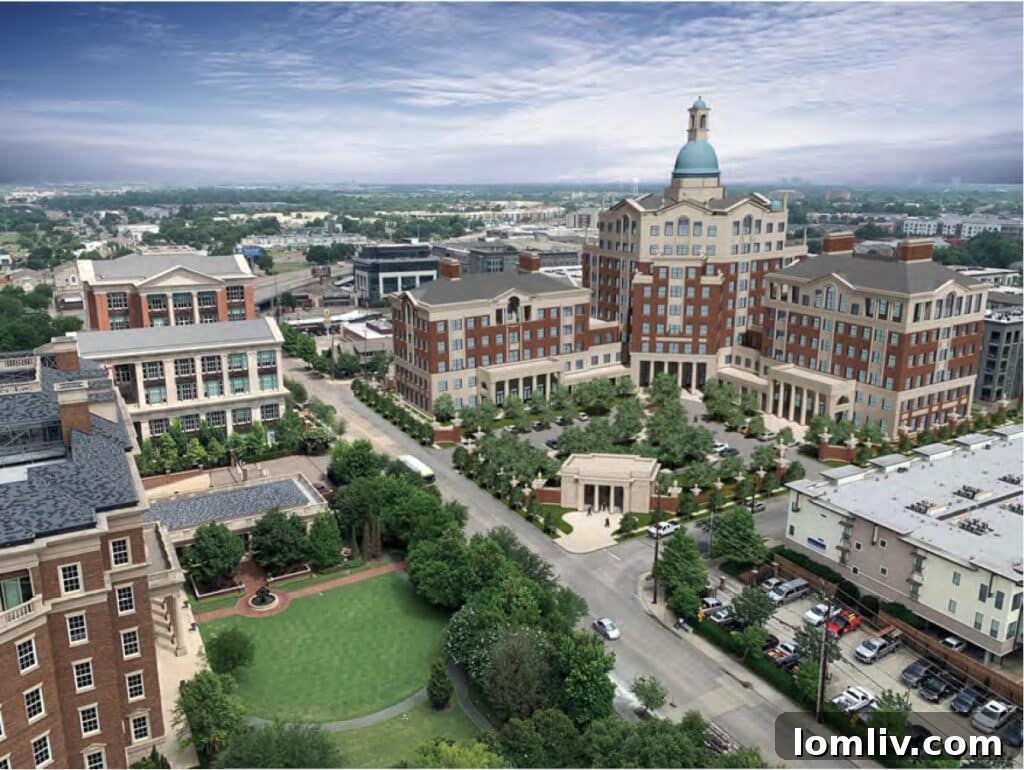
Today, the meticulously planned new campus seamlessly envelops the original 1913 Parkland Hospital building, creating a harmonious blend of history and contemporary functionality. Beyond its stately gates, the historic structures not only survive but thrive, exuding an aura of timeless elegance and purpose. The interiors are frequently lauded as genuine works of art, captivating visitors with their exquisite craftsmanship. From the intricate patterns of the polished wood floors that guide your steps to the finely carved wood railings, panels, columns, and grand rotundas that define the spaces, every detail speaks of unparalleled quality and design. Descriptors for Old Parkland range widely, often likened to an “Ivy League” corporate park, while others, including our publisher during her inaugural visit, have described a distinct sensation akin to being within a revered Capitol building – an environment that commands respect and inspires awe. This sense of grandeur is further amplified by the extraordinary collection of fine art adorning nearly every wall, as noted by D Magazine: “everything from Old Parkland memorabilia to death masks to a piece of a curtain Abraham Lincoln is believed to have grabbed and torn after being shot at Ford’s Theatre in Washington, D.C., in 1865—are tucked into every nook and cranny.” This eclectic and historically rich collection underscores the campus’s commitment to both cultural preservation and intellectual engagement, making it much more than just an office complex.
Architecturally, Old Parkland stands as an impressive masterclass in neoclassical style, marrying classical aesthetics with modern corporate needs. Its distinct character and exclusive appeal led CBRE’s Phil Puckett to aptly christen Old Parkland as the “Smithsonian Institute in Dallas.” This moniker perfectly encapsulates its role as an elite enclave where select tenants, often prominent figures and institutions, congregate behind its protective walls and gates, willing to invest upwards of $50 per square foot for the privilege of its unique environment. The campus even features a “bullpen,” a term that hints at a collaborative yet competitive atmosphere among its high-profile occupants.
Yet, despite its grandeur and exclusivity, a growing sentiment suggests that the original campus, impressive as it is, might not be extensive enough to accommodate the expanding ambitions of Crow Holdings and its vision for Old Parkland’s future within the dynamic Dallas real estate market.
Old Parkland: The Vision for Expansion
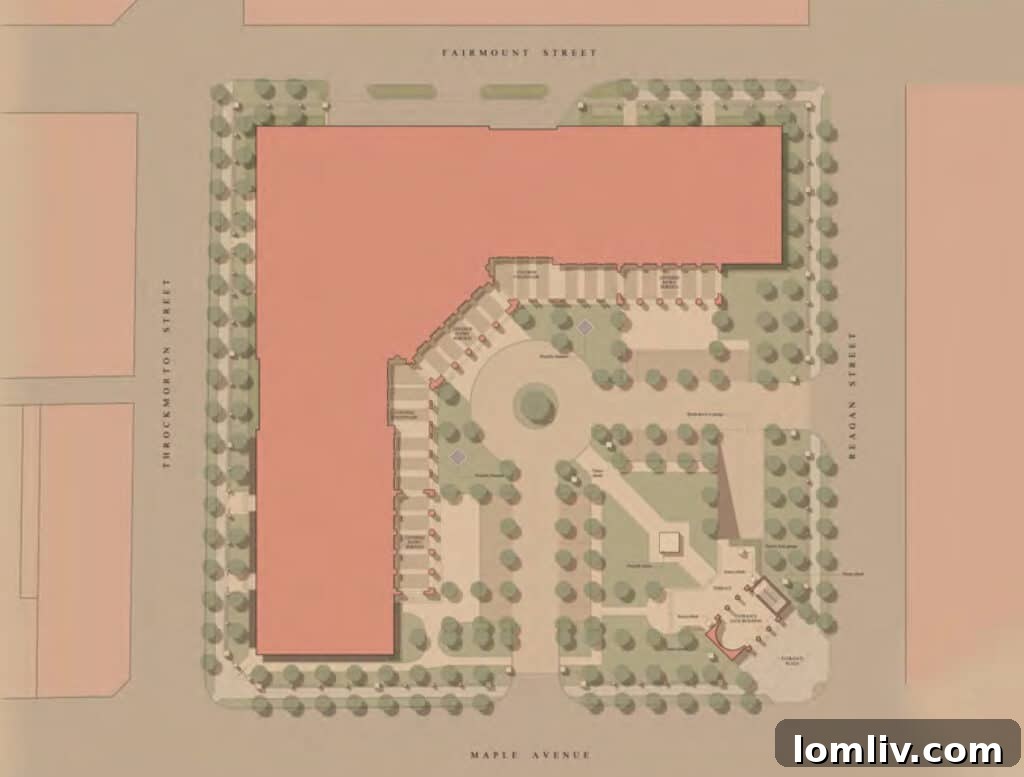
The desire for expansion recently became concrete when Crow Holdings presented a significant request to the Oak Lawn Committee. This proposal seeks to extend the acclaimed Old Parkland campus across Maple Avenue, aiming to develop the entire city block bordered by Maple, Fairmount, Reagan, and Throckmorton. This ambitious plan directly impacts an area currently home to various establishments, including the popular restaurant Sprezza, the now-defunct Merchant House on Maple, and the long-standing, fifteen-year-old, three-story Seville North apartments that face Fairmount Street.
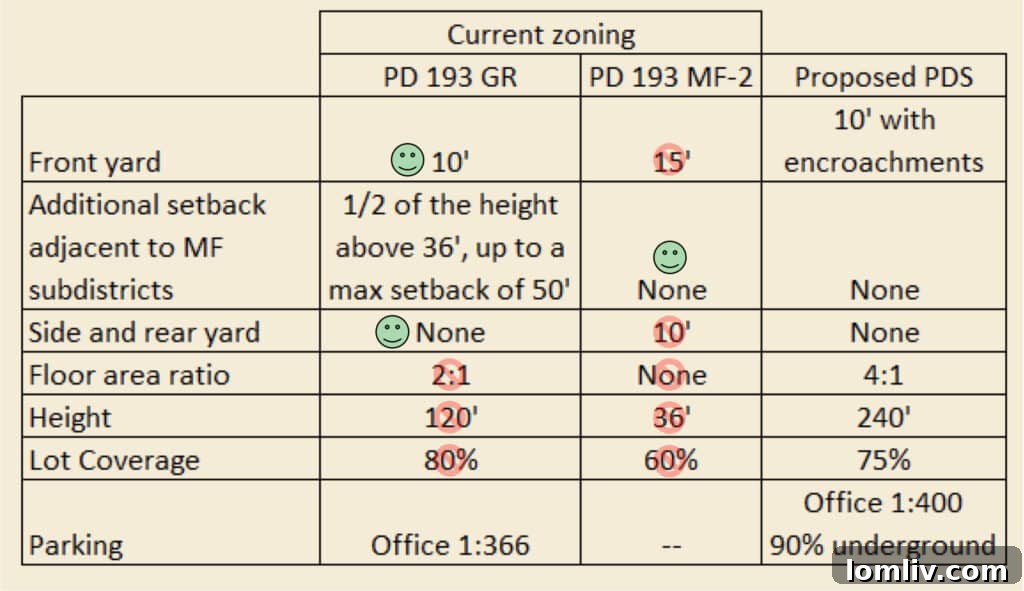
Currently, this targeted block is characterized by a fragmented zoning landscape, reflecting its diverse historical development. The Maple frontage primarily falls under a GR (General Retail) zoning designation, which permits building heights up to 120 feet. In contrast, the Seville apartments conform to an MF-2 designation, restricting their height to under 36 feet, typical for multi-family residential structures in the area. A smaller, interstitial portion of the block is designated for parking, further complicating any cohesive development strategy.
Crow Holdings’ central request is to consolidate these disparate zoning categories into a single, unified PD (Planned Development) subdistrict. The strategic intent behind this move is to align the zoning of this new parcel with that of the existing Old Parkland campus directly across Maple Avenue, which also borders the Dallas North Tollway. This proposed new zoning would dramatically alter the block’s development potential, calling for a maximum building height of 240 feet. Simultaneously, it seeks to more than double the allowable Floor Area Ratio (FAR) from a current combination of 2:1 and 1.8:1 to a significantly increased 4:1. This substantial increase in FAR would permit a much greater density of construction, effectively maximizing the usable space within the proposed new structures.
Beyond height and density, the project’s proposal also includes several critical deviations from standard urban planning regulations. Crow Holdings aims to eliminate traditional setback requirements, particularly those typically mandated when building adjacent to multi-family residential areas. This adjustment is explicitly designed to accommodate a “sheer wall” architectural design that would face the Alexan and Essence apartments across Fairmount. Similarly, the proposal calls for the elimination of side and rear yard requirements, a change that would effectively push sidewalks onto what is currently public land along Throckmorton and Fairmount, potentially altering the pedestrian experience and public realm. Moreover, an increase in lot coverage is also part of the request. While this is framed as “Phase 2” of the Old Parkland campus, the implications of increased lot coverage suggest that the finished product might be less visually accessible to the public, further concentrating development within the block’s boundaries.
Decoding the Impact: More Than Meets the Eye
Understanding the full ramifications of Crow Holdings’ proposal requires a closer look at the numbers and their implications for the Oak Lawn neighborhood and Dallas urban planning. The parcels encompassed by this expansion currently total 111,220 square feet, which equates to approximately 2.56 acres. Under their existing Floor Area Ratio (FAR) – a metric that dictates the total floor area permitted on a given land parcel – the maximum allowable building size would be roughly 211,318 square feet. However, Crow Holdings’ request to increase the FAR to 4:1 would more than double this potential, permitting the construction of approximately 445,320 square feet of building space. This dramatic increase in density underscores the scale of development envisioned for this strategic location.
Furthermore, this expansion would lead to a significant encroachment into the MF-2/36-foot height district located east of Maple Avenue, fundamentally altering the established character of this predominantly residential zone. This move is particularly noteworthy as it would occur just three blocks from the recently approved Caven-Ablon project on Dickason, a development that also borders Reagan and Throckmorton. This alignment with prior large-scale developments precisely reflects the predictions made by Plan Commissioner Jung, signaling a trend towards increased density in this part of Oak Lawn. However, a distinguishing feature of the Old Parkland proposal, unlike some other recent developments, is its commitment to at least 90 percent underground parking. While this minimizes the visual impact of parking structures, it also speaks to the considerable investment and intricate engineering required for such a high-density, exclusive development.
The proposed height of 240 feet also raises questions. While Crow Holdings is requesting this maximum height, the renderings provided for the project primarily depict a trio of connecting structures that appear to top out at around nine stories, plus an additional cupola. Visually, these structures seem to align more closely with the existing GR zoning’s 120-foot height limit. This discrepancy begs the question: what is the purpose of the additional 120 feet being requested? Crow representatives have asserted that the 240-foot measurement refers to the very top of the cupola. However, to a discerning observer, this explanation appears to stretch credibility. Even accounting for a substantial cupola or bell tower, it seems improbable that such an architectural feature would add a full 100 feet or more above a nine-story building, suggesting that the requested height might offer future flexibility for development beyond what is currently illustrated.
Community Benefits: A Scrutiny of “Give Backs”
In any significant urban development proposal, the discussion inevitably turns to “Community Give Backs” – the benefits that the project is supposed to offer to the surrounding neighborhood. Crow Holdings’ proposal for the Old Parkland expansion outlines several such contributions: the inclusion of underground parking, an enhanced pedestrian experience, upgraded treatment of the Maple Avenue corridor, and a commitment to thoughtful architectural design. While these elements are presented as boons to the community, it’s essential to scrutinize them with a critical eye.
The primary concern here is that many of these “give backs” are, in essence, standard practices for high-quality, high-value developments, particularly those undertaken by a reputable firm like Crow Holdings. It is highly probable that Crow would have incorporated underground parking into any substantial development, much like it did for its main campus and even its own residential properties. The suggestion of a potential tunnel connecting the existing campus to the new expansion further highlights the desire for seamless, private connectivity, which often benefits the developer more directly than the public. Similarly, an enhanced pedestrian experience, an upgraded Maple Avenue corridor, and thoughtful architectural design are often inherent components of premium developments aiming to attract high-caliber tenants and maintain a prestigious brand image. These improvements, while outwardly beneficial, also undeniably enhance the views and surroundings for the existing Old Parkland campus across the street, effectively improving the developer’s current assets.
This leads to the crucial question: Is this truly a “win-win” situation for both the developer and the community? In a narrow sense, it might be argued that it is. Crow Holdings, or another developer, could potentially propose a far less desirable or architecturally sensitive project for the site, and the current proposal certainly avoids that. However, from a community perspective, the current proposal leans heavily towards a scenario where the neighborhood is “allowed to have more Old Parkland,” rather than witnessing genuine, mutually beneficial outcomes. The focus appears to be on expanding the existing exclusive enclave, with community benefits perhaps acting more as a mitigation strategy or a byproduct of high-end development, rather than a primary driver for the project’s design. A true win-win would likely involve more direct and tangible benefits that address specific community needs, rather than enhancements that primarily serve the development’s aesthetic and functional goals.
Beyond the Horizon: Doubts of a Definitive End
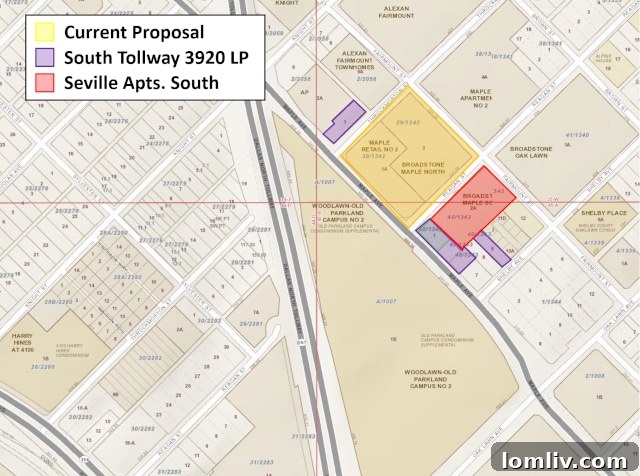
While the current proposal outlines a significant expansion, there’s ample reason to believe that this is far from Crow Holdings’ ultimate vision for the area. A closer examination of land ownership patterns reveals a broader strategy at play. The Maple-frontage parcels designated for the current expansion are owned by Crow’s South Tollway 3920 LP. Crucially, this entity also holds ownership of the land beneath the popular 18th & Vine restaurant and four other neighboring parcels, as clearly illustrated in the accompanying map. Many of these adjacent parcels are currently vacant lots. In urban planning, the presence of vacant, “gap-toothed” blocks often signals a deliberate strategy: by creating voids, developers can subtly, or not so subtly, diminish the perceived desirability and customer base of existing businesses or residential areas, thereby making future acquisitions and consolidation easier and potentially less costly.
When questioned about the Seville South complex, prominently noted in red on the map and contiguous to the proposed development, Crow representatives stated that they had not yet acquired it. When pressed further about any future plans for this crucial residential property, the response was a cautious “none at this time.” The phrasing “at this time” is a significant qualifier, strongly suggesting that while immediate plans may not exist, the long-term strategic intent is likely to include these properties in future phases. This hints at a patient, methodical approach to land assembly.
Considering the strategic orientation of the current proposal towards the corner of Reagan and Maple, it’s not difficult to envision a much larger, eventual plan to expand Old Parkland further along Maple Avenue, potentially “jumping the shark” well beyond the scope of this single request. The architectural language and scale being proposed could easily be replicated to create a visually complementary, book-matched set of buildings on the southern block. This long-term consolidation strategy would not only extend the Old Parkland brand but also solidify Crow Holdings’ control over a significant and highly valuable stretch of the Oak Lawn corridor, fundamentally reshaping this critical nexus of Dallas.
A Nuanced Perspective: Admiration Mixed with Apprehension
It might come as a surprise, given the critical scrutiny of the zoning and community benefits, but there’s a certain appreciation for the aesthetic of this architectural proposal. The visual presentation of the expanded Old Parkland is undeniably impressive. While it might be accused of “pounding its chest a bit too hard” with its overt grandiosity, the design promises a top-quality imitation of the neoclassical style that defines the original campus. This commitment to architectural excellence, even in an expansion, is commendable in an era where generic, uninspired design often dominates new construction. The visual consistency and high-quality materials are likely to contribute positively to the streetscape.
However, aesthetic appeal does not negate legitimate concerns. My primary reservations stem from the ambitious 240-foot height request. This is a substantial vertical leap for the area, and its full implications for surrounding residential neighborhoods need careful consideration. Moreover, the proposed further encroachment into the existing MF-2 multi-family neighborhood is particularly troubling. This district, traditionally characterized by lower-rise residential buildings, faces the prospect of being overshadowed by a significantly taller and denser commercial development, potentially altering its character and livability for current residents. The balance between growth and neighborhood preservation remains a delicate and often contentious issue in rapidly developing urban areas like Dallas.
The Oak Lawn Committee: A Flicker of Renewed Influence?
For some time, the future and effectiveness of the Oak Lawn Committee (OLC) have been subjects of debate, with some observers, myself included, having previously declared its influence waning. However, with Paul Ridley now serving as the council member for District 14, there appears to be a new, albeit perhaps temporary, lease on life for the committee. The coming months will be crucial in determining how the OLC leverages this renewed political alignment to solidify its power and enhance its impact on local development decisions. The committee’s ability to advocate for neighborhood interests and influence the direction of growth in Oak Lawn is now under renewed focus.
Despite this potential resurgence, a recent meeting highlighted significant challenges that continue to plague the OLC. Last night’s proceedings, like many over the past year, were conducted via Zoom, a format that shows no sign of abating. Disappointingly, the meeting’s chat function was unilaterally blocked by OLC president Paul Ellenbogen, who reportedly took issue with some of the comments being posted. This act of censorship is deeply concerning, as it stifles open dialogue and limits public engagement – core tenets of effective community committees. In a time when transparency and accessibility are paramount for civic participation, restricting communication channels undermines the very purpose of such a forum.
Nevertheless, the importance of community oversight remains undeniable. Despite these procedural missteps, I intend to contribute to the group’s objectives in my own capacity, recognizing that the OLC, with all its imperfections, plays a vital role in local urban development conversations.
Addressing Systemic Flaws: Conflicts of Interest in the OLC
A more profound and systemic issue within the Oak Lawn Committee that demands urgent attention is the complete absence of formal rules pertaining to conflicts of interest. This critical oversight means that if a member of the OLC also holds an association, direct or indirect, with a case or development proposal currently before the group, there is no obligation for that individual to recuse themselves from the proceedings. Such a member is, by default, privy to every conversation, every email, and every strategic discussion related to their own, or their affiliated party’s, project.
The implications of this policy vacuum are severe and far-reaching. It effectively eliminates any confidential space for the OLC to deliberate on a project without the applicant, or their representative, hearing and reading every single word exchanged. This lack of a protected discussion environment is particularly problematic when the OLC finds itself in opposition to a case. Every strategy, every point of contention, and every planned counter-argument is laid bare for the applicant to observe and subsequently counter, often by directly engaging with city leaders who hold the ultimate decision-making power. In essence, this creates a situation where the applicant, through their affiliated OLC member, acts as a “literal spy in their midst,” gaining an unfair advantage that compromises the integrity and effectiveness of the committee’s review process. Addressing this fundamental flaw is crucial for restoring trust and ensuring equitable and transparent decision-making within the Oak Lawn Committee.