The dynamic world of real estate is constantly evolving, presenting new opportunities and challenges for buyers, sellers, and industry professionals alike. From fluctuating rent prices and changing commute patterns to the significant impact of international investment and shifts in client-agent relationships, staying informed is key. This week, we delve into the latest insights shaping the housing markets in North Texas and across the United States. Discover which North Texas cities are experiencing the most significant rent increases, compare commute times between major hubs like Dallas and Fort Worth, uncover where foreign buyers are investing their capital, and examine crucial statistics concerning real estate agent satisfaction. Join us as we explore these vital trends that define today’s property landscape.
Understanding North Texas Rental Market Dynamics: Where Are Rents Soaring?
The rental landscape in North Texas continues its upward trajectory, with July witnessing considerable increases across many cities. While the Dallas-Fort Worth Metroplex generally saw steady growth, the most dramatic surges in rental prices were observed in the Permian Basin, as highlighted by a comprehensive monthly apartment market report from RENTCafe. This data provides a crucial snapshot for renters, investors, and developers alike, indicating where demand is strongest and where affordability might be becoming a pressing concern.
Dallas and Fort Worth: Steady Growth in Major Urban Centers
In Dallas, a prominent economic hub, the average rent for a two-bedroom apartment reached $1,356. This figure represents a modest 0.4 percent increase month-over-month, but a more substantial 4.5 percent rise year-over-year, signaling a robust and consistent growth pattern. When considering all apartment types, the average rent in Dallas stood at $1,117, marking a 3.4 percent increase compared to the previous year. This steady appreciation reflects Dallas’s booming job market, continuous population influx, and its status as a desirable urban living destination.
Just west, Fort Worth also experienced incremental but firm growth. The average two-bedroom apartment rented for $1,175, showing a 0.2 percent month-over-month increase and a 3.3 percent year-over-year hike. The overall average rent for apartments in Fort Worth was $1,068, with a 3.1 percent annual increase. While slightly less aggressive than Dallas, Fort Worth’s rental market underscores its growing appeal, driven by its unique blend of cultural attractions, economic development, and relative affordability compared to its larger neighbor. These figures suggest a healthy, competitive market where demand continues to outpace new supply.
Frisco and Arlington: High Demand and Notable Increases
Venturing into the highly sought-after suburbs, Frisco emerged as the city with the highest average rent for a two-bedroom apartment in North Texas, commanding $1,523 in July. Despite this premium pricing, Frisco saw a more modest year-over-year increase of 0.2 percent, indicating that its rental prices, while high, have stabilized somewhat at the top tier. Frisco’s desirability stems from its excellent school districts, family-friendly amenities, and growing corporate presence, which continues to attract affluent residents.
Arlington, strategically positioned between Dallas and Fort Worth, recorded the largest year-over-year percentage increase for a two-bedroom apartment in the North Texas region, excluding the Permian Basin. With an average rent of $1,103, Arlington experienced a significant 4 percent annual jump. This surge highlights Arlington’s increasing appeal, possibly due to its more accessible price point relative to Dallas and Frisco, coupled with its central location and access to entertainment and employment centers. It represents a market where renters are finding value and convenience, driving up demand.
Midland and Odessa: The Permian Basin’s Unprecedented Surge
While the DFW Metroplex cities exhibited strong, steady growth, the increases witnessed in Midland and Odessa were nothing short of extraordinary, largely driven by the booming oil and gas industry in the Permian Basin. In Midland, the average monthly rent skyrocketed to $1,615, reflecting an astonishing 36.1 percent year-over-year increase. Odessa followed suit, with an average overall rent of $1,354 in July, marking a similarly staggering 34.3 percent annual surge. These dramatic figures underscore the immense pressure on housing supply in these energy-rich areas, where rapid job growth far outpaces the construction of new residential units. For investors, these cities represent significant, albeit volatile, opportunities, while for residents, the escalating costs pose substantial challenges to affordability and quality of life. The Permian Basin’s unique economic drivers create a distinct real estate market, sharply contrasting with the more diversified economies of the larger North Texas metropolitan areas.
The Commute Conundrum: Dallas vs. Fort Worth and Beyond
For many Texans, the daily commute is a significant part of life, influencing everything from housing choices to overall quality of life. Understanding commute patterns can offer insights into urban planning, traffic infrastructure, and even the desirability of different neighborhoods. HomeArea.com recently compiled a comprehensive list based on data from the Census Bureau’s American Community Survey, evaluating all Texas cities with populations exceeding 60,000. The results, particularly for North Texas residents, might offer some surprising revelations.
Texas Commute Averages and Top Performers
The statewide average travel time to work in Texas stands at 26.5 minutes, showing a slight increase of 0.7 percent from the previous estimate of 26.3 minutes. This subtle but consistent rise highlights the ongoing challenges posed by growing populations and expanding urban footprints. The report, which cleverly calculates the percentage of an average resident’s day spent commuting, identified Lubbock as the city with the fastest commute this year, with residents spending just 16.3 percent of their day traveling to work. Waco made a notable entry, ranking second with 18.2 percent. These cities, often characterized by less dense urban environments and shorter distances between residential and commercial areas, offer a stark contrast to the longer commutes experienced in Texas’s major metropolitan areas.
North Texas Cities: Navigating the Daily Drive
Within North Texas, Richardson led the pack, coming in at No. 8 statewide, with residents dedicating 24.6 percent of their day to commuting. This relatively lower percentage for a DFW suburb suggests efficient infrastructure or more localized employment opportunities. Irving followed closely at No. 11, with 26.1 percent. These figures place them slightly below or around the state average, indicating manageable commutes despite their proximity to major employment centers.
Dallas, Plano, and Arlington ranked consecutively at 12, 13, and 14, with residents spending 26.7 percent, 26.8 percent, and 27.3 percent of their day commuting, respectively. These numbers reflect the reality of living and working in major urban and suburban areas of the DFW Metroplex, where traffic congestion and longer distances are common. For prospective residents, these statistics are vital considerations when weighing housing locations against workplace accessibility and overall lifestyle.
Fort Worth positioned itself at 16th place, with its residents spending 27.9 percent of their day in their cars. This is slightly higher than Dallas, suggesting that despite its somewhat less dense core, the expansive nature of the city and its surrounding areas can lead to extended travel times. Perhaps the most surprising finding from the survey was Garland’s last-place finish among the North Texas cities evaluated, with residents enduring the longest commutes, dedicating 29.5 percent of their day to travel. This could be attributed to its position within the broader metropolitan area, requiring longer journeys to key employment hubs, or specific infrastructure challenges. These commute times directly impact daily life, influencing everything from leisure time to fuel costs and, ultimately, the attractiveness of a particular location for residents and businesses.
Texas Emerges as a Top Destination for Foreign Real Estate Buyers
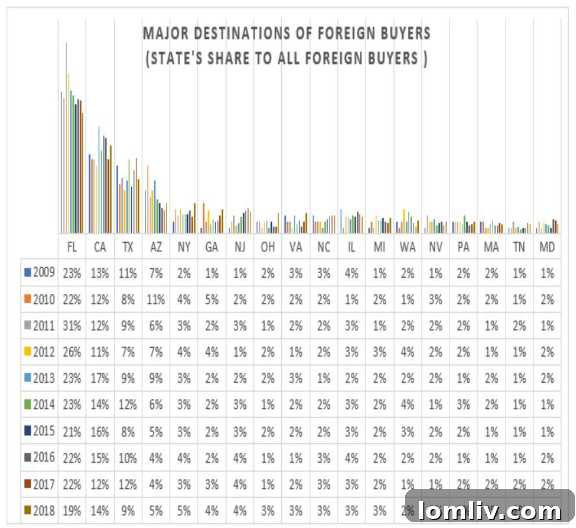
The allure of the U.S. real estate market continues to attract significant international investment, with foreign buyers playing a crucial role in shaping demand and market trends. A recent annual report by the National Association of Realtors (NAR) revealed that nearly half of all foreign real estate purchases in the U.S. are concentrated in just five states: Florida, California, Texas, Arizona, and New York. This geographical focus underscores the economic appeal, lifestyle advantages, and diverse investment opportunities these regions offer to international investors.
Leading States and Texas’s Enduring Appeal
Florida maintains its position as the top destination for foreign buyers, accounting for a substantial 19 percent of all international real estate purchases, largely driven by its warm climate and vibrant resort areas, which appeal to those seeking vacation homes. California holds the second spot at 14 percent, thanks to its robust economy, diverse cultural landscape, and strong real estate appreciation potential.
Texas, despite a slight decrease in its share from 12 percent in 2017 to 9 percent in 2018, continues to be a major destination for foreign investors. This sustained interest can be attributed to Texas’s strong economic growth, diverse job markets, and relatively more affordable property prices compared to coastal states. The state’s business-friendly environment and expanding population also contribute to its attractiveness as an investment hub.
Diverse Motivations Across Buyer Nationalities
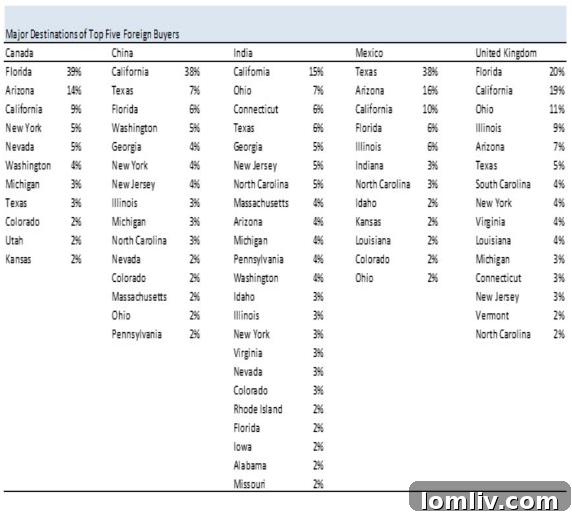
The NAR report also sheds light on the varied motivations of different foreign buyer groups. Canadian buyers, for instance, predominantly seek properties for use as vacation homes, with a significant 62 percent choosing states like Florida, Arizona, or California for their warm climates and resort amenities. This trend highlights a desire for leisure and seasonal residency among Canadian investors.
Chinese buyers represent another significant segment, with over 30 percent opting to purchase properties in California. However, Texas also emerges as a key destination for this group. A notable finding is that Chinese foreign buyers are most likely to purchase homes for students studying in the United States, with seven percent indicating this as their primary reason. Consequently, areas boasting reputable universities and strong educational infrastructure, such as various cities in Texas, hold particular appeal for Chinese investors looking to support their children’s academic pursuits.
Mexican buyers, in contrast, are primarily driven by the desire for permanent residency. The report indicates that a substantial 62 percent of Mexican buyers acquire property in the U.S. with the intention of living in it, rather than for investment or vacation purposes. Texas, sharing a long border and strong cultural and economic ties with Mexico, naturally stands out as a preferred location for these buyers. Its proximity, combined with economic opportunities and community connections, makes it an ideal place for Mexican nationals seeking to establish roots. The diversity in buyer motivations underscores the multifaceted nature of the U.S. real estate market and the targeted strategies that states like Texas employ to attract international capital and residents.
J.D. Power Survey Reveals Evolving Landscape for Real Estate Professionals
The role of the real estate agent in today’s market is a subject of ongoing debate, particularly concerning commission structures and the value proposition agents offer. As previously discussed, discussions surrounding Realtor commissions continue to spark considerable debate within the industry and among consumers. Adding further dimension to this conversation, J.D. Power’s 2018 Home Buyer/Seller Satisfaction Study has unveiled statistics that warrant close attention from real estate professionals, indicating both areas of success and potential concern.
High Marks for Service, Shifting Value Proposition
While J.D. Power typically reserves the full details of its survey results for subscribers, a press release offered key insights. Craig Martin, Senior Director of Financial Services at J.D. Power, noted that real estate firms are generally receiving high marks for their service. This positive feedback suggests that agents are effectively meeting customer expectations in several aspects of the transaction process.
Martin emphasized a crucial shift in the industry: “Real estate firms are recognizing that their value proposition has shifted from that of information broker to trusted advisor; as a result, we’re seeing increases in customer satisfaction in each of the segments of home buyers and sellers.” This transformation highlights the evolving demands of clients who, with abundant online information at their fingertips, now seek more than just property listings. They desire guidance, expertise, and personalized advice through complex transactions. “The challenge for these companies is to consistently demonstrate and communicate the value to current and potential customers,” Martin added. “Those who ensure trust and understanding are at the center of their client and customer strategies will truly differentiate from both traditional competition and those attempting to disrupt the industry.” This underscores the need for agents to build strong, trust-based relationships and to articulate their unique contributions beyond mere data provision.
Emerging Trends: Buyers and Sellers Bypassing Agents
Despite the overall high satisfaction scores, the survey brought to light a potentially concerning trend for realtors: an increasing number of experienced home buyers and sellers are choosing to forgo agent representation. “A significant majority (88%) of home buyers are beginning their search for a new home before selecting an agent,” the release stated. This suggests that initial property exploration has largely moved online, with buyers becoming more informed before engaging a professional.
More critically, the study revealed a steady rise over the past two years in buyers and sellers opting out of using an agent altogether: “19% of repeat buyers, 14% of repeat sellers, 13% of first-time buyers and 9% of first-time sellers did not use an agent to buy/sell their home.” This trend signals a growing segment of the market exploring alternative methods, such as For Sale By Owner (FSBO) or online platforms, which could pose a significant challenge to the traditional agent model if not addressed. Realtors must adapt by offering indispensable value that cannot be easily replicated by digital tools or individual efforts.
The Growing Influence of Social Media and Reputation
The survey also identified the increasing importance of social media in the agent selection process. “Nearly half (47%) of buyers and 55% of sellers indicate using social media to find agents,” the statement confirmed. This highlights the critical need for real estate professionals to maintain a strong, active, and professional online presence to attract and engage potential clients. Social media platforms are no longer just for personal networking; they are powerful tools for business development and brand building in the real estate sector.
Furthermore, reputation emerged as the paramount factor in selecting a real estate firm. Among first-time sellers surveyed, 44 percent cited reputation as their number one reason for selection, a sentiment echoed by 39 percent of first-time buyers. This emphasis on reputation superseded personal recommendations and past experiences with other Realtors, underscoring that a firm’s public image and perceived trustworthiness are more influential than ever. Agents who consistently deliver excellent service, foster positive client experiences, and actively manage their online reputation will be better positioned to attract and retain clients in a competitive market.
“Among both buyers and sellers, overall satisfaction scores are roughly 100 points higher when agents provide timely responses to questions; keep customers informed of key points in the transaction; and share comparable properties,” the press release concluded. These findings reinforce the enduring importance of fundamental professional practices: clear communication, transparency, and expert knowledge remain cornerstones of client satisfaction and loyalty, crucial for real estate agents navigating an increasingly digital and discerning market.