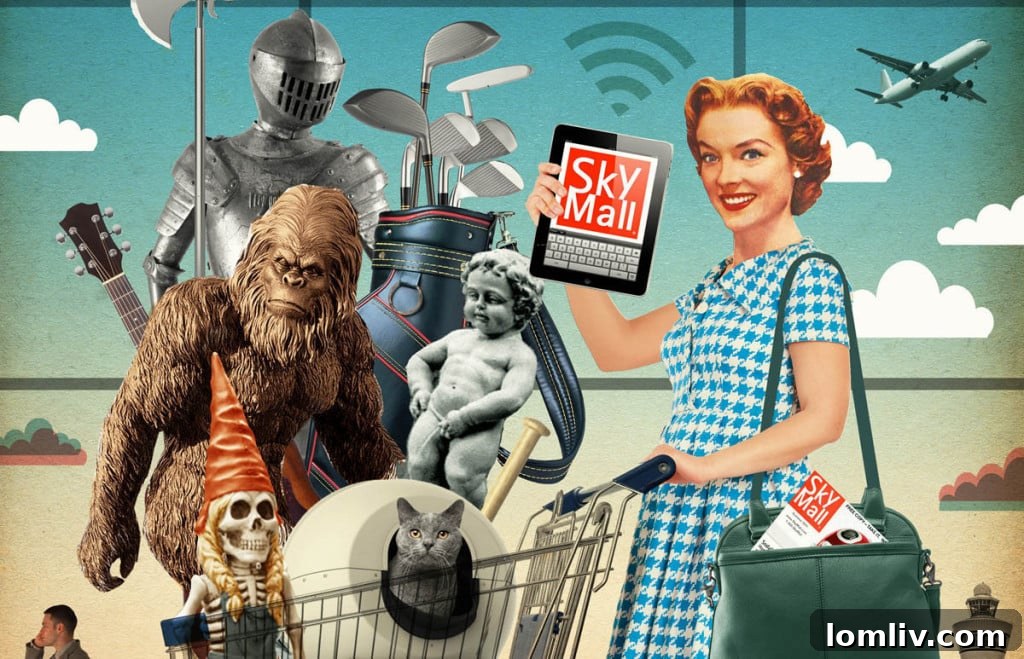
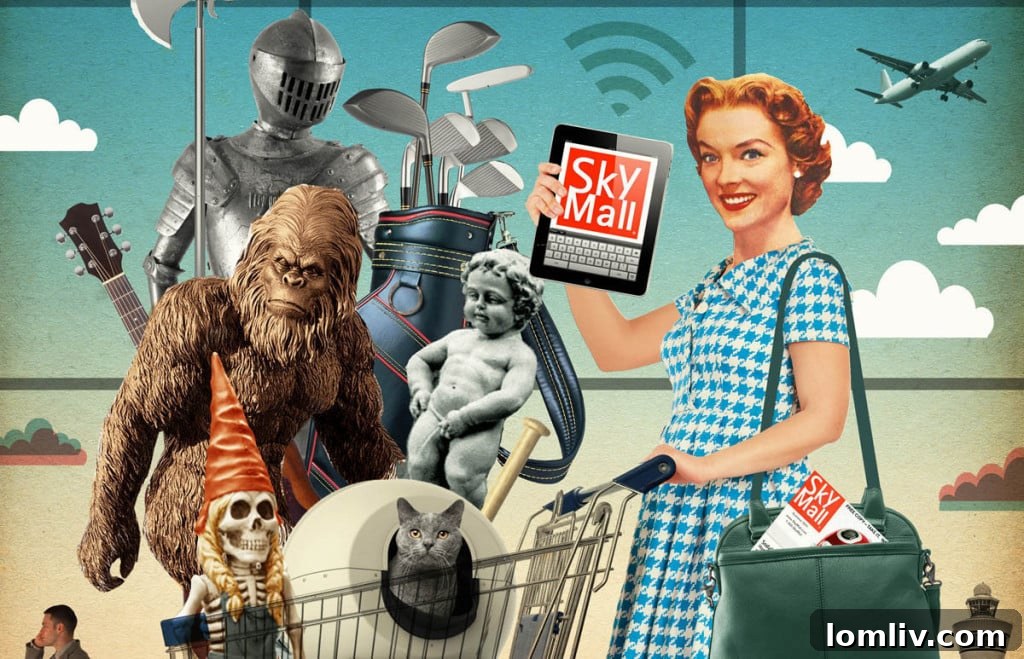
The cabin lights dim, the engines hum, and passengers settle in for another journey across the skies. For decades, a familiar comfort awaited them in the seatback pocket: the SkyMall catalog. More than just a shopping guide, it was a portal to a world of quirky gadgets, ingenious inventions, and often, utterly baffling creations. Its recent demise marks the end of an era, a bittersweet farewell to a unique retail experience that captured the imaginations, and sometimes the bewilderment, of millions of travelers. I vividly recall leafing through a SkyMall on my last flight from San Francisco to Dallas, a ritualistic indulgence in its eccentric offerings, always followed by a prudent application of hand sanitizer.
SkyMall wasn’t merely a catalog; it was a cultural phenomenon, an entertaining diversion that helped pass the time during long flights when in-flight entertainment options were scarce or non-existent. It presented a curated collection of items that defied conventional retail logic, tempting fliers with everything from the genuinely innovative to the hilariously impractical. Its pages were a treasure trove of “totally useless but creative crap,” as some might affectionately call it. Who could forget the solar-powered cooling hat, promising relief from the sun with questionable efficacy, or the “Designated Driver” golf club beer tap, an item surely designed for the truly dedicated, or perhaps misguided, golfer?


Beyond these, the catalog showcased a bewildering array of products: a wineglass holder necklace for the ultimate multi-tasker, an aerator wine glass promising to enhance every sip, and a litter robot for the pet owner tired of scooping. There were those rings for wine glasses that supposedly help you “remember” your glass – though one might argue getting a fresh one is simpler. Then there was the truly extravagant: a $999 portable spa, offering relaxation at an exorbitant price, and whimsical garden décor like a Bigfoot garden yeti. My personal favorites, however, veered towards the truly bizarre: a sumo wrestler table and, of course, the infamous SkyRest, quite possibly the most uncomfortable travel pillow ever conceived, despite its lofty promises of ergonomic comfort. These items, more often than not, invited amusement and ridicule rather than actual purchases, contributing to SkyMall’s unique, almost mythical status in popular culture.
The company, which began its journey in 1989, officially suspended its retail catalog operations on January 16th. This move was not without significant human cost; sadly, 47 of its 137 employees faced layoffs, a somber detail reported by the Wall Street Journal. The parent company, Xhibit Corp., which had only acquired SkyMall in 2013, has also filed for Chapter 11 bankruptcy protection, signaling a swift and dramatic downfall for the in-flight retail giant. The acting Chief Executive, Scott Wiley, expressed profound disappointment, holding onto a faint hope that the catalog might still find a way to persist. However, the commercial realities painted a grim picture.
Mr. Wiley candidly attributed the quarterly publication’s recent struggles to a “crowded, rapidly evolving and intensely competitive” retail environment. He highlighted a crucial shift in consumer behavior, stating, “With the increased use of electronic devices on planes, fewer people browsed the SkyMall in-flight catalog.”

His assessment rings absolutely true. The landscape of air travel, and indeed, retail itself, has undergone a seismic transformation. The affluent traveler, once a prime target for SkyMall’s unique offerings, has increasingly embraced electronic devices as their primary source of entertainment and information. The days of idly flipping through a physical catalog, simply because there was nothing else to do, have largely vanished. Passengers now have a multitude of digital distractions at their fingertips: streaming movies, playing games, catching up on work, or simply browsing the vast expanse of the internet via in-flight Wi-Fi. This shift is analogous to the broader decline of traditional print media; I recall a past Christmas, while many were away, witnessing housekeepers discarding piles of expensive, ad-laden newspapers that their intended high-net-worth readers would never even glance at. The physical catalog, once a captive audience’s only solace, became an anachronism in a world wired for instant digital gratification.
The declining engagement with SkyMall’s content directly translated into a plummeting sales performance. The Wall Street Journal reported that SkyMall’s retailing business generated approximately $33.7 million in revenue in 2013. However, for the nine months ending September 28, 2014, that figure had plummeted to a mere $15.8 million – less than half the previous year’s earnings. This precipitous decline underscored the dire financial straits the company found itself in. In its bankruptcy petition, SkyMall disclosed assets estimated between $1 million and $10 million, weighed against liabilities of approximately $12 million. This stark imbalance further highlighted the unsustainability of its business model. Among the largest unsecured creditors listed were major airlines such as Delta Air Lines, American Airlines, and US Airways, indicating substantial outstanding debts to its primary distribution partners. Southwest Airlines had already signaled its intention to cease stocking SkyMall on its planes that year, citing a simple, undeniable truth: “no one read it.” This collective abandonment by the airlines, once SkyMall’s lifeline, delivered a fatal blow to its already struggling operations.
The SkyMall story is a potent illustration of how rapidly consumer behavior can shift and how unforgiving the modern retail environment can be. What was once a novel and entertaining aspect of air travel became obsolete in the face of technological progress and evolving passenger preferences. Its unique blend of the bizarre and the innovative may have provided countless moments of entertainment, but it ultimately couldn’t withstand the digital tide. The challenges faced by SkyMall are a testament to the imperative for businesses, even those with seemingly captive audiences, to continuously adapt and innovate in an increasingly competitive and digitally-driven world. As we look to the future of air travel, the seatback pockets may remain, but the quirky, fantastical world of SkyMall will forever be a nostalgic relic of a bygone era.
In a final, wry twist, one might speculate on the fate of the infamous SkyRest pillows. If we begin to see Delta and American offering these peculiar inflatables in their first-class cabins, we’ll know precisely why: a creative way for the airlines to recover some of their outstanding debt from SkyMall’s assets. It would be a fitting, if somewhat uncomfortable, epilogue to the curious tale of the in-flight catalog that was both loved and ridiculed.