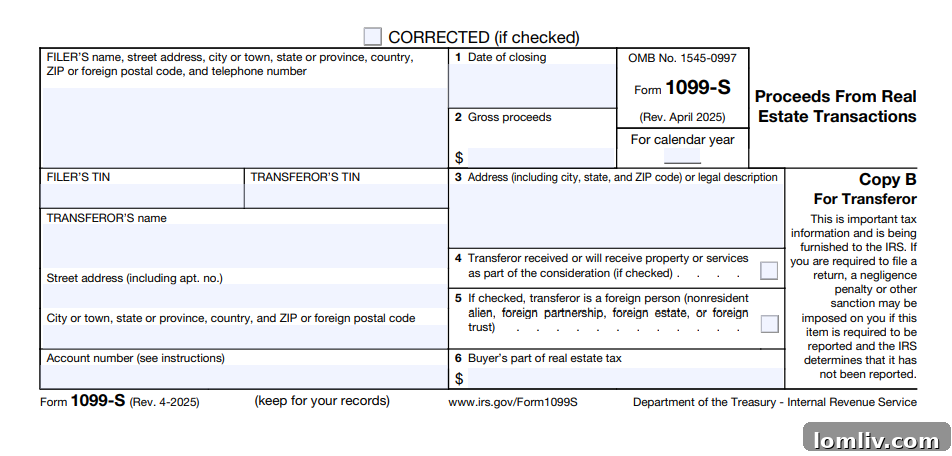
Navigating the complexities of real estate transactions requires meticulous attention to detail, especially when it comes to tax reporting. Before the keys are handed over and a deal is officially closed, both sellers and real estate professionals must be fully aware of a crucial document: IRS Form 1099-S, Proceeds From Real Estate Transactions. This form serves as the Internal Revenue Service’s primary tool for tracking real estate sales exceeding $600, ensuring proper income reporting and taxation. For sellers, understanding its implications can prevent unexpected tax liabilities, while for real estate agents, brokers, and closing professionals, knowing its requirements is paramount to maintaining compliance and avoiding costly penalties. This comprehensive guide will delve into the intricacies of Form 1099-S, explaining when it’s necessary, who bears the responsibility for filing it, common pitfalls to steer clear of, and a practical checklist to streamline your real estate closings, ensuring every transaction is handled correctly and efficiently.
Understanding Form 1099-S in Real Estate Transactions
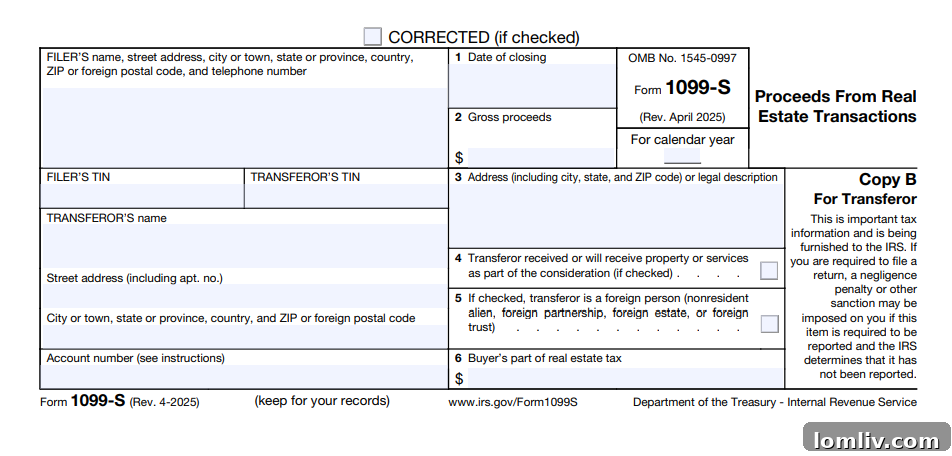
Form 1099-S, officially titled “Proceeds From Real Estate Transactions,” is a cornerstone document in the U.S. tax system for reporting the sale or exchange of real property to the IRS. Its purpose is clear: to provide the IRS with a record of income generated from real estate transactions, helping to ensure that capital gains are accurately reported and taxed. If you are involved in real estate closings—whether as a broker, attorney, title agent, or escrow officer—you are likely to encounter this form and may even be responsible for its accurate and timely submission.
The scope of Form 1099-S is broad, encompassing various types of real property. Understanding what constitutes “real property” for reporting purposes is vital:
- Land: This category includes all forms of land, whether developed or undeveloped. It extends beyond the surface to include rights associated with the land, such as air rights, mineral rights, and subsurface rights, which are often integral components of property value and can be transacted separately.
- Permanent Structure: This refers to buildings and structures that are considered inherently permanent attachments to the land. This includes, but is not limited to, residential homes (single-family, multi-family), commercial properties (office buildings, retail spaces), and industrial facilities. The key is their fixed and long-term nature, distinguishing them from temporary or movable structures.
- Condominium Units: The sale of a condominium unit is a common reportable transaction. This covers not only the physical unit itself and its permanent fixtures but also the seller’s proportionate interest in the common areas of the condominium complex, such as lobbies, hallways, recreational facilities, and the underlying land.
- Cooperative Housing Stock: When a buyer acquires shares in a cooperative housing corporation, as defined under Internal Revenue Service Section 216, this transaction is also subject to Form 1099-S reporting. Unlike traditional property ownership, cooperative housing involves purchasing shares in a corporation that owns the property, granting the shareholder the right to occupy a specific unit. The sale of these shares represents a transfer of an interest in real estate.
- Standing Timber: The sale of standing timber, specifically when it involves the transfer of full ownership of the timber itself, must be reported. This typically applies when the timber is sold as real property, rather than as inventory or a product to be harvested immediately.
In essence, Form 1099-S ensures that any transaction involving the transfer of significant interests in real property, where value exceeds the minimum threshold, is brought to the IRS’s attention, contributing to transparency and accountability in the real estate market.
When Is Form 1099-S Needed?

Form 1099-S is a mandatory filing for most real estate sales or exchanges that are classified as “reportable transactions” under federal tax regulations. This broad definition covers a wide array of property transfers, ensuring that the IRS has a comprehensive overview of real estate market activity. Key examples of transactions requiring Form 1099-S include:
- Sale of a Principal Residence: Even if the seller expects to exclude the gain from taxation under Section 121 of the Internal Revenue Code, the sale generally still needs to be reported on Form 1099-S unless specific exemption criteria are met. This ensures the IRS is aware of the transaction before any exclusion is claimed.
- Sales Made Through Land Contracts: Also known as a contract for deed or installment land contract, these agreements involve the seller retaining legal title to the property until the buyer completes all payments. Despite the unique financing structure, the transfer of beneficial ownership triggers a reporting requirement.
- Forced Sales Due to Foreclosure Risk: Transactions such as short sales, where a lender agrees to accept a mortgage payoff amount less than what is owed, or deeds in lieu of foreclosure, where the borrower voluntarily transfers the property to the lender to satisfy a debt, are typically reportable. These transactions involve a transfer of ownership that results in proceeds (or debt relief) for the seller.
- Deals Involving Full Ownership, Leases Longer Than 30 Years, or Permanent Easements: Form 1099-S is required for sales that convey fee simple ownership (full legal and equitable title). It also applies to certain long-term lease agreements (typically 30 years or more, including renewal options) that are treated as sales of real property interests, and transfers of permanent easements, which grant a permanent right to use another’s land for a specific purpose.
However, there are critical exceptions where Form 1099-S is not required, designed to reduce unnecessary reporting for certain types of transactions:
- Principal Residence Exclusion Qualification: This is one of the most significant exceptions. Form 1099-S is generally not required if the property sold was the seller’s principal residence, and the entire gain from the sale is excludable from gross income under Section 121 of the Internal Revenue Code.
To qualify for this specific reporting exception, several conditions must be met:
1. The gross sales price of the principal residence must not exceed $250,000 for single individuals or $500,000 for married couples filing jointly.
2. The seller must provide certification to the reporting person (e.g., the closing agent) that the property was their principal residence for at least two of the five years preceding the sale, that no portion of the property was used for a non-qualified use after December 31, 2008, and that the full gain is excludable under Section 121.
3. The reporting person must receive this certification from the seller by January 31 of the year following the sale and must retain it for at least four years. This certification is crucial for the closing agent to justify not filing the 1099-S.
It’s important to note that even if Form 1099-S is issued (perhaps because the closing agent didn’t receive proper certification or due to a misunderstanding), the seller may still claim the exclusion on their tax return. In such cases, the transaction should be reported on Schedule D (Form 1040), Capital Gains and Losses, and the exclusion claimed accordingly to adjust the taxable gain. - Corporate or Government Transfers: Sales made by corporations, governmental units, foreign governments, or international organizations are exempt from Form 1099-S reporting. This exemption simplifies reporting for entities that are typically subject to other extensive reporting and auditing requirements.
- Non-Sale Transactions: Transfers of property that do not involve a sale or exchange are generally exempt. This includes inheritances (where property is passed down upon death), gifts (where property is transferred without compensation), or refinancing transactions that do not involve a change of ownership. These are not income-generating events in the traditional sense for the recipient.
- Transfers to Satisfy Debt: While some debt-related transfers (like foreclosures) are reportable, certain specific transfers made solely to satisfy debt, such as a transfer resulting from the abandonment of property (where the owner gives up legal claim without formally transferring title), may not require a 1099-S.
- Small Transactions: If the total gross proceeds from a real estate transaction are less than $600, Form 1099-S is not required. This threshold simplifies reporting for very minor property interests.
Real estate professionals, including brokers, agents, and closing attorneys, bear a significant responsibility in accurately evaluating each transaction. They must carefully determine whether any of these exceptions apply, especially concerning principal residence sales, to ensure compliance. Misinterpreting these rules can lead to either over-reporting (creating unnecessary tax questions for sellers) or non-compliance (resulting in penalties for the reporting entity).
IRS Form 1099-S Deadlines and Penalties

Adhering to the IRS’s strict deadlines for Form 1099-S is not merely a formality; it is a critical aspect of compliance that directly impacts both the reporting party and the seller. Failure to meet these deadlines can result in significant financial penalties, which can quickly accumulate.
Here are the crucial dates to engrave in your memory:
- February 17 (Extended from January 31): This is the deadline for the reporting person to furnish the seller with their copy of Form 1099-S. Providing the seller with this document well in advance is essential, as it allows them ample time to accurately include the reported proceeds on their annual tax return. Delays can cause stress for sellers and potentially impact their ability to file on time.
- March 31 (Extended from February 28/29): This is the deadline for electronically filing Form 1099-S with the IRS. For most reporting entities, especially those filing 250 or more forms of any type, e-filing is mandated by the IRS, reflecting a broader shift towards digital tax submissions. If you are eligible to file by mail (typically for a very small number of forms), the deadline is usually February 28 (or February 29 in a leap year). Given the convenience and accuracy of e-filing, it is generally the preferred and often required method.
Missing these deadlines carries tangible financial consequences. The IRS imposes penalties that can range from $60 to $660 per form, depending on the severity of the delay and the total number of forms involved. For instance:
- Minor Delay: Filing within 30 days after the deadline might incur a lower penalty per form.
- Significant Delay: Filing more than 30 days late, but by August 1, typically results in a higher penalty per form.
- Failure to File: If you fail to file Form 1099-S by August 1, or if you intentionally disregard the filing requirement, the penalty per form can be substantially higher.
These penalties are cumulative, meaning that if you are late in filing multiple forms, the total penalty can quickly escalate into thousands of dollars. Beyond monetary fines, repeated non-compliance can attract closer scrutiny from the IRS, potentially leading to audits or more severe enforcement actions. Therefore, it is paramount for all real estate professionals to implement robust systems and processes to stay on top of these dates and ensure timely and accurate submissions.
Who Is Responsible for Filing Form 1099-S?

Determining who is responsible for filing Form 1099-S can sometimes be complex, but the IRS provides a clear hierarchy. Generally, the primary responsibility falls upon the individual or entity that is considered the “reporting person,” which is most often the person or company handling the closing, such as a title company, escrow agent, or closing attorney, as explicitly identified on the Closing Disclosure document.
In situations where there is no designated closing agent or if the closing agent fails to file, the responsibility for e-filing 1099-S with the IRS cascades down a specific order:
- Buyer’s Attorney: If the buyer’s attorney is involved in preparing the closing documents or disbursing funds, they may assume primary responsibility.
- Seller’s Attorney: If the buyer’s attorney is not designated or not involved in these key aspects, the seller’s attorney may then become responsible.
- Title or Escrow Company Disbursing Funds: This is typically the most common scenario, where the title or escrow company manages the financial aspects of the closing and is explicitly responsible.
- Mortgage Lender with the Primary Lien: In cases where other parties are not responsible, the mortgage lender holding the primary lien on the property might be required to file.
- Seller’s Real Estate Broker: If none of the above parties are identified as the reporting person, the seller’s real estate broker comes next in line.
- Buyer’s Real Estate Broker: Following the seller’s broker, the buyer’s real estate broker could be assigned the responsibility.
- Buyer: As a last resort, if no other party meets the criteria or takes responsibility, the buyer themselves may be required to file Form 1099-S. This is rare but important to acknowledge.
It’s crucial to understand that this responsibility can be explicitly reassigned through a written agreement. This agreement must be made either before or at the time of closing and must clearly specify the names and addresses of all parties involved, be properly signed and dated by all principals, and retained for a period of at least four years. This ensures clear accountability and prevents disputes over filing obligations. Only one party is required to file Form 1099-S for each transaction, and employees or agents are permitted to act on behalf of their company or principal.
In transactions conducted without the involvement of a traditional title company or escrow agent (e.g., internal company closings or private sales), real estate professionals must take proactive steps to ensure the form is filed correctly. Practical strategies to facilitate this include:
- Requesting the Seller to Complete Form W-9: The reporting person should always obtain a completed Form W-9 from the seller (or Form W-8BEN for foreign persons) to gather their accurate Taxpayer Identification Number (TIN). This form should be submitted to the buyer or designated reporting person.
- Including a Designation Clause in the Purchase Agreement: Integrating a specific clause within the purchase and sale agreement that clearly designates the party responsible for filing Form 1099-S can prevent ambiguity and ensure compliance from the outset.
- Giving the Seller a Pre-filled and Addressed Form: In certain private sale scenarios where a closing agent is not involved, the party responsible might pre-fill the seller’s information on the 1099-S and provide instructions for them to send it to the IRS. This helps ensure the reporting requirement is met, even if less conventionally.
Proactive communication and clear documentation are essential to prevent filing omissions and maintain IRS compliance.
How to Complete Form 1099-S, Step by Step
Accurately completing Form 1099-S is paramount for compliance and to avoid potential penalties for both the reporting person and the seller. Each field on the form serves a specific purpose, and precision is key. Here’s a detailed breakdown of the information you’ll need to provide:
- Filer’s Name, Address, and TIN: This section identifies the reporting person or entity responsible for submitting the form to the IRS. The Taxpayer Identification Number (TIN) for individuals is their Social Security Number (SSN), while for businesses, it’s their Employer Identification Number (EIN). This information ensures the IRS can properly identify who is reporting the transaction.
- Seller’s Name, Address, and TIN: You must obtain the seller’s full legal name, current address, and their accurate Taxpayer Identification Number. For U.S. persons, this information is typically gathered via a signed Form W-9, Request for Taxpayer Identification Number and Certification. For foreign persons, Form W-8BEN, Certificate of Foreign Status of Beneficial Owner for U.S. Tax Withholding and Reporting (Individuals), or other W-8 series forms are used. Obtaining this certification “under penalty of perjury” is critical, as it attests to the accuracy of the seller’s information. These records must be diligently kept on file by the reporting person for at least four years following the transaction date.
- Closing Date: This is the official date on which the real estate transaction was legally finalized and recorded. This date is crucial for determining the tax year in which the sale should be reported.
- Gross Proceeds: This is one of the most important fields. It represents the total amount of money and the fair market value of any other property received by the seller from the transaction. This includes cash received, the amount of any notes payable to the seller, and any liabilities (such as existing mortgages) that the buyer assumed as part of the purchase. It’s vital to report the gross amount, meaning you should not deduct any seller-paid expenses, such as real estate commissions, attorney fees, or recording costs, from this figure. If the payment to the seller is contingent upon future events (e.g., earn-out clauses), you must report the highest amount that can reasonably be determined at the time of the sale. The IRS wants to see the total economic value received by the seller before any deductions.
- Property Address or Legal Description: This field requires specific identification of the property sold. While a street address is often sufficient for urban properties, for undeveloped land or properties without a standard address, a full legal description (e.g., lot and block number, metes and bounds) may be necessary to precisely identify the parcel.
- Foreign Seller Indicator: There is a specific box to check if the seller is a nonresident alien. Identifying a foreign seller is important because it may trigger withholding requirements under the Foreign Investment in Real Property Tax Act (FIRPTA). Reporting persons should consult IRS Publication 515, Withholding of Tax on Nonresident Aliens and Foreign Entities, for detailed guidance on FIRPTA withholding obligations.
- Buyer-Paid Real Estate Tax: If the buyer paid any real estate taxes on behalf of the seller at closing (e.g., for a period prior to the closing date for which the seller was responsible), this amount should be included in this box. This is considered part of the proceeds to the seller for tax purposes.
Real estate professionals involved in the closing process must meticulously verify all these details before submission. This verification process at closing helps ensure accuracy and compliance, safeguarding both the reporting party and the seller from potential IRS inquiries or penalties due to incorrect information.
How to Report Real Estate Sales on Your Tax Return
For sellers, receiving a Form 1099-S means that the IRS is aware of their real estate transaction, and consequently, the sale must be properly reported on their individual tax return. The method of reporting depends significantly on the type of property sold and its use:
- Principal Residence: If the property sold was the seller’s primary home, they may qualify for the home sale exclusion under Section 121 of the Internal Revenue Code. This allows individuals to exclude up to $250,000 of gain ($500,000 for married couples filing jointly) if they meet ownership and use tests. Even if the entire gain is excluded and therefore tax-free, if a Form 1099-S was issued, the sale still needs to be reported on the seller’s tax return. This is typically done on Schedule D (Form 1040), Capital Gains and Losses. The exclusion is then claimed on Schedule D to reduce the taxable gain to zero.
- Investment Property: The sale of investment properties, such as raw land, vacant lots, or properties held solely for appreciation, typically results in capital gains or losses. These transactions must be reported on Form 8949, Sales and Other Dispositions of Capital Assets, which details the specifics of each sale (cost basis, sales price, acquisition date, etc.). The totals from Form 8949 are then transferred to Schedule D to calculate the overall net capital gain or loss for the year.
- Rental Property: When a rental property is sold, the reporting process is more involved. Sellers must use Form 4797, Sales of Business Property, to report the transaction. This form accounts for any depreciation previously taken on the property, which must be “recaptured” as ordinary income up to a certain limit (known as depreciation recapture). Any remaining gain beyond the recaptured depreciation is then treated as a Section 1231 gain and transferred to Schedule D to be taxed at capital gains rates.
- Business Property: Similar to rental property, the sale of real estate used in a trade or business (e.g., an office building owned by a company) is also reported on Form 4797. This includes accounting for depreciation taken over the years and applying the rules for Section 1231 gains or losses, which eventually flow to Schedule D.
Real estate professionals play a vital advisory role in helping their clients navigate this complex reporting process. By understanding the nuances of each property type, they can guide sellers to ensure all sales are filed correctly, and all eligible exclusions, deductions, and favorable tax treatments (like capital gains rates) are appropriately claimed.
Beyond the standard reporting, a few special situations require additional attention:
- Multiple Sellers: If a property is owned by multiple individuals (e.g., co-owners, partners), a separate Form 1099-S must be filed for each seller. The gross proceeds must be clearly allocated among them. The reporting person must make a reasonable effort to contact all parties to obtain their individual TINs and ensure each receives their copy of the form.
- Foreign Sellers: Sales involving foreign sellers still require Form 1099-S reporting. Furthermore, these transactions are often subject to withholding under FIRPTA (Foreign Investment in Real Property Tax Act). This typically requires the buyer or the closing agent to withhold a percentage of the gross sales price and remit it to the IRS. Detailed guidance can be found in IRS Publication 515.
- Contingent Payments: If a portion of the sale proceeds is contingent on future events (e.g., a bonus payment if a certain development permit is obtained), the reporting person must report the highest amount that can reasonably be determined at the time of the sale. Subsequent adjustments may require corrected forms.
Avoid These Common 1099-S Filing Mistakes
While Form 1099-S may appear straightforward, even minor errors can lead to significant headaches, penalties, and compliance issues for real estate professionals and sellers alike. Being aware of the most common pitfalls and implementing preventative measures is crucial:
- Verify Taxpayer Identification Numbers (TINs) Thoroughly: One of the most frequent errors is an incorrect or missing seller’s Taxpayer Identification Number (SSN or EIN). This can trigger backup withholding requirements, where the IRS mandates that the reporting person withhold a percentage of the proceeds, or lead to automatic penalties for incorrect information returns. Always obtain a signed Form W-9 from U.S. sellers and ensure the TIN is double-checked against official records.
- Complete All Required Fields Accurately: Leaving fields blank or providing incomplete information (e.g., omitting a seller’s full address, misstating the gross proceeds, or an incorrect closing date) can cause the IRS to reject the filing or flag it for review. Ensure every box applicable to the transaction is filled out with precise data.
- Use the Right Form for the Right Transaction: Mistaking Form 1099-S for other 1099 series forms is a common mistake. Remember: Form 1099-S is specifically for real estate transactions. Do not confuse it with Form 1099-MISC (used for miscellaneous income like rent or prizes) or Form 1099-NEC (for non-employee compensation, such as independent contractor payments). Each serves a distinct reporting purpose.
- Meet IRS Deadlines Without Fail: As previously discussed, adhering to the deadlines for providing the seller’s copy (February 17) and electronically filing with the IRS (March 31) is non-negotiable. Procrastination or oversight will almost certainly result in penalties. Mark these dates prominently in your calendar and establish internal processes to ensure timely submission.
- Maintain Comprehensive Records: It is not enough to simply file the form. The IRS requires that reporting persons keep copies of Form 1099-S, the seller’s Form W-9 (or W-8), and any supporting documentation related to the transaction for at least four years after the filing date. These records are vital in case of an IRS audit or inquiry.
- Clearly Assign Responsibility: In transactions where there isn’t a clear closing agent, or if multiple parties could potentially be responsible, ambiguity can lead to no one filing the form or, conversely, duplicate submissions. To prevent this, include a specific clause in the purchase agreement or a separate written agreement that clearly designates who is responsible for filing Form 1099-S. This ensures accountability and avoids confusion.
To proactively stay compliant and minimize risks, real estate professionals should integrate these best practices into their workflow:
- Always include a Form 1099-S designation clause in all purchase agreements.
- Make obtaining a complete and accurate Form W-9 (or W-8) from the seller a standard part of your closing procedure.
- Be acutely aware of the escalating non-filing penalties, which can start from $60 and go up to $660 per violation, with an annual maximum of $565,000 for larger entities.
Final Thoughts
In the dynamic world of real estate, Form 1099-S may not always grab the spotlight, but its significance in ensuring tax compliance cannot be overstated. It acts as a critical link between property sales and the IRS, making it an indispensable part of every reportable transaction. For real estate professionals, understanding when this form is required, who is responsible for its submission, and how to meticulously avoid common errors is not just about avoiding penalties; it’s about upholding professional integrity and providing exceptional service to clients. Mastering the nuances of Form 1099-S empowers you to navigate closings with confidence, minimize risks for all parties, and contribute to the transparency of the real estate market. Leveraging the right e-file provider can further streamline this process, simplifying compliance and allowing you to focus on what you do best: facilitating successful property transfers.