
The Millennium Title Catastrophe: Millions Lost in a Southlake Escrow Scandal
The quiet affluence of Southlake, Texas, was shattered by a financial earthquake that left investors grappling with devastating losses. At the heart of this unfolding tragedy is the Millennium Title Company, an entity whose owner, Nancy Carroll, allegedly vanished, taking with her an estimated $3 million from unsuspecting clients’ escrow accounts. This scandal, detailed extensively by reports, highlights the precarious nature of real estate investments and the critical importance of due diligence, especially when substantial sums are at stake.
The Disappearance of $1 Million: Scott Schambacher’s Ordeal
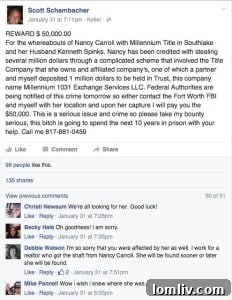
Among the most prominent victims of the Millennium Title collapse is Scott Schambacher, owner of Keller-based Avondale Development Group. Schambacher’s company found itself at the epicenter of the crisis after wiring a staggering $1 million to Nancy Carroll, the now-absent owner of Millennium Title Company. This substantial sum was intended for a 1031 Exchange, a crucial financial mechanism designed to defer capital gains taxes through strategic real estate reinvestment. For Schambacher and his investors, the money was meant to be held securely in escrow, a temporary holding ground until a new property could be identified and acquired to complete the exchange. The loss, as Schambacher confirmed, was precisely one million dollars to the penny.
The gravity of the situation became terrifyingly real for Schambacher in December when he visited the Millennium Title office to finalize a closing date. A casual overhear of a receptionist’s phone call instantly signaled trouble.
“I hear, ‘Oh, we don’t know where she’s at. It appears worse than what we thought. Let me email you something, bla-bla-bla,’ and hangs up,” Schambacher recounted. “And I’m thinking that doesn’t sound good.”
Indeed, those were not the reassuring words any investor wants to hear when their life savings or significant capital is entrusted to an escrow officer. Within a matter of days, Schambacher’s worst fears were confirmed: the Texas Department of Insurance had intervened and seized Millennium Title Company, signaling a severe breach of trust and financial mismanagement.
Understanding the Vulnerability of 1031 Exchanges
A 1031 Exchange, also known as a like-kind exchange, is a powerful tool for real estate investors. It allows them to defer capital gains taxes when they sell an investment property and reinvest the proceeds into another similar property within a specific timeframe. This tax deferral can significantly boost an investor’s purchasing power and accelerate wealth accumulation. However, the process requires strict adherence to IRS rules, including the use of a qualified intermediary or, as in this case, a title company to hold the funds in an escrow account during the transition period. This intermediary is entrusted with the investor’s proceeds, acting as a safeguard to ensure the funds are properly applied to the replacement property.
The inherent flaw, as many victims of the Millennium Title scandal discovered, is the fundamental lack of state insurance for these specific funds. Unlike traditional bank deposits, which are often FDIC-insured up to a certain limit, funds held in 1031 Exchange escrow accounts by title companies or intermediaries typically do not fall under the same protective umbrella. This makes investors particularly vulnerable to fraud or mismanagement, as there is often no state-backed safety net to recover lost funds. Schambacher’s poignant realization that “the state generally does not insure funds in 1031 Exchanges” underscores this critical gap in investor protection.
The Broadening Scope of the Disaster: More Victims Emerge
The seizure of Millennium Title Company by regulators quickly brought the full scale of the alleged fraud to light. Court papers revealed a shocking reality: the owner, Nancy Carroll, had vanished, and a total of $3 million was missing from the company’s escrow accounts. This discovery confirmed that the problem extended far beyond a single investor. Another victim, John Herlihy, promptly filed a lawsuit, accusing Carroll of absconding with an additional $1 million of his money and fleeing the country. The sentiment among victims was universal.
“I was blown away,” Schambacher remarked, conveying the profound shock. “I’ve been doing this 24 years and have never seen anything like this.”
Such a sentiment speaks volumes about the unusual and brazen nature of the alleged scheme. The sheer audacity of a title company owner disappearing with millions of dollars from client accounts sent shockwaves through the Southlake real estate community, eroding trust in a system that relies heavily on the integrity of its participants.
The Elusive Owner: Nancy Carroll’s Denials and Silence
In the wake of the scandal, Nancy Carroll, though disappeared, did offer a response to NBC 5 through emails. She vehemently denied the accusations leveled against her. Intriguingly, she also claimed that Schambacher was an investor in Millennium, a assertion he unequivocally refuted. Beyond these blanket denials, Carroll remained tight-lipped, refusing to answer specific questions about the whereabouts of the missing millions. Instead, she referred NBC 5 to her attorney, Michael McCue of Dallas. Unfortunately, attempts to reach McCue proved futile, as he did not respond to phone calls or emails, leaving victims and investigators with more questions than answers.
The Human Cost: Retirement Dreams Shattered
The Millennium Title debacle was not confined to multi-million-dollar investors. The human toll extended to individuals whose modest yet hard-earned savings were at risk. One anonymous 1031 investor, a diligent worker who had invested in real estate as a cornerstone of his retirement plan, fears he may lose approximately $50,000. He made the fateful decision to choose Millennium Title over a local bank, swayed by the prospect of saving a mere $1,000. For this individual, and many others like him, the loss represents years of sacrifice and careful planning.
“We bought our first home, and then we bought another but we kept the first one, renting it out,” he explained, detailing how he and his wife often scrimped and saved to manage their properties. “I know it’s not several million, but we worked hard over many years to acquire that money.”
This investor, like Schambacher, learned the harsh reality of the limited financial protection offered for 1031 Exchanges. He clings to hope for restitution through the Texas Bar Association, given that Nancy Carroll, the owner of Millennium Title, is a licensed Texas attorney. The possibility that a legal professional could be at the center of such an alleged scheme only deepens the sense of betrayal and exasperation among victims.
Unsettling Connections and Lingering Questions
As the investigation into Millennium Title unfolded, unsettling details began to surface, painting an even more complex and potentially sinister picture. Speculation mounted regarding the true extent of Carroll’s alleged absconding, with state investigators reportedly suggesting she may have disappeared with as much as $20 million – a figure significantly higher than the initial $3 million reported.
Adding another layer of intrigue, sources noted a personal detail about Nancy Carroll: her recent remarriage to a much younger man. While perhaps an innocuous personal decision, in the context of a financial disappearance, such details can sometimes be perceived as potential “red flags” or contribute to the narrative of a calculated escape.
The Cartel Connection: Juan Jesus Guerrero Chapa
Perhaps the most chilling revelation connecting Nancy Carroll to a darker undercurrent came to light when it was discovered that Millennium Title Company had handled the title work for Juan Jesus Guerrero Chapa. Guerrero Chapa was a Mexican drug cartel lawyer who became infamous after being gunned down in Southlake Town Square in May 2013, a high-profile, unsolved murder that rocked the community.
The details surrounding Guerrero Chapa’s life and death, as reported by Scott Gordon in a 2014 follow-up, are rife with suspicion. While it may simply be a profound coincidence, Carroll’s name appears in these investigative reports, raising uncomfortable questions about the clientele her company served.
Guerrero Chapa’s autopsy revealed he was ambushed and shot once in the chest and nine times in the back, indicating a professional hit. Key details from the investigation painted a picture of a man entangled in illicit activities: he allegedly had a drug problem with cocaine in his system at the time of his death, had been arrested in Miami Beach, and faced assault accusations from his girlfriend in Southlake. Furthermore, he had formed several Texas corporations that experts speculated might have been created for money laundering purposes.
One of the most suspicious transactions linked to Guerrero Chapa was the cash purchase of his Southlake home. Tax records show the home, a luxurious five-bedroom, 5.5-bathroom property, was purchased on July 15, 2011, under the name Ma G Alheli Dias Teixeira. Public records, however, yield no trace of anyone by that name, strongly suggesting a false identity. The asking price for the house was $1.35 million, and the previous owner confirmed the buyer paid entirely in cash.
Realtor Sharon Hodnett, who facilitated the sale, stated she could not recall the details of the transaction. Crucially, **Nancy Carroll, whose company handled the title transfer for this highly suspicious property acquisition, also declined to comment due to privacy laws.** While privacy laws are standard, her involvement in such a transaction, followed by her own disappearance with millions, adds a deeply troubling layer to the entire saga. This connection, whether coincidental or not, raises profound questions about the vetting processes at Millennium Title Company and the potential for larger, more organized criminal elements to exploit such vulnerabilities.
Protecting Your Investments: Lessons from the Scandal
The Millennium Title scandal serves as a stark reminder for all real estate investors about the critical need for vigilance and robust due diligence. To mitigate the risks of similar escrow fraud or mismanagement, investors should consider the following safeguards:
- Thorough Vetting of Title Companies and Intermediaries: Always research the reputation, licensing, and financial stability of any title company or qualified intermediary. Look for companies with long-standing track records and positive reviews. Verify their licensing with the state’s Department of Insurance or equivalent regulatory body.
- Understand Insurance and Bonding: Clarify what types of insurance and bonding the title company holds. While 1031 Exchange funds may not be state-insured, some reputable companies carry additional professional liability insurance or fidelity bonds that could offer a layer of protection against employee theft or fraud.
- Verify Escrow Accounts: Ensure that escrow accounts are held in reputable, FDIC-insured financial institutions and that the accounts are properly segregated. Request bank statements or verification letters directly from the bank, not just the title company, to confirm the funds’ presence.
- Seek Legal and Financial Counsel: Before entering any complex transaction like a 1031 Exchange, consult with an independent attorney specializing in real estate and a qualified financial advisor. They can review agreements, explain risks, and guide you through the process, helping identify potential red flags.
- Stay Informed: Be aware of the regulatory landscape and any changes that might affect investor protection. Financial vigilance is an ongoing process.
Conclusion: A Legacy of Betrayal and Unanswered Questions
The Millennium Title Company scandal is more than just a financial crime; it’s a profound breach of trust that has left individuals and businesses devastated. Scott Schambacher, the anonymous investor, and countless others are left to navigate the complex and often unforgiving landscape of restitution, hoping for justice against an elusive perpetrator. The connection to a high-profile cartel murder further deepens the mystery, suggesting potential ramifications far beyond simple financial fraud.
As the legal and investigative processes continue, the Southlake community and the broader real estate investment world watch intently. The disappearance of Nancy Carroll and the millions entrusted to her underscore the critical need for stringent oversight, transparent practices, and robust investor protection mechanisms. Until answers are found and justice is served, the legacy of Millennium Title remains a cautionary tale of betrayal, reminding everyone that in the world of high finance, trust, once broken, can be impossible to fully restore.