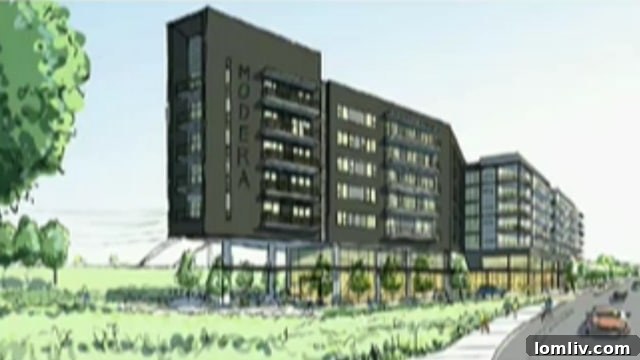
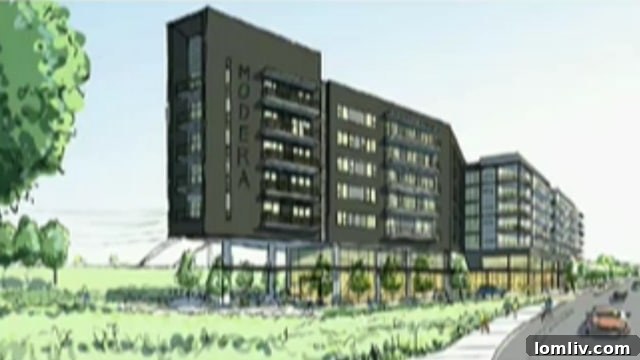
In recent weeks, the discourse around Dallas’s urban evolution has intensified, spurred by concerns over the city’s approach to its architectural heritage and future development. Following two widely discussed columns—one highlighting how iconic views of the classic Dallas skyline have been obscured by new, often uninspired structures, and another focusing on the proposed Modera project—the city’s planning decisions are under scrutiny. This article delves deeper into the Modera development, a significant proposal by Mill Creek strategically located on the Trinity River at Commerce Street, and examines its implications for Dallas’s unique urban landscape and skyline.
The Modera project, initially slated for presentation to the City Plan Commission on October 15, experienced a pivotal shift in its review process. It was removed from the agenda and instead referred to the Urban Design Peer Review Panel. This move, which occurred last Friday, provided an opportunity for closer examination by architectural and design experts, albeit with some challenges in obtaining comprehensive visual documentation.
Despite the efforts to bring greater transparency, obtaining clear images of Mill Creek’s Modera intentions proved difficult. The city did not promptly distribute or post the presentation materials, and the quality of the city’s video system was not high-definition. Furthermore, while Mill Creek representative Kevin Hickman expressed reservations about previous critiques, no detailed images were provided by the developer either. This lack of visual clarity only fueled public anticipation and concern regarding a project poised to significantly impact the Trinity Riverfront and the broader Dallas urban fabric.
The Modera Project’s Design: Initial Impressions and Evolution
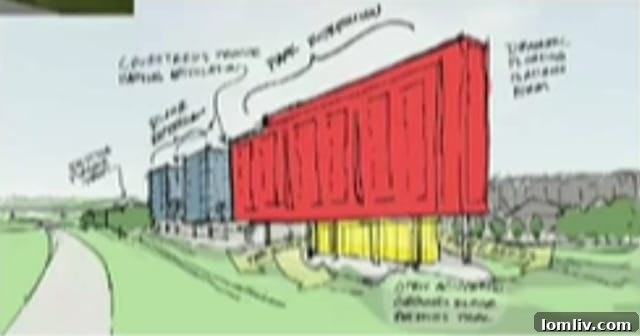
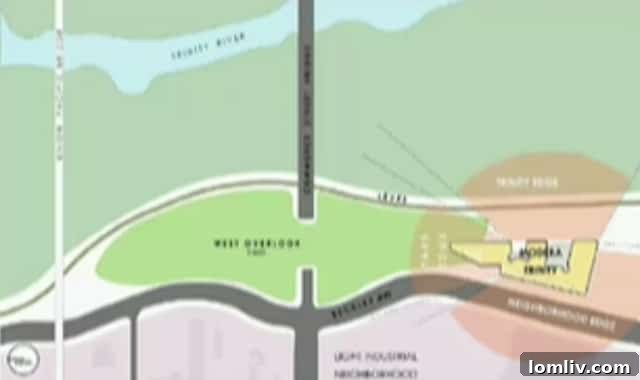
Upon reviewing the limited available renderings, the Modera project’s design was not as alarming as initial fears suggested. The unique geometry of the land parcels largely dictates the building’s fundamental shape, which Mill Creek describes as a “flat iron,” drawing parallels to New York City’s iconic Flatiron Building. However, an alternative perspective views the structure more akin to a “fan blade”—a distinction that proves significant in later design discussions concerning its interaction with the Trinity River and the Dallas skyline. This five-story development is planned as a brick-and-stick structure, elevated atop three concrete stories of above-ground parking. The decision against underground parking is largely practical, driven by the prohibitive costs and the engineering complexities posed by the adjacent levee system.
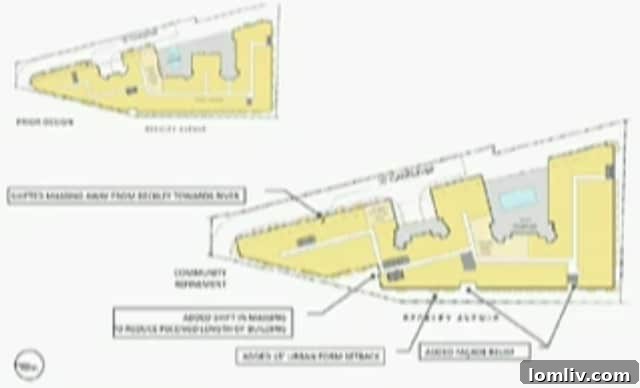
The Modera proposal outlines 280 apartment units, complemented by a selection of townhouses along Beckley Street. These townhouses are strategically positioned to wrap around the garage structure, effectively shielding the parking from direct street view—a common urban design strategy to enhance pedestrian experience. Crucially, the plans illustrate a noticeable evolution in the project’s perimeter from June to its current iteration. The upper or “back” edge of the building, which directly faces the Trinity River and offers prime views of downtown Dallas, has unfortunately become less intricate and articulated. What was once a connected, expansive amenity deck now appears smaller, featuring a noticeable cutout. Furthermore, a third, left-side cutout has been eliminated, resulting in a squarer, more conventional end to accommodate standard apartment layouts. These design modifications raise questions about the prioritization of internal unit efficiency over external aesthetic impact and engagement with the riverfront.
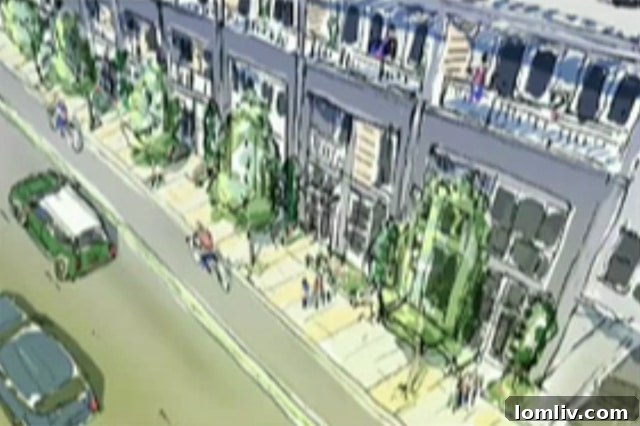
The peer reviewers generally commended the integration of townhouses into the Modera project, acknowledging their sensible design. However, their inclusion implicitly signals a conservative outlook on the future pedestrian traffic and commercial vitality of Beckley Street. The absence of additional ground-floor retail or restaurant spaces in these areas suggests that developers do not anticipate sufficient footfall to justify such amenities, or that the parking requirements for them would be too demanding. Conversely, the plans do incorporate two restaurant spaces positioned at the Commerce Street end of the building, one of which is designed to seamlessly connect with the future West Overlook Park. These spaces hold significant potential to become vibrant community hubs, providing essential services and enhancing the experience for residents and visitors exploring the new park and the Trinity Skyline Trail.
Rethinking the “Back”: Opportunities for Enhanced Riverfront Design
During the presentation, Mill Creek prominently showcased the building’s front elevations, yet a singular rendering was provided for the “back” of the structure—the side that offers unparalleled views of the Trinity River and the Dallas city skyline. This river-facing side, critically, is where a proposed restaurant (indicated in yellow) is strategically placed, promising an exceptional vantage point for enjoying the future park and the river views. However, this promising feature is juxtaposed with significant design drawbacks. The rendering unfortunately reveals exposed parking structures situated below the levee level, which detrimentally impacts the visual appeal from Commerce Street and, more importantly, from the highly utilized Trinity Skyline Trail. Compounding this issue is a series of largely unarticulated, flat walls where balconies are slated to be installed, presenting a missed opportunity for dynamic architectural expression.
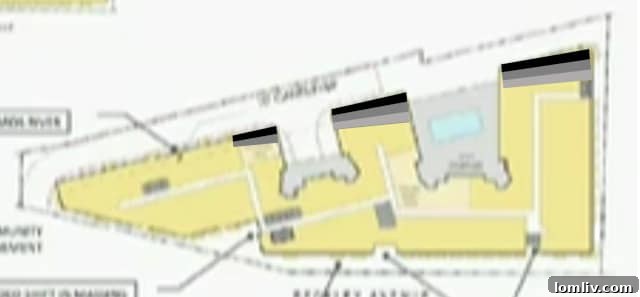
A compelling alternative, as suggested by some design experts, involves configuring the building’s river-facing side with a stair-stepped profile, reminiscent of a “fan blade” design. This architectural approach would not only visually reduce the building’s mass from the perspective of the Trinity Skyline Trail but also create spectacular, expansive terraces for numerous units. Such premium units, with their enhanced outdoor living spaces and panoramic views, would undoubtedly command higher rents, thereby increasing the project’s overall value. While this configuration might result in a slight reduction in the total number of units, the substantial increase in visual interest and the creation of highly desirable, high-value spaces could easily offset this. As one peer reviewer astutely noted, the river-facing side should, in fact, be considered the building’s true “front”—a critical facade that demands thoughtful articulation and an engaging presence to truly leverage its exceptional setting and contribute positively to the Dallas urban experience.
Optimizing Views: The Case for Larger Windows in Modern Dallas Architecture
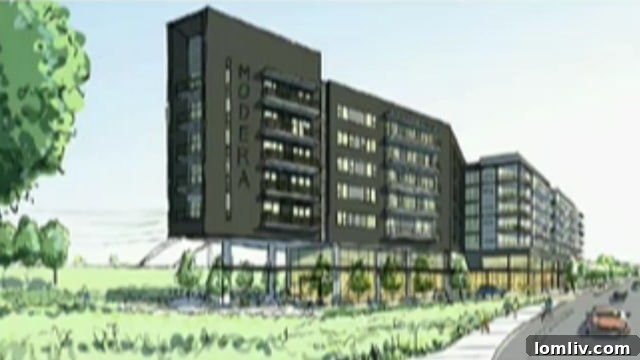
In historical architecture, window sizes were often constrained by the high cost of glass and sometimes by municipal taxes levied on glass or the number of windows in a building. Thankfully, these limitations are relics of the past. For a development like Modera, poised at a premier location offering expansive vistas of the Trinity River, the burgeoning West Overlook Park, and the iconic Dallas urban skyline, the architectural philosophy should wholeheartedly embrace transparency and maximize outward engagement. The “tip” of the building, in particular, presents an extraordinary opportunity to be transformed into a dramatic, all-glass prow, much like the bow of a ship, that fully capitalizes on its panoramic position. While the ground-level restaurant patio appropriately adopts an almost transparent design, the residential levels above appear to offer merely “focused” views when the overarching goal should be to provide full-blown, immersive visual experiences.
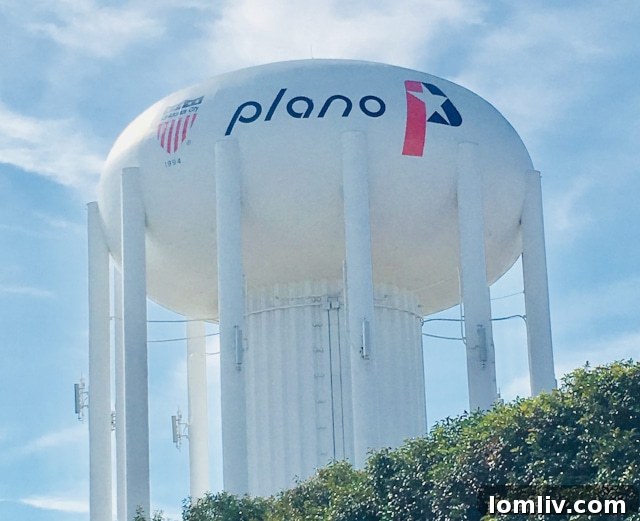
The current design appears to feature heavy residential floors that sit somewhat incongruously on a more transparent ground level. For a building whose admitted primary allure and signature feature are its stunning views of the Trinity River, the future park, and the vibrant urban skyline, the proposed glass-to-wall ratio is surprisingly conservative. It evokes the aesthetic of a suburban structure facing a prosaic water tower, rather than a dynamic urban development overlooking a park and a world-class city backdrop. This design choice represents a significant missed opportunity to elevate the living experience for residents and to contribute a visually striking, modern landmark to the Dallas riverfront. A truly forward-thinking design would prioritize expansive glazing, allowing natural light to flood the interiors and residents to fully connect with their spectacular surroundings, thereby creating a stronger dialogue between the built environment and its unique natural and urban context.
Exterior Aesthetic: Beyond the “Seattle” Look for Dallas Urban Development
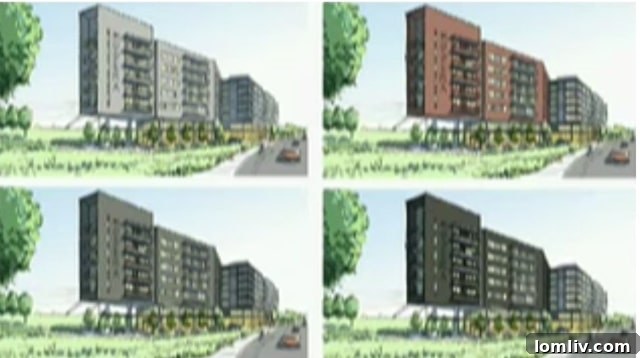
As a proponent of modern architectural aesthetics, I advocate for designs that resonate with their specific urban context, and Dallas is distinctly different from the Pacific Northwest. Mill Creek presented four potential exterior finishes, all seemingly variations of a “natural” treatment, presumably intended to harmonize with the greenery of the proposed park and the riverine landscape. However, this Modera project is not nestled within a dense forest; it is situated within a singularly urban environment bisected by a river. The Trinity River, in this context, functions as a beautiful anomaly—a natural feature within a built landscape. Therefore, an exterior that merely attempts a “matchy-matchy” blend with nature feels incongruous and risks imparting a suburban sensibility to what should be a bold, urban statement piece. Dallas’s urban fabric deserves buildings that assert their identity, reflecting the city’s ambition and dynamism, rather than receding into an ill-fitting naturalistic palette. While the building’s overall massing and “envelope” show potential, the proposed exterior finishes require substantial reconsideration to truly elevate Modera to a landmark status.
The Question of a Tower: Financial Realities and City Incentives in Dallas
The initial proposal for the Modera project briefly included an option for a 14-story tower, a topic that was touched upon in passing. As previously discussed, the economic disparity between different construction types—specifically the more affordable brick-and-stick construction versus the significantly more expensive steel-and-concrete required for high-rise towers—creates a substantial financial gap. This gap often makes higher-density, taller developments unfeasible given the typical neighborhood rental rates. Mill Creek representatives candidly stated that such a tower, and even the current version of the project, might require significant financial incentives from the city to bridge this economic divide and make it viable. This raises a critical question for Dallas’s urban planning and economic development strategy: to what extent should the city provide subsidies for private developments, and are these investments truly aligned with the long-term economic and aesthetic interests of the community? The developer’s reliance on potential city funding serves as a strong indicator that the project’s current scope and proposed high-rise option may not be inherently sustainable without external financial support, prompting a deeper evaluation of its timing and necessity.
“Ghost Zoning” and the Ethics of Future Development in Dallas
Mill Creek’s revelation that they have been engaged in this development deal for 14 months, without a firm construction start date, highlights a phenomenon often referred to as “ghost zoning.” Their presentation explained that their zoning request was structured to allow existing businesses to operate until construction officially commences. Throughout the review process, the imminent West Overlook Park was frequently cited as a crucial catalyst for the area’s growth. However, this enthusiasm was tempered by admissions that the park itself might take a decade to complete. While peer reviewers expressed hope for Mill Creek’s swift return in a matter of months, other hints suggested construction might still be years away, particularly for the high-rise component. This prolonged timeline strongly suggests a strategy of “ghost zoning”—where development rights are secured years in advance, long before any concrete plans for actual construction are in place. This practice is not unique to Modera; the example of the lots across Cole Avenue from West Village, rezoned by Gables years ago for three high-rises that have yet to materialize, serves as a stark precedent.
The core question this practice poses is whether it is equitable or beneficial for the city to determine the fate of valuable land parcels without a solid, legally binding commitment to build within a reasonable timeframe. “Ghost zoning” can lead to land banking, where owners or developers simply hold land, increasing its value through rezoning without contributing to the city’s immediate development needs. A rezoning decision made today, based on current conditions, priorities, and market demands, may become obsolete or inappropriate years later when actual construction begins. This raises concerns about speculative development, the efficient use of urban land, and the potential for a disconnect between current urban planning goals and future realities. The city must critically evaluate whether approving zoning changes for projects with uncertain timelines truly serves the public interest or if it merely enables speculative real estate plays, potentially holding valuable urban land hostage to future market fluctuations.
The West Dallas Plan, Historical Context, and Racial Implications
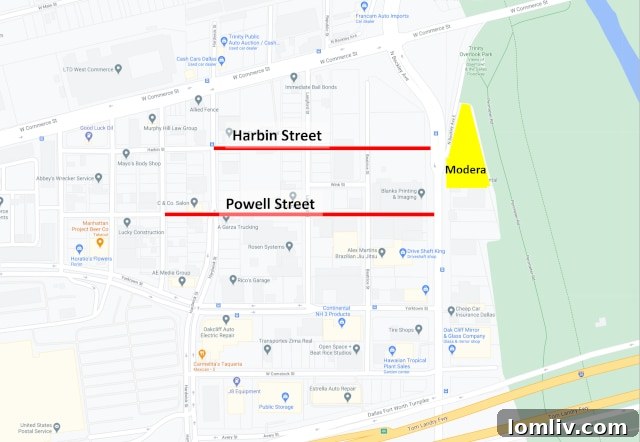
The discussion around the Modera project frequently invoked the West Dallas Plan, yet its interpretation and implementation proved contradictory. Mill Creek, for instance, based part of its argument on the plan’s call for taller buildings along the Trinity River. However, this justification was often immediately undercut by critics who pointed out the plan’s general lack of adherence in other respects. This selective interpretation mirrors a tendency to cherry-pick elements that support a particular agenda, rather than engaging with the plan’s holistic vision for West Dallas. A significant point of contention was the failure of the neighborhood to reinstate the grid-pattern of streets, a key tenet of the West Dallas Plan. Re-establishing this grid would necessitate disassembling larger, contiguous lots—a complex undertaking. The developers argued that when the city drafted the West Dallas Plan in 2011, it failed to update the Planned Development Districts’ descriptions for the area, a process that would have required either landowner approval or an authorized public hearing. It is highly improbable that any landowner would voluntarily agree to a new road dissecting their valuable, contiguous lot, thereby diminishing its redevelopment potential.
Crucially, understanding the historical context, particularly the racial implications, is vital to appreciating the complexities of the West Dallas Plan. Decades ago, these streets were deliberately blocked to facilitate the assembly of large parcels for commercial and industrial development. This historical maneuver fundamentally altered a once predominantly minority-owned residential district. In the 1960s, city leaders strategically utilized zoning and planning mechanisms to displace these communities, reshaping West Dallas. This legacy of displacement and top-down planning decisions continues to influence land ownership, development patterns, and community sentiment today. Any new development in West Dallas, including Modera, must be considered within this historical framework, acknowledging the enduring impact of past policies on the current socio-economic landscape and ensuring that new projects contribute equitably to the community’s future.
Navigating Floodplain Challenges and Stormwater Management
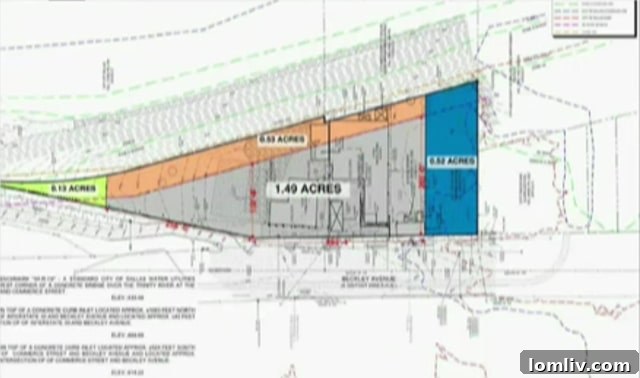
A significant practical constraint for the Modera project involves its proximity to the floodplain. Initial plans aimed to extend the development one lot further south, but this proved impossible due to its location within the designated floodplain. This critical proximity might visually explain why the building’s design, in some renderings, gives the impression of water flowing beneath it, suggesting an architectural response to hydrological realities. During the peer review, a pertinent question arose regarding stormwater runoff. Mill Creek’s response, however, was particularly noteworthy and somewhat ambiguous. They stated that the new building would not generate more runoff than “what’s currently allowed,” rather than specifying “what’s currently produced.” This distinction is critically important. “What’s currently allowed” refers to regulatory limits, which might be generous or outdated, whereas “what’s currently produced” refers to the actual existing runoff from the site in its current state. Developing a new structure inherently alters impervious surfaces and drainage patterns. Therefore, merely meeting a regulatory allowance, which might not reflect best practices or account for increased storm intensity due to climate change, could still exacerbate local flooding issues or strain existing infrastructure. This nuanced answer underscores a potential environmental concern and emphasizes the need for robust, proactive stormwater management strategies that go beyond minimal compliance to truly mitigate environmental impact in sensitive floodplain areas, especially for a large-scale Dallas urban development project.
Despite earlier anxieties, the Modera project’s fundamental footprint appears workable, largely dictated by the unique dimensions of the parcel. Nevertheless, several crucial aspects require significant refinement. These include the building’s exterior—particularly its less-articulated “back” facade—the suboptimal window-to-wall ratio that underutilizes spectacular views, inadequate parking shielding, and its overall integration with the vital Trinity Skyline Trail. While these issues are likely fixable with a collaborative effort from Mill Creek and the City of Dallas, a more profound concern lingers: Is this the truly appropriate-sized and designed building for such an incredibly important site? This location bookends one end of the future West Overlook Park and abuts the beloved Trinity Skyline Trail, demanding a design that is not just acceptable, but exceptional. Furthermore, how will the surrounding West Dallas neighborhood continue to evolve before any plan is ultimately built, and will the chosen design still harmoniously integrate with that transformed environment years down the line? These questions underscore the long-term vision required for responsible urban development in Dallas.
Peer Review or Job Interview? Scrutiny of the Process in Dallas Development
Initially, the referral of the Modera project from the Plan Commission to the Urban Design Peer Review Panel was met with optimism, envisioning a robust and publicly transparent assessment by Dallas’s esteemed architecture and design community. However, this starry-eyed hope quickly dissipated upon witnessing the actual proceedings. It became apparent that the process veered significantly from a critical, objective review towards an atmosphere more akin to the sycophancy often found in a job interview. This shift was starkly illustrated when one peer reviewer, astonishingly, asked Mill Creek how the panel could “help” them—a response that visibly surprised the developers themselves, perhaps accustomed to a more rigorous questioning. The full extent of this incongruity became unequivocally clear when another Peer Review member recused himself, revealing he was actively working with Mill Creek and would even be delivering a portion of their presentation. While there might have been no malicious intent, this incident starkly illuminates the inherent “inbrededness” that can pervade local design and development circles. Such a scenario, where potential employees review the plans of potential employers, casts a shadow over the impartiality and independence essential for an effective peer review process. It raises serious questions about transparency, conflicts of interest, and the integrity of a system designed to ensure the highest standards for urban development in a rapidly growing city like Dallas.