North Texas Housing Market Continues its Upward Trajectory: A Deep Dive into January’s Performance
The real estate market across North Texas remains consistently vibrant and intensely competitive, solidifying its position as one of the nation’s most dynamic regions. The latest comprehensive report from the MetroTex Association of Realtors provides a detailed snapshot of January’s activity, reaffirming a pronounced seller’s market and presenting significant challenges for prospective buyers. This analysis delves into key metrics across 16 counties, offering critical insights into home sales figures in bustling metropolitan centers, flourishing suburban communities, and expanding exurban areas.
Overall Market Dynamics: A Strong Seller’s Advantage
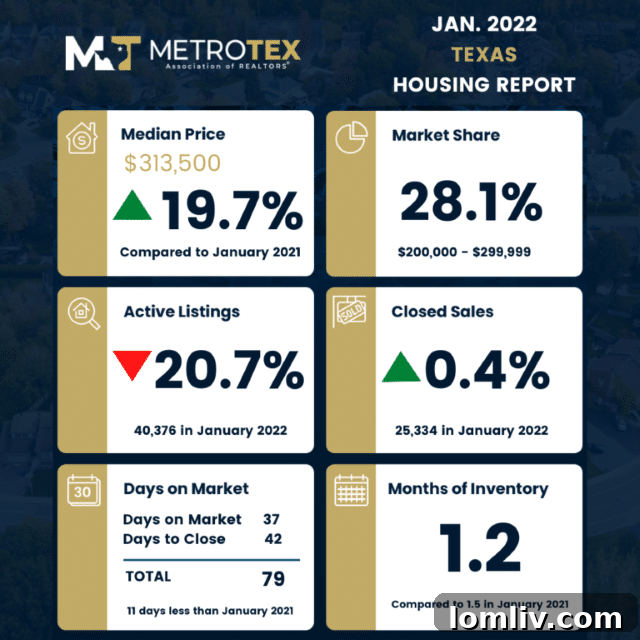
January’s data unequivocally illustrates a market heavily favoring sellers. North Texas witnessed a remarkable 19.7 percent year-over-year increase in the median sales price, reaching an impressive $313,500. This substantial appreciation is a direct consequence of sustained high demand, fueled by continuous population growth, a thriving regional economy, and a limited supply of available homes. For buyers, this translates into higher entry costs and a more competitive bidding landscape.
The scarcity of available properties is a defining characteristic of the current market. Active listings plummeted by a significant 20.7 percent, totaling just 40,376 units across the region. This severe shortage creates an environment where properties are snapped up quickly, often above asking price, as buyers compete for a shrinking pool of homes. The speed at which homes are selling is further highlighted by an average of only 79 days on market before a sale closes. This rapid pace contributes to an alarmingly low 1.2 months of inventory—a figure far below the 6-month benchmark typically associated with a balanced market. Such limited inventory signals that the existing supply of homes would be exhausted in just over a month if no new listings were added, underscoring the urgency felt by motivated buyers.
Regional Performance: Suburbs Lead While Exurbs Show Varied Growth
While the overall narrative points to robust growth, the MetroTex report unveils a nuanced picture when examining different geographical segments. Suburbs, in particular, demonstrated exceptional strength in home price appreciation. These areas continue to attract buyers seeking a blend of urban accessibility with suburban tranquility, often boasting desirable amenities, strong school districts, and vibrant community infrastructures. Exurban regions, though experiencing growth in many instances, presented a more mixed performance, with some localities seeing significant booms and others facing unique localized challenges.
County-Specific Analysis: The Market’s Frontrunners and Unique Cases
The report’s granular data provides a comprehensive overview of how each of the 16 North Texas counties performed, detailing shifts in median prices, active listings, days on market, and months of inventory. This breakdown offers critical insights for understanding the localized real estate environment.
| County | Median Price Change | Current Median Price | Active Listings Change | Days on Market | Months of Inventory |
|---|---|---|---|---|
| Collin | 🔺 24.8% | $465,000 | 🔻 42% | 73 | 0.5 |
| Dallas | 🔺 16.2% | $315,000 | 🔻49.4% | 63 | 0.8 |
| Denton | 🔺 26.6% | $420,000 | 🔻 39.3% | 68 | 0.5 |
| Ellis | 🔺 28.3% | $377,945 | 🔺 9.1% | 85 | 1.1 |
| Grayson | 🔺 26.6% | $270,250 | 🔻 14.2% | 68 | 1.3 |
| Hopkins | 🔺 28.7% | $208,500 | 🔻 12.2% | 94 | 1.3 |
| Hunt | 🔺 29.8% | $277,700 | 🔺 25.1% | 77 | 1.5 |
| Johnson | 🔺 26.9% | $304,625 | 🔻 25.7% | 66 | 1.0 |
| Kaufman | 🔺 21.3% | $310,450 | 🔻 9.6% | 107 | 1.1 |
| Navarro | 🔺 12.7% | $233,250 | 🔻 14.5% | 116 | 1.6 |
| Parker | 🔺 28.8% | $405,393 | 🔻 18% | 85 | 1.4 |
| Rockwall | 🔺 28.8% | $390,000 | 🔻 23.4% | 73 | 0.9 |
| Stephens | 🔻 53.4% | $93,950 | 🔺 17.4% | 108 | 3.5 |
| Tarrant | 🔺 23.4% | $327,000 | 🔻 30.9% | 63 | 0.6 |
| Van Zandt | 🔺 33.5% | $295,000 | 🔻 6.9% | 73 | 1.7 |
| Wise | 🔺 23.3% | $330,900 | 🔻 13.6% | 96 | 1.3 |
The Pacesetters: DFW’s Core Metro Counties
The major counties forming the heart of the Dallas-Fort Worth Metroplex demonstrated consistent and robust growth. Collin County, a beacon of affluent communities and highly-rated school systems, recorded the highest median home sales price in the entire report, reaching a staggering $465,250. This represents a substantial 24.8 percent increase, cementing its status as a premier residential destination. With active listings down by a dramatic 42 percent and merely 0.5 months of inventory, Collin County remains one of the nation’s most competitive and sought-after real estate markets.
Neighboring Denton County mirrored this intensity, experiencing a remarkable 26.6 percent price surge, bringing its median to $420,000. Its critically low inventory (0.5 months) and rapid sales pace (68 days on market) underscore intense buyer demand, driven by its appealing growth corridors and attractive lifestyle amenities.
Dallas County, the urban core, saw its median home price rise by 16.2 percent to $315,000. Despite its more established nature, demand is exceptionally high, with active listings nearly halved (down 49.4 percent) and homes selling in a brisk 63 days. This indicates a strong enduring urban appeal and ongoing revitalization efforts within its diverse neighborhoods.
On the western flank of the metroplex, Tarrant County showcased impressive vitality, with a 23.4 percent increase pushing its median price to $327,000. Significantly, Tarrant County led the report in terms of sheer transaction volume, logging 1,768 single-family home sales. Its unique blend of relative affordability compared to the eastern suburbs, robust job market growth, and diverse community offerings continues to draw a wide spectrum of buyers, contributing to its low 0.6 months of inventory.
Exurban Expansion and Emerging Value Markets
Venturing beyond the immediate metro core, several exurban and outer suburban counties registered substantial appreciation, often driven by buyers seeking greater space, newer homes, or more accessible price points. Van Zandt County stood out as the top performer in percentage growth, boasting an impressive 33.5 percent surge in median home sales prices to $295,000. This remarkable growth exemplifies a broader trend where buyers are increasingly willing to explore further afield for enhanced value, larger properties, and a more serene lifestyle.
Other significant exurban gainers included Ellis County (up 28.3% to $377,945), Hopkins County (up 28.7% to $208,500), Hunt County (up 29.8% to $277,700), Johnson County (up 26.9% to $304,625), and Parker County (up 28.8% to $405,393). These areas consistently demonstrated strong year-over-year gains, reflecting the expanding reach of North Texas’s robust housing demand. Even Kaufman County (up 21.3% to $310,450) and Rockwall County (up 28.8% to $390,000) continued their upward ascent, benefiting from ongoing developments and infrastructure enhancements.
Grayson County (up 26.6% to $270,250) and Wise County (up 23.3% to $330,900) also reported impressive growth, signaling their increasing attractiveness to individuals seeking a harmonious blend of suburban conveniences and rural charm, often at more appealing price points than the inner-ring suburbs.
The Stephens County Anomaly: A Market Deviation
In stark contrast to the widespread appreciation, Stephens County presented a notable outlier with a dramatic 53.4 percent decline in its median home sales price, falling to just $93,950. This significant drop, while not representative of the broader North Texas market, likely stems from highly localized economic factors, unique property inventory, or a small sample size of sales that skewed the median dramatically. Its geographical distance—located “beyond Fort Worth, beyond Weatherford, beyond Mineral Wells on the way to Abilene”—positions it outside the immediate economic influence of the booming DFW core, highlighting the diverse micro-markets that exist within the larger North Texas region.
Navarro County, while recording a modest 12.7% increase to $233,250, exhibited a comparatively higher average days on market (116) and months of inventory (1.6). This suggests a slightly less frantic market pace compared to the highly competitive counties closer to the metroplex, potentially offering buyers a bit more breathing room.
Spotlight on Communities: Hotbeds and Unexpected Dips
The MetroTex report further highlighted specific communities that experienced exceptional market activity:
- Hot Communities:
- Bedford: Witnessed an astonishing 50 percent surge, reflecting intense buyer demand in this well-established Tarrant County city.
- Crowley: Recorded a robust 30 percent increase, signaling its growing popularity and desirability.
- Richardson: Showed a healthy 15 percent climb, maintaining its reputation as a sought-after Dallas County suburb with strong amenities.
- Saginaw: Grew by 14 percent, indicating sustained interest in this Fort Worth-adjacent locale, likely due to affordability and accessibility.
- Mansfield: Experienced a 10 percent rise, continuing its steady growth trajectory as a family-friendly community.
- Cold Community:
- Allen: Surprisingly, reported a 31 percent decrease. This figure stands as a notable anomaly in an otherwise booming market. While the report does not detail specific causes, such a significant drop in a typically high-demand area like Allen could be attributed to a shift in the types of properties sold during that month (e.g., a higher proportion of smaller or older homes), a statistical fluctuation due to a limited number of transactions, or localized market adjustments. This warrants closer observation in subsequent reports to understand the underlying factors.
Key Drivers of the North Texas Real Estate Boom
The sustained and robust growth of the North Texas housing market is underpinned by a confluence of powerful factors:
- Unprecedented Population Influx: Texas, particularly the Dallas-Fort Worth metroplex, continues to be a magnet for corporate relocations and individual migration from across the country. People are drawn by abundant job opportunities, a relatively lower cost of living (compared to coastal mega-cities), and an attractive quality of life. This steady stream of new residents creates relentless demand for housing.
- Dynamic Economic Growth and Strong Job Market: The DFW area boasts a diverse and resilient economy, with significant job creation in high-growth sectors such as technology, finance, logistics, and healthcare. A robust employment landscape provides more individuals with the financial stability and confidence to invest in homeownership.
- Persistent Housing Supply Shortage: Despite ongoing construction efforts, the development of new homes has consistently struggled to keep pace with soaring demand. Challenges like escalating material costs, labor scarcity, and regulatory complexities hinder the speed at which new inventory can enter the market, intensifying the existing supply-demand imbalance.
- Historically Favorable Interest Rates: During the period covered by this report, mortgage interest rates were often at historically low levels. These attractive rates made homeownership more accessible and affordable, further stimulating buyer demand and contributing to market competitiveness.
- Strategic Infrastructure Development: Continuous investment in regional infrastructure, including new highways, expanded public transit options, and improved utilities, has made previously more distant exurban areas increasingly accessible. This expands the viable commuting radius, opening up new frontiers for residential development and property value appreciation.
Implications for Stakeholders: Buyers and Sellers
Navigating the North Texas real estate market successfully requires a clear understanding of these dynamics for all participants:
- For Sellers: This remains an exceptionally favorable period to list a property. With high demand and critically low inventory, sellers can anticipate competitive offers, potentially exceeding asking prices, and remarkably swift sales. Maximizing returns will depend on strategic pricing, professional home staging, and effective marketing campaigns.
- For Buyers: The current market environment demands thorough preparation, resilience, and decisive action. Obtaining pre-approval for a mortgage is an essential first step. Buyers must be ready to submit strong, competitive offers promptly, and while caution is advised, they may need to consider waiving certain contingencies (always with expert advice). Exploring communities slightly further from the core metro areas might offer more diverse options and potentially better value. Collaborating with an experienced local real estate agent who understands these fast-paced conditions is absolutely crucial for success.
Conclusion: A Resilient and Evolving North Texas Market
The January report from the MetroTex Association of Realtors paints a vivid picture of a North Texas housing market that is both highly resilient and undergoing rapid transformation. Driven by robust economic fundamentals, sustained population growth, and a persistent shortage of housing supply, home prices continue their upward climb across the majority of the region. While this intensely competitive environment presents undeniable challenges for buyers, it simultaneously creates unparalleled opportunities for sellers. As the North Texas landscape continues its dynamic growth and evolution, staying well-informed about these intricate market forces will be paramount for successfully navigating its exciting and complex real estate future.
Note: This article revisits data from an earlier report, which inadvertently omitted Van Zandt and Wise counties in its initial version. All data presented here is current for the specified report period.