Shaping the Future of Preston Center: Insights from a Pivotal Community Meeting
The urban landscape of Dallas is in constant flux, and few areas embody this dynamic more vividly than Preston Center. A recent community meeting brought to the forefront critical discussions about the future development and infrastructure challenges facing this affluent yet increasingly congested district. While I regretfully missed the early proceedings, relying on the astute reporting of Eric Nicholson from the Dallas Observer, I’ve gathered key takeaways that underscore the deep complexities and passionate debates surrounding Preston Center’s evolution.
The meeting drew a diverse crowd, including influential figures like former Mayor Laura Miller, observed in serious conversation with City Council member Jennifer Gates, and former City Councilman Mitchell Rasansky. Their continued engagement in local politics, even without remuneration, highlights the enduring commitment many civic leaders have to their communities, perhaps rendering debates over Proposition 8 and city council raises somewhat secondary to their passion for shaping Dallas’s destiny. A recurring theme emerged early on: a palpable tension between certain community factions and Council member Gates. Attendees described an intense “grilling” session, where a small, vocal group pressed Gates, almost implying an undisclosed agenda regarding future development.
Only one member of the audience truly grilled Gates on development in and around Preston Center, trying unsuccessfully to goad her into either pledging to defend the status quo or, conversely, to lure her into admitting she was gung ho for more development.
Gates, however, steadfastly maintained her neutrality, assuring residents that she had no such agenda and was committed to a fair and collaborative planning process. This initial confrontation set the tone for a discussion that would delve into traffic, funding, and the very identity of Preston Center.
The Visionary and the Purse Strings: Michael Morris and Regional Planning
A central figure in the evening’s discussion was Michael Morris, the transportation planner from the North Central Texas Council of Governments (NCTCOG). Often characterized, perhaps playfully by Eric, as an “urbanist bogeyman” due to his control over regional transportation funding and his prominent support for the controversial Trinity Tollroad, Morris’s presence underscored the regional scope of Preston Center’s challenges. His role is particularly significant as NCTCOG acts as the metropolitan planning organization for 16 North Central Texas counties, allocating federal and state transportation funds that shape the very fabric of our urban mobility.
Despite his sometimes-controversial reputation, my post-meeting interaction with Morris revealed a thoughtful individual keenly aware of Dallas’s interconnected traffic issues. He articulated a perspective that frames local congestion, like that on Northwest Highway, not in isolation but as a symptom of broader systemic problems. For instance, he noted that Northwest Highway effectively functions as a cross-town expressway, not by design, but by necessity, as downtown Dallas struggles with significant congestion, forcing drivers to seek alternative routes.
Funding a Master Plan for Preston Center’s Future
A significant announcement from Morris was his pledge of $200,000 to $300,000 towards the creation of a comprehensive master plan for Preston Center. This substantial contribution is anticipated to cover roughly half the total cost of the plan, with Council member Gates expressing confidence that the remaining funds could be “cobbled together from the neighborhood’s well-resourced neighborhood groups.” Indeed, these groups, which I would describe as “well-heeled,” have a history of mobilizing resources, often hiring top legal talent to challenge redevelopment proposals. The expectation now is that their financial capacity can be directed towards proactive planning and long-term traffic solutions, transforming a reactive stance into a collaborative investment in the area’s future.
The development of a master plan is a crucial undertaking. It’s not just about addressing traffic; it’s about creating a holistic vision for the area encompassing land use, infrastructure, green spaces, and community amenities. Such a plan provides a framework for future development, ensuring that growth is managed thoughtfully and sustainably, aligning with the community’s aspirations while also addressing pressing issues like congestion and aging infrastructure. Without a guiding master plan, development can often feel piecemeal and reactive, leading to unintended consequences and exacerbated problems.
Addressing Dallas’s Interconnected Traffic Woes and the Promise of Walkability
Morris’s emphasis on the interconnectedness of Dallas traffic highlights a critical urban planning principle: solutions in one area can profoundly impact others. The idea that Northwest Highway serves as an impromptu cross-town route because of downtown’s perpetual gridlock is a powerful illustration. This perspective aligns with ongoing discussions about potentially reimagining downtown highways, perhaps by closing or capping them, to create new urban parks, foster vibrant downtown neighborhoods, and spur significant real estate investment. These bold visions prioritize walkability and integrated urban living, moving away from a car-centric model that has dominated Dallas for decades.
Walkability, a core tenet of modern urban planning, is essential for creating vibrant, healthy, and sustainable communities. It encourages physical activity, reduces reliance on automobiles, lowers carbon emissions, and fosters a stronger sense of local community. However, achieving true walkability in a sprawling, car-dependent city like Dallas presents unique challenges. For residents living in nearby areas such as Irving, walking to Preston Center is simply not a viable option. Morris offered an intriguing, albeit ambitious, solution for improving pedestrian access to Preston Center: a dedicated bridge over Northwest Highway. This proposed infrastructure would connect the surrounding neighborhoods directly to Preston Center, dramatically enhancing safety and convenience for pedestrians.
My own recent experience reinforces the urgency of such a pedestrian solution. Witnessing a woman precariously navigate that treacherous street with two dogs in tow, I found myself momentarily paralyzed with concern for her safety. A pedestrian bridge would not only prevent such harrowing moments but also unlock a new dimension of connectivity and community life for Preston Center.
Lessons from Garland Road: Shifting Traffic Dynamics
To illustrate the potential for transforming traffic patterns, Morris drew a parallel with Garland Road’s evolution. Decades ago, Garland Road primarily served as a pass-through route, with 70 to 90 percent of its traffic merely transiting to Garland itself. However, with the strategic development of major infrastructure projects, including the LBJ Freeway, this dynamic fundamentally shifted. Today, 70 to 90 percent of trips on Garland Road are local, serving the immediate area. This example powerfully demonstrates how well-executed urban planning and infrastructure development can redefine the function of roadways, prioritizing local access and community integration over regional transit through neighborhood arteries.
This paradigm shift underscores the potential for Preston Center. By strategically planning and implementing infrastructure improvements, alongside thoughtful land-use decisions, it’s conceivable that the overwhelming pass-through traffic currently choking Northwest Highway could be mitigated, allowing Preston Center’s roadways to primarily serve local residents and businesses, thereby improving the quality of life for all.
Key Takeaways and the Road Ahead for Preston Center
Reflecting on the meeting, further enriched by Eric Nicholson’s comprehensive reporting and subsequent conversations with residents, several critical insights emerged regarding Preston Center’s future:
- The Preston Center Paradox: Despite being surrounded by some of the nation’s wealthiest demographics, parts of Preston Center are undeniably choked with traffic and exhibit signs of age, appearing “dumpy” in contrast to their affluent surroundings. Interestingly, some residents expressed a preference for the status quo, highlighting a divide in the community’s vision for progress.
- The Master Plan’s Timeline and Stakes: The proposed master plan, intended to guide all future development, is projected to take approximately a year and a half to produce. This document will address fundamental questions that will define Preston Center for decades to come: What role will apartments play (beyond existing developments like The Shelton and other condos)? Will there be mixed-use commercial complexes, perhaps even a hypothetical venture by Mark Cuban near Ebby Halliday’s iconic “Little White House”? And critically, what about the density of areas like the “Behind the Pink Wall” condos – should they be permitted to exceed their current three-story zoning?
- Development Disputes and Legal Battles: The area is ripe with development pressures, evident in pending lawsuits at The Imperial House. These cases involve proposals to sell units for redevelopment, particularly given their prime location on Northwest Highway, buffered from single-family homes just two blocks south. Such legal actions underscore the intense battle over land use and property values in a rapidly evolving urban core.
- Community Resistance vs. Progress: A sentiment shared by many attendees, including developers and their supporters, is that a small but vociferous group of residents may be hindering necessary progress and modernization in Preston Center. This dynamic creates a challenging environment for consensus-building and forward-thinking planning.
- The “Pink Wall” Dilemma: The situation “Behind the Pink Wall,” referring to a contentious Transwestern development deal, illustrates the fierce opposition some redevelopment efforts face. Supporters of the project reportedly felt threatened or bullied, making it difficult to voice their perspectives. The concern is that if neighbors perpetually block redevelopment, these aging areas could, paradoxically, devolve into a “slum in their backyard” rather than transforming into vibrant, denser communities with modern amenities and potentially four or five-story apartments that align with smart growth principles.
- The Persistent Traffic Light Problem: The notorious traffic light at the intersection of Northwest Highway and Preston continues to be a source of immense frustration.
The only sure-fire remedy is to upgrade the signals, which will be a challenge as Dallas has a long list of dire infrastructure needs that trump a single set of stoplights in Preston Hollow and is unlikely to cough up any cash before the next bond program.
This highlights a pervasive issue within Dallas’s municipal budgeting: critical infrastructure needs often compete for limited funds. It raises a pertinent question: how can the city reasonably consider a City Council raise when fundamental services like street maintenance and traffic signal upgrades remain underfunded? This prioritization mirrors a homeowner buying a luxury handbag while their roof is leaking – a seemingly illogical allocation of resources.
Jennifer Gates’ Task Force: A New Model for Community Engagement
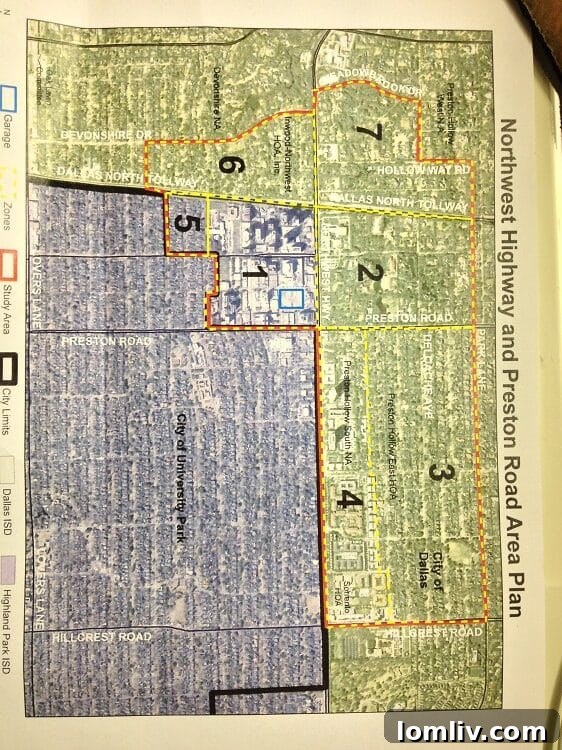
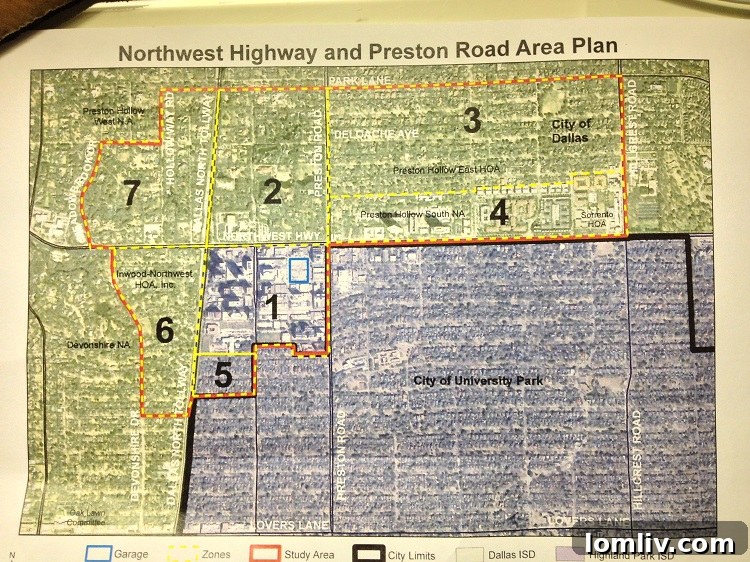
In response to these complex challenges and the need for structured community input, Council member Gates has initiated a comprehensive planning process by establishing seven distinct geographic zones within Preston Center. Zone 1 encompasses Preston Center itself, while Zone 4 covers the condos “Behind the Pink Wall,” with the remaining zones comprising various single-family neighborhoods. Each zone is tasked with electing a pair of representatives, who will collectively form a dedicated task force. This task force will be instrumental in guiding critical decisions regarding transportation, land-use planning, competitive bids for development projects, and ultimately, the long-term fate of the entire area.
An interesting detail noted on the provided map is the deliberate expansion of Area 7 to include the residence of former Mayor Laura Miller. Given her demonstrated passion for civic engagement, it would come as no surprise if she were to assume a prominent role on this crucial task force, bringing her extensive experience and deep understanding of Dallas politics to the table.
This structured approach, with direct community representation, represents a hopeful step towards more collaborative and effective urban planning for Preston Center. The success of this task force will hinge on its ability to reconcile diverse interests, balance preservation with progress, and forge a shared vision for a district that is both economically vibrant and intimately connected to its residents.
The journey to redefine Preston Center is ongoing and complex. The discussions initiated at this meeting represent just the beginning of a potentially transformative period for this vital Dallas community. We look forward to continued engagement and collective efforts to shape a future that serves all its stakeholders.
PS: For those navigating the area, a practical tip: always take Douglas north to cross Northwest Highway, then turn right onto Park Lane for a smoother route. PPS: While Preston & Northwest Highway presents challenges, consider the even more congested intersection of Beltline & Preston for comparison – a reminder of the broader traffic issues across Dallas.