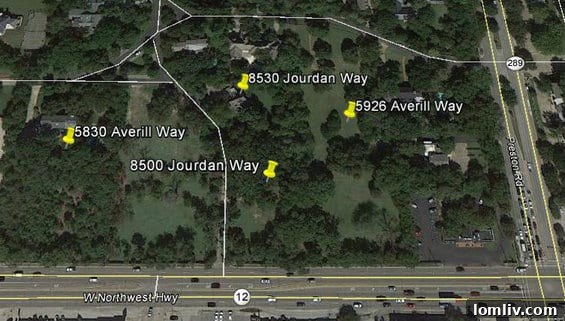
Mark Cuban’s Preston Hollow Property Saga: A Deep Dive into Neighborhood Tensions
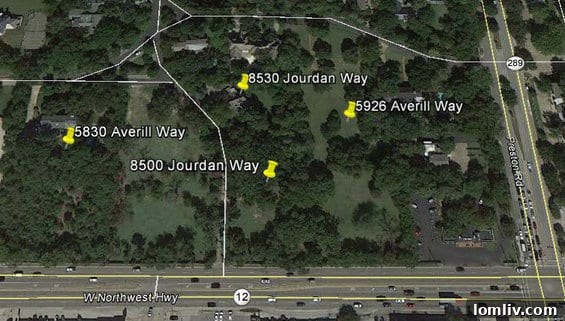
Preston Hollow, an exclusive and highly coveted neighborhood within Dallas, Texas, is synonymous with sprawling estates, meticulously manicured landscapes, and a profound sense of community. Its residents, accustomed to privacy and tranquility, have recently found their peace disrupted by a burgeoning dispute involving one of the city’s most recognizable figures: billionaire entrepreneur and Dallas Mavericks owner, Mark Cuban. While Cuban’s substantial real estate acquisitions along the busy Northwest Highway and Preston Road are well within his legal rights, his subsequent actions and apparent reluctance to engage with concerned neighbors have ignited a significant local controversy. This article delves into the intricacies of this dispute, exploring the clash between property rights and community expectations, and examining the efforts to navigate these challenging waters.
The Roots of the Ripple: Development, Diplomacy, and Discontent
The core of the issue stems from Cuban’s systematic clearing of trees across the various properties he has accumulated in this prime Dallas location. For decades, these mature trees served a crucial function, acting as a natural buffer that shielded the affluent residences from the incessant traffic, noise, and visual intrusion of the bustling six-lane Northwest Highway. Their removal has left the properties exposed, raising immediate concerns among adjacent homeowners about diminished privacy, increased noise pollution, and a fundamental alteration of the neighborhood’s aesthetic and residential character. This isn’t merely an aesthetic squabble; for many, it represents a tangible decline in their quality of life and property value.
Dallas City Council member Jennifer Staubach Gates has emerged as a key mediator in this unfolding drama. While acknowledging Cuban’s legal prerogative to develop his land within city codes – a point she has reiterated publicly – Gates has also championed the cause of her constituents. She has actively sought dialogue and resolution, recognizing the deep-seated anxieties among the residents. However, despite her repeated attempts to facilitate a meeting or encourage participation in the broader Preston Hollow Area Study, Cuban has reportedly remained unresponsive. His disinterest in direct engagement or collaborative planning has only intensified the neighbors’ feelings of frustration and neglect.
It’s important to note that Preston Hollow residents are no strangers to community activism. They have a documented history of passionate opposition to development projects perceived as detrimental to their neighborhood’s integrity. Past instances, including vociferous town hall meetings concerning residential developments on other prominent corners of Northwest Highway and Preston Road, demonstrate a highly engaged and protective community. This precedent suggests that Cuban’s detached approach is likely to fuel, rather than dampen, their collective resolve, potentially leading to a more protracted and public struggle over the future of their beloved neighborhood.
Unpacking the Exchanges: Emails Revealing a Billionaire’s Stance
A significant portion of the controversy came to light through the investigative reporting of Eric Nicholson at the Dallas Observer, who published excerpts from email correspondence between Mark Cuban and Councilwoman Gates. These exchanges provide an unfiltered glimpse into Cuban’s perspective, which many have characterized as unwavering, and at times, dismissive of the communal concerns. Nicholson’s report drew parallels between Cuban’s responses and the unyielding, self-interested character of Cartman from South Park, highlighting a perceived lack of neighborly compromise. To illustrate the tone and progression of these critical communications, we revisit key moments from their email thread:
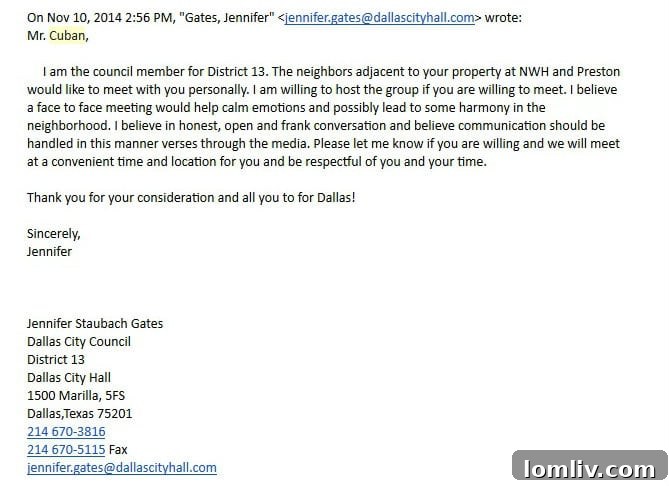
Councilwoman Gates’s initial outreach seeking an in-person meeting.
Councilwoman Gates initiated contact with an earnest plea for direct communication, hoping to foster understanding and ease the escalating tensions:
“I believe a face to face meeting would help calm emotions and possibly lead to some harmony in the neighborhood.”
This opening gambit aimed to move beyond formal communications and establish a personal rapport, which is often crucial in resolving community-level disputes. Her emphasis on “calming emotions” and “leading to harmony” clearly articulated the council’s desire for a peaceable resolution that would satisfy both Cuban’s interests and the community’s well-being. However, the subsequent interactions suggest that this appeal for harmony was not met with the desired immediate willingness for engagement.
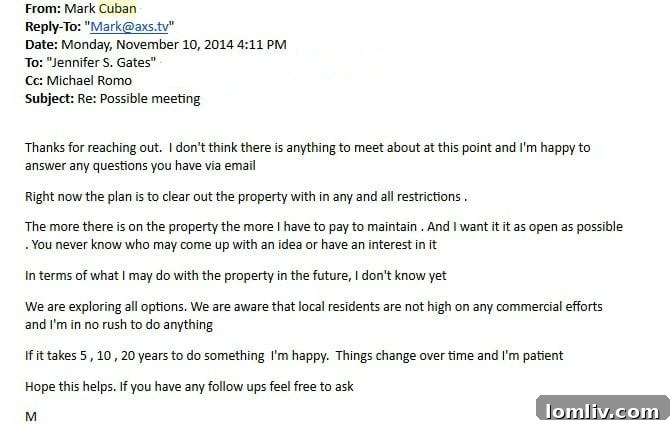
Cuban’s response highlighting his long-term perspective.
In response to the underlying pressure for immediate action or resolution, Cuban articulated a stance that conveyed his profound patience and long-term investment strategy:
“If it takes 5, 10, 20 years to do something I’m happy. Things change over time and I’m patient”
This statement, while seemingly innocuous, carries significant weight in the context of the dispute. It communicates that Cuban is under no perceived obligation to rush any development or respond to short-term community pressures. His emphasis on patience suggests a strategic approach where he is content to let market dynamics or other factors dictate his timeline, a perspective that stands in stark contrast to the immediate concerns of neighbors about their disrupted environment. This highlights the inherent power imbalance when a patient billionaire investor faces anxious homeowners seeking swift mitigation.
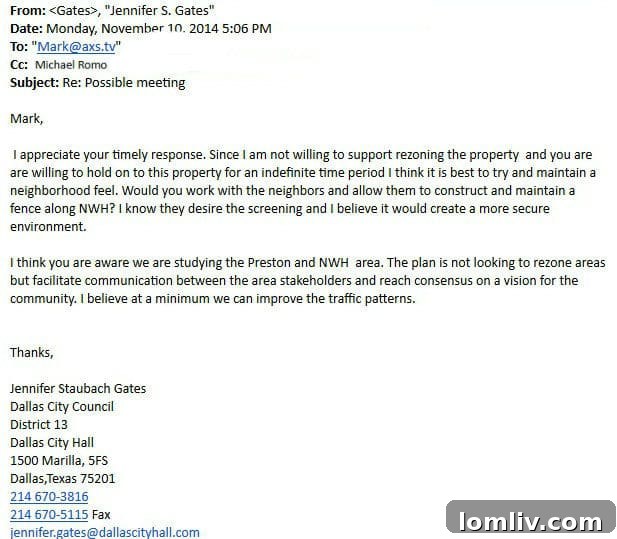
Gates’s proposal for a community-maintained fence along Northwest Highway.
Recognizing Cuban’s unyielding position on his property’s future, Gates shifted her approach to a more pragmatic, low-cost solution for Cuban, proposing a community-driven initiative:
“Would you work with the neighbors and allow them to construct and maintain a fence along NWH? I know they desire the screening and I believe it would create a more secure environment.”
This proposal was a clear attempt at compromise, aimed at directly addressing the residents’ need for visual screening and security without imposing financial or maintenance burdens on Cuban. It presented an opportunity for Cuban to show goodwill by simply granting permission for an action that would benefit his neighbors. Such an arrangement would allow the community to mitigate the negative impacts of the cleared land, restoring a degree of privacy and protection from the busy thoroughfare. This seemed like a reasonable middle ground, yet it was met with an initial silence that spoke volumes.
After a week passed without a response to this seemingly straightforward request, Councilwoman Gates sent a follow-up, underscoring the sincerity and urgency of the neighbors’ desire for a solution:
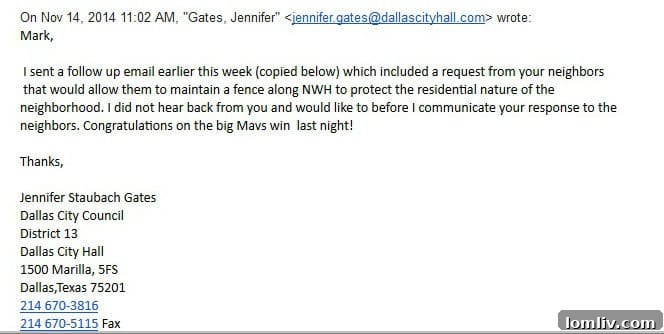
Gates’s follow-up email, emphasizing the protection of neighborhood character.
Her follow-up reiterated the importance of the proposed fence, not just for screening but for preserving the very essence of Preston Hollow:
“I sent a follow-up email earlier this week (copied below, which included a request from your neighbors that would allow them to maintain a fence along NWH to protect the residential nature of the neighborhood.”
The phrase “to protect the residential nature of the neighborhood” was crucial, highlighting that the fence was not just about aesthetics but about safeguarding the fundamental character and quality of life in Preston Hollow. It conveyed a collective concern that extended beyond individual property lines to the very identity of the community, hoping to appeal to a sense of civic responsibility. The residents saw this as a minimal ask for a significant collective benefit.
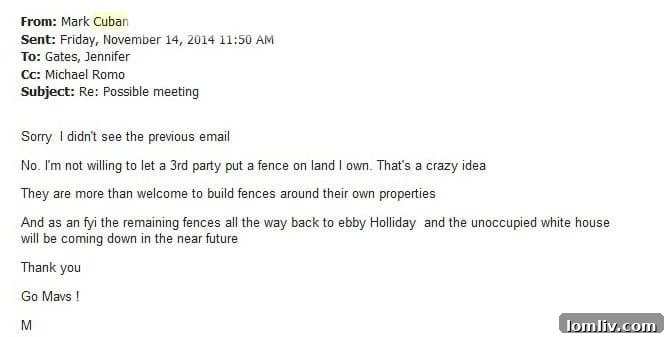
Cuban’s definitive and terse refusal of the fence proposal.
Cuban’s eventual response was both swift and unyielding, putting an immediate end to the fence discussion with a blunt refusal:
“No. I’m not willing to let a 3rd party put a fence on land I own. That’s a crazy idea … Go Mavs!”
This terse and definitive response left no room for further negotiation or compromise. Labeling the suggestion a “crazy idea” conveyed a strong sense of dismissal, reinforcing his absolute control over his property and his disinterest in shared access or community-led modifications. The abrupt “Go Mavs!” sign-off, a characteristic flourish, added a touch of his well-known persona, perhaps indicating a desire to quickly move past the topic or a subtle expression of his priorities. This exchange, more than any other, encapsulates the communication breakdown and the stark difference in perspectives between a property owner asserting absolute control and a community seeking cooperative solutions.

The Broader Implications: Property Rights Versus Community Cohesion
The Mark Cuban property dispute in Preston Hollow transcends a mere neighborhood disagreement; it serves as a compelling case study on the enduring tension between individual property rights and the collective interest in preserving community character. On one side stands Cuban, a shrewd businessman operating within the legal framework, exercising his right to manage his privately owned land as he sees fit. His long-term vision, patience, and absolute control are hallmarks of successful real estate investment. From a purely legal standpoint, his actions are defensible.
On the other side are the long-standing residents of Preston Hollow, whose concerns extend beyond legalities to the intangible qualities that define their home: privacy, aesthetics, quiet enjoyment, and the overall “residential nature” of their community. When an influential landowner’s actions significantly diminish these qualities – whether through extensive tree removal or an unwillingness to entertain even modest compromises – it fosters a sense of helplessness and frustration. The residents feel that their collective investment in maintaining a desirable living environment is being undermined by a single entity, regardless of whether those actions are technically permissible.
The involvement of City Council member Jennifer Staubach Gates highlights the challenging tightrope walk for local government officials. They are sworn to uphold laws that protect property rights, yet also tasked with fostering a harmonious and livable urban environment. Gates’s persistent attempts to mediate, to propose practical solutions, and to simply facilitate communication underscore the difficulty in balancing these often-conflicting mandates. Her ultimate inability to broker a face-to-face meeting or even a simple fence agreement, despite the minimal burden on Cuban, showcases the limits of local governance when confronted with a private owner who prefers a hands-off, long-term strategy.
Navigating the Future: An Enduring Legacy or Eventual Resolution?
The ongoing saga concerning Mark Cuban’s properties in Preston Hollow is set to leave a lasting impact on the community. For the residents, it serves as a potent reminder that even in highly affluent and established neighborhoods, the preservation of local character and quality of life can be a continuous uphill battle against powerful development interests. It inevitably prompts discussions about the adequacy of existing zoning laws, the efficacy of community planning studies, and the ultimate influence wielded by individual landowners, especially those with significant financial clout.
As for the future, various scenarios could unfold, though immediate resolution seems unlikely given Cuban’s expressed patience. His willingness to wait “5, 10, 20 years” suggests that the properties may remain largely as they are for the foreseeable future, perpetuating the current visual and auditory exposure to Northwest Highway for his neighbors. This prolonged stasis could further entrench the community’s grievances. Alternatively, sustained community activism might eventually pressure for new dialogues, or perhaps even inspire innovative community-led initiatives to address such challenges outside of direct engagement with Cuban.
Ultimately, the Preston Hollow property dispute transcends a localized squabble. It serves as a compelling narrative illustrating the intricate dynamics of power, property ownership, and the fundamental pursuit of peace and preservation within one’s community. It powerfully demonstrates how legally permissible actions, when perceived as lacking empathy or an unwillingness for dialogue, can inadvertently ignite profound community resentment. As Mark Cuban continues to exert his influence over his corner of Preston Hollow, the eyes of Dallas will undoubtedly remain fixed on this evolving situation, hopeful for a future where individual development goals and collective neighborhood well-being can eventually find a more harmonious and mutually respectful coexistence.