Mansion Park Downzoning Saga: Unraveling Dallas’s High-Rise Dilemma in Oak Lawn
The contentious authorized hearing, initially commenced and subsequently paused by former council member Philip Kingston, is once again in motion. New District 14 Council Member David Blewett is systematically addressing lingering issues from his predecessor’s tenure, and the proposed downzoning of Mansion Park is at the forefront. This tony neighborhood, nestled within the vibrant Oak Lawn area of Dallas, recently saw Blewett host a pivotal meeting at Oak Lawn’s “Kroger library,” signaling a renewed effort to resolve this long-standing urban planning debate.
The Genesis of Conflict: High-Rise Ambitions and Community Resistance
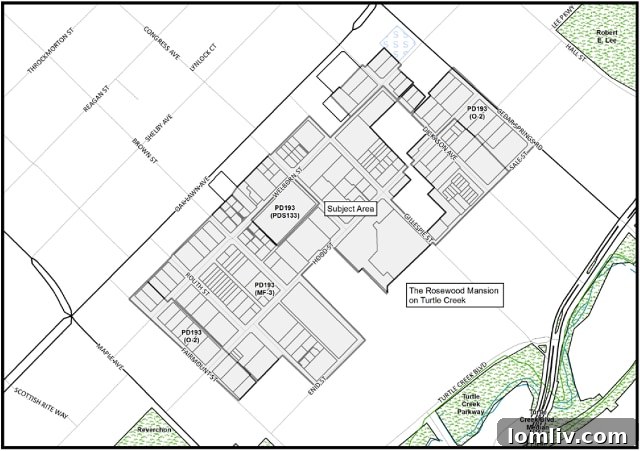
The roots of this heated discussion stretch back to 2016 and 2017 when two ambitious high-rise projects sought crucial approvals. These developments were slated for interior lots bounded by Oak Lawn Avenue, Cedar Springs Road, Turtle Creek Boulevard, and Fairmount Street – an area that the city had previously rezoned in the 1960s. Under the antiquated Chapter 51 of the city zoning ordinance, this specific designation, MF-3, controversially permits unlimited building height, subject only to FAA restrictions. This decades-old zoning decision, intended to foster density, inadvertently laid the groundwork for the current community strife.
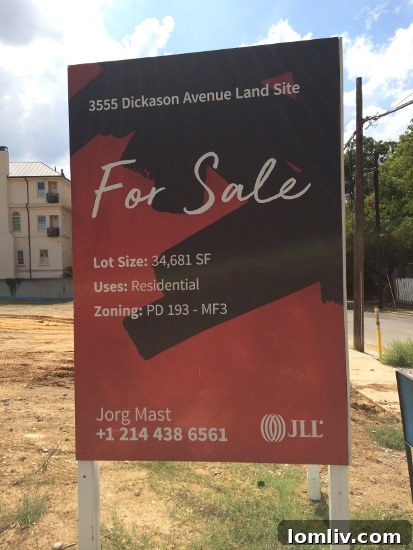
Developers Toll Brothers and Teixeira Duarte spearheaded these proposals. The Toll Brothers project, despite igniting considerable community angst, ultimately received city approval and is currently undergoing construction, visibly transforming a portion of the neighborhood skyline. Conversely, the Teixeira Duarte parcels, situated at the prominent corner of Hood and Dickason, were initially cleared for development. However, unforeseen financial setbacks within the parent company brought the project to an abrupt halt, leaving the valuable land parcels unsold and awaiting new ownership – a visible testament to the unpredictable nature of large-scale urban development.
A Community Divided: The Battle for Mansion Park’s Future
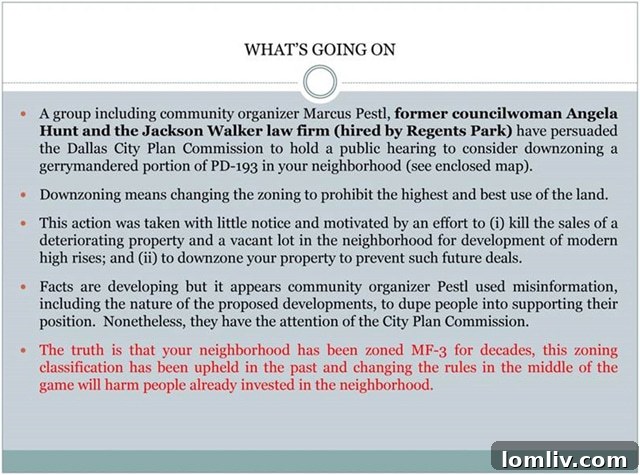
The specter of these high-rise developments galvanized residents, prompting the formation of a dedicated group committed to downzoning the area. Their primary objective: to safeguard the existing character of Mansion Park and preempt future high-density projects. As far back as 2016, these residents had proactively engaged formidable representation, enlisting former District 14 council member Angela Hunt and the prestigious law firm Jackson Walker to champion their cause and articulate their vision for a more controlled development landscape.
Within Mansion Park, the community finds itself cleaved into two distinct factions, each possessing deeply entrenched, yet fundamentally opposing, views on development and property rights. One group passionately advocates for the preservation of the neighborhood’s eclectic mix of townhouses and single-family homes, vehemently opposing any alterations to current height and density limits. They envision a future where the current low-rise, charming aesthetic remains untouched, believing it to be integral to the area’s unique appeal and quality of life.
Conversely, the second group eyes the significant property appreciation that existing high-density zoning can unlock. These individuals, often owners of older properties ripe for redevelopment, foresee substantial financial windfalls from the sale or transformation of their land. Their perspective centers on maximizing the economic potential of their assets, a right they believe is inherent to their property ownership.
Conflicting Interests: A Closer Look at the Factions
Group one encompasses a diverse demographic, including long-term residents and newer arrivals residing in charming one- to three-story properties. Interestingly, this group also includes residents of the existing Plaza high-rises who, having already benefited from the very high-density allowances they now seek to restrict, are fighting to preserve a specific neighborhood character. Their arguments often hinge on concerns over infrastructure strain, increased traffic, loss of neighborhood charm, and maintaining the area’s existing residential feel.
Group two is largely comprised of property owners whose older buildings present lucrative redevelopment opportunities. For them, the existing MF-3 zoning represents not just land, but considerable potential capital. A downzoning would effectively diminish the value of their property by curtailing its development potential, thereby impacting their ability to “cash out” on their investments. This group argues for the sanctity of established zoning rights and the economic benefits that responsible development can bring to a city.
The Elusive Compromise and the Specter of Legal Battles
An authorized hearing is typically designed as a forum for neighborhood stakeholders to collaboratively forge a compromise agreement, which would then proceed for approval by the plan commission and the city council. However, much like the prolonged dispute over PD-15, the two sides in Mansion Park are fundamentally and diametrically opposed. Their core interests diverge so significantly that finding common ground appears to be, as the saying goes, a “fool’s errand.” The depth of this division casts a long shadow over the prospects of an amicable resolution.
Moreover, as highlighted back in 2017, the act of downzoning carries a substantial legal peril for the city. Such a move would almost certainly invite lawsuits alleging “takings” of buildable rights – which, in the realm of real estate, directly translates to money. Property owners whose development potential is suddenly curtailed by a change in zoning can argue that the city has effectively diminished the value of their land without just compensation, a claim protected under constitutional provisions regarding eminent domain. Following Blewett’s recent meeting, the critical question of potential legal repercussions was so pressing that city staffers were urged to consult the city attorney regarding the high likelihood of costly litigation against the city. One might even speculate if this very concern was a primary reason Kingston hesitated to reconvene a second meeting.
The Costly Precedent: Municipalities at Risk
Numerous precedents exist across the country where municipalities have attempted downzoning only to suffer significant legal defeats. In such cases, cities have been compelled to compensate landowners for the substantial difference in value between the original, more permissive zoning rights and the newly imposed, lesser rights. To put this into perspective, if land in the Mansion Park area is conservatively valued at approximately $9 million per acre under its current MF-3 zoning, a downzoning to MF-2 could reduce its value by millions of dollars per acre. Considering the considerable size of the affected area, the potential financial liability for the City of Dallas could easily escalate into the hundreds of millions of dollars – a staggering sum that would undoubtedly impact public services and taxpayer funds.
And, it is a cynical but realistic observation that should such a payout materialize, the very protestors who championed the downzoning cause might quietly seek their share of the settlement. It is improbable to find many individuals genuinely willing to see the city disburse millions to their neighbors for the purely altruistic goal of maintaining a low-rise neighborhood aesthetic. Human nature, often driven by self-interest, suggests that financial compensation could quickly overshadow initial ideological stances.
Semantics and Reality: Downzoning vs. Right-Sizing
Before any eager readers rush to the comments section to offer corrections, suggesting that this is not “downzoning” but rather “right-sizing” the zoning, let’s clarify the distinction. When an area is already zoned for unlimited height – a condition that actively enabled the very high-rise proposals that initiated this entire conflict – any change to a more restrictive height or density allowance can only be accurately described as downzoning. The term “right-sizing” implies a correction to an incorrectly scaled designation, but in the context of existing, unlimited height permissions that were exploited by high-rise developers, the effect is unequivocally a reduction of buildable rights, making it a downzone in practical and legal terms.
Council Member Blewett’s Meeting and the Path Forward
The recent meeting served as a procedural re-kickoff. City representatives outlined the intricacies of the authorized hearing process, along with a somewhat generalized historical overview of how this specific hearing came into being. Attendees learned that Council Member Blewett plans to establish a task force, which will meticulously guide the next steps towards an eventual public hearing before both the plan commission and, ultimately, the city council. This structured approach aims to provide a more organized pathway through the complex issues at hand.
However, the question and answer session, while intended for clarification, quickly devolved into what could be described as “ruminations masquerading as fact.” While genuine inquiries from new attendees seeking information after a year-long hiatus were welcome and necessary, patience quickly wears thin when questions become thinly veiled statements of personal opinion. Notable examples included “Mr. 37” and the former council member, whose extensive and often subjective interjections prolonged the discussion without necessarily advancing the understanding of the complex zoning issues.
A Pragmatic Perspective on Mansion Park’s Future
Having meticulously presented the historical context, the community’s divisions, and the potential legal pitfalls, it’s time to offer a candid opinion. Did the City of Dallas err in upzoning this area to MF-3 with unlimited height back in the 1960s? In retrospect, probably so. Was it a shortsighted decision that prioritized density without fully considering the long-term impact on neighborhood character or future legal challenges? It’s highly plausible.
However, the critical question now is: Can the area be successfully downzoned without incurring a tremendous monetary cost to the city and its taxpayers? The answer, realistically, is probably not. The legal precedents and the financial liabilities associated with “taking” established property rights are simply too significant to ignore. Therefore, will the area ultimately be rezoned down? Given the immense financial risks and legal complexities, it is highly probable that it will not.
An Unconventional Solution: Leveraging Infrastructure
As the holiday season approaches, perhaps a practical suggestion can be offered as a “gift.” One crucial aspect that many stakeholders have overlooked, despite their complaints, concerns the neighborhood’s characteristically narrow roads. While residents are undoubtedly correct in their assessment of these thoroughfares, they might be missing a potent strategic angle. Instead of a direct downzoning battle, residents should aggressively advocate for the city to enforce and demand that these roads be brought up to correct, modern width standards.
This approach, while seemingly tangential, has a powerful indirect effect. Requiring developers to widen roads would force them to cede valuable front-lot depth, thereby impacting the buildable envelope of their parcels. Such a reduction in usable land area could significantly alter the economics and feasibility of high-rise projects, potentially influencing how and what developers choose to build, or even deterring such projects altogether. It’s a nuanced strategy that works within existing municipal frameworks to achieve desired outcomes without triggering the immense legal and financial liabilities of outright downzoning.
Merry Christmas.

Remember: My coverage extensively explores high-rises, homeowners’ associations (HOAs), and property renovations. I also maintain a keen interest in the delicate balance between modern and historical architecture, particularly in the context of the evolving YIMBY (Yes In My Backyard) movement. My writing has been consistently recognized by the National Association of Real Estate Editors, earning me three Bronze awards in 2016, 2017, and 2018, alongside two Silver awards in 2016 and 2017. Have a compelling story to share, a perspective to offer, or even a marriage proposal to make? Feel free to reach out via email at [email protected]. You’re welcome to search for me on Facebook and Twitter, though you might find the digital trail elusive!