The Pink Wall Predicament: Unpacking a Controversial Buyout Bid in Preston Center
Dallas’s Preston Center is more than just a vibrant commercial hub; it’s a neighborhood rich in history and defined by unique residential enclaves. Among its most distinctive features are the “Pink Wall” condo complexes, an iconic collection of communities celebrated for their charm, prime location, and surprisingly accessible price points. These complexes, often characterized by their signature mid-century architecture and lush courtyards, represent a cherished lifestyle for many residents, offering a blend of urban convenience and community tranquility.
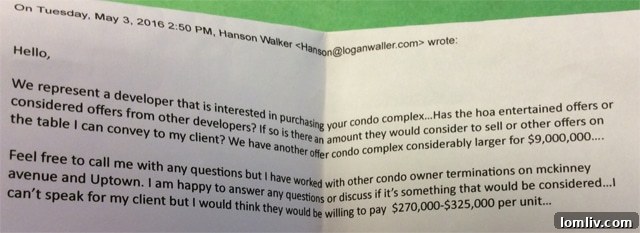
However, the serene facade of the Pink Wall has recently been stirred by a significant development that could reshape its future. Just hours before a crucial Preston Center Task Force Meeting, an unexpected email landed in the inboxes of Homeowners Associations (HOAs) across 14 Pink Wall complexes. Sent by Hanson Walker, assistant to Logan Waller of Waller Group Homes, this communication hinted at a broad acquisition strategy, igniting immediate speculation and concern within the community. The timing of this unsolicited outreach, preceding a public forum where many residents were likely to convene, was particularly noteworthy, creating a fertile ground for discussion, comparison, and perhaps, a healthy dose of neighborhood ‘gossip.’ This article delves into the details of this provocative buyout attempt, examining the developer’s approach, the intricate challenges posed by existing deed restrictions, and the broader implications for the future of the Pink Wall and Preston Center at large. As residents grapple with the potential changes, understanding the nuances of this proposal becomes paramount to safeguarding their community.
An Unsolicited Offer: Who Received the Pink Wall Buyout Note?
The widespread nature of this inquiry signals a clear intent: a comprehensive effort to consolidate properties within this highly desirable area. The email from Waller Group Homes targeted a substantial number of the Pink Wall’s most prominent communities, indicating a strategic attempt to gain significant ground in the area’s real estate landscape. The recipients list reads like a who’s who of the Pink Wall’s esteemed addresses, each representing a unique facet of this beloved Dallas community. Those who received the note included:
- 6040 Place
- Diamond Head Condos
- Edgemere on the Parkway
- Fontainbleu
- Harcourt House
- Imperial House
- Park Carillon
- Prestwick Manor
- Royal Arms
- Royal Orleans
- Seville House
- Villa Serena
This extensive list underscores the developer’s ambitious scope, suggesting a desire not just for a single complex, but for a transformative presence within the Pink Wall. Such a widespread overture, particularly without prior formal engagement, immediately raised questions about the ultimate motivations and the potential for a large-scale redevelopment that could fundamentally alter the character of these long-established communities. The sheer number of HOAs contacted indicates a calculated move towards a bulk acquisition, a strategy often employed when individual property purchases are insufficient to achieve a larger development goal.
The Developer’s ‘Fishing Expedition’: Unraveling the Strategy Behind the Offer
At its core, this email appears to be a sophisticated ‘fishing expedition,’ a preliminary probe by an unnamed developer aiming to gauge the interest of multiple Pink Wall complexes in a potential bulk purchase. The ultimate goal, as many within the Dallas real estate community understand, likely revolves around the extinguishment of existing deed restrictions – a formidable hurdle for any large-scale redevelopment in this historic area. As I prophetically noted just days prior in an earlier piece, “DON’Tgo Pink if you’re a developer looking for a quick buck,unless you’re moneyed enough to buy enough complexes to extinguish the deed restrictions.” This recent development seems to validate that foresight, highlighting the critical importance of these restrictions in defining the Pink Wall’s current landscape and presenting a significant barrier to conventional development.
The strategy is clear: acquire enough properties to gain a controlling interest – typically 51% of the voting power within a specific sub-tract – thereby enabling the developer to legally nullify these longstanding restrictions. These ‘zombie restrictions,’ as they are sometimes playfully called, dating back 50 years, have recently reasserted their relevance, becoming a key factor in any development discussions. These covenants, designed to preserve the original vision for the area, can dictate everything from building height and density to architectural styles, making them particularly challenging for developers seeking to maximize land use. Without the ability to extinguish these, the redevelopment potential of individual properties, or even small clusters, is severely limited, making a bulk acquisition the most viable, albeit challenging, path for a developer with grander ambitions for the Preston Center area. The success of such a strategy would not only impact the complexes acquired but could set a precedent for future development across the entire Pink Wall neighborhood.
Analyzing the Buyout Proposal: A Closer Look at the Email’s Content
The buyout note itself, despite its significant implications, contained several curious elements that immediately caught the attention of those in the know. Upon closer examination, three particular aspects stood out, raising questions about the professionalism and seriousness of the offer, and signaling potential red flags for the targeted HOAs:
1. The Curious Case of Communication Quality
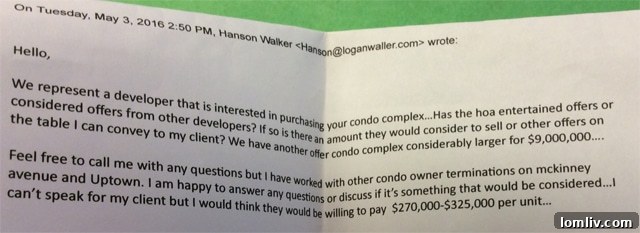
One of the most immediate observations was the quality of the grammar and syntax within Walker’s email. For a communication dealing with multi-million dollar real estate transactions, the language often fell short of professional standards. Phrases like, “We have another offer condo complex considerably larger for $9,000,000….” are not merely stylistic imperfections; they can undermine credibility and suggest a lack of meticulousness typically expected in high-stakes property dealings. In the sophisticated world of Dallas real estate, such errors can be a significant red flag, echoing the less-than-credible solicitations often associated with, say, a ‘Nigerian prince’ email needing help to unlock a fortune – certainly not the impression one desires to convey when proposing a major acquisition. Professionalism in communication is a cornerstone of trust in real estate, and its absence here raises questions about the thoroughness and seriousness of the entire proposal.
2. A Non-Offer Approach: Asking for the Price Tag
Perhaps even more striking was the developer’s strategy of asking the complexes to state their desired selling price, rather than presenting a concrete offer. Instead of putting a definitive sum on the table, the note sought to extract figures from the HOAs. This approach, while sometimes used in very early exploratory phases, can be perceived as less serious or a tactic to gain negotiating leverage without revealing the developer’s true budget or valuation. In a market as competitive as Preston Center, a developer genuinely committed to an acquisition typically demonstrates that commitment by initiating with a compelling offer, not by deflecting the onus of valuation onto the potential sellers. This method places the burden of valuation on the HOAs, which may lack the specific market intelligence and negotiation experience that a well-prepared developer would possess, potentially leading to undervaluation.
3. The Per-Unit Valuation: A Missed Opportunity for a ‘Developer Bump’?
Despite requesting the HOAs’ ‘number,’ the email then proceeded to offer a conceptual range for per-unit pricing. Walker noted, “I can’t speak for my client but I would think they would be willing to pay $270,000-$325,000 per unit…” This range, while seemingly substantial, represents a critical point of contention. For many units within the Pink Wall complexes, particularly at esteemed addresses like Imperial House, this figure aligns closely with, or in some cases, falls below, existing market value. What it conspicuously lacks is a “developer bump”—the premium an investor typically pays above current market value to account for the property’s redevelopment potential and the hassle of a collective sale. Without this incentive, the offer loses much of its appeal. Homeowners would be selling at what they could potentially achieve on the open market, thereby foregoing any compensation for the collective effort and strategic value of selling as a unified complex. This makes the “deal” a “no-deal deal” for many, prompting the sardonic thought: “Maybe that Nigerian prince has a better offer?” A true acquisition for redevelopment typically involves offering a premium that reflects the future value unlocked by consolidation and the removal of restrictions, a component notably absent here.
Navigating the Labyrinth of Deed Restrictions in Preston Center
The heart of the Pink Wall predicament, and indeed the primary driver behind a bulk acquisition strategy, lies in the complex web of deed restrictions that govern these properties. As previously explored in my article, “Preston Center Task Force: Pink Wall, Restricted Community,” these covenants are not mere suggestions but legally binding agreements that dictate land use, density, and even aesthetic aspects. Many of these restrictions date back half a century, originally designed to preserve the residential character and quality of life in the area by controlling factors like building height, setbacks, and even the types of materials that can be used for construction.
For a developer aiming to redevelop, these restrictions are significant impediments. They can prevent higher-density projects, limit the scale of new construction, or impose design requirements that conflict with modern development trends and profitability goals. This is precisely why the concept of acquiring 51 percent of the voting power within one of the three underlying sub-tracts of the Pink Wall becomes crucial. By achieving this threshold, a developer can, in a single decisive action, move to extinguish these ‘zombie restrictions’ that have only recently come back into sharp focus. This mechanism is a powerful tool in property law, allowing a majority of property owners within a defined area to collectively modify or remove restrictive covenants that might otherwise hinder their future plans. The ability to legally clear these hurdles is often the key to unlocking the full redevelopment potential and significantly increasing the land’s value for the acquiring party.
Understanding the intricacies of these restrictions is not just an academic exercise; it’s central to grasping the high stakes involved in this buyout attempt. The future character of Preston Center, its density, and its architectural aesthetic could hinge on whether a developer succeeds in overcoming these historic legal safeguards. Residents, therefore, must be acutely aware of their rights and the collective power they hold in upholding or modifying these foundational documents.
The City’s Perspective and the Enforcement Dilemma
The complexities of the Pink Wall situation extend beyond developer strategies and property law to involve the City of Dallas itself. During the very Task Force Meeting that the initial email preceded, Councilwoman Jennifer Gates provided crucial insights into the city’s stance on such matters. She candidly posited that a developer indeed *could* pursue a strategy of acquiring enough voting power to extinguish deed restrictions, validating the concerns of many residents and highlighting a legal pathway that has developers eyeing communities like the Pink Wall.
More importantly, Councilwoman Gates clarified a critical distinction in the eyes of the municipal government: the City of Dallas does not legally concern itself with *civil* deed restrictions when it comes to issuing permits. This means that if a proposed development conforms to the city’s zoning ordinances, the city would proceed to issue a permit, even if that development simultaneously violates existing civil deed restrictions. The burden of enforcing these restrictions, she explained, falls squarely on the community. Restrictions can only be enforced civilly through a lawsuit initiated by affected parties. This places a significant onus on homeowners and HOAs, who would need to organize, fund, and pursue legal action independently to uphold their community’s covenants.
This revelation highlights a significant dilemma for Pink Wall residents. While their deed restrictions offer a layer of protection, they are not automatically enforced by the city’s planning and development departments. Instead, residents themselves would need to band together, potentially pooling resources for legal action, to challenge any zoning-conforming but restriction-violating development. The unspoken question hanging in the air during that meeting was whether any of the staunch Pink Wall development opponents in the room—individuals like “Steve” or “Ashley,” who have been vocal advocates for preservation—would be willing and able to “rat out” such a development and pursue the necessary legal avenues. This sets the stage for a potential legal battle, or as the historical phrase suggests, to “Release the dogs of war,” should a developer move forward with a plan that clashes with the community’s established covenants and residents decide to defend their neighborhood character through legal means.
The Future of Pink Wall: Preservation, Development, and Community Vigilance
The recent buyout attempt in Preston Center’s Pink Wall complexes serves as a stark reminder of the constant pressures faced by established communities in rapidly developing urban landscapes. The delicate balance between preserving historical charm and accommodating modern growth is a challenge that Dallas, like many other major cities, continually navigates. For the Pink Wall, this isn’t just about property values; it’s about safeguarding a unique cultural and architectural identity that contributes significantly to the fabric of Preston Center. The outcome of this particular developer’s “fishing expedition” will likely set a precedent for how similar situations are handled in Dallas’s evolving real estate market.
The developer’s ‘fishing expedition,’ characterized by a strategic but perhaps understated initial offer and a clear intent to circumvent deed restrictions, has laid bare the vulnerabilities and strengths of community governance. The incident underscores the critical importance of vigilant HOAs, informed residents, and a clear understanding of property law and zoning regulations. The outcome of this particular bid remains to be seen, but it has undoubtedly galvanized residents to consider their collective future, fostering discussions about what they value most: the quiet charm of their existing communities or the potential for significant financial gain balanced against an altered neighborhood. This tension between preservation and profitability is a common thread in urban development, making the Pink Wall a microcosm of larger city-wide debates.
Whether this attempt leads to a widespread buyout, a series of individual sales, or a renewed commitment to preservation, one thing is certain: the Pink Wall community, alongside its advocates, will play a pivotal role in shaping its destiny. The discussions initiated by this email will likely continue to reverberate through Preston Center, influencing future development debates and setting precedents for how Dallas balances progress with preservation. The ongoing narrative of the Pink Wall is a testament to the power of community action and the enduring value of local character in the face of rapid urban transformation.
Share Your Story: Connecting Dallas Real Estate & Community
Have you been impacted by an HOA story in Dallas? Perhaps you possess a fascinating piece of high-rise history or have insights into local development trends? This platform is dedicated to fostering an open dialogue about Dallas real estate and the vibrant communities that define our city. Realtors, we invite you to feature a listing – whether it’s a property with incredible renovation potential or a beautifully completed home that shines. Or perhaps you’d like to host a virtual “Candy’s Dirt Staff Meeting” to share your expertise and network? We believe that collective knowledge and shared experiences are vital for navigating the complexities of our dynamic real estate landscape.
We are always eager to hear your perspectives, anecdotes, and professional insights. Feel free to shoot Jon an email with your stories, questions, or even unique proposals (yes, marriage proposals are accepted – they’re legal!). Your contributions help enrich our understanding of Dallas’s dynamic real estate market and its diverse communities, fostering a platform for informed discussion and valuable connections.
Connect with us at: [email protected]