Dallas ISD Trustee Residency Controversy: A Deep Dive into Jaime Resendez’s Eligibility
The Dallas Independent School District (DISD) has been embroiled in a significant controversy surrounding the residency of school board trustee Jaime Resendez. What began with public allegations quickly escalated into a complex legal and political saga, questioning the fundamental eligibility of an elected official and highlighting the intricate nature of local governance.
The issue gained immediate traction following a social media post by former WFAA reporter and political candidate, Brett Shipp, who raised concerns that Trustee Resendez might no longer reside within the boundaries of his elected District 4. This initial tweet served as a catalyst, prompting extensive scrutiny from journalists, community members, and various stakeholders, all attempting to decipher the unfolding situation.
Major news outlets, including The Dallas Morning News, soon picked up the story, publishing several articles that aimed to clarify the facts. Meanwhile, Shipp consistently updated his followers with new developments, fueling ongoing public discussion. Despite widespread reporting, the intricacies of the situation remained a source of confusion for many, underscoring the need for a comprehensive breakdown of the events and their implications.
The Core Allegations: A Move Beyond District Lines
At the heart of the controversy is a verifiable fact: Jaime Resendez relocated from his District 4 residence. Records from the Dallas Central Appraisal District confirm that the deed for a property on Mission Hills Lane was transferred to Resendez on August 30, 2017. This new address, critically, is situated just a few blocks outside the geographical boundaries of District 4, the very district he was elected to represent. This relocation, occurring in the late summer or early fall of 2017, forms the foundational basis of the eligibility questions.
Further compounding the issue, Resendez did not file a homestead exemption on the Mission Hills Lane property. A homestead exemption typically designates a property as one’s primary residence, offering tax benefits. The absence of this filing, while not definitive proof of non-residency, added another layer of ambiguity to his declared living situation, strengthening the public and media’s investigative efforts.
Navigating Conflicting State Laws and Legal Interpretations
The situation quickly became a legal quagmire due to the existence of two conflicting state laws governing the eligibility of public officials. One statute suggests that a trustee, once elected, can continue to serve until a replacement is duly chosen and installed, implying a degree of continuity even if residency requirements change mid-term. This law aims to prevent sudden vacancies that could disrupt governance and leave a district unrepresented.
Conversely, another state law explicitly states that an elected official automatically vacates their seat upon moving out of the district they represent. This provision is designed to ensure that representatives maintain a direct connection to, and understanding of, the community they serve, promoting accountability and local representation. The clash between these two legal interpretations created a significant dilemma for the Dallas ISD board and its legal counsel, necessitating careful and potentially precedent-setting analysis.
The implications of this legal ambiguity are profound. If the former law takes precedence, Resendez could technically continue his term, albeit under a cloud of controversy. If the latter prevails, his seat would be considered vacant from the moment of his move, potentially invalidating any actions taken since that time and requiring an immediate resolution. This legal gray area threatened to destabilize board operations and erode public trust in the integrity of the electoral process.
Board Deliberations and Resendez’s Response
The gravity of the situation prompted swift action from the Dallas ISD school board. At a recent board meeting, Board President Edwin Flores referenced a “gaggle” of expensive attorneys who were scheduled to meet with the board in an executive session that very evening. Executive sessions, by their nature, are confidential and not open to public record, allowing the board to discuss sensitive legal matters, personnel issues, and other privileged information without public disclosure. This closed-door meeting indicated the serious legal counsel the board was seeking to navigate the complex residency issue.
Following this critical executive session, Resendez notably departed the meeting without participating in any votes on the agenda items. This action, while not an explicit admission, was widely interpreted as a signal that the legal discussions had significant implications for his position, underscoring the precariousness of his tenure.
When the residency allegations first surfaced, I reached out to Resendez via Facebook Messenger, inquiring about Shipp’s statements and offering him an opportunity to address them. I also asked if Shipp had attempted to contact him before making his allegations public. Resendez’s response was direct: “I’m definitely going to address Brett Shipp’s statements. He never tried contacting me.” A few hours later, he provided a link to the initial Dallas Morning Newsarticle on the issue, signaling his awareness and engagement with the developing story.
In subsequent statements, Resendez affirmed that he had contacted DISD’s attorneys immediately upon learning of the residency concern, seeking “clarification and guidance.” This proactive step suggested an effort to comply with district procedures and resolve the matter legally and ethically, even as public pressure mounted.
Anticipated Resolution and an Unexpected Twist
By yesterday, it appeared a resolution had been reached: Resendez would resign from his position as trustee. The board was expected to appoint a replacement to serve the remaining months of his term. This outcome also had broader political implications, as Resendez had previously announced he would not seek re-election for the school board but instead intended to run for the city council seat currently held by Rickey Don Callahan, who had declared his retirement.
The district released a statement late Wednesday, indicating a clear path forward: “It’s anticipated that the oath of office will be administered on Friday to the appointed board member.” This announcement strongly suggested that a successor had been identified and the transition was imminent, providing a sense of closure to the contentious issue.
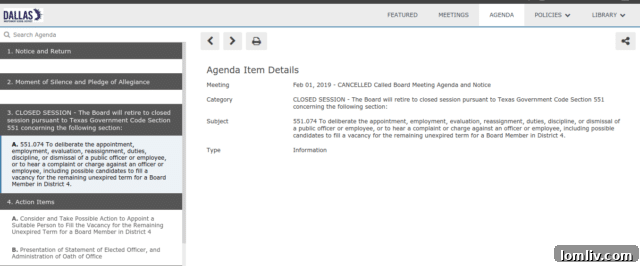
However, the narrative took an unexpected turn. This morning, upon checking the agenda for the upcoming meeting – a routine practice before every school board session – it was discovered that the meeting had been abruptly canceled. No official explanation has yet been provided for the cancellation, leaving the public and media in limbo regarding the next steps and the ultimate fate of the trustee’s seat. The sudden cancellation reignited uncertainty, calling into question the previously anticipated resolution and prolonging the controversy.
The immediate cancellation of a pivotal board meeting, especially after a public statement regarding an impending appointment, raises more questions than it answers. Is there new legal advice? Has Resendez reconsidered his resignation? Or are there other procedural hurdles that have surfaced? The vacuum of information has only intensified speculation and underscored the ongoing complexities of this developing story.
The implications of this prolonged uncertainty are significant for District 4, which faces potential instability in its representation. Furthermore, the incident underscores the critical importance of residency requirements for elected officials, ensuring that representatives truly belong to and understand the communities they serve. It also highlights the intricate legal framework that governs public office and the challenges that arise when interpretations conflict.
The Story Continues to Develop
As the situation currently stands, the future of Jaime Resendez’s trustee seat and the immediate path forward for Dallas ISD District 4 remain unclear. The community, the board, and the media eagerly await further details regarding the canceled meeting and the rescheduled plans. This evolving narrative serves as a stark reminder of the dynamic nature of local politics and the constant scrutiny faced by public officials. The transparency and swift resolution of such matters are crucial for maintaining public trust and ensuring effective governance within the Dallas Independent School District.
Update: It appears the meeting has been rescheduled for 4 p.m. on Tuesday, February 5. Further developments are expected then.
Bethany Erickson is the education and public policy writer for Daltxrealestate.com. Her extensive experience in journalism and public policy uniquely positions her to cover complex issues affecting the Dallas community. She also serves as the Director of Audience Engagement for Candy’s Media. Erickson is an active member of several prestigious professional organizations, including the Online News Association, the Education Writers Association, the International Academy of Digital Arts and Sciences, the National Association of Real Estate Editors, and the Society of Professional Journalists. Her distinguished work has been recognized with significant accolades, including the 2018 NAREE Gold winner for best series and a 2018 Dallas Press Club Hugh Aynsworth Award winner. She can be contacted at [email protected].