The student loan crisis is a defining financial challenge for millions of Americans, casting a long shadow over their aspirations for homeownership, retirement, and overall financial stability. Across the nation, individuals grapple with staggering debt loads, impacting their ability to build wealth and participate fully in the economy. For instance, in Texas alone, the average student loan debt stands at a formidable $26,292, with an alarming 56 percent of residents burdened by these obligations. This pervasive issue has spurred innovative solutions, with one forward-thinking company pioneering a strategy to help its employees navigate and accelerate the elimination of this formidable debt.
The Escalating Burden of Student Loan Debt on Generations
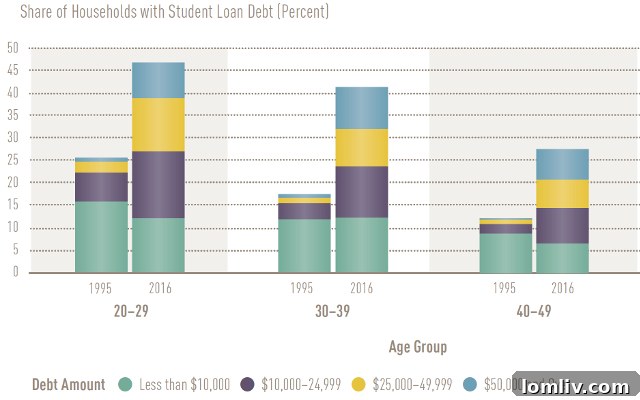
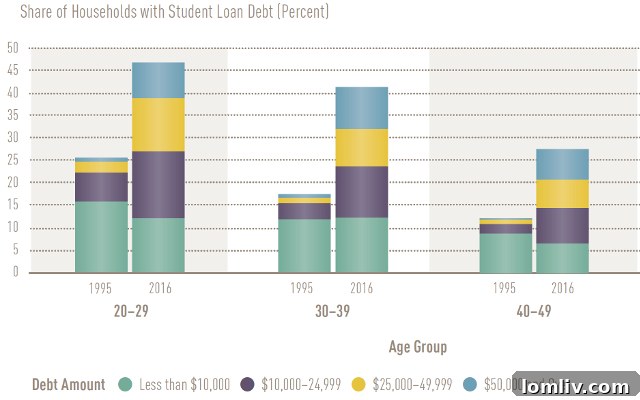
The landscape of student loan debt has undergone a dramatic transformation over the past few decades, evolving from a manageable concern for a minority to a pervasive crisis impacting nearly half of young adults. In 1995, approximately a quarter of adults aged 20-29 carried student loan debt. By 2016, this figure had nearly doubled, soaring to 47 percent. This increase wasn’t merely in the number of borrowers, but also in the magnitude of their debt. The percentage of individuals owing less than $10,000 actually decreased from 16 to 12 percent, indicating that fewer borrowers were holding small, easily manageable debts. Conversely, those owing $10,000 to $24,999 rose significantly from 8 percent to 15 percent, while former students burdened with $25,000 to $49,999 saw an even sharper increase from a mere two percent to 12 percent. The most alarming shift was in the highest debt category: individuals owing over $50,000 surged from one percent to eight percent, revealing a growing segment of the population facing truly overwhelming financial commitments.
This escalating debt profoundly impacts crucial life milestones, particularly homeownership. Data indicates that it takes the average college-educated individual with student loan debt until around age 35 to achieve the same homeownership rates as their peers who graduated without debt. This delay in purchasing a first home is one of the primary reasons why the Millennial generation has taken longer to establish themselves in the housing market. Looking ahead, Generation Z, whose oldest members are just entering the workforce and adulthood, faces an even more precarious future, potentially inheriting an even larger student loan burden that could further postpone their financial independence and wealth accumulation.
Abbott Labs’ Groundbreaking Solution: A Path to Financial Wellness
Recognizing the profound impact of student debt on its workforce, Illinois-based Abbott Labs initiated a pioneering program designed to alleviate this financial strain while simultaneously boosting employee retirement savings. In a bold move, Abbott Labs approached the IRS, seeking permission to contribute to an employee’s 401(k) retirement plan even if the employee wasn’t directly contributing to their 401(k), provided they were actively paying off their student loan debt. The IRS granted this crucial request in August, marking a significant milestone in corporate benefits and financial wellness initiatives.
Under this innovative structure, if an employee dedicates at least 2 percent of their salary towards paying down their student loans, Abbott Labs commits to contributing five percent into their 401(k) retirement plan. This match is equivalent to what the company would contribute if the employee had directly invested that same two percent of their salary into their 401(k). This revolutionary approach offers a dual benefit: it incentivizes accelerated student loan repayment while ensuring employees do not fall behind on critical retirement savings, a common dilemma for those saddled with educational debt.

Broad Implications and the Drive for Widespread Adoption
The IRS’s decision to approve Abbott Labs’ request is a landmark moment. It signifies the first instance where the IRS has permitted an employer to contribute to a 401(k) without a direct employee contribution to the retirement account itself, recognizing the unique financial pressures posed by student loans. This ruling is a strong indicator that both government and businesses are increasingly acknowledging the debilitating effects of student loan debt on individuals’ long-term financial health. The statistics are stark: by age 30, individuals without student loan debt have accumulated a staggering 50 percent more in retirement assets compared to their indebted peers. Since retirement savings is a long-term endeavor, starting out with such a significant financial handicap can be incredibly challenging, if not impossible, to overcome.
Real estate, particularly a primary residence, forms a crucial component of overall retirement assets and wealth accumulation. The earlier an individual can enter the property market, the more time their investment has to benefit from appreciation and equity growth. This compounding effect is powerful, as demonstrated by homes purchased decades ago for modest sums now commanding substantial values, often far outpacing inflation. For example, a home acquired for approximately $42,000 in 1972 might easily be valued at $600,000 today, reflecting a growth rate more than double that of cumulative inflation.
The Abbott option provides a pragmatic solution. Employees gain the flexibility to dedicate more resources to extinguishing their student loans faster, without completely sacrificing their 401(k) contributions. Many individuals currently attempt to contribute to both, often stretching their finances thin and weakening their ability to pay off loans efficiently. By streamlining this process, the Abbott model empowers employees to shed their student loan burden more quickly, thereby accelerating their journey towards purchasing a first home, building equity, and securing their financial future.
The National Association of Realtors (NAR) has already thrown its weight behind this initiative, advocating for broader adoption of similar programs. Recognizing the critical link between student loan debt and delayed homeownership, the NAR understands that easing this burden will directly stimulate the housing market. Many corporate retirement plans operate under the Employee Retirement Income Security Act (ERISA). The industry committee responsible for these plans has proactively sent a letter to the IRS, urging for more general guidance on the Abbott case. A broad ruling would allow countless other companies to implement similar student loan assistance programs, transforming the financial outlook for millions of employees nationwide.
The Mess of Student Loans: A Systemic Breakdown
To fully grasp the significance of solutions like Abbott’s, it’s essential to understand the systemic issues that led to the skyrocketing cost of education and the current student loan crisis. The roots of this problem can be traced back to policy changes and a pervasive culture of greed. A pivotal moment occurred in 1978 when the Carter administration signed a bankruptcy reform bill that controversially protected federal student loans from being discharged in bankruptcy. This bill was reportedly enacted in response to dubious claims of widespread student fraud—that a high number of graduates were allegedly declaring bankruptcy to avoid repayment. These claims were particularly questionable given the financial landscape of the time; in 1979, needs-based Pell Grants covered a substantial 77 percent of the tuition for a state school and 36 percent of private colleges, making higher education far more accessible. Today, the current maximum Pell Grant of $5,775 has failed to keep pace with tuition inflation, now equating to only 57 percent and a meager 16 percent of tuition costs for state and private institutions, respectively.
The stark reality of tuition inflation underscores the crisis. In 1980, the average annual tuition and fees for a state school were approximately $800, which, adjusted for inflation, would be about $2,591 in today’s money. For private institutions, the average was $3,620, equivalent to $11,725 today. Fast forward to 2018, and these figures have exploded: the average state school tuition climbed to $9,970, representing a staggering 385 percent increase, while private colleges reached $34,740, a 297 percent increase. Both increases dramatically outpace the cumulative inflation rate, highlighting a profound disconnect between educational costs and economic realities.
The problem was further exacerbated in 2005 when the Bush administration extended the non-dischargeability of student loan debt from federal-only loans to include private lenders. This critical change eliminated a crucial safety net for borrowers and fundamentally altered the lending environment.
The inability to extinguish student loan debt through bankruptcy unleashed a tidal wave of money into the student loan marketplace. Imagine the lax lending practices that naturally arise when there’s minimal oversight into a student’s actual ability to repay a loan, or when lenders face little risk due to the non-dischargeability clause. This environment fostered irresponsible lending, directing substantial funds towards marginal students who often failed to complete their schooling, leaving them with debt but no degree. It also fueled the unchecked proliferation of the for-profit education industry, which, free from the usual market constraints, eagerly picked the pockets of unwary students, often with inflated promises and dubious educational value.
This situation bears an unsettling resemblance to the sub-prime mortgage fiasco that triggered the housing bubble and subsequent recession. However, the student loan crisis is arguably more insidious because, unlike with mortgages, there’s no bankruptcy option to clear out bad loans. The victims of predatory lending and exorbitant tuition are left forever impoverished, creating a lingering economic drag that impacts national growth and individual prosperity for decades. While barring the extinguishment of student loan debt in bankruptcy may not have been necessary initially, the sheer volume of bad loans made precisely because borrowers cannot escape them makes such a reform an urgent necessity today.
Back to Abbott: A Beacon of Hope
Any initiative that can accelerate the extinguishment of student loan debt, thereby empowering younger generations to start building essential assets for retirement—including homeownership and real estate investment—should be unequivocally embraced. It might seem surprising that such a progressive and impactful solution originated within the “Big Pharma” sector, traditionally associated with different corporate priorities. However, it also underscores the growing recognition among even high-margin businesses that the financial health of their workforce is intrinsically linked to their overall success and productivity. Abbott’s program stands as a powerful example of how corporations can step up to address a systemic issue, offering a tangible pathway to financial relief and long-term security for their employees, and potentially setting a precedent for a more financially stable future for millions.

Remember: My focus areas include high-rises, HOAs, and renovation trends, alongside an appreciation for modern and historical architecture balanced with the principles of the YIMBY movement. My writing has been recognized by the National Association of Real Estate Editors, earning three Bronze awards in 2016, 2017, and 2018, as well as two Silver awards in 2016 and 2017. If you have a story to share or a proposal to make, feel free to email me at [email protected]. While you’re welcome to search for me on Facebook and Twitter, you won’t find me there, but the thought is appreciated.