

The Rising Tide: Institutional Investors and iBuyers Reshape the Housing Market
The landscape of real estate acquisition is undergoing a profound transformation, driven by the convergence of innovative technology and significant capital. New data released by ATTOM Data Solutions reveals a compelling trend: institutional investors are increasingly leveraging iBuyer platforms to make bulk property purchases. Specifically, one out of every ten homes acquired through the two leading iBuyer programs – Opendoor and Offerpad – were subsequently purchased by institutional buyers. These are not small-scale acquisitions; these particular buyers are investing in properties in significant quantities, typically purchasing ten or more homes at a time.
The iBuyer phenomenon, characterized by companies that make instant, all-cash offers to homeowners, has rapidly gained traction. Its appeal lies in the promise of speed, certainty, and convenience for sellers looking to bypass the traditional, often lengthy and complex sales process. This model has seen explosive growth and attracted major players, with Coldwell Banker launching its own “cataLIST” iBuyer program and Zillow’s “Instant Offers” expanding aggressively. The market is also seeing geographic expansion, with Offerpad recently moving into the North Texas market and setting its sights on Houston and San Antonio in the near future.
Understanding the iBuyer Model and Its Market Impact
To fully grasp the significance of institutional investor involvement, it’s crucial to understand the iBuyer model itself. The term “iBuyer” (short for instant buyer) refers to companies that use technology and algorithms to make quick, competitive cash offers on homes. Their primary value proposition is convenience and speed, allowing sellers to avoid showings, repairs, and the uncertainty of traditional market listings. While they typically charge a service fee, many homeowners find the certainty and quick closing times highly appealing, especially in a fast-paced market.
The rapid expansion of iBuyers like Opendoor and Offerpad has created a new, streamlined channel for real estate transactions. Historically, large-scale property acquisitions by institutional investors were often complex and resource-intensive, requiring extensive due diligence, negotiation, and financing. iBuyers, by consolidating and standardizing the acquisition process, inadvertently offer a new, efficient pipeline for these larger entities to expand their portfolios.
Institutional Capital: A Closer Look at Bulk Property Acquisitions
So, who exactly are these institutional investors, and what motivates their large-scale purchasing through iBuyer programs? Institutional investors in real estate typically include pension funds, hedge funds, private equity firms, and other large investment vehicles. Their primary objectives often involve generating stable returns, diversifying portfolios, and acquiring assets that can appreciate over time or provide consistent rental income. For many, single-family rental (SFR) properties have become an attractive asset class, offering a blend of stability and growth potential.
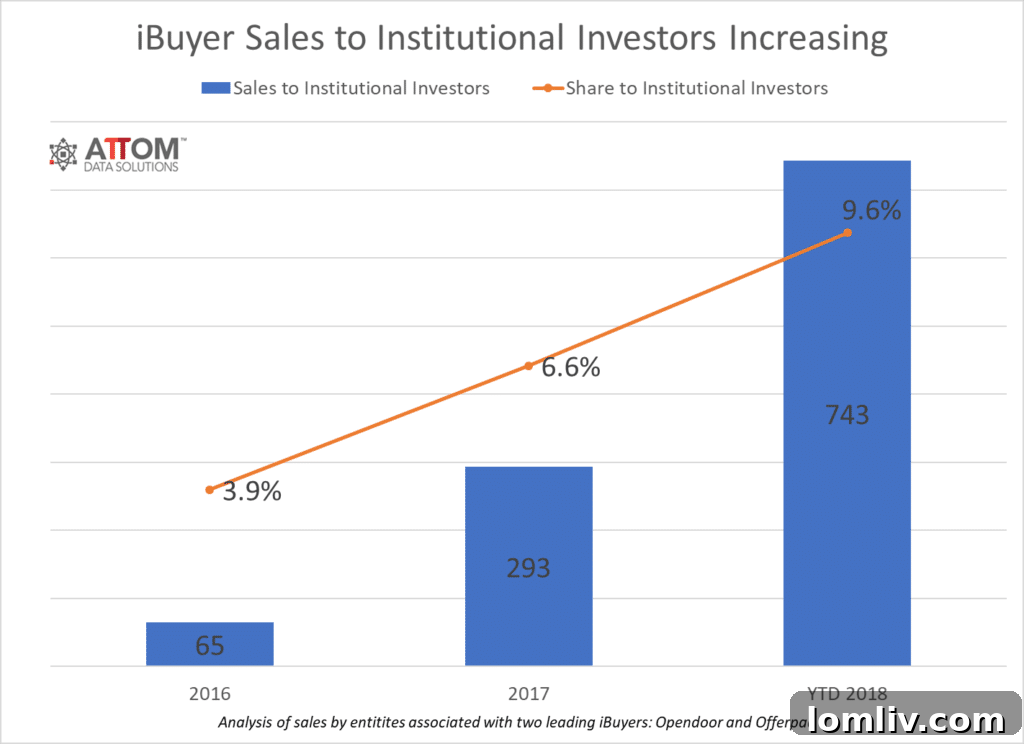
The data clearly illustrates this growing synergy. A comprehensive analysis highlights that a total of 743 homes sold by the two leading iBuyers — companies that buy directly from homeowners via all-cash offers — were purchased by institutional investors so far in 2018. This represents a significant 9.6 percent of all sales by those two iBuyers combined. This figure marks a substantial increase from previous years: in 2017, there were 293 institutional investor purchases, accounting for 6.6 percent of iBuyer sales, and in 2016, only 65 institutional investor purchases represented 3.9 percent of total iBuyer sales. This upward trajectory underscores a deliberate and accelerating strategy by institutional players to tap into the iBuyer ecosystem.
According to the analysis, a total of 743 homes sold by the two iBuyers — companies that buy directly from homeowners via all-cash offers — were purchased by institutional investors so far in 2018, representing 9.6 percent of all sales by those two iBuyers combined. That is up from 293 institutional investor purchases representing 6.6 percent of the iBuyer sales in 2017, and 65 institutional investor purchases representing 3.9 percent of the iBuyer sales in 2016.
More Than Just Numbers: The Broader Market Implications
It’s important to contextualize these findings. While the growth of institutional involvement with iBuyers is undeniable, it also means that over 90 percent of iBuyer sales are still made to individual buyers. Many of these individual transactions may involve traditional financing, adding layers of complexity that all-cash offers often circumvent. The speed and simplicity of all-cash offers, whether from institutions or individuals, are a driving force in today’s dynamic market. Innovations, such as proposed new rules regarding appraisals, which might do away with them for less-expensive properties, could further streamline transactions for individual buyers utilizing iBuyer programs, but the institutional impact remains a distinct and growing phenomenon.
The motivations for this shift are multifaceted. Daren Blomquist, Senior Vice President with ATTOM Data Solutions, highlights a critical market dynamic: “Tight inventory is a common challenge facing both individual and institutional single-family rental investors across the country.” He adds, “Meanwhile the appetite for more SFR inventory continues to grow as a new wave of institutional capital builds. Industry innovators are rising to meet this challenge through a variety of inventory-inducing channels, including off-market, build-to-rent, and iBuyer initiatives.” This perspective underscores that iBuyers are not just transforming how homes are bought and sold, but are also becoming a crucial inventory source for large-scale investors grappling with supply shortages.
Navigating a Shifting Landscape: Institutional Market Share and Key Players
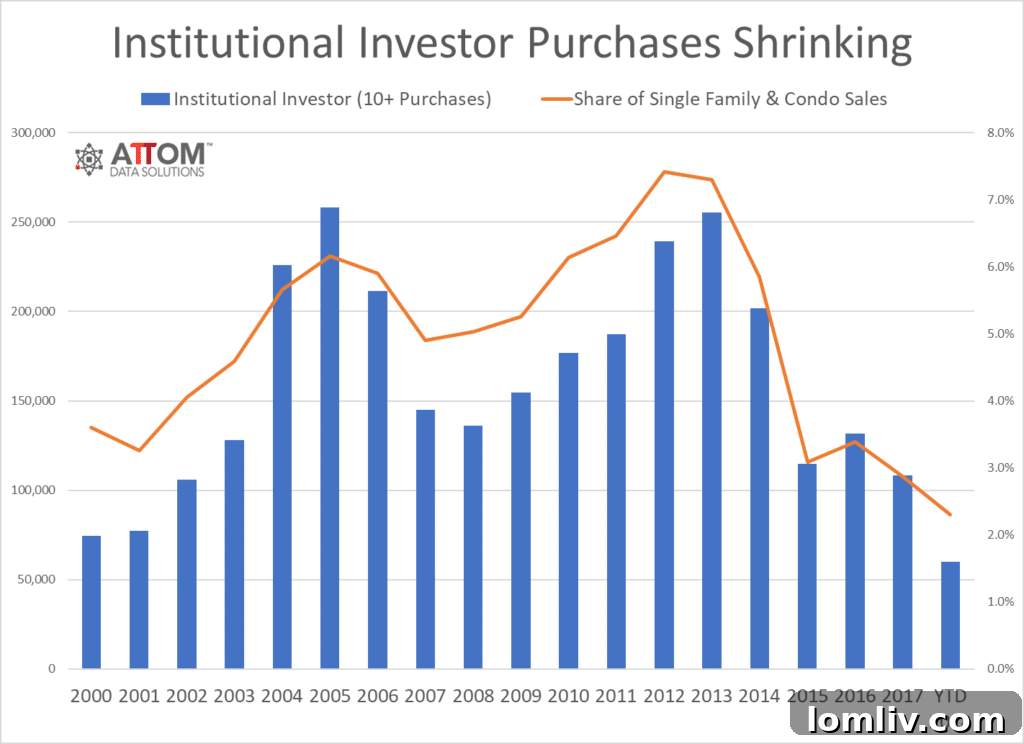
Interestingly, while institutional investors are increasingly turning to iBuyers, their overall market share of home purchases has actually seen a decrease in recent years. This broader trend is largely attributable to the drying up of foreclosures, which were historically a major source of readily available inventory for these large-scale buyers. In fact, purchases from institutional investors constituted only 2.3 percent of all home sales nationwide in 2018, a drop from 2.7 percent in the prior year and a significant decline from 7.4 percent in 2012. This paradox – a declining overall market share yet increased reliance on iBuyers – suggests that iBuyer platforms are filling a crucial gap for institutional capital, providing a targeted and efficient acquisition channel in a tighter market.
The question then arises: which institutional entities are at the forefront of this iBuyer-enabled acquisition spree? The analysis pinpoints the top three institutional buying entities as CERBERUS SFR HOLDINGS LP, CSH PROPERTY ONE LLC, and TAH HOLDING LP. All three appear to be related to companies specifically focused on purchasing single-family homes for rental purposes. These entities represent significant capital dedicated to building and managing vast portfolios of single-family rentals, signaling a long-term strategic play in the housing market.
The top three institutional buying entities — CERBERUS SFR HOLDINGS LP, CSH PROPERTY ONE LLC, and TAH HOLDING LP — all appear to be related to companies purchasing single-family homes as rentals.
The Future of Real Estate: Technology, Data, and Strategic Growth
The insights from industry leaders further illuminate this evolving dynamic. Kevin Ortner, CEO of Renters Warehouse, a company managing over 22,000 SFR properties across 42 states, observes, “There are a lot of buyers, both big and small, looking to grow their SFR portfolios and inventory is very tight. This is leading to creative ways to find new product — from build-to-rent programs, off-market inventory programs and iBuyer initiatives.” His comments underscore the innovative approaches being adopted to overcome supply constraints and meet investor demand. He also notes the increasing role of technology: “I’m also seeing investment in technology and data across the space allowing greater scale, efficiencies and insights.” This technological integration is key to allowing both iBuyers to operate effectively and institutional investors to manage their growing portfolios with greater precision and profitability.
This strategic pivot by institutional investors could also be a forward-thinking response to a subtly changing market. As the real estate market shows signs of moderating after a period of rapid appreciation, institutional investors might be positioning themselves to acquire single-family rental inventory strategically. While the market is far from a halt or even a significant slowdown, a slight cooling can present opportunities for large-scale buyers to secure assets at potentially more favorable long-term valuations. Building up SFR portfolios during such periods can be a calculated move to capitalize on future rental demand and market cycles, providing a hedge against potential volatility in other asset classes.
Conclusion: A New Era for Real Estate Investment
The convergence of iBuyer platforms and institutional investors marks a significant development in the real estate sector. What began as a disruptive model for individual homeowners is now evolving into a sophisticated acquisition channel for major capital. The data clearly shows an accelerating trend: institutional investors are increasingly relying on iBuyers to efficiently acquire single-family homes, particularly for their rental portfolios. This trend is driven by persistent inventory challenges, the growing appetite for SFR assets, and the technological efficiencies offered by iBuyer models.
As the market continues to evolve, shaped by technological advancements, shifting investor strategies, and dynamic economic conditions, the relationship between iBuyers and institutional investors will be a critical area to watch. This partnership is not merely transactional; it represents a fundamental reshaping of how real estate assets are sourced, acquired, and managed at scale, with profound implications for homeowners, individual buyers, and the broader housing market alike.