The Coming Wave of First-Time Homebuyers: What Zillow’s Report Reveals for the Housing Market
The real estate landscape is perpetually in motion, often influenced by economic cycles and demographic shifts. While recent reports might suggest a period of market cooling, a comprehensive analysis by Zillow indicates a powerful undercurrent gathering momentum: a significant wave of new homebuyers is on the horizon. This demographic surge promises to reshape the housing market, though its impact will resonate differently across various cities and regions.
Over the past decade, the housing market witnessed a substantial influx of first-time home buyers. However, Zillow’s forward-looking research points to an even more pronounced shift in the coming years. Their projections reveal that an additional 3.11 million individuals are set to reach the prime first-time buyer age of 34 within the next ten years. This isn’t merely a small increase; it signifies a generational turning point for homeownership.
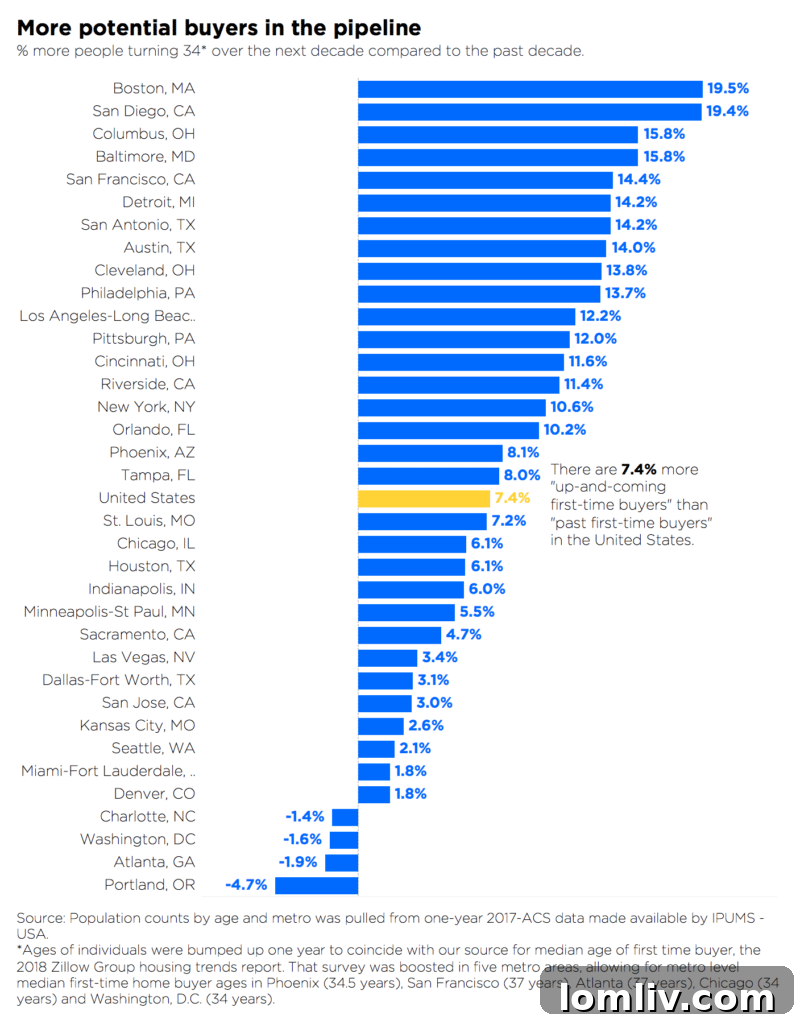
Delving into the specifics, Zillow’s report highlights a striking statistic: “From 2019 through 2028, 44.9 million people will turn 34, the median age of current first-time home buyers.” This figure represents a remarkable 7.4 percent increase compared to the preceding ten years, during which 41.8 million individuals crossed that critical age threshold. This demographic phenomenon, often referred to as a “buyer bulge,” is set to inject unprecedented demand into a market already grappling with supply challenges.
Understanding the Generational Impact on Homeownership
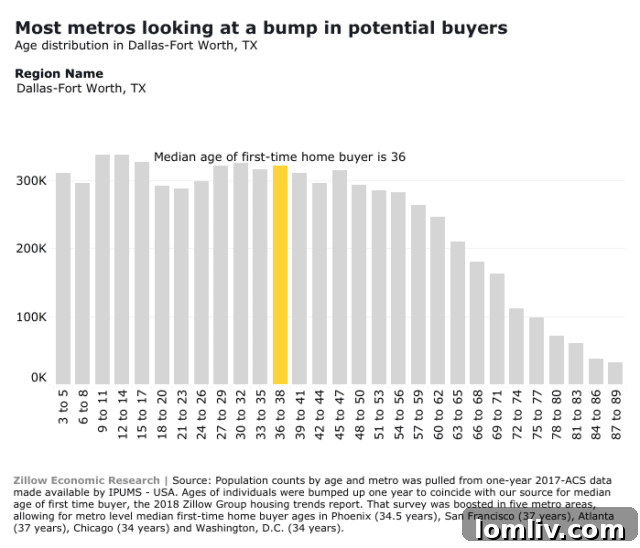
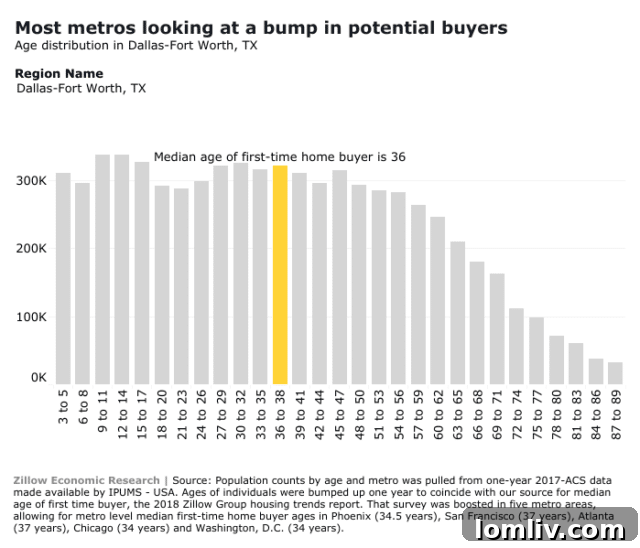
It’s crucial to recognize that not every individual reaching the age of 34 will immediately jump into the housing market. Economic conditions, personal finances, and lifestyle choices all play a role in the decision to purchase a home. However, this sheer influx of potential buyers will undoubtedly exert considerable pressure on the market. The largest three-year generational cohort in the U.S. currently falls within the 24 to 26 age bracket. This means that the full extent of their collective buying power has yet to be unleashed, signaling a sustained period of increased demand as they mature into their prime home-buying years.
This demographic shift is largely driven by Millennials, a generation that, despite facing student loan debt and economic uncertainties early in their careers, is now reaching peak earning and family-forming years. Their sheer size dictates that their preferences and financial readiness will be a dominant force in real estate for years to come, influencing everything from housing types to neighborhood amenities.
Regional Hotspots: Where Demand Will Soar
The impact of this coming wave will not be uniform across the nation. Zillow’s report offers a granular look at how different metropolitan areas are projected to experience this surge in potential homebuyers. Texas, in particular, is poised for significant growth.
- Dallas-Fort Worth: This bustling metro area is estimated to see approximately a 3.1 percent increase in potential homebuyers within the prime age range. Dallas-Fort Worth’s robust job market, particularly in tech and corporate sectors, combined with its relative affordability compared to coastal cities, makes it a magnet for young professionals seeking homeownership.
- Austin and San Antonio: These vibrant Texas cities are projected to experience an even more dramatic increase, each seeing an estimated 14.2 percent rise in potential first-time buyers. Austin’s tech boom and cultural appeal, alongside San Antonio’s growing military and healthcare industries, are attracting a young, upwardly mobile population eager to establish roots.
- Houston: As a major energy and healthcare hub, Houston is anticipated to witness a 6.1 percent increase in its pool of prospective first-time homebuyers. Its diverse economy and accessible housing options continue to draw new residents, fueling demand across various segments of the market.
While most major metropolitan areas researched by Zillow are expected to see an increase in potential buyers, a few exceptions stand out. Cities like Charlotte, North Carolina; Washington, D.C.; Atlanta, Georgia; and Portland, Oregon are projected to experience slight decreases. These variations can often be attributed to factors such as existing high housing costs, specific local economic conditions, or differing migration patterns for the target demographic.
The data visualization above (or its static representation) illustrates the varied regional impacts of this generational shift, underscoring the localized nature of real estate trends.
Varying Paths to Homeownership: Median Age Across Cities
The “prime first-time buyer age” of 34 is a national median, but the reality on the ground shows significant variation from city to city. Factors like local housing costs, average income levels, and cultural norms contribute to these differences.
- In Texas metros such as Dallas, Austin, Houston, and San Antonio, the average first-time buyer typically enters the market at 36 years old. This slightly older age could reflect the time it takes to save for a down payment in these growing markets or the pursuit of established careers.
- In high-cost coastal cities, the median age tends to be higher. For instance, in San Francisco, the average first-time buyer is 37, a testament to the astronomical property values requiring longer periods of saving and career advancement.
- Conversely, some major urban centers see younger first-time buyers. New York City registers an average age of 34, aligning with the national median. Los Angeles, surprisingly, sees an even younger average at 33, which could be influenced by diverse housing types and potentially higher household incomes for some segments of its younger population.
Market Implications: Prices, Inventory, and Affordability
The most immediate and critical question arising from this impending surge of buyers is its impact on housing prices. For one, it strongly suggests that prices could continue their upward trajectory over the next decade. The pace and intensity of this increase will likely correlate directly with the projected number of prospective first-timers in each city. More demand chasing limited supply inevitably leads to higher prices.
A long-standing issue in the housing market has been the struggle of inventory to keep pace with demand. Historically, new construction has often lagged behind population growth and household formation. If this trend persists and housing supply does not significantly increase to accommodate the additional influx of potential buyers, coupled with the growing number of baby boomers who are increasingly choosing to “age in place,” the median age for first-time homebuyers will likely continue to creep upwards. This creates a perpetual cycle where delayed homeownership becomes a more common reality, pushing aspiring buyers further out of the market as affordability wanes.
The Ripple Effect: Pressure on the Rental Market
The challenges in the homeownership market have a direct and significant ripple effect on the rental sector. As more would-be first-time buyers postpone their home purchases until later in life, the demand for rental properties intensifies. This sustained and growing demand inevitably leads to rising rental rates across urban and suburban areas alike. The equation is simple: fewer people transitioning from renting to owning means more competition for available rental units.
Adding to this pressure is the ongoing imbalance in new construction. While luxury apartment units continue to be built at a relatively rapid pace in many metropolitan areas, the development of affordable housing units consistently lags. This disparity means that the options for mid-income renters, especially those saving for a down payment, become increasingly scarce and expensive, exacerbating the overall affordability crisis and making the path to homeownership even steeper.
A Closer Look at Dallas: Rent Trends and Occupancy
Dallas serves as a prime example of these broader trends manifesting at the local level. At the close of 2018, reports indicated that most apartments in Dallas were already occupied. The city was experiencing robust rent growth, a trend further affirmed by the Yardi Matrix Multifamily National Report for 2018.
Specifically, nearly 95 percent of Dallas apartments were occupied in October 2018, with the yearly rent growth reaching 2.1 percent by November 2018. Looking ahead, projections for 2019 anticipated an even more substantial increase, with rent growth expected to hit 4.4 percent. These figures underscore the intense demand within Dallas’s rental market, driven by a growing population and the challenges many face in transitioning to homeownership.
Zillow aptly summarizes the underlying issue: “This is a huge generation and the rate of multifamily building, as aggressive as it seems for anyone watching the skylines of urban areas, does not make up for years’ worth of shortfall when more capital was being directed to single-family building during the housing bubble.” This statement highlights that even with seemingly brisk construction, the market is still playing catch-up from previous periods of underbuilding, especially in the multifamily sector, which is critical for housing a growing renter population.
Navigating the Future Housing Landscape
The Zillow report paints a clear picture of an evolving housing market, one shaped by powerful demographic forces. For aspiring first-time homebuyers, understanding these trends is crucial for strategic planning. For policymakers and developers, it signals an urgent need to address housing supply challenges, particularly in the affordable and mid-range sectors. The coming wave represents both a challenge and an opportunity: a challenge to maintain affordability and supply, and an opportunity for sustainable growth and community development.
This generational shift underscores the dynamic nature of real estate. While market conditions ebb and flow, long-term demographic trends provide a compass for understanding future trajectories. The growing cohort of potential first-time buyers is not just a statistic; it’s a driving force that will redefine neighborhoods, influence urban planning, and ultimately shape the fabric of communities across the nation.
To delve deeper into the detailed findings and data of this influential report, click here to access the full Zillow analysis.