Texas’s Apartment Paradox: Surging Construction Meets Persistent Affordability Challenges
Despite a visible surge in apartment construction across Texas, this unprecedented building boom isn’t necessarily translating into more affordable rents for residents. This striking paradox was a central theme at a recent conference on affordable housing hosted by the Federal Reserve Bank of Dallas, where leading economists delved into the complex dynamics of the state’s rental market.
Greg Willett, Chief Economist at RealPage, a prominent provider of property management software and services, addressed a gathering of industry professionals and policymakers. He highlighted a concerning trend: the same formidable affordable housing issues that have increasingly hampered families’ ability to purchase homes are now becoming a significant barrier within the rental sector. This emerging challenge demands immediate attention, as it impacts a vast segment of the population.
“We are beginning to observe the identical affordability challenges in rental housing,” Willett explained. He emphasized that this issue is unfolding even amidst a nationwide explosion in apartment completions, suggesting that the sheer volume of new units isn’t automatically solving the underlying problem of housing accessibility for all income brackets.
The Unprecedented Apartment Building Boom
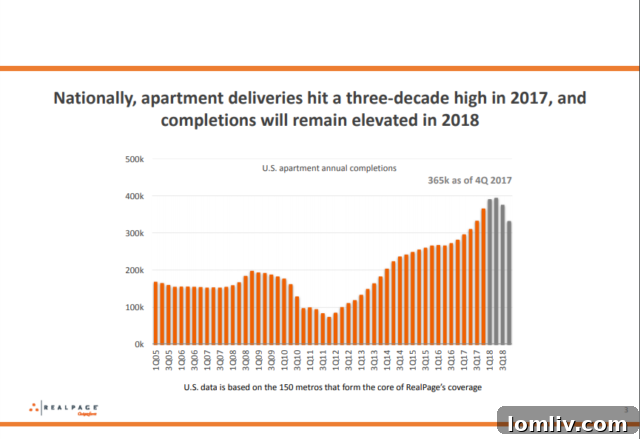
Willett detailed the scale of current construction, noting a robust rental housing building boom that spans the nation and significantly impacts several, though not all, key markets within Texas. “Nationally, apartment deliveries reached a three-decade high in 2017, and completions are projected to remain elevated throughout 2018,” he stated. This sustained level of new construction signifies an aggressive expansion of the multifamily housing supply, a trend that continues to shape urban landscapes.
The economist projected that the multifamily rental market is on track for another one to two years of “pretty aggressive” construction. This ongoing development will introduce a substantial volume of new rental products online, intensifying competition among properties while simultaneously addressing growing demand driven by population influx and economic expansion.
Texas: A Powerhouse in the U.S. Apartment Market
Texas plays a pivotal role in the larger U.S. apartment market, boasting eleven metro areas among the nation’s 150 biggest markets by apartment inventory. Collectively, these Texas markets account for a remarkable 12 percent of the total stock in the top 150 markets, underscoring the state’s influence and rapid growth in residential development. The economic vibrancy and increasing populations in these areas continue to fuel the demand for new housing.
When examining growth metrics, several Texas markets stand out. Austin leads the pack with an impressive 26.3 percent growth rate, followed closely by Midland-Odessa at 25.3 percent. San Antonio shows strong expansion at 23.9 percent, while Dallas registers 19.2 percent, and Houston contributes 16.4 percent. These figures reflect dynamic urban centers experiencing significant demographic and economic shifts.
Willett further elaborated on Texas’s contribution to national housing trends: “Key Texas markets have contributed an astounding 18 percent of the top 150’s deliveries during this economic cycle, and currently contain 15 percent of all product under construction nationwide.” This data clearly positions Texas as a central engine for apartment development, crucial for understanding national housing trends.
Interestingly, while many Texas cities are booming, Fort Worth’s multifamily growth has been comparatively “restrained,” accounting for approximately 9 percent growth. This contrasts sharply with its neighboring cities. Willett highlighted the sheer scale of development in the state’s largest metropolitan areas: “Houston and DFW (Dallas-Fort Worth) have each added more product during this cycle than exists in total for all but 50 or so U.S. metros combined.” In essence, Texas is inundated with apartments, showcasing an abundant supply that, paradoxically, doesn’t always translate to lower costs for renters.
Occupancy Rates: A Healthy but Nuanced Picture
Despite the massive influx of new inventory, overall U.S. apartment occupancy rates remain remarkably healthy. Willett noted that this stability persists even as a significant volume of new units moves through their initial lease-up phases. Current national occupancy rates hover around an encouraging 95 percent, indicating strong demand for rental housing across the country.
In Texas, the rapid building boom tends to result in occupancy rates that are slightly below the national average. However, Willett clarified that this minor deviation typically does not signal a widespread issue, with one notable exception.
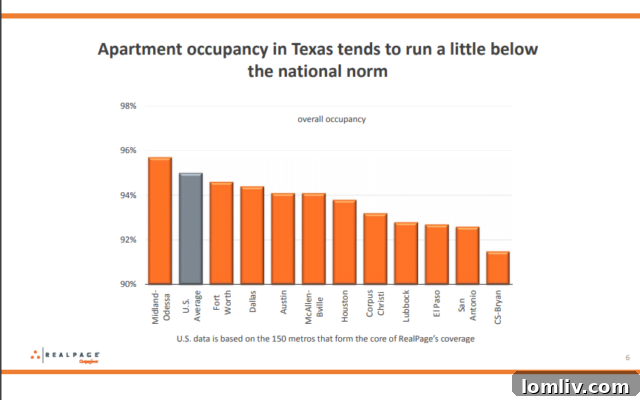
“The singular location in Texas where an actual vacancy issue is evident is College Station,” he revealed. “They constructed more student housing units in College Station than any other market in Texas,” leading to an oversupply specific to that niche. This scenario underscores how localized market dynamics, even within a booming state, can lead to unique challenges.
Conversely, the Midland-Odessa market continues to defy trends, consistently registering occupancy rates higher than the national average, reflecting its unique economic drivers, primarily related to the energy sector. Dallas and Fort Worth, while significant growth areas, hover only slightly below the national average for occupancy, by mere percentage points, confirming their robust rental markets.
The Relentless Ascent of Rental Rates
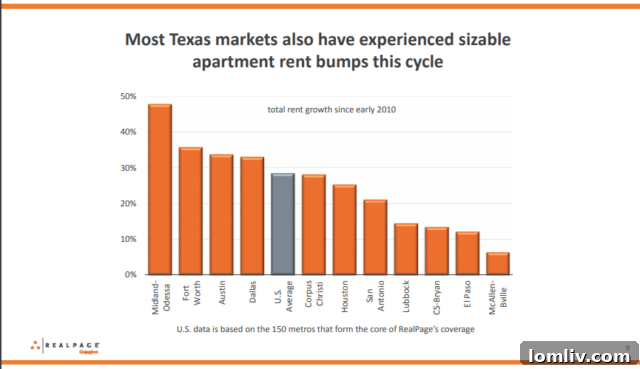
While occupancy generally remains strong, rental rates tell a different, more challenging story. “We are currently experiencing an unprecedented run-up in national apartment rents,” Willett cautioned. This pervasive upward trend has profoundly impacted Texas, as “most Texas markets have also witnessed sizeable apartment rent bumps throughout this cycle.” The cost of living, particularly housing, continues to be a growing concern for many residents.
Since 2010, major metropolitan areas like Dallas, Austin, and Fort Worth have experienced rental growth exceeding 30 percent. This sustained increase places significant pressure on household budgets. More recently, however, “DFW dropped from the national leaderboard for rent growth, and Austin is declining slightly,” indicating a potential moderation in these previously red-hot markets. In fact, rent growth has generally slowed in most Texas metro markets, with the notable exception of Midland-Odessa, which continues its rapid ascent.
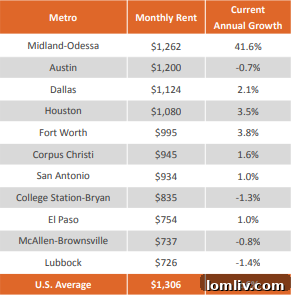
“The most expensive rents in the state of Texas are currently found in Midland,” Willett confirmed, a testament to the concentrated demand in this energy-rich region. Yet, even Midland’s high rents trail the national average, highlighting that while Texas rents are rising, they still generally offer a comparative value against other major U.S. markets. “Even the most expensive Texas apartment markets register rents below the national average,” he stated, offering a nuanced perspective on statewide affordability.
However, not all Texas markets are experiencing upward rent trajectories. College Station-Bryan, El Paso, McAllen-Brownsville, and Lubbock have, in fact, experienced negative rental rate growth, demonstrating diverse economic conditions and demand patterns across the vast state.
The Widening Affordability Gap: Wages vs. Rents
Lower-than-national-average rents in Texas do not automatically equate to robust local affordability. This crucial distinction lies in the relationship between rent growth and wage growth. “Rent growth is beginning to trail wage growth in quite a few locations,” Willett pointed out, revealing a critical affordability gap. When rents outpace incomes, even seemingly modest rents become a burden.
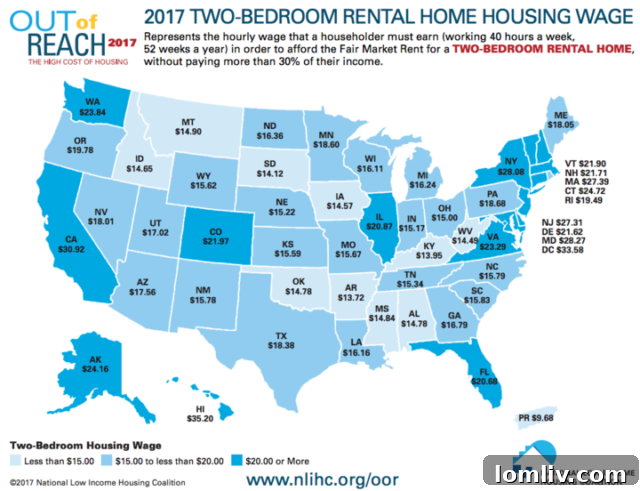
A sobering 2017 report by the National Low Income Housing Coalition (NLIHC) starkly illustrated this challenge. To afford a two-bedroom apartment in Texas, the report indicated that an individual would need to earn a minimum of $18.80 per hour. This benchmark significantly surpasses the average renter wage of $17.89 per hour, creating a substantial barrier for many working individuals and families.
The NLIHC’s analysis further estimated the grueling reality for minimum wage earners. Someone earning the minimum wage would need to work an astonishing 101 hours a week to afford a two-bedroom apartment, or 82 hours a week for a one-bedroom unit. These figures underscore the severity of the housing crisis for low-income workers.
In major metropolitan centers like Dallas, a minimum-wage worker would require the equivalent of 2.7 full-time jobs just to cover the rent for a two-bedroom apartment. Similarly, in Fort Worth-Arlington, the requirement stands at 2.6 full-time jobs. These statistics paint a grim picture of housing instability and the immense pressure placed on the state’s most vulnerable populations.
The Luxury Trap: Why New Construction Doesn’t Solve Affordability
Compounding the affordability issue is the predominant type of apartments being constructed. “Most of this cycle’s completions are luxury communities,” Willett explained. Developers are primarily targeting the high-end market, driven by higher profit margins and demand from affluent renters. “Today’s typical suburban project is a mid-rise building with garage parking, rather than a low-rise development with surface parking,” a design choice that inherently increases construction costs and, consequently, rents.
Furthermore, urban core projects now account for a significantly larger share of total building activity than in previous periods. “Urban land costs inherently drive up the rents, and high-rise construction pushes the numbers even higher,” Willett elaborated. The combination of expensive land and sophisticated construction methods results in units that are out of reach for many Texans seeking affordable rental options.
The rent premium for a Class A (luxury) development over a Class B (mid-tier) product has also surged during this cycle. In Dallas, luxury renters pay a premium of 30 percent, while in Fort Worth, this premium is 34 percent. Both figures are below the national average of 38 percent. However, Austin and Houston exhibit even higher premium percentages, at 53 percent and 45 percent respectively, reflecting intense demand for high-end living in these vibrant urban centers.
“U.S. rent-to-income ratios are inversely correlated to apartment product class,” Willett elucidated. This means that “those who opt for Class A apartments rarely face affordability constraints.” The challenge intensifies dramatically “when moving to those lower-end product segments,” where income often struggles to keep pace with even moderate rents. “Certainly, it’s always been true that those living in luxury spend lower shares of income on rent,” he added, “but it’s probably more pronounced now as it’s gotten more challenging in the bottom end of the market.”
Willett identified the critical income threshold for market-rate housing at approximately $30,000 annually. “Households that are earning less than that typically do not appear in conventional market-rate product,” he noted, implying that these individuals and families are forced to seek housing solutions outside the standard rental market, often in less desirable or informal arrangements, or face severe housing instability.
Future Trends: The Rise of Workforce Housing Neighborhoods
So, where will the next wave of multifamily growth and rent increases occur? According to RealPage’s insightful analysis, the focus is shifting towards what they term “workforce housing neighborhoods.” This refers to areas traditionally catering to essential workers and middle-income households, which are now experiencing heightened demand and rising costs.
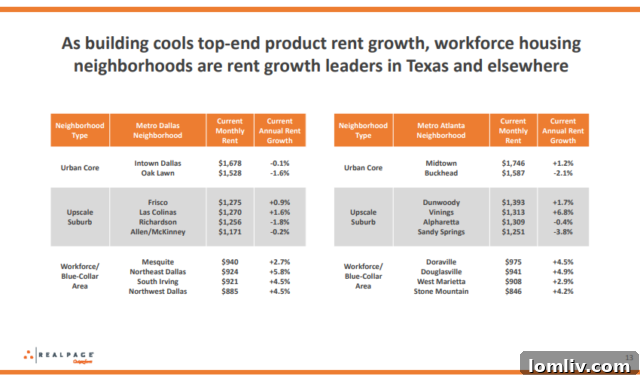
Statistical evidence already supports this trend. Rents are beginning to stagnate in more upscale, heavy-market areas like Frisco and Las Colinas, and have even seen drops in historically affluent areas such as Oak Lawn. Conversely, in neighborhoods characterized by a higher concentration of workforce housing—including Mesquite, Northeast Dallas, South Irving, and Northwest Dallas—rents are increasing by as much as nearly 6 percent. This shift indicates that the affordability crisis is pushing demand into previously more accessible areas, inevitably driving up costs there too.
In conclusion, while Texas continues to experience an unparalleled apartment building boom, the benefits of this expansion are not evenly distributed. The state’s rental market is marked by a complex interplay of rapid construction, fluctuating occupancy rates, and steadily rising rents, particularly in the luxury segment. The widening gap between wages and rental costs presents a significant challenge to housing affordability, especially for low-income households. As demand shifts towards workforce housing neighborhoods, these areas are becoming the next frontier in Texas’s evolving, and increasingly complex, rental market landscape.