Navigating Growth: Understanding Enrollment Trends in Highland Park ISD
The Highland Park Independent School District (HPISD), renowned for its exceptional educational standards and desirable community, has experienced a significant surge in student enrollment over the past decade. This growth presents both opportunities and challenges, prompting district leaders to proactively address the evolving needs of the community.
Dr. Dawson Orr, Superintendent of the Highland Park Independent School System, recently issued an important announcement to the mayors, councilmembers, and city managers of Dallas, Highland Park, and University Park. This communication aimed to shed light on the primary factors driving HPISD’s enrollment increase, fostering a collaborative understanding among municipal leaders regarding the shared implications of this growth. The announcement highlighted key demographic shifts and policy changes contributing to the expanding student body within one of Texas’s most coveted school districts.
Key Drivers of HPISD Enrollment Growth
The 14% enrollment increase within HPISD over the last ten years is not a random occurrence but rather a direct result of several distinct and powerful trends impacting the Park Cities area. Understanding these drivers is crucial for effective long-term planning for both the school district and the surrounding municipalities.
1. Rapid Development of Single-Family Homes
One of the most significant contributors to HPISD’s enrollment growth is the relentless pace of single-family home construction and redevelopment within the district’s boundaries. The Park Cities continue to be an exceptionally attractive residential destination, drawing families seeking top-tier schools, a strong sense of community, and convenient access to the amenities of Dallas. This sustained demand fuels a dynamic housing market where older homes are frequently replaced by larger, newer residences, or new construction fills available lots at an astonishing rate. Each new or redeveloped single-family home often brings with it new families, many of whom have school-aged children eager to enroll in HPISD. This continuous influx of residents directly translates into a growing student population, placing increased demands on school facilities, resources, and staffing.
2. SMU’s On-Campus Housing Policy Shift
Another compelling factor influencing local demographics and, consequently, HPISD enrollment, stems from a recent policy change at Southern Methodist University (SMU). The university now requires freshmen and sophomores to live on campus, a move designed to enhance the student experience, foster a stronger campus community, and improve academic outcomes for younger students. While this policy primarily impacts SMU’s student body, its ripple effects extend into the local housing market.
Historically, many SMU students, particularly underclassmen, would lease houses or apartments in the surrounding Park Cities area. With the new on-campus living requirement, a significant portion of these rental properties have become available. This policy has inadvertently created an opportunity for families with children to lease homes in the Park Cities that might have previously been occupied by university students. These properties, often smaller or more moderately priced by Park Cities standards, offer a more accessible entry point into the desirable school district for families who might not otherwise be able to purchase a home in the area. The availability of these “inexpensive” (relative to purchase prices) rental options provides a crucial pathway for new families to access HPISD’s highly acclaimed educational offerings, thereby contributing to the district’s rising enrollment figures.
A Decade of Remarkable Growth: HPISD Enrollment Data
HPISD’s standing as one of the state’s most sought-after school districts is undeniable, and its enrollment figures vividly illustrate this popularity. The district has experienced substantial growth, with total enrollment climbing from 6,172 to 7,037 students over the last ten years, marking a robust 14 percent increase. This upward trend underscores the sustained appeal of the Highland Park community and its commitment to educational excellence.
Visualizing this growth provides a clearer perspective on the district’s trajectory. The following images depict the enrollment trends over both a 10-year and a 50-year period, highlighting the consistent and significant expansion of the HPISD student body:
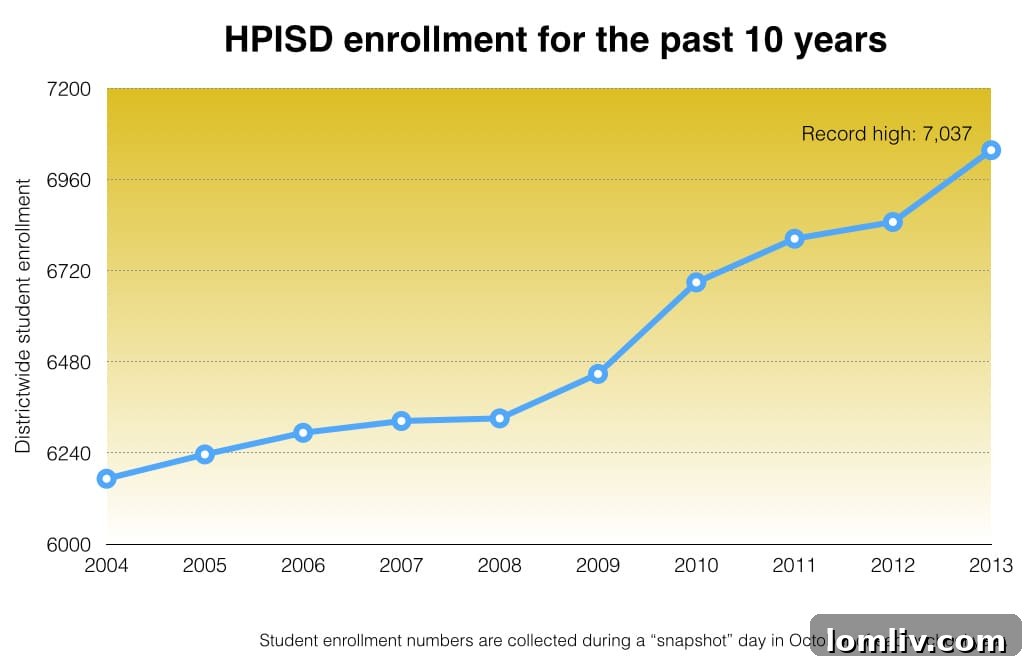
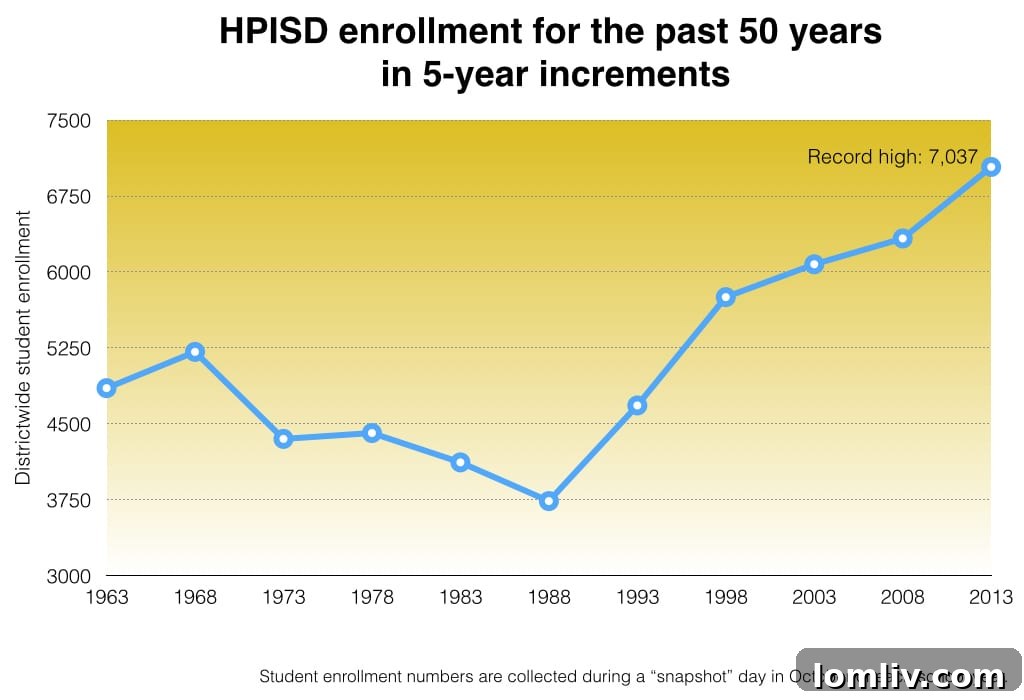
These historical data points are invaluable for district planners, demonstrating not just a temporary spike but a sustained pattern of growth that necessitates careful strategic planning across all areas of school operations, from facility expansion to staffing and resource allocation.
The Delicate Balance: Real Estate Development and School District Impact
The intersection of urban development and public education is often complex, requiring careful consideration and open dialogue among all stakeholders. Dr. Orr’s statement regarding the proposed Highland House development in Preston Center reflects this delicate balance, articulating the district’s position on such projects.
We respect each municipal council’s authority over the consideration of real estate development proposals, and we believe in working closely with our city partners to share enrollment updates and other information that affects us all. However, we do not believe that it is appropriate for the school district to advocate for or against specific real estate projects.
This position underscores HPISD’s role as an educational institution focused on its core mission, while also acknowledging its vital partnership with the local municipalities. The district’s commitment is to provide data and insights regarding potential impacts, allowing city councils to make informed decisions about zoning and development that best serve the broader community.
Addressing Community Concerns About High-Rise Development
The prospect of a new high-rise development, such as the one proposed for Preston Center, often elicits strong reactions from community members, particularly parents. Many HPISD parents have contacted the district expressing concerns about the potential effects of such a large-scale residential project on school enrollment and resources. These concerns are valid, as any significant increase in local housing density, regardless of its stated target demographic, can ultimately influence the student population.
Dr. Orr candidly addressed the uncertainty surrounding the exact impact of such a development:
Many of our parents have contacted us with concerns over the high-rise proposed for Preston Center. None of us can accurately project what the effect would be on HPISD enrollment, but according to the developer, this proposed property will target empty nesters and young professionals. In the interest of estimating what the impact would be if the project moves forward, we will use The Shelton condominiums, off Luther Lane and the Tollway, as a point of comparison.
The developer’s assertion that the Highland House project will primarily target “empty nesters and young professionals” aims to mitigate concerns about increased student enrollment. However, experience shows that even developments designed for specific demographics can, over time, house families with children, whether through direct occupancy or subsequent resale/rental. Therefore, the district must prepare for various scenarios.
Using Comparables: The Shelton Condominiums
To provide a more tangible perspective on potential impact, HPISD has chosen to use The Shelton condominiums as a point of comparison. The Shelton, located off Luther Lane and the Dallas North Tollway, offers a real-world example of how a multi-unit residential building within or near the district contributes to student enrollment. This approach allows for a data-driven, albeit estimated, projection.
-
The Shelton: Comprises 121 units and currently accounts for 24 students spread across grades K-12 within HPISD.
-
Crosland Proposed Development (Highland House): Envisions between 200-240 units.
By applying the student-per-unit ratio observed at The Shelton to the proposed Crosland development, the district can generate a preliminary estimate of potential new students. For instance, if The Shelton’s ratio (24 students / 121 units ≈ 0.2 students/unit) were directly applied, a 200-unit development could potentially add around 40 students, and a 240-unit development could add roughly 48 students. While these numbers might seem small in isolation, when combined with the continuous growth from single-family homes and other factors, they contribute to the cumulative demand on the district’s resources. This analytical approach provides a valuable tool for city planners and the school district to assess the potential strains on infrastructure, classrooms, and educational programs, ensuring that HPISD continues to provide an exemplary education for all its students amidst ongoing community evolution.
Strategic Planning for a Growing Future
The sustained enrollment growth in Highland Park ISD underscores the district’s ongoing appeal and the vibrancy of the surrounding communities. This growth, driven by a thriving housing market and shifts in local demographics, necessitates proactive and collaborative strategic planning. HPISD is committed to working closely with its municipal partners, leveraging data, and engaging with the community to ensure that as the district grows, it continues to uphold its tradition of academic excellence and provide an enriching environment for every student. Addressing facility needs, maintaining optimal class sizes, and adapting educational programs are paramount to successfully navigating this period of expansion, securing HPISD’s future as a premier educational institution.