Navigating the Absurdity: Unpacking the Latest HOA Board Meeting Shenanigans
It’s been quite some time since we’ve collectively indulged in a satisfying HOA schadenfreude moment. Sensing a widespread need for that familiar fix, and armed with fresh insights from a recent board meeting recounted by a frustrated resident, we find ourselves once again delving into the often-baffling world of Homeowners Association governance. This isn’t just one resident’s story; it’s a window into the systemic issues that plague many communities, highlighting the all-too-common disconnect between board members and the residents they are elected to serve.
Every HOA board meeting, it seems, begins with a predictable rhythm of procedural tedium: the roll calls, the often-perfunctory calls for votes on topics residents struggle to grasp (due to a persistent lack of accessible information), and a litany of recurring agenda items. This preliminary dance often serves to obscure the truly pertinent discussions that residents hope to engage in. Yet, this particular meeting, the first following recent elections, held a different kind of promise – or peril, depending on your perspective. A “new” board had taken the helm, and the initial announcements regarding committee roles quickly revealed a concerning pattern. With the exception of the seemingly innocuous and often underpowered Social Committee, which genuinely sought volunteers, the remaining committee positions appeared to be pre-filled with an exclusive circle of “cronies and besties” connected to the board. This immediate red flag signaled potential issues of transparency, impartiality, and true representation. As veteran observers of HOA dynamics might warn: Danger, Will Robinson, Danger!
Gas Leaks and Self-Congratulation: A Story of Selective Narratives
The meeting continued with a display of what could only be described as humble-bragging. The board took a moment to pat themselves on the back, extolling the tireless efforts of the building manager in swiftly resolving a mysterious gas leak that had been reported by a resident in December. While ostensibly a positive development, the self-congratulatory narrative conspicuously omitted a crucial detail: the very same resident had initially raised this exact complaint months earlier, only to be dismissed and fobbed off. This incident perfectly illustrates a common, disheartening trend in many HOAs: credit is eagerly claimed for resolutions, but accountability for prior neglect is conveniently overlooked. It’s a classic case of “the victors write the history,” where inconvenient truths are erased from the official record, leaving residents feeling unheard and undervalued.
The Illusion of “Question Time” and the Puzzles of Prioritization
Following the self-congratulatory segment, the meeting transitioned to the eagerly anticipated “question time” – a period ostensibly reserved for residents to ask… well, anything. However, the reality of these sessions often falls far short of expectations. It appears that the more serious, insightful, or potentially illuminating a topic might be, the less time is allotted for its discussion. This deliberate curtailment of meaningful discourse serves to protect the board from genuine scrutiny, perpetuating a cycle of superficial engagement. One can’t help but note the ironic fascination some older residents exhibit for games like “Wheel of Fortune,” a game rooted in “Hangman” – perhaps a subconscious reflection of the frustrating guessing game that board meetings often become when crucial information is withheld or minimized.
During this truncated question period, a resident, whose demeanor might best be described as gruff but direct, raised a critical point. He reminded the board and management that months prior, he and another resident had brought several maintenance issues to their attention. Despite repeated follow-ups, nothing had been done. The majority of these tasks were visually unappealing but minor in scope, easily manageable by on-site staff without requiring significant external resources. The implications were clear: a failure of basic property management and a disregard for resident well-reported concerns.
The Former President’s Intervention: Redefining “Life-Threatening”
Suddenly, the meeting took an unexpected turn. One could almost hear the symbolic “ding-ding-ding” of a fight bell as the previous board president, a woman reportedly prone to dramatic entrances, abruptly interjected. She declared that the board (of which she was no longer a member) was exclusively concerned with “life-threatening” repairs. This statement, delivered with an air of self-importance, highlighted a glaring inconsistency. This was the same former president whose primary focus just over a year ago had been a costly (and arguably non-life-threatening) $650,000 hallway renovation. That project, which she had championed with much fanfare, reportedly received a lukewarm reception at best upon its completion, underscoring a questionable sense of prioritization when it came to allocating community funds and addressing resident needs.
As part of her impassioned, and largely unfounded, rant, the former president then asserted that a specific owner was out of compliance regarding fire suppression. The origin of this highly sensitive and personal information, coming from someone no longer on the board, remained an utter mystery. Following the meeting, it was confirmed by legitimate authorities that no one with actual oversight knew what on earth she was “gabbling on about.” This pattern of fabricating information or exaggerating claims to suit an immediate agenda speaks volumes about the challenges of maintaining a truthful and constructive dialogue within HOA settings.
The Persistent Parking Lot Door Debacle: A Case Study in Neglected Solutions
Another resident then brought up a perennial safety concern: one of the parking lot doors consistently fails to close properly. A propped-open door, particularly in a shared residential building, poses a significant security risk and allows for unwanted elements to enter or energy to escape. This issue, the resident noted, re-emerges every winter, largely due to air pressure imbalances in the elevator vestibule that effectively prevent the door from sealing correctly.
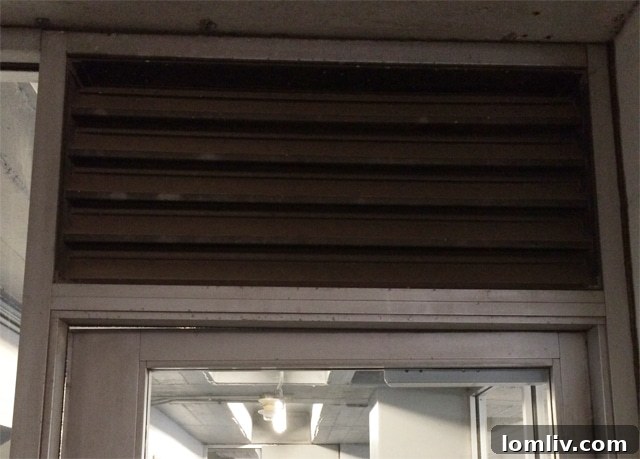
As the accompanying image clearly illustrates, the vestibule was originally designed with a set of louvered transoms, specifically intended to ensure proper ventilation and equalize air pressure. However, at some undisclosed point in the building’s history, these crucial transoms were inexplicably boarded up. This seemingly minor alteration is the root cause of the persistent door closure problem, creating the very air pressure differential that impedes its functionality.
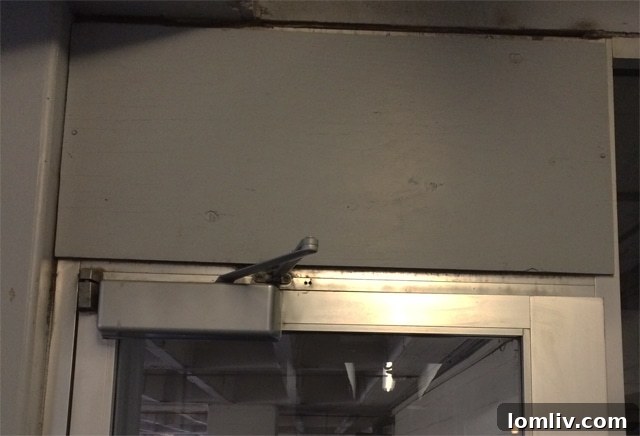
The solution to this recurring problem is remarkably straightforward and requires minimal effort: simply create a few strategic holes in the plywood covering the transoms to allow air pressure to normalize. This elegant, five-minute fix has been proposed repeatedly, year after year, yet it has been consistently ignored. The continued neglect of such a simple, effective solution in favor of more complicated, often punitive, alternatives is a hallmark of ineffective governance.
Board’s “Solution”: Blame the Residents, Ignore the Root Cause
What, then, was the board’s insightful response to the concerned attendees at this meeting regarding the parking lot door? Their proposed “solution” was to install video cameras to identify residents who fail to physically close the door each time. This response not only sidesteps the fundamental issue of the air pressure problem but also shifts the blame entirely onto the residents. And what exactly would be the consequence of these identifications? Fines? Public shaming? Perhaps forcing them into a dunk tank at the next community carnival? The irony of this approach is palpable: punish the symptoms rather than cure the disease.
Adding another layer of absurdity, the building manager reportedly argued against fixing the air pressure, claiming it might make the doors too heavy to open for residents with arms laden with packages. This excuse, however, entirely misses a critical detail: when exiting the garage, where one’s arms would indeed be full, the door in question operates as a “push” rather than a “pull.” This glaring oversight underscores a lack of practical understanding and a willingness to offer flimsy justifications for inaction.
Beyond the Meeting: A Call for Transparency and Action in HOA Living
Commiserating with my friend after this bewildering experience, it became abundantly clear that this single 40-minute HOA meeting contained more than its fair share of the truly bizarre and frustrating. It serves as a potent reminder that while HOAs are designed to foster community and maintain property values, they can often become breeding grounds for mismanagement, miscommunication, and outright absurdity.
For fellow HOA members out there, how does this tale compare to your own board meeting experiences? Do these narratives of ignored concerns, selective transparency, and ineffective problem-solving resonate with your struggles? Share your thoughts and stories in the comments below, or feel free to reach out privately. Your experiences contribute to a larger understanding of the challenges and opportunities within community living.
Remember: Do you have an HOA story that deserves to be told? Perhaps a fascinating piece of high-rise history? Realtors, interested in featuring a listing that’s ripe for renovation or one that has achieved spectacular success? Or how about hosting a Candy’s Dirt Staff Meeting and sharing your insights? Don’t hesitate to shoot Jon an email. We even accept (legal!) marriage proposals! You can reach us at [email protected].