The Rados House: A Mid-Century Modern Masterpiece by Richard Neutra
In the vibrant post-war era of the 1950s, as Southern California blossomed into a hub of innovation and lifestyle, shipbuilder John Rados embarked on a quest to create a home that was as visionary as his own industrial empire. Having acquired a magnificent, expansive hillside lot offering unparalleled vistas of the bustling Port of Los Angeles, Rados sought out an architect whose genius could truly capture and amplify the site’s potential. His choice fell upon a fellow Austro-Hungarian émigré, the renowned modernist architect Richard Neutra, a decision that would culminate in one of the most significant residential designs of the period: the Rados House.
The Visionary Client: John Rados and the Harbor Boat Building Company
John Rados’s journey to becoming a prominent figure in American industry was one of resilience and ambition. Fifty years prior to commissioning his dream home, Rados, alongside his family, had fled the turbulent Austro-Hungarian Empire, seeking new opportunities in the United States. Their hard work and entrepreneurial spirit led to the establishment of the Harbor Boat Building Company. Under Rados’s leadership, the firm flourished, evolving into one of the nation’s most prolific shipbuilding enterprises. This remarkable success provided Rados not only with substantial wealth but also a profound appreciation for precision engineering, structural integrity, and the beauty of functional design – qualities he undoubtedly admired in Neutra’s architectural philosophy.
Rados envisioned a home that would reflect his achievements and provide a sanctuary for his family, seamlessly integrated with the dramatic Southern California landscape. His industrial background likely influenced his desire for a residence that was both robust and elegantly engineered, capable of standing the test of time while embracing modern living principles.
Richard Neutra: A Master of Mid-Century Modernism
Richard Neutra was, without a doubt, a supremely wise choice for the challenging yet rewarding Rancho Palos Verdes site. By the 1950s, Neutra had firmly established himself as a leading voice in American modernism, particularly celebrated for his ability to translate European modernist ideals into a distinctly Californian aesthetic. His designs were characterized by an unfussy elegance, a deep respect for the natural environment, and an innovative use of materials that allowed his structures to connect intimately with their surroundings.
Neutra’s architectural philosophy, often termed “biorealism,” emphasized the psychological and physiological connection between humans and their built environment. He meticulously considered light, air, and views, aiming to create spaces that promoted well-being and a sense of harmony. For the Rados House, overlooking such a panoramic expanse, Neutra’s approach was perfectly suited. He was known for crafting homes that didn’t just sit on a landscape but became an integral, responsive part of it, especially showcasing the phenomenal views abundantly available in Southern California.
The Rados House: A Symphony of Design and Nature
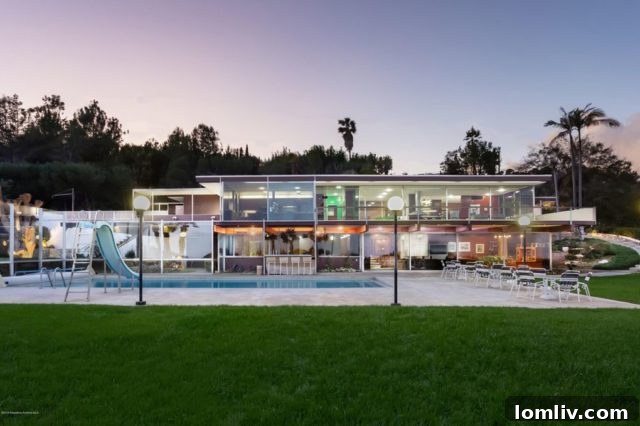
Completed in 1957, the Rados House stands as a monumental testament to Neutra’s design philosophy and is widely believed to be one of his largest residential commissions. This 4,000-square-foot home is a masterclass in site-specific architecture, meticulously carved from the hillside to maximize its dramatic setting. The approach to the house is deliberately understated; a long, private drive leads to a front elevation that is remarkably unassuming, offering a subtle hint of the grandeur that lies beyond its walls.
Innovative Integration with the Landscape
Once inside, the residence unfolds into a breathtaking series of interconnected spaces, demonstrating Neutra’s commitment to open living. The careful integration with the landscape is evident in every detail. Rather than merely building on the land, Neutra sculpted the house into the terrain, creating an organic relationship between the built environment and its natural context. This technique allowed for intimate, sheltered zones while simultaneously opening up to the vast exterior views.
Architectural Features and Materials
The materials chosen for the Rados House are both sophisticated and functional, contributing to its unique character. Terrazzo floors flow seamlessly throughout the main living areas, providing a durable, elegant surface that enhances the sense of continuity and expands the visual space. These polished surfaces reflect natural light, adding to the home’s luminous quality. The extensive use of floor-to-ceiling windows and expansive sliding glass doors not only floods the interiors with daylight but also blurs the boundaries between indoor and outdoor living. This transparency allows the surrounding natural beauty to become an intrinsic part of the home’s décor, changing with the seasons and the time of day.
In a subtle yet significant nod to John Rados’s profession, marine-grade wood beams are incorporated into the structure. These robust elements provide both architectural interest and a sense of enduring strength, echoing the craftsmanship and resilience found in shipbuilding. Their warm tones contrast beautifully with the cool neutrality of the terrazzo and glass, introducing a tactile richness that prevents the modern design from feeling stark or cold. These thoughtful material choices contribute to open spaces that, despite their generosity, still evoke a profound sense of warmth and coziness.
The “Ready-for-Anything” Philosophy in Practice
Neutra’s design philosophy for the Rados House emphasized a “ready-for-anything” plan, advocating for flexible living spaces that could be easily transformed to suit any need. This concept is beautifully realized through the home’s open layout, where living, dining, and entertaining areas flow effortlessly into one another. Movable partitions or strategically placed furniture could redefine these zones, allowing for intimate family moments or grand social gatherings. This adaptability was a hallmark of Neutra’s modernist vision, anticipating the evolving needs of contemporary families and offering a dynamic approach to home life.
Unparalleled Panoramic Views
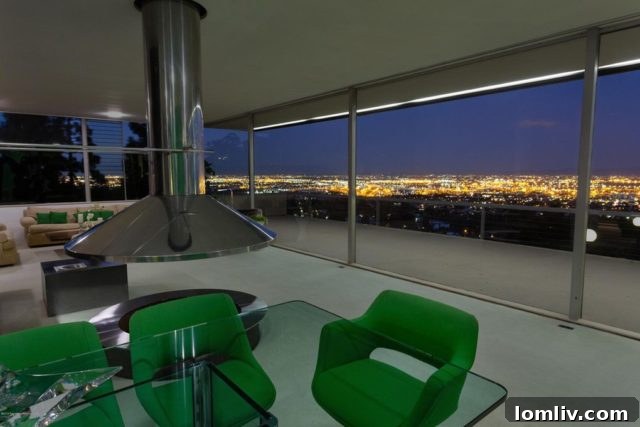
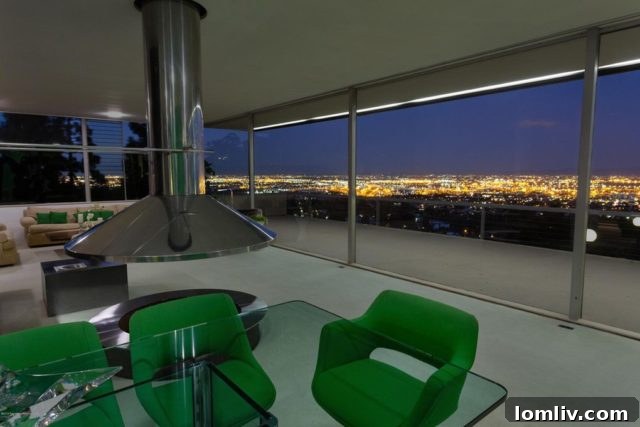
Perhaps the most captivating feature of the Rados House is its absolutely unparalleled 270-degree panoramic views. From its privileged perch in Rancho Palos Verdes, residents and guests are treated to an ever-changing tableau of the Southern California landscape. The gaze sweeps across the sprawling LA basin, a glittering tapestry of city lights by night and a vibrant urban expanse by day. To the east, the majestic San Gabriel Mountains and the distant, rugged San Jacinto Mountains provide a dramatic backdrop, their peaks often capped with snow in winter, offering a stunning contrast to the coastal setting. To the south, the picturesque coastline stretches towards Dana Point, where the Pacific Ocean meets the land in a captivating dance of waves and cliffs. These breathtaking vistas are not just an external amenity; they are woven into the very fabric of the home, transforming every room into a living canvas.
A Timeless Icon: The Enduring Legacy of the Rados House
The Rados House stands as a significant landmark in Richard Neutra’s prolific career and a shining example of mid-century modern architecture in Southern California. It encapsulates a period of optimistic post-war expansion, where innovative design and a connection to nature were paramount. The collaboration between a visionary client like John Rados and an architectural genius like Richard Neutra resulted in a residence that is not merely a structure but an experience – a harmonious blend of human ingenuity and natural splendor.
Its enduring appeal lies in its timeless design, its masterful integration with its environment, and its ability to inspire a sense of calm and wonder. The Rados House continues to be celebrated for its architectural integrity, its innovative use of space, and its truly spectacular setting, making it a coveted piece of architectural history that resonates with admirers of modernist design worldwide.
For those eager to delve deeper into the fascinating narrative and visual splendor of this iconic Richard Neutra creation, additional insights and details can be found by exploring specialized architectural resources.
For more, check out the story at SecondShelters.com.