Dallas’ Fair Park at a Crossroads: New City Attorney Casts Doubt on Privatization Plan
A fresh chapter has begun in Dallas’ legal department, bringing with it renewed scrutiny over one of the city’s most ambitious and controversial undertakings: the proposed privatization of Fair Park. Larry Castro officially assumed the role of Dallas City Attorney this past Monday, and sources indicate his tenure is commencing with a robust internal review, including immediate personnel adjustments. However, the most profound impact of Castro’s leadership may lie in a thorough re-evaluation of the legal opinion that previously sanctioned the Humann Plan for Fair Park’s privatization.
The very concept of privatizing Fair Park has always been a compelling, albeit complex, proposition. With 277 acres of prime civic real estate, the potential for transformative development is immense, truly a canvas where innovation could flourish. However, the existing Humann Plan has consistently drawn significant criticism, particularly regarding its financial structure and governance. We, along with many other concerned stakeholders, contend that the current proposal is not only excessively expensive but also suffers from a severe lack of oversight. Crucially, it asks for virtually no tangible contributions from the State Fair of Texas, and fundamentally, it incorporates far too few checks and balances to adequately protect Dallas taxpayers.
The Humann Plan: Unpacking the Financial and Oversight Deficiencies
Our objections to the Humann Plan stem from several key areas of concern. Firstly, the financial projections and proposed operational costs raise serious questions about its long-term viability and potential burden on city resources. The plan appears structured in a way that could transfer significant financial risk to the public without commensurate returns or adequate safeguards. Secondly, the framework lacks robust oversight mechanisms, leaving ample room for potential mismanagement or deviation from public interest goals. This deficit in accountability could undermine the very purpose of revitalizing Fair Park for the benefit of all Dallas residents.
Perhaps most strikingly, the plan makes no significant demands or requests of the State Fair of Texas, a major and long-standing tenant on the Fair Park grounds. Given the immense public investment and the value of the land, it seems inequitable that such a key stakeholder would not be asked to contribute more substantially to the park’s future. This absence of reciprocal benefit, coupled with an overall scarcity of independent checks and balances, creates a scenario where the financial interests of Dallas taxpayers are precariously exposed, potentially subsidizing a private entity with insufficient public protections.
Bidding Process Bypass: A Legal Minefield
A central and deeply troubling aspect of the Humann Plan has been the controversial decision to bypass a competitive bidding process. State law unequivocally mandates that cities engage in competitive bidding for projects of this magnitude, a requirement designed to ensure transparency, fairness, and ultimately, secure the “best value for the municipality.” This legal safeguard exists precisely to prevent sole-source contracts that might not serve the public interest optimally. The justification provided for this circumvention, reportedly Mayor Rawlings’ assertion that “no one told him he had to” pursue competitive bids, has been widely perceived as inadequate and dismissive of established legal protocols.
Mayor Rawlings has consistently championed Walt Humann as uniquely positioned to navigate the complex negotiations with the formidable State Fair of Texas. This belief was notably reinforced at a League of Women Voters-sponsored debate, where Walt Humann himself issued a stark warning. He suggested that any attempt to “mess with” the State Fair’s long-standing agreement with the city would result in the Fair actively “torpedoing” Dallas, implying a swift and aggressive legal challenge. This threat, even if perceived, painted a daunting picture and, for a brief moment, offered a glimpse into the rationale behind the Mayor’s unwavering support for a single negotiator in the face of such a powerful entity.
The City Attorney’s Legal Interpretation Under Scrutiny
The legal basis for bypassing competitive bidding originated from the City Attorney’s office during Chris Bowers’ tenure as interim City Attorney. During a City Council briefing, Bowers articulated his department’s belief that the city was exempt from competitive bidding. He pointed to Section 252.001 of the Texas Local Government Code, which allows for exemptions when considering:
“management services provided by a nonprofit organization to a municipal museum, park, zoo, or other facility to which the organization has provided significant financial or other benefits.”
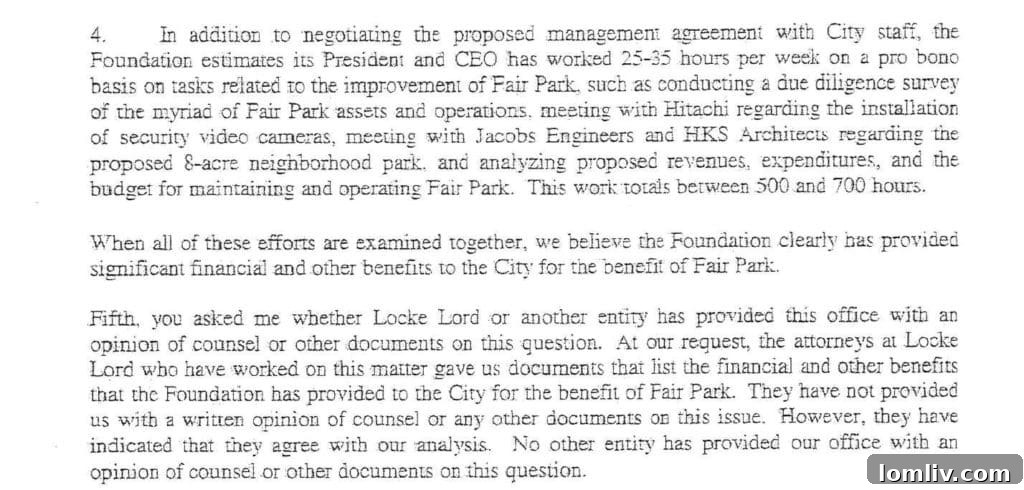
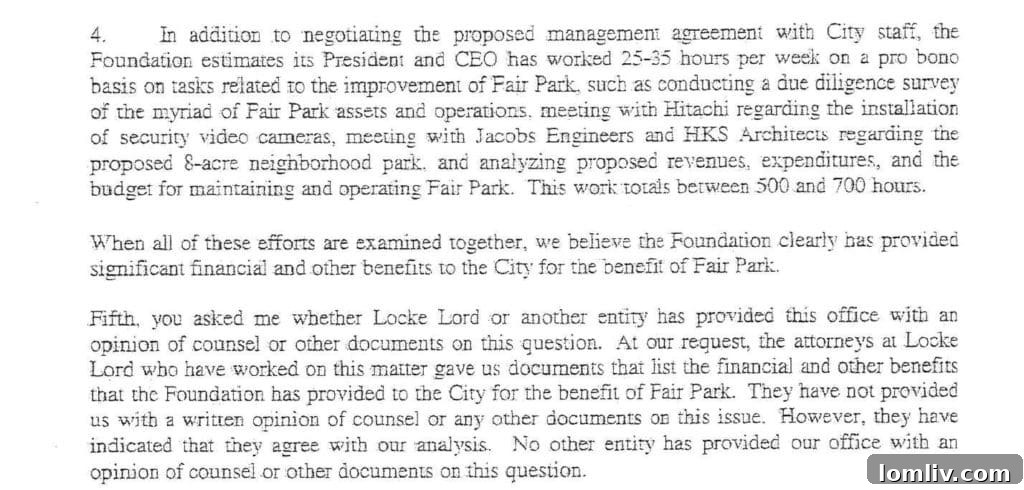
The argument posited was that Walt Humann’s estimated 500 to 700 hours of volunteer time and expertise—quantified in various project graphics—constituted these “management services provided” and served as a valid substitute for tangible financial contributions. In essence, the legal opinion suggested that Humann’s pro bono efforts, channeled through his foundation, fulfilled the “significant financial or other benefits” clause, thereby legalizing the bypass of competitive bids.
However, this specific interpretation has now become the subject of significant internal dissent within the City Attorney’s office. This growing internal friction strongly suggests that a different, potentially more rigorous, legal opinion may soon be forthcoming. The crux of the disagreement revolves around whether volunteer time, even extensive, without a fully established operational nonprofit providing concrete benefits, genuinely satisfies the statutory language. Some attorneys are reportedly keen to “test the legal waters,” believing that even if their interpretation of Section 252.001 is found to be flawed by a court, other legal avenues might still lead to a favorable ruling for the city. This willingness to engage in litigation, however, carries inherent risks of prolonged battles, substantial legal costs, and potential reputational damage.
Mayoral Legacy and the Perils of Protracted Litigation
The prospect of extended legal battles directly contradicts Mayor Rawlings’ expressed desire for a swift resolution. His declaration at the briefing that this was the “last chance” for Fair Park underscored the urgency he attached to the project. It is highly unlikely that his vision for the park’s revitalization included a scenario where the plan would be tied up in court for three to five years. Such delays would not only jeopardize the project’s timeline but also risk eroding public confidence and significantly impact the legacy he hopes to leave behind regarding Fair Park’s future.
The internal legal debate and the potential for a drawn-out court case highlight the critical juncture Dallas now faces. The path chosen—whether to uphold the current interpretation or to pivot towards competitive bidding—will have profound implications not just for Fair Park, but for the integrity of municipal contracting, the financial health of the city, and the long-term relationship between Dallas leadership and its citizens.
A New Path Forward: Bidding, Dialogue, and Concessions
Amidst this legal uncertainty, there are encouraging signs that a more transparent and equitable path may be emerging. Whispers suggest a genuine opportunity to reconsider the privatization plan and, crucially, open it up for competitive bids. This potential shift signals a willingness to embrace robust public processes and secure a truly “best value” outcome for Dallas.
Furthermore, the narrative portraying the State Fair of Texas as an unyielding entity ready to launch immediate legal action is also being critically re-evaluated. City Councilman Philip Kingston offers a notably different perspective, expressing that his recent, positive meetings with the State Fair of Texas board have led him to believe that suing the city would “not be their first choice at all.” This sentiment directly challenges the previously intimidating warnings and opens the door for a more constructive dialogue. Kingston goes further, framing this entire situation not as a predicament, but as a significant opportunity. Unlike the Mayor, he sees a chance to proactively rework the city’s existing agreement with the State Fair of Texas, advocating for meaningful concessions that would genuinely benefit both Fair Park and the wider city of Dallas. This forward-thinking approach prioritizes collaborative negotiation and mutual benefit over confrontation, aiming to establish a fairer and more sustainable partnership.
Fair Park: A Vital Dallas Real Estate Asset
At its core, the story of Fair Park is a compelling real estate narrative. We are discussing 277 acres of invaluable urban land, a monumental public asset within a thriving and expanding metropolitan area. The long-term lease agreements currently governing Fair Park, especially with the State Fair of Texas, are decades old and are undeniably due for comprehensive adjustments. These adjustments must transcend mere legal technicalities or political pressures. They must fundamentally aim to maximize the public value derived from this irreplaceable property, ensuring it serves the diverse needs and aspirations of all Dallas residents.
The convergence of new leadership in the City Attorney’s office, internal legal dissent, and a more conciliatory, proactive stance from key council members presents a critical opportunity. It is a chance to rectify past missteps, ensure transparency and fiscal responsibility, and forge a brighter, more sustainable future for Fair Park. The decisions made in the coming months will undoubtedly shape the legacy of current city leadership and determine the true, long-term potential of one of Dallas’ most cherished and historically significant landmarks.