

In today’s digitally-driven world, the landscape of real estate marketing has undergone a profound transformation. With the vast majority of potential homebuyers initiating their property searches online, and traditional print media steadily declining in relevance, real estate professionals have strategically shifted the bulk of their marketing endeavors to digital platforms. High-performing real estate agents and groups invariably feature prominent links to their social media profiles on their websites, typically encompassing Facebook, Instagram, LinkedIn, and Twitter, and increasingly, innovative platforms like TikTok.
Given this heavy reliance on social media for outreach and engagement, it was entirely understandable that a wave of apprehension swept through the real estate community when individuals managing Facebook Business Pages began receiving emails on September 30. These notifications heralded upcoming modifications to the way real estate listings could be marketed on Facebook, sparking immediate concern and, in many cases, outright panic among agents, brokers, and marketing professionals alike.
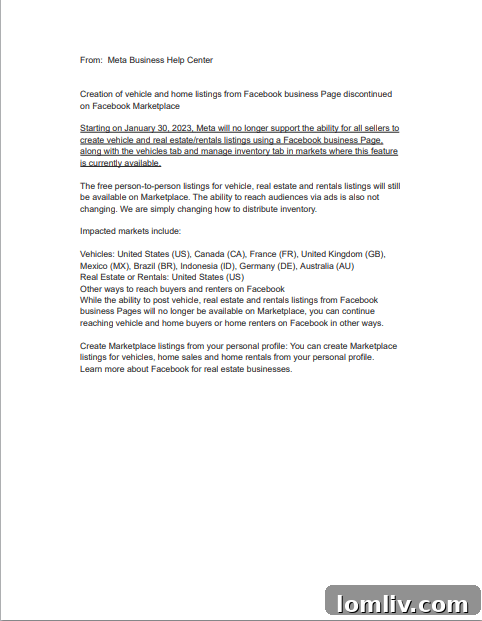
The pivotal email, dispatched from the Meta Business Help Center, delivered a clear directive: effective January 30, 2023, Facebook Business Pages would no longer be permitted to post either real estate or vehicle listings directly on Facebook Marketplace. This critical piece of information disseminated rapidly through various real estate channels, including broker meetings, MLS meetings, and professional networking groups. Unfortunately, the message was often misconstrued, leading a significant number of agents to incorrectly interpret it as a complete prohibition on posting any form of listing content on their Facebook pages.
Understanding the Facebook Business Pages Change for Real Estate Professionals
To cut through the confusion, it’s essential to clarify what this policy update truly signifies for Realtors. The change means that real estate agents, or any entity for that matter, will no longer be able to create and manage real estate property listings on Facebook Marketplace specifically *from* their Business Pages. This distinction is crucial. If listing properties directly on Marketplace was a sales strategy an agent utilized in the past – a practice that, in many regions, was uncommon for professional Realtors – they would now need to revert to using their *personal* Facebook Page for such postings. This strategic shift by Meta aims to uphold the original integrity of Marketplace as a platform primarily designed for peer-to-peer transactions between individuals, preventing larger businesses from dominating a space intended for direct consumer interaction.
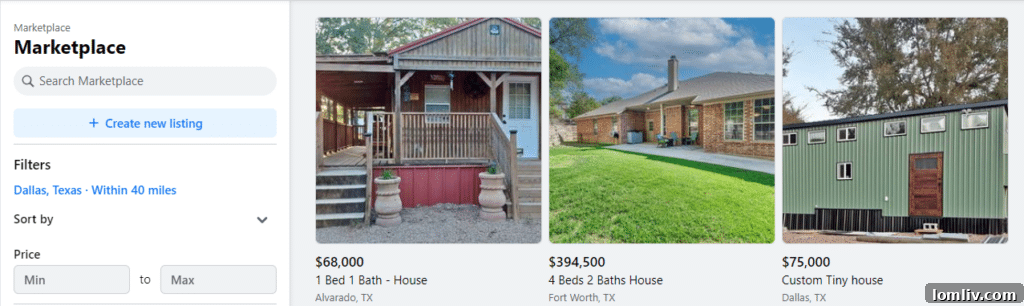
In essence, for the vast majority of real estate professionals, particularly those who primarily leverage their Business Pages for branding, community engagement, and promoting listings through standard posts, this modification should have negligible, if any, direct impact on their established marketing strategies. A quick review of Marketplace listings typically reveals a prevalence of For Sale By Owner (FSBO) properties and rental opportunities, underscoring its historical use by private individuals rather than commercial real estate entities.
My own experience as a freelance digital marketing professional serving the real estate sector provided a firsthand glimpse into this widespread misunderstanding. I first became aware of the mounting concern when a client, a prominent luxury agent in San Antonio, forwarded an urgent email from her broker titled, “URGENT! We can’t post listings on Facebook anymore???” Her brokerage had hastily called a meeting, and the collective sentiment among agents was one of absolute panic. I immediately assured her that the situation was not as dire as it appeared. However, it required several phone calls and supplementary clarification from authoritative bodies like the San Antonio Board of Realtors to successfully de-escalate the widespread anxiety and provide accurate information.
Even official communications from Realtor associations, while well-intentioned, occasionally contributed to the initial confusion. MetroTex, the influential Realtor association for Dallas-Fort Worth, issued a statement to its members about the changes. Yet, even their initial phrasing, while technically accurate, could easily mislead:
“Starting Jan. 30, 2023, you will no longer be able to create real estate sales and rental listings using your Facebook business page.”
This statement, though followed by clarifying details, presented an initial headline that, in my humble opinion, was prone to misinterpretation and necessitated a second read to fully grasp its implications. My attempts to get further comment from MetroTex went unanswered, as did my (admittedly hopeful) inquiries to Facebook directly.
Historical Context: Why Realtors Are Wary of Facebook Policy Shifts
The tendency for agents and marketers to react with alarm to new directives from Facebook is entirely understandable, especially considering past dramatic overhauls. A prime example is the significant alteration Facebook made to its real estate advertising rules in 2019. Prior to that, agents had become highly adept and confident in leveraging Facebook’s robust advertising tools to target listing and branding campaigns to remarkably specific and effective demographic segments. The subsequent removal of many of these granular targeting options, aimed at preventing discriminatory practices, forced a complete re-evaluation of ad strategies and left a lasting imprint of caution among real estate marketers.
“I’ve stopped using Facebook ads as a primary tool for that reason,” remarked Joanne Bryan of Coldwell Banker, highlighting the profound impact of past changes. Thus, the leap to assume that Facebook was now prohibiting Business Pages from posting *anything about* real estate listings wasn’t entirely far-fetched for many. However, such a policy would represent an enormous misstep by Meta, considering that showcasing properties is the almost exclusive, daily focus of an entire multi-billion-dollar industry.
Bryan further elaborated on the platform’s enduring value: “It is a good tool. I use it more for promoting my expertise, my services, than for trying to find a buyer for a specific listing. But to take that away would certainly negatively affect the business as a whole.”
Fortunately, the current changes are far less drastic and do not impede the fundamental ways most Realtors use the platform. Therefore, to dispel any lingering confusion or apprehension, let’s be absolutely clear:
You are absolutely permitted to continue posting images, sharing links, providing detailed descriptions, and disseminating any relevant information about your listings on your Facebook Business Page. The singular aspect affected by this upcoming policy change is your ability to create a dedicated property listing directly on Facebook Marketplace using your Business Page — a functionality that, for most professional Realtors, was rarely, if ever, utilized as a core marketing tactic.
Maximizing Your Facebook Business Page for Real Estate Marketing
Even with the Marketplace adjustment, your Facebook Business Page remains an invaluable asset for real estate marketing. It serves as a dynamic hub for establishing your personal brand, showcasing your expertise, and engaging with your target audience. You can continue to share captivating photos and virtual tours of new listings, announce open houses, post insightful market updates, highlight charming community features, share client testimonials, and even host live Q&A sessions. These activities are central to building trust and generating leads, and they are entirely unaffected by the new policy.
The key takeaway is to distinguish between a general promotional post on your Business Page – which informs and engages your audience about available properties – and a formal ‘listing’ within the Facebook Marketplace platform, which is designed for direct, often informal, transactions. Your Business Page is a powerful storytelling tool; continue to use it to tell the story of your properties, your services, and your unique value proposition in the real estate market.
Let us Know Your Thoughts
Did you receive the original email and experience initial panic? Does this specific change regarding Facebook Marketplace affect your current real estate marketing strategy? Do you typically list properties directly on Facebook Marketplace from your Business Page?
We invite you to share your experiences and perspectives in the comments section below.