

Dallas ISD Forges Future with Evolving ACE Program and New Choice Schools
The Dallas Independent School District (Dallas ISD) recently held a pivotal board of trustees meeting, marking a dynamic evening centered on two cornerstone initiatives: the strategic evolution of the highly successful Accelerating Campus Excellence (ACE) program and the critical expansion of innovative choice schools. These decisions underscore the district’s proactive approach to enhancing educational outcomes and addressing evolving demographic challenges, reaffirming its commitment to student success and community engagement.
The Transformative Power of the ACE Program: A Model for School Improvement
The Dallas ISD’s Accelerating Campus Excellence (ACE) program has garnered national attention for its profound impact on struggling schools. Launched as a bold intervention strategy, ACE has been instrumental in turning around numerous campuses previously designated as “Improvement Required” (IR) or those serving at-risk student populations. The program’s impressive results have not only revitalized these schools but have also inspired other districts, including Plano and Richardson, to adopt similar strategies.
“The ACE model is now being replicated in districts throughout the Dallas area,” explained Chief of School Leadership Stephanie Elizalde to the trustees. She highlighted the program’s significant achievements: “We’ve seen a dramatic reduction, going from 43 Improvement Required schools down to just 13.” This remarkable progress, she emphasized, is largely attributable to the foundational principles of the Dallas ISD ACE program and the complementary support from the district’s Intensive Support Network (ISN).
Evolving for Sustainability: Introducing ACE 3.0
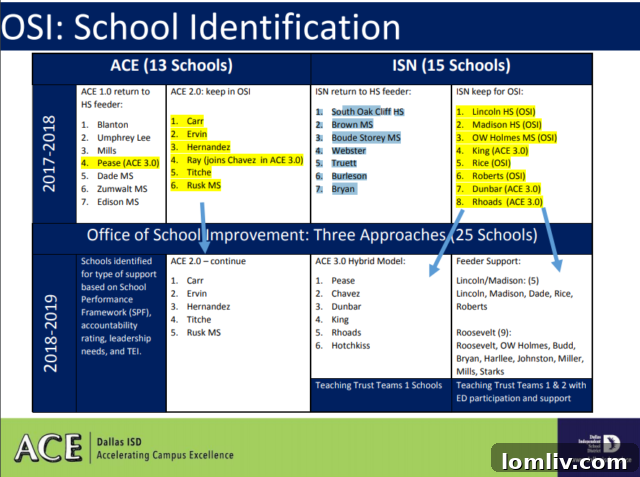
As the ACE program matures and continues to achieve its objectives, Dallas ISD leaders are focusing on long-term sustainability and optimizing resource allocation. Stephanie Elizalde and ACE executive director Jolee Healey presented the next phase of the program, branded as ACE 3.0. A key structural change involves the merger of the ISN and ACE initiatives into a unified Office of School Improvement, which Jolee Healey will lead starting the next academic year. This consolidation aims to streamline operations, enhance collaboration, and ensure a cohesive strategy for campus improvement across the district.
The district anticipates that as the number of IR campuses continues to decline, there will be a natural reduction in certain district-level staffing needs, reflecting the efficiency and effectiveness of these programs. Currently, ACE schools operate under their own distinct oversight, similar to how individual feeder patterns have dedicated executive directors. However, the success of some ACE campuses means they are ready for reintegration. Healey confirmed that many of the original ACE schools, with the exception of Pease Elementary, will rejoin their respective feeder patterns next year. Meanwhile, the ISN, historically a campus-specific program, will now pivot its focus to provide intensive supervision and additional supports to fragile feeder patterns, ensuring no school is left behind.
The revamped ACE 3.0 model promises enhanced support for newly designated ACE schools, including opportunities for extended school days tailored for students requiring additional interventions and closer administrative oversight. A paramount priority, Elizalde reassured the board, is addressing teacher staffing challenges by ensuring a highly qualified educator in every classroom. This commitment stems from the core philosophy of ACE.
“At the heart of ACE is the idea of equity, and distributing our resources equitably,” Elizalde passionately stated. “Our most important resource is our teachers.” This emphasis on equitable resource distribution, particularly in staffing, is central to the program’s ongoing success.
Strategic Retooling for Long-Term Viability
Acknowledging budget constraints and the imperative for efficiency, Dallas ISD is carefully retooling the ACE program to ensure its enduring viability. Elizalde candidly addressed the financial realities: “Along the way, we’ve learned some lessons – it’s expensive to do this.” She elaborated on the significant investment required for extensive training for ACE school teachers and administrators, as well as the resources needed for extended school days and other crucial activities. These elements, while vital for ACE’s impact, can create logistical and financial pressures.
Consequently, ACE 3.0 introduces a “hybrid” plan designed for greater sustainability. Healey explained that this revised model will not mandate an extended school day for all students but will instead strategically target additional supports for specific students identified as needing extra assistance. Furthermore, the stipend program, previously offered more broadly, will now be refined to primarily incentivize lead teachers and administrators. Elizalde asserted that by having “the right lead teachers at those schools,” a complete restaffing – which was a hallmark of the original ACE program – becomes less necessary, allowing for a more focused allocation of funds without compromising educational quality. Encouragingly, ACE schools have consistently demonstrated higher teacher retention rates compared to the district average, a testament to the program’s positive working environment and impact.
The schools included in this revamped hybrid model are Pease, Chavez (which will integrate students from current ACE school J.W. Ray next year), Dunbar, King, J.J. Rhoads, and Hotchkiss elementaries. These campuses are poised to benefit from the refined, targeted support of ACE 3.0.
While trustees universally praised the ACE program’s undeniable successes, a sense of regret was voiced regarding the necessity of budget-driven modifications. Board President Dan Micciche lauded the achievements, describing the gains made by ACE schools as “just astonishing.” He remarked, “This program has been so successful in its current form. I’m regretful that it has to be modified because of budgetary reasons.”
Superintendent Michael Hinojosa expressed pride in the program’s adoption by suburban districts, emphasizing that ACE’s benefits extend beyond academic metrics. “What people often don’t say is that these phenomenal gains also translate to better behavior,” Hinojosa noted. Data consistently show that ACE schools experience fewer disciplinary issues due to increased student engagement and a heightened focus on social and emotional learning, fostering a more positive and productive school environment.
Strategic Expansion of Choice Schools to Combat Enrollment Declines
The Dallas ISD board meeting culminated with intense discussion surrounding two critical agenda items: the pressing issue of declining student enrollment and the district’s bold strategy to create additional choice schools. Demographic projections indicate a potential loss of nearly 2,000 students in the coming year, attributed to the increasing presence of charter school operators and a declining birth rate within the district’s boundaries. In response, district officials are determined to accelerate the creation of more diverse and appealing choice school options.
Superintendent Hinojosa revealed that previous decisions to establish choice schools for the upcoming year had already generated an overwhelming number of applications. This robust demand signaled a clear path forward, prompting staff to actively explore innovative ways to serve communities with persistently low-enrollment schools. The board’s recent vote solidified this direction, approving the consolidation of Sam Houston and Onesimo Hernandez elementaries with nearby Medrano and Maple Lawn elementaries, respectively. More significantly, the board also approved the creation of new specialized programs within these consolidated structures. Onesimo Hernandez Elementary will transition to Maple Lawn and be transformed into a Montessori elementary school, while Sam Houston Elementary will become a personalized learning school, offering bespoke educational pathways for its students.
Initially, these new programs will cater to students from pre-kindergarten through second grade. Current third through fifth graders at both Sam Houston and Hernandez will be permitted to remain at their respective campuses until they naturally progress to middle school. This strategic move leverages existing infrastructure in areas previously underserved by choice schools, offering highly popular Montessori and personalized learning programs to communities that lacked such options. The original Sam Houston and Hernandez schools both faced significant enrollment challenges, collectively serving only about 500 students, making consolidation and transformation a pragmatic solution.
Navigating Board Concerns and Future Projections
The discussion surrounding the new choice schools was not without spirited debate. Trustee Audrey Pinkerton questioned the district’s ability to simultaneously project a loss of 2,000 students while confidently predicting record enrollment for two new choice schools. “To make this investment, we have to be highly confident now,” she asserted, pressing Superintendent Hinojosa for a more concrete guarantee of enrollment figures.
Hinojosa, while not providing a specific number that evening, appealed to the board for a vote of confidence in the district’s strategic vision. “What we are asking for is a vote of support for the Dallas Independent School District,” he stated, emphasizing the necessity of bold action.
Trustee Edwin Flores passionately advocated for residents in the Oak Lawn and Love Field communities, arguing that they deserve the same diverse educational opportunities available to students in his district. “I can tell you that families are moving into District 1 so they can attend District 1 schools,” he explained, citing the extensive range of programs, including Spanish immersion, offered in his North Dallas area. Flores underscored the critical need to expand these educational innovations to other areas of the city.
“We do need to make the investment in the district,” Flores insisted. “We have to, or else we can just throw up our hands and say, ‘oh, let the charters have them.'” He acknowledged the initial costs associated with launching these revamped schools but stressed the palpable community interest and demand. “It’s right for the community and right for the kids,” he maintained, highlighting that communities like Hernandez, in particular, have been historically underserved when it comes to choice options. “There are no options currently in that part of town,” he pointed out. “We’re saying, ‘You know what, we’re FINALLY going to bring some good stuff to this community.’”
Board President Micciche echoed the sentiment, recognizing the administrative team’s commitment: “Both of these schools have had serious declines in enrollment. The administration has come up with a good plan to demonstrate a real commitment to this community.” When pressed by the board, Elizalde provided a projection of 1,400 potential new students, clarifying that this estimate was for students not currently enrolled in Dallas ISD schools, indicating a strategy to attract families back to the district.
Trustee Joyce Foreman repeatedly raised concerns about the district deviating from its original plan of introducing one new choice school per year. Elizalde explained that the accelerating rate of enrollment decline necessitated a more aggressive pivot from the initial plan. “If we continue to do nothing, we are going to continue to get the same result,” Hinojosa cautioned the board, emphasizing the urgency of these new initiatives.
A Broader Context for Enrollment Challenges
Earlier in the meeting, Superintendent Hinojosa provided crucial context, revealing that Dallas ISD’s enrollment declines are not isolated incidents. Other urban districts nationwide are grappling with similar challenges. He cited data from the Texas Urban Council of Superintendents, noting that seven out of its nine member urban districts experienced a loss of over 1,000 students between October 2016 and October 2017. Even some suburban districts, traditionally seen as growth areas, are feeling the pinch. “Arlington lost 1,000, and Plano lost 600,” Hinojosa highlighted, illustrating the widespread nature of the issue.
“Hope is not a strategy,” Hinojosa declared, reinforcing the district’s proactive stance. While he may not share Elizalde’s precise certainty of gaining 1,400 new students from these specific choice schools, he is unequivocally confident that the staff’s overarching strategy of creating diverse and high-quality choice options is the most effective way to stem the exodus of students and attract new families to the Dallas Independent School District. These strategic investments in both evolving successful programs like ACE and expanding innovative choice schools reflect Dallas ISD’s unwavering dedication to providing exceptional educational opportunities and securing a vibrant future for all its students.