Finding Your Ideal Home: A Deep Dive into Dallas-Fort Worth’s Top Upscale Suburbs
The Dallas-Fort Worth (DFW) metroplex continues to cement its reputation as one of the most dynamic and sought-after metropolitan regions in the United States. Over the past decade, DFW has experienced an astounding influx of more than 1.2 million new residents, transforming its urban and suburban landscapes. This remarkable growth is fueled by a robust job market, diverse cultural offerings, and a high quality of life. Within this sprawling economic powerhouse, a select group of Dallas suburbs consistently rank among the best places to live, not only in Texas but across the entire nation. These premier communities have become magnets for high-income households, thriving businesses, and major corporate headquarters seeking an advantageous environment.
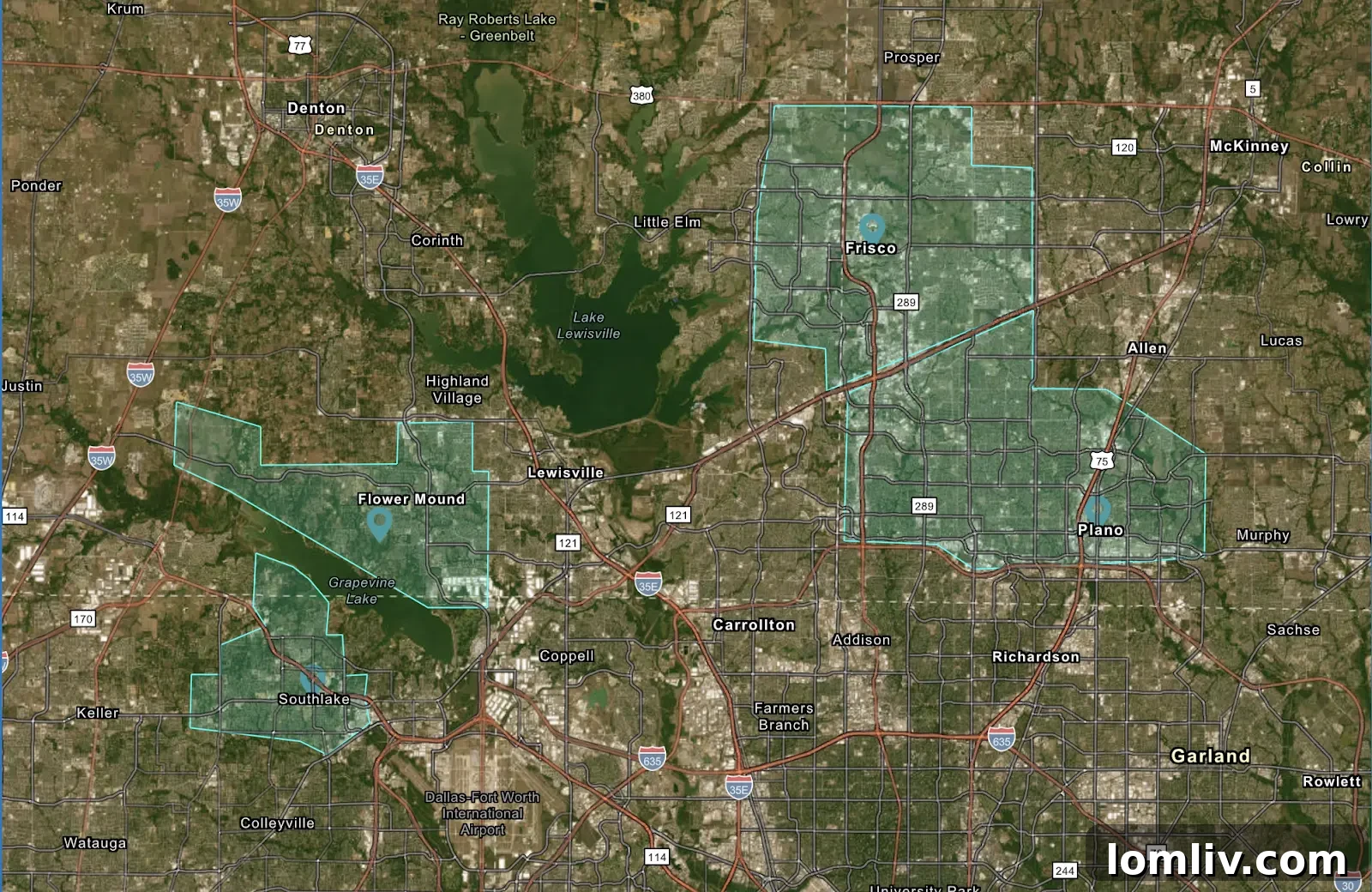
While some of DFW’s most exclusive enclaves may now be perceived as prohibitively expensive or experiencing slower growth, other distinguished suburbs remain highly accessible to upper-middle-class families and are currently undergoing significant expansion and development. This comprehensive guide will shine a spotlight on four such flourishing upscale Dallas suburbs: Flower Mound, Frisco, Plano, and Southlake. These areas represent the pinnacle of suburban living in North Texas, each offering unique advantages and a superior lifestyle.
Our objective is to provide an impartial, data-driven comparison of these four exceptional communities. We will analyze crucial metrics ranging from demographics, housing market trends, and crime rates to educational excellence, political landscapes, and potential property value appreciation. Our goal is to empower you with the insights needed to determine which of these suburbs best aligns with your lifestyle, priorities, and long-term aspirations. To conclude, we will declare an overall winner, weighing both desirability and value for money, offering a definitive guide for those considering a move to the DFW area.
All data and comprehensive analyses presented in this article were meticulously compiled and provided by Maptimum, a premier online tool specializing in neighborhood evaluation. For an in-depth interactive report, you can explore the detailed comparison at Maptimum’s dedicated page.
For those eager for a quick summary, here’s a snapshot of our findings: all four areas offer an exceptionally high quality of life, making the choice incredibly nuanced. However, Southlake emerges as the overall winner in terms of pure desirability, albeit by a narrow margin. When considering value for money, Frisco and Flower Mound stand out, again, with a slight edge over the competition. These nuanced differences highlight the importance of understanding the specifics of each community before making a decision.
At a Glance: Dallas Suburb Comparison Table
Below is a summary table showcasing key variables across Flower Mound, Frisco, Plano, and Southlake, offering a quick comparison of their distinguishing characteristics:
| Variable | Flower Mound | Frisco | Plano | Southlake |
|---|---|---|---|---|
| Population Density | Moderate | Highest | High | Lowest |
| Population Growth | Steady | Highest | Steady | Lowest |
| Median Age | Younger | Lowest | Middle | Highest |
| Racial Diversity | Moderate | Most Diverse | Most Diverse | Least Diverse |
| Educational Attainment | High | High | Lowest (among these four) | Highest |
| Owner-Occupied Homes | High | High | Lowest (among these four) | Highest |
| Age of Buildings | Newer | Newest | Oldest | Older |
| Low-Income Housing | None | Significant | Significant | None |
| Land Cover | Most Agricultural | Developing | Most Developed | Developed |
| Crime Rate | Lowest | Low | Moderate (among these four) | Low |
| Fatal Car Accidents | Low | Low | Highest | Lowest |
| Registered Sex Offenders | Most (among these four) | Moderate | High | Least |
| Political Orientation | Conservative | Moderate | Most Liberal | Most Conservative |
| Desirability Score | High | High | Lower | Highest |
| Bang for the Buck Score | Best | Best | Good | Worst (among these four) |
Fun Facts & Unique Charms of Each Suburb
Before we delve into the detailed analysis, let’s explore some captivating facts that highlight the unique character and appeal of these dynamic suburbs:
- Flower Mound: This charming town derives its distinctive name from a picturesque 12.5-acre natural mound, renowned for its vibrant display of wildflowers. This landmark has been meticulously preserved, serving as a powerful symbol of the community’s profound commitment to nature and green spaces. Residents enjoy a harmonious blend of suburban comfort and natural beauty, making it an attractive option for those seeking tranquility.
- Frisco: A true hub for sports enthusiasts, Frisco proudly hosts The Star, the iconic headquarters and state-of-the-art training facility of the legendary Dallas Cowboys. This impressive complex is not merely a sports venue but a vibrant entertainment district, drawing thousands of visitors and offering a diverse array of dining, shopping, and entertainment options. Frisco’s rapid growth is inextricably linked to its modern amenities and dynamic atmosphere.
- Plano: As a significant economic engine of North Texas, Plano is home to the corporate headquarters of numerous multinational corporations, including major players like Toyota North America, Frito-Lay, and J.C. Penney. This concentration of major employers establishes Plano as a robust employment hub, offering abundant career opportunities and attracting a highly skilled workforce, contributing to its bustling urban-suburban feel.
- Southlake: This affluent community is famously known for its annual Oktoberfest celebration, a highly anticipated event that draws tens of thousands of visitors from across the region. The festival is a lively showcase of vibrant party scenes, delectable food, authentic German beverages, and a wide range of entertainment activities, embodying Southlake’s sophisticated yet community-oriented spirit.
Demographics: Understanding the Community Fabric
The demographic makeup of a region provides profound insights into its character and future trajectory. Let’s meticulously compare these four suburbs across various demographic dimensions, painting a clear picture of their populations:
- Population Density: Population density profoundly impacts daily life, influencing everything from traffic to access to amenities and the overall community feel.
- Frisco: Stands out as the densest of the four, with approximately 3,500 persons per square mile. This higher density often translates to a more urbanized feel, with a greater concentration of businesses, restaurants, and entertainment venues, catering to a bustling lifestyle.
- Southlake: In stark contrast, Southlake is the least dense, boasting roughly 1,400 persons per square mile. This lower density offers residents more expansive properties, a quieter environment, and a stronger sense of privacy, appealing to those who prefer a more tranquil setting.
- Population Growth: Growth rates are key indicators of a suburb’s vitality and future development. Rapid growth often brings new amenities and opportunities but can also strain infrastructure.
- Frisco: Continues its impressive trajectory, with an anticipated growth rate of about 15% over the next five years. This sustained growth points to its ongoing appeal as a destination for families and businesses, driving new construction and economic expansion.
- Flower Mound, Plano, and Southlake: Exhibit more moderate, yet still healthy, population growth rates. While not as explosive as Frisco’s, their steady expansion ensures continued development and a stable community environment without the intense pressures of hyper-growth.
- Median Age: The median age is a telling statistic, revealing the generational makeup of a community and often correlating with lifestyle and priorities.
- Frisco: Boasts the youngest population, with a median age of 36.6 years. This younger demographic typically translates into a vibrant, family-centric atmosphere, with a demand for parks, youth sports, and modern entertainment.
- Southlake: Features the oldest population, with a median age of 43 years. This suggests a more established community, potentially attracting empty-nesters or families seeking a stable environment with excellent schools and refined amenities.
- Racial Diversity: Diversity enriches a community with varied perspectives, cultures, and culinary experiences.
- Southlake: Exhibits the highest proportion of non-Hispanic whites, at 65%. While still diverse, it is comparatively less heterogeneous than its counterparts, reflecting a more uniform cultural landscape.
- Frisco and Plano: Stand out as the most racially diverse suburbs. Both feature substantial Asian, Hispanic, and African-American populations, contributing to a rich tapestry of cultures, languages, and traditions that foster a cosmopolitan atmosphere.
- Educational Attainment: High educational attainment often correlates with higher-income households, strong school systems, and a community that values intellectual growth.
- Southlake: Leads significantly, with nearly 80% of its residents holding a college degree or higher. This exceptional level of education underscores a highly skilled workforce and a strong emphasis on academic achievement within the community.
- Plano: While still impressive, ranks lowest among these four, with approximately 60% of residents possessing a college degree or higher. This figure remains well above the national average, indicating a highly educated population capable of supporting its numerous corporate headquarters.
Housing and Development: A Look at the Real Estate Landscape
The housing market is a crucial determinant for potential residents, reflecting both investment potential and lifestyle quality. Let’s examine the key housing and development statistics across these elite suburbs:
Occupancy Rates: The proportion of owner-occupied versus renter-occupied homes provides insights into community stability and upkeep. High owner-occupancy often indicates a greater vested interest in neighborhood maintenance and property values.
- In Southlake, an impressive 90% of homes are owner-occupied. This high rate is generally viewed as a positive indicator, as homeowners tend to invest more effort and resources into maintaining their properties and contributing to the overall appeal and stability of the community.
- Plano, in contrast, sees about 40% of its homes occupied by renters. While still a thriving community, this higher renter ratio means Plano might trend towards becoming one of the DFW suburbs with a renter majority in the coming years. This can sometimes lead to different dynamics in terms of community engagement and property maintenance compared to predominantly owner-occupied areas.
Age of Buildings: The median age of homes provides a snapshot of a suburb’s development history and architectural style. Newer homes often feature modern designs and amenities, while older homes may offer more character and established landscapes.
- Unsurprisingly, Frisco boasts the youngest housing stock, with the median home constructed in 2007. This reflects its rapid and ongoing development, offering residents access to contemporary designs and state-of-the-art facilities.
- Plano, as a more established suburb, has the oldest median building age, with homes typically built around 1992. This signifies a more mature community with well-developed infrastructure and often larger, more established trees and landscaping.
Low-Income Housing: The presence and distribution of low-income housing options can indicate a suburb’s socio-economic inclusivity and housing strategy.
- Southlake and Flower Mound: Maintain an exclusive profile with no significant low-income housing properties, such as public housing or Section 8 units. This contributes to their perception as highly affluent and uniform communities.
- Plano and Frisco: Each feature a notable presence of low-income housing, with approximately four such properties in each suburb, accounting for around 100 housing units per property. This demonstrates a more varied housing landscape, providing options across a broader economic spectrum.
Land Cover: Land cover statistics illustrate the environmental and developmental patterns of each area, revealing the balance between urbanized spaces and natural environments.
- The most distinct pattern in land cover among the four areas is observed in Frisco, which still retains a considerable amount of agricultural land, roughly 25%. This signifies ongoing development and potential for future expansion.
- Plano, conversely, has the highest proportion of developed land, encompassing almost 75% for either residential or commercial use. This highlights its mature urban-suburban environment and robust infrastructure.
Crime and Safety: Prioritizing Peace of Mind
Safety is a paramount concern for families and individuals alike when choosing a place to live. It’s reassuring to note that all four suburbs boast significantly lower crime rates than the national average, affirming their status as desirable, secure communities within the DFW metroplex. However, nuances exist within these already safe environments.
- Flower Mound: Takes the lead with the lowest overall crime rate, registering a total index of 34, which is approximately one-third of the national average. This outstanding performance makes Flower Mound an exceptionally safe haven, offering residents unparalleled peace of mind.
- Plano: While still safer than most of the nation, ranks fourth among these four elite suburbs with a crime index of 70, roughly two-thirds of the national average for most crimes. This indicates a relatively higher, though still very manageable, crime rate compared to its immediate peers, possibly due to its larger population and more commercial activity.
Car Accidents: An Indicator of Road Safety and Driver Behavior
The frequency and severity of car accidents can be a subtle yet crucial indicator of road safety, traffic management, and the prevailing culture of responsible driving within a community.
- In the most recent data available (2019-2022), Southlake reported the fewest fatal car accidents, with only 3 incidents. This low figure speaks volumes about its well-maintained roads, less congested traffic, and potentially a more cautious driving population, contributing to safer commutes.
- Plano: Recorded the highest number of fatal car accidents, with 44 incidents during the same period, including a significant one-third involving DUI. Even when adjusting for its larger size and population, this represents a substantial difference compared to the other suburbs, suggesting areas for improvement in traffic safety and driver awareness.
Registered Sex Offenders: A Critical Safety Metric
For families, the presence of registered sex offenders is a particularly sensitive safety metric, influencing decisions about community choice and child safety.
- Once again, Southlake stands out positively, reporting only 1 registered sex offender at the time of this writing. This exceptionally low number reinforces its image as an extremely secure environment for families.
- Plano: Has the highest number among the four, with 109 registered sex offenders, translating to almost 2 per square mile. While safety measures are in place, this density is a factor for residents to consider when assessing local safety profiles.
Schools: The Cornerstone of Family Life
For families with children, the quality of local schools is often the single most important factor in choosing a residential area. All four of these Dallas suburbs are renowned for their top-rated school districts, offering excellent educational opportunities that attract families seeking the best for their children.
- Southlake: Is served by the highly acclaimed Carroll Independent School District (ISD), which consistently ranks as the number one school district in all of Texas. This stellar reputation unequivocally places Southlake at the pinnacle of this category, making it a dream destination for parents prioritizing elite education. Its schools are known for exceptional academic performance, robust extracurricular programs, and state-of-the-art facilities.
- Frisco: Its ISD comes in a commendable second place to Carroll, yet still holds an impressive ranking in the 95th percentile statewide. Frisco ISD is celebrated for its innovative approaches to education, diverse course offerings, and rapid growth that matches its burgeoning population. Its commitment to excellence ensures students receive a high-quality education in a dynamic learning environment.
- Plano and Flower Mound: Are served by Plano ISD and Lewisville ISD, respectively. These districts rank respectably in the 88th and 66th percentiles statewide. While not reaching the very top tier of Carroll or Frisco, both Plano and Lewisville ISDs offer strong academic programs, dedicated educators, and a wide array of opportunities for student success, maintaining a high standard of public education.
It is also noteworthy that all these areas provide access to a selection of exceptional charter and private schools, offering alternative educational pathways and specialized learning environments for families who prefer them.
Environment: Air Quality, Natural Risks, and Green Spaces
Environmental factors play an increasingly vital role in residential choices, impacting health, outdoor activities, and long-term livability. Understanding these aspects helps residents assess the natural challenges and amenities of each suburb.
Air Quality: Generally, the air quality across all four suburbs is considered good. However, residents should be aware that during the summer months, there is a common pattern of worsening air quality due to higher ozone levels. This is a regional phenomenon characteristic of the DFW metroplex, which can occasionally affect outdoor activities for sensitive individuals.
Natural Risks: While the DFW area is not typically associated with major geological hazards, it’s essential to understand specific risks:
- All four areas face almost zero risk of earthquakes, offering geological stability that provides peace of mind for residents.
- However, they all include high-risk flood zones, particularly in areas adjacent to rivers and lakes. This is a crucial consideration for property buyers, necessitating proper insurance and awareness of local flood maps. Despite these zones, broader flood risks are generally well-managed through municipal planning.
Walkability: Navigating Your Community on Foot
Walkability is a growing priority for many homebuyers, influencing lifestyle, convenience, and a community’s environmental footprint. A walkable community offers residents the ability to access amenities, services, and recreational opportunities without relying solely on a car.
- Plano and Frisco: Stand out as the most walkable among the four. Their urban planning has increasingly focused on creating mixed-use developments, accessible commercial centers, and interconnected pedestrian pathways. This design philosophy supports a more active lifestyle, reduces reliance on vehicles, and fosters a stronger sense of community as residents can easily stroll to shops, restaurants, and parks.
- Flower Mound: In contrast, is characterized by its more suburban, spread-out design, making it the most car-dependent. While offering beautiful natural spaces and larger lots, daily errands and commuting typically require a vehicle. This caters to residents who prioritize spacious living and tranquility over pedestrian access to amenities.
Politics: Community Values and Voter Alignments
The political orientation of a community can often reflect its prevailing values, priorities, and socio-cultural landscape, influencing local governance and community discourse. Understanding these leanings can help individuals find a community that aligns with their personal beliefs.
- Southlake: Is notably the most conservative area among the four. In the 2020 presidential election, almost 62% of its residents voted for Donald Trump. This strong conservative bent often translates into policies emphasizing individual liberty, lower taxes, and a traditional approach to community management.
- Plano: Presents a contrasting political landscape, being the most liberal suburb. Almost 55% of its voters supported Joe Biden in the 2020 election. This liberal leaning often fosters a more progressive approach to social issues, environmental policies, and urban development, reflecting its diverse population.
- Frisco: Demonstrates a remarkable political moderation, with each presidential candidate in 2020 receiving approximately 49% of the votes. This nearly even split suggests a politically balanced community, where a wider range of perspectives may coexist, leading to more centrist local policies and a potentially more diverse civic dialogue.
Affordability and Appreciation Forecasts: An Investor’s Perspective
Beyond lifestyle factors, the financial aspects of homeownership—initial cost and future value appreciation—are critical for both homebuyers and investors. The real estate markets in these DFW suburbs exhibit distinct characteristics in terms of current pricing and growth projections.
- Current Median Home Costs:
- At present, Southlake commands the highest housing prices, with a median home cost hovering around $750,000. This reflects its exclusivity, top-tier schools, and luxurious amenities.
- Plano offers the most accessible entry point into this group of upscale suburbs, with a median home price of approximately $480,000. This relative affordability, combined with its robust economy and amenities, makes it an attractive option for a wider range of buyers.
- Price Appreciation Forecasts (Next 5 Years): Future appreciation rates are vital for understanding the long-term investment potential of a property.
- Flower Mound and Plano: Are projected to experience the steepest increases in property values over the next five years, with anticipated appreciation rates of approximately 8% and 7%, respectively. This strong growth potential makes them particularly appealing for those looking for significant equity gains.
- Frisco and Southlake: Are expected to have more modest, yet still healthy, appreciation rates of 4% and 5%, respectively. While their growth might not be as rapid, their established desirability and high property values ensure a stable and consistent return on investment.
Overall Winner: Desirability vs. Value for Money
To provide a comprehensive conclusion, Maptimum employs two distinct scoring metrics: the Desirability Score and the Bang for the Buck Score. These scores offer valuable perspectives on each suburb’s overall appeal and financial prudence.
The **Desirability Score** quantifies how closely a suburb’s features align with those of an ideal, flawless community. A score closer to 100 signifies greater perfection across various non-financial criteria. This score allows us to evaluate the pure quality of life and amenity offerings, independent of price.
The four areas score remarkably closely, underscoring their exceptional quality:
- Southlake: 72.03/100
- Frisco: 71.93/100
- Flower Mound: 67.35/100
- Plano: 63.08/100
Based on desirability alone, Southlake emerges as the marginal winner, a testament to its unparalleled schools, safety, and affluent environment.
The **Bang for the Buck Score**, conversely, assesses the value residents receive from an area relative to its price. This metric is crucial for those balancing quality of life with financial investment.
Again, the scores are incredibly close, highlighting the strong value propositions across these suburbs:
- Flower Mound: 69/100
- Frisco: 69/100
- Plano: 68/100
- Southlake: 63/100
In this category, Frisco and Flower Mound share the top honors, demonstrating that they offer an outstanding quality of life at a more accessible price point compared to Southlake.
In conclusion, the data analysis unequivocally confirms that these four Dallas suburbs—Flower Mound, Frisco, Plano, and Southlake—each provide their residents with an outstanding quality of life. Southlake, being the most expensive, predictably performed marginally better in most desirability categories, reinforcing its reputation as a premium residential destination. However, when considering the crucial aspect of value for money, Frisco and Flower Mound shine, offering an exceptional blend of amenities and affordability. Plano, while a strong contender, often ranks slightly below the other three, perhaps due to its more commercial orientation and established infrastructure which differentiates it from the predominantly residential oases of its peers.
It is important to remember that these statistics and analyses pertain to entire suburbs, which are often quite extensive. Therefore, specific neighborhoods or micro-areas within each suburb may exhibit variations in features, local vibe, and property dynamics. For a highly personalized and precise assessment, we strongly recommend utilizing Maptimum’s comprehensive tools to request a detailed neighborhood analysis for an exact address. This ensures that the smaller, specific area you are considering truly aligns with your unique needs and preferences, helping you make the most informed decision for your next home.