Navigating the Shifting Tides: A Deep Dive into the North Texas Real Estate Market in Late 2021
The North Texas real estate market, a vibrant and often frenetic hub of activity, began to show definitive signs of transformation towards the end of 2021. For many months, the region experienced unprecedented demand, leading to rapid price escalation, fierce bidding wars, and a scarcity of available homes. However, expert analysis from Dr. Luis Torres, a distinguished research economist at the Texas Real Estate Research Center at Texas A&M University, signaled a pivotal shift: the era of unchecked “frenzy” appears to be drawing to a close, making way for a more sustainable growth trajectory.
Dr. Torres’s observations, grounded in a meticulous examination of key market indicators, point towards a tempering of the previously explosive growth rates. “Both housing sales growth and housing price growth have peaked and are slowing,” Torres affirmed in a recent news release. This pronouncement carries significant weight, offering a beacon of insight for buyers, sellers, and investors alike who are trying to make sense of the market’s evolving landscape. The research also highlighted another crucial development: “In addition, months of inventory, listings, and days on market have reached a trough and are beginning to rise.” This subtle yet powerful change suggests a gradual easing of the intense competitive pressures that defined the market for so long.
Beyond the Boom: Understanding the Market’s New Rhythm
For many North Texas residents, the daily ritual of checking Zillow for updated home valuations became a common pastime during the peak of the market surge. The question now arises: is it time to dial back that eager anticipation? Possibly. While the North Texas housing market is undeniably transitioning, it’s not experiencing a collapse; rather, it’s recalibrating. Dr. Torres outlined several persistent factors that continue to underpin strong demand, preventing any dramatic downturn. These include historically depressed mortgage rates, a continued societal preference for homeownership, the gradual lessening of the pandemic’s direct impact on homebuyers’ immediate decisions, the influence of federal government transfer payments, and the ongoing suspension of student loan debt payments. These elements collectively inject significant purchasing power and confidence into the market, keeping the buyer pool robust. As supply slowly catches up to this sustained demand, home sales in Texas are expected to maintain healthy volumes, albeit at a more measured pace.
The transition from a “frenzy” implies a departure from unsustainable speculative growth towards more pragmatic, long-term sustainable rates. This shift is generally healthier for the market as a whole, fostering stability and reducing the risk of bubbles. For both buyers and sellers in DFW and beyond, this means a more predictable environment. The Texas Real Estate Research Center’s forecasts for both 2021 and 2022 corroborated this outlook, anticipating continued strong demand, a gradual improvement in housing inventories, moderate yet consistent price growth, and a slow, anticipated rise in mortgage rates. These predictions paint a picture of a Texas real estate market that, while cooling from its white-hot intensity, remains fundamentally robust and attractive for long-term investment.
The Influence of Expert Insight: Why Dr. Torres’s Words Matter for Texas Housing Trends
The insights offered by Dr. Luis Torres are not merely academic observations; they carry substantial practical weight within the real estate community, often likened to the influence exerted by a Federal Reserve chairman on economic policy. This is because his analyses are rooted in comprehensive research and data, providing an objective view of complex market dynamics. And, as subsequent data began to confirm, his assessment was indeed prescient. In North Texas, the early signs of this shift became evident in October 2021, which marked the fifth consecutive month of year-over-year declines in home sales. While sales volume remained high compared to historical norms, the deceleration in growth highlighted a clear inflection point in the market’s trajectory, signaling a change in North Texas housing market trends.
Delving into the Data: North Texas and Statewide Performance in Q3 2021
To fully grasp the nuances of this market shift, it’s crucial to examine the specific data points from the third quarter of 2021. The joint report by the Texas Real Estate Research Center and Texas Realtors provided a comprehensive snapshot of the housing health across the state. While Dr. Torres’s forward-looking statements hinted at an impending slowdown, the Q3 data still reflected the strong momentum of the preceding period, showcasing the complexity of market transitions and the continued strength of Texas housing market statistics.
The Dallas-Fort Worth-Arlington Market: A Closer Look at DFW Real Estate
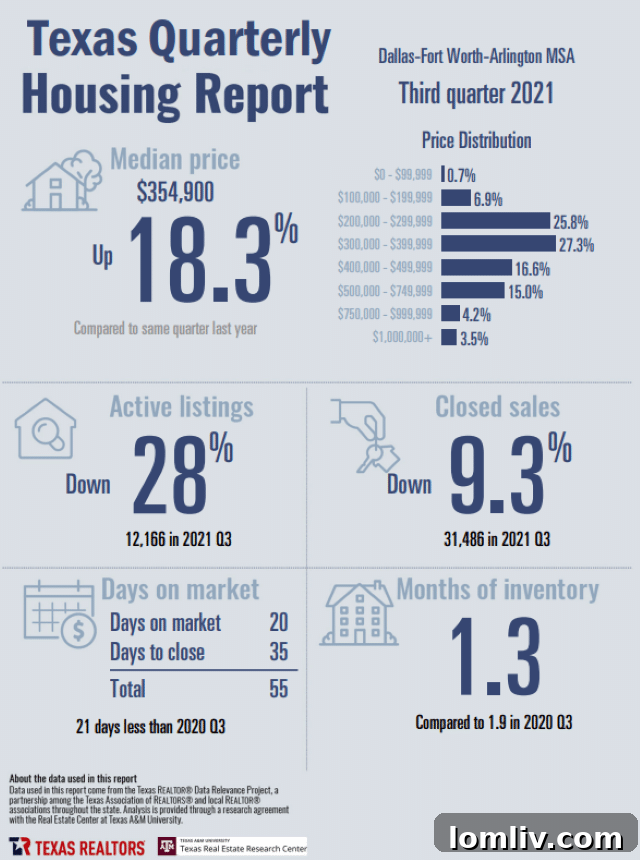
The Dallas-Fort Worth-Arlington metropolitan area, a powerhouse within the North Texas region, continued to demonstrate significant appreciation. In Q3 2021, the median home price in DFW reached an impressive $354,900. This figure represented a substantial 18.3 percent increase compared to the same quarter in the previous year (Q3 2020). Such a robust year-over-year increase underscored the sustained demand and limited supply that characterized much of 2021 within the DFW real estate market.
However, beneath the surface of rising prices, other indicators revealed the emerging shifts:
- Active Listings: The number of active listings in DFW saw a significant decline, down 28 percent compared to Q3 2020. This persistent shortage of homes available for sale was a primary driver of price increases and competition, creating a challenging environment for DFW homebuyers.
- Closed Sales: While still high in absolute terms, closed sales experienced a 9.3 percent decrease when compared to the third quarter of 2020. This decline was an early signal of the market’s deceleration, indicating that fewer transactions were being completed year-over-year, reflecting changing home sales North Texas dynamics.
- Months of Inventory: Perhaps the most critical metric for understanding market balance, months of inventory stood at a remarkably low 1.3 months in Q3 2021. Although an improvement from the absolute trough in some areas, this was still a decrease from 1.9 months in Q3 2020, highlighting the severe imbalance between supply and demand. A balanced market typically has 6-6.5 months of inventory, illustrating just how competitive the DFW real estate market remained for buyers seeking options.
Despite these challenges in inventory, North Texas demonstrated its sheer volume, with real estate agents successfully selling an impressive 31,486 single-family homes in the third quarter alone. This made North Texas the most active market in the state, a testament to its economic vitality and continued appeal as a destination for new residents and businesses, cementing its status as a key player in the Texas housing market.
Statewide Trends: Mirroring North Texas’s Dynamics and Texas Housing Market Overview
The broader Texas housing market largely mirrored the trends observed in North Texas, albeit with slightly different magnitudes, offering a comprehensive Texas housing market overview:
- Median Price: Across the entire state, the median home price rose to $310,000, marking a substantial 16.9 percent increase year-over-year. This widespread appreciation underscored the strength of the Texas economy and its attractiveness to relocating individuals and families seeking new opportunities.
- Active Listings: Statewide active listings were down 18.2 percent, indicating a persistent supply crunch that affected all major metropolitan areas, making Texas housing inventory a critical factor for market participants.
- Closed Sales: Total closed sales across Texas saw a modest decline of 3.5 percent, reflecting the same cooling trend seen in DFW but at a slightly less pronounced rate. This indicated a slight normalization in the pace of Texas home sales.
- Months of Inventory: Texas’s overall months of inventory stood at 1.6 months, down from 2.3 months in Q3 2020. This figure, while marginally higher than DFW’s, still indicated a severe seller’s market, where properties were moving quickly and buyers faced limited choices across the state.
Marvin Jolly, a Plano agent and the then-chairman of the Texas Realtors Association, encapsulated the prevailing sentiment: “Across the state, we’re still experiencing strong demand for housing, and buyers are moving to Texas from all over the nation.” This influx of new residents, driven by job opportunities, a lower cost of living (relative to other major states), and a favorable business climate, remains a powerful engine for the Texas housing market, ensuring sustained activity even as growth rates normalize. This migration pattern is a crucial aspect of the Texas real estate outlook.
What Lies Ahead: Implications for the North Texas Real Estate Landscape
The analysis from late 2021 provides crucial insights into the evolving nature of the North Texas real estate market. For prospective homebuyers, this shift implies a potentially less frantic purchasing experience. While prices remain elevated due to consistent demand and still-limited inventory, the slowing pace of appreciation and the gradual increase in available listings could lead to fewer intense bidding wars and a bit more time for decision-making. The rising months of inventory, even if still low by historical standards, offers a glimmer of hope for a more balanced environment in the future for North Texas homebuyers.
For sellers, the market remains strong, but the expectation of instantaneous sales with multiple offers might need to be adjusted. Strategic pricing and effective marketing will become even more important as the market becomes less overheated. However, with robust demand and a healthy economy, sellers in North Texas can still expect to realize significant returns on their investments, though perhaps with a more measured process.
The overarching theme is one of normalization. The extraordinary market conditions of the pandemic era are giving way to a more conventional, yet still highly competitive, environment. The Texas Real Estate Research Center’s projections of moderate price growth and slowly rising mortgage rates suggest that affordability will remain a key consideration for the average buyer. While the “frenzy” might be over, the North Texas real estate market continues to be a dynamic and appealing sector, poised for steady, sustainable growth in the years to come, solidifying its place in the broader Texas housing market forecast.
Understanding these subtle shifts, backed by expert analysis and concrete data, is paramount for anyone looking to engage with the North Texas housing market. The market may be transitioning, but its underlying strength and appeal are enduring, promising a dynamic future for one of the nation’s most vibrant real estate regions.